
Every real estate agency eventually runs into the same frustrating pattern. Leads are coming in, the cost per lead looks reasonable, and yet almost none of them turn into an actual site visit or a closed deal. That gap between form fills and buyers isn’t a platform problem, it’s a structure problem.
This guide covers how to actually generate qualified leads with Meta Ads for real estate, from budget expectations and targeting through creative, pre-qualification, and the tracking that separates a functioning campaign from a vanity-metric machine.
Table of Contents
ToggleWhy Meta Ads for Real Estate Leads Work So Well
Real estate decisions are emotional and visual, which plays directly into what Meta’s ad formats do best. Carousels, Reels, and short video walkthroughs bring a property to life in a way a static listing photo never could.
Beyond format, the platform’s targeting layers let advertisers reach people by more than just age and location. Behavioral signals like recent engagement with property content, interest in mortgage services, or affinity for real estate portals help narrow in on genuine buying intent rather than casting a wide, expensive net.
That said, most agencies running ads on this platform still struggle to generate leads that actually convert into bookings. Industry estimates suggest fewer than a third of real estate advertisers consistently produce leads that turn into site visits, and the difference usually comes down to strategy rather than budget size.
1. Build Organic Trust Before You Spend a Rupee on Ads
Real estate is a high-ticket, high-trust purchase, and an ad alone rarely closes that gap. When someone sees a compelling property ad, their next move is almost always checking the advertiser’s profile before reaching out.
A thin or inactive Instagram or Facebook presence undermines even a well-targeted campaign, since prospects who click through to an empty profile often lose confidence immediately. Testimonials, social proof, and consistent posts about active projects go a long way toward making that first click convert into a genuine inquiry.
This doesn’t require a huge following. A modest, consistently active profile with real client feedback and project updates is usually enough to establish credibility before the ad spend even starts working.
2. The Three-Stage Funnel: Awareness, Consideration, Conversion
Running a single campaign for every stage of the buyer journey is one of the most common structural mistakes in real estate advertising. Top-of-funnel and bottom-of-funnel audiences need different objectives, budgets, and creative, and combining them prevents Meta’s system from optimizing well for either.
| Funnel Stage | Objective | Example Campaign |
|---|---|---|
| Awareness | Build interest | “New 2BHKs from ₹1.2 Cr, now open for booking” |
| Consideration | Educate and nurture | “Take a virtual walkthrough of our ready-to-move apartments” |
| Conversion | Capture intent | “Book a free site visit this weekend, limited slots” |
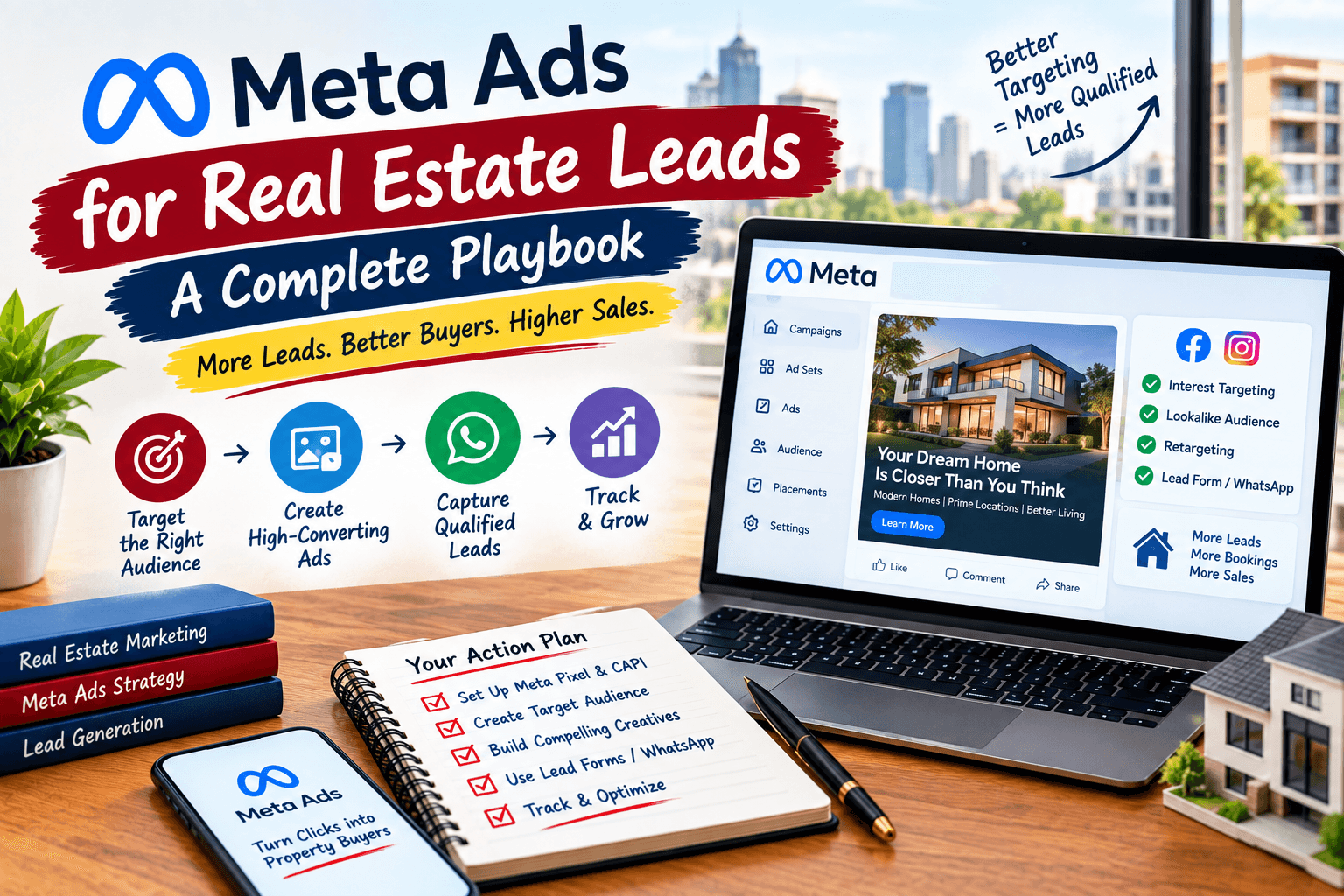
Awareness campaigns work best with broad targeting and a modest budget, simply introducing the property to a wide relevant audience. Consideration content should go deeper, showing walkthroughs and answering the questions a serious buyer would actually ask. Conversion campaigns, aimed at people who’ve already engaged, should carry a clear, time-bound call to action rather than another generic “learn more” message. A well-structured Meta Ads for real estate leads campaign should move prospects from awareness to consideration and finally to conversion. Each stage needs its own audience, creative, and objective
3. Budget Reality: What This Actually Costs
Cost per lead for real estate through Meta typically runs higher than most other verticals, generally falling somewhere between ₹400 and ₹1,200 depending on property type, city, and how well the campaign is structured. Poorly built campaigns can run three to four times higher than that range.
For meaningful data and a real shot at exiting Meta’s learning phase, a minimum monthly budget in the ₹15,000 to ₹20,000 range is usually the realistic floor, with ₹50,000 or more recommended for agencies running full three-stage funnels across multiple projects. Below roughly ₹500 a day, the algorithm often doesn’t have enough conversion signal to optimize targeting effectively.
A useful way to frame expected outcomes: a modest ₹15,000 monthly spend for a single project might realistically generate somewhere between 25 and 60 leads, translating to a handful of booked viewings and, over time, a fraction of a closed deal. Against a typical brokerage commission, that ratio can still be strongly profitable even at a fairly small budget.
Scaling should happen gradually, generally increasing budgets by 15 to 20 percent every few days rather than doubling spend overnight. Sudden jumps tend to reset the learning phase and temporarily spike cost per lead right when performance was starting to stabilize. The right budget for Meta Ads for real estate leads depends on the property value, location, competition, and expected lead volume. Start with enough budget to generate meaningful conversion data before scaling.
4. Targeting That Actually Finds Buyers
The single biggest budget-killer in real estate advertising is targeting that sounds specific but is actually enormous. “Bangalore, ages 25 to 55, interested in real estate” can easily cover a couple million people, the overwhelming majority of whom aren’t in an active buying window.
Radius targeting around a specific project, rather than stacking several micro-locations, tends to perform better. A single consolidated radius, often 30 to 45 kilometers depending on the market, prevents audience fragmentation and gives the algorithm enough combined data to optimize efficiently.
Layering in interest signals like property portals, mortgage services, or home design content adds useful precision on top of location and age. Custom audiences built from CRM lists and website visitors, along with lookalike audiences modeled on past converters, generally outperform interest-only targeting once there’s enough historical conversion data to build from.
For agencies targeting NRI buyers specifically, location parameters can be set to Gulf countries or Western markets with large Indian diaspora populations, layered with behaviors like prior residence in India or affinity for Indian financial institutions. Messaging that speaks to currency advantages, tax considerations, and trusted local property management tends to resonate more with this segment than standard domestic ad copy. Effective Meta Ads for real estate leads campaigns combine location targeting with relevant audience signals and first-party data. This helps reduce wasted impressions and focus delivery on potential buyers.
5. Creative That Converts
Real estate creative wins or loses attention within the first few seconds, well before anyone reads the caption. Static, generic renders that look identical to every other developer’s ad get scrolled past, while raw, authentic property footage tends to hold attention longer.
Emotional framing outperforms pure feature lists, since people are ultimately buying a lifestyle and a sense of arrival, not just square footage. Showing real moments, family scenes, sunset views from a balcony, a finished kitchen in use, tends to connect more than a clean architectural render ever will.
Movement matters too. Short video walkthroughs or dynamic slideshows covering exteriors, interiors, and amenities tend to get prioritized in feed placements over static images, and they let a prospect actually picture themselves in the space.
Clear proof points belong directly in the creative or overlay text: unit configuration, starting price, proximity to transit, and RERA approval status all build credibility at a glance. In India specifically, displaying RERA approval prominently has a measurable effect on trust and lead form completion.
Creative fatigue happens fast in this category, typically within two to three weeks. Refreshing walkthroughs, price points, and testimonials on a rolling 10 to 14 day cycle keeps click-through rates from sliding and prevents cost per lead from creeping upward. Creative is especially important for Meta Ads for real estate leads because buyers need enough information to trust the property before submitting an inquiry.
6. Ad Copy Framework
A consistent copy structure tends to outperform ad-by-ad improvisation. Opening with a hook that names either a problem or an aspiration, something like moving out of a rental into ownership, immediately signals relevance to the right reader.
From there, the value proposition should be specific rather than vague: exact configuration, starting price, and standout amenities communicate more than adjectives like “luxurious” or “premium” ever will. Social proof, whether a trusted builder name, a completed-projects count, or a testimonial line, reduces the skepticism that’s naturally high in a big-ticket purchase.
The closing call to action should be concrete and time-bound wherever honestly possible, whether that’s booking a site visit this weekend or requesting a brochure before a price revision. Psychological triggers like genuine scarcity, exclusivity, or a specific comfort factor such as zero brokerage can strengthen that final push without tipping into obviously manipulative territory.
7. Lead Capture: Forms vs. WhatsApp vs. Landing Pages
How a lead is captured matters almost as much as how it’s targeted. Instant lead forms inside Meta reduce friction dramatically, but every additional field drops completion meaningfully, so a lean form with only essential questions tends to outperform a long qualification questionnaire at the capture stage.
Click-to-WhatsApp ads have become especially effective for broker-led sales in markets like India, since the conversion path skips a form entirely and drops the prospect straight into a conversation. A short instant form followed by a WhatsApp handoff often captures both the low-friction advantage of forms and the immediacy of direct messaging.
Landing pages still have a place, particularly for bottom-of-funnel campaigns where a richer CRM data set matters more than raw volume. The tradeoff is real forms typically produce a noticeably lower cost per lead than landing pages, but often at the cost of some lead quality, which is exactly why the next section on pre-qualification matters so much. A simple lead form or WhatsApp flow can make Meta Ads for real estate leads more effective by reducing friction between the initial ad interaction and the sales conversation.
8. Pre-Qualification: Filtering Serious Buyers From Tire-Kickers
Volume alone is close to meaningless in this category, since even a hundred raw leads can produce almost no closed deals without proper filtering. Building qualification directly into the funnel, rather than leaving it entirely to a sales team’s phone calls, saves enormous wasted follow-up time.
A short, multiple-choice qualification layer, covering budget range, preferred configuration, and rough timeline, filters out casual browsers before they ever reach a salesperson. Each additional qualifying question does reduce total form completions somewhat, but the leads that make it through tend to be dramatically more sales-ready.
Once a lead moves to WhatsApp or a call, a second, lighter layer of qualification, simply asking whether they’re ready to schedule a site visit or a call, further separates genuinely warm prospects from people still in early research mode. This two-step filtering approach consistently produces a far higher lead-to-visit ratio than accepting every form submission at face value.
9. Retargeting: The Most Skipped, Most Valuable Layer
Not building a retargeting audience is one of the most common and expensive oversights in real estate advertising. Website visitors, video viewers, and page engagers convert at a meaningfully lower cost than cold audiences, often three to five times cheaper per resulting lead.
Segmenting retargeting by engagement depth improves efficiency further. Someone who watched 70 percent or more of a property video has shown far stronger intent than someone who scrolled past after a couple of seconds, and that distinction should shape both targeting and creative.
Retargeting creative should differ meaningfully from the initial cold-audience ad, often introducing a specific incentive like a limited-time offer or an added amenity to create urgency for people who’ve already shown interest but haven’t yet acted. A defined retention window, commonly around 20 to 30 days, keeps this audience pool from growing stale or drifting away from active buying intent.
10. Tracking the Right Metrics
Cost per lead is the metric most agencies obsess over, and it’s also the most misleading one in isolation. A cheap lead that never answers a call or shows up for a viewing isn’t actually cheap, it’s wasted spend with a flattering dashboard number attached.
Cost per site visit is the more honest metric for real estate specifically, since it accounts for the entire chain from ad click through to a physical or virtual showing. An ad set generating leads at a higher cost per lead but a strong site-visit rate is almost always more profitable than one producing cheap, low-quality volume.
Building a feedback loop between the sales team and whoever manages the ad account closes this gap over time. Sharing which specific ad sets, audiences, and creatives produced actual site visits and bookings, not just form submissions, lets budget shift toward what’s genuinely working rather than what merely looks efficient on paper.
Real-World Example
A premium residential developer in Hyderabad was running heavy ad spend against a ₹2.5 crore project but struggling badly, with cost per lead around ₹1,450 and a lead-to-site-visit ratio under 4 percent. The creative was generic, and follow-up on new leads was slow and inconsistent.
The fix wasn’t a bigger budget. Switching from static renders to an authentic video tour of the actual finished apartments, replacing a generic headline with copy built around a specific, vivid selling point, and adding fast automated follow-up on new inquiries changed the trajectory noticeably.
Cost per lead dropped to roughly ₹680, and the lead-to-site-visit ratio climbed to around 12 percent. Within seven weeks, the project had sold roughly 80 percent of its remaining inventory, a result driven far more by creative quality and response speed than by increased ad spend.
Common Mistakes That Waste Real Estate Ad Budgets
A handful of recurring errors account for most underperforming real estate campaigns, and most are fixable without touching the overall budget.
Targeting too broadly under the illusion of specificity wastes spend on people who were never going to buy. Using stale, generic renders instead of real, current property footage kills engagement before an ad even gets a fair chance.
Sending traffic to long lead forms rather than a lean form or a direct WhatsApp path drops completion rates significantly, since every added field measurably reduces submissions. Ignoring retargeting entirely leaves the cheapest, highest-intent audience segment completely untapped.
Pausing campaigns after just a week or two because early leads seem weak usually means the algorithm was still in its learning phase, not that the strategy failed. Slow follow-up rounds out the list, since a response delay of even ten minutes can measurably reduce how many leads actually turn into a real conversation.
Conclusion
Generating quality leads with Meta Ads for real estate leads comes down to treating the campaign as a full system rather than a single ad campaign. Organic trust, a properly staged funnel, realistic budgeting, precise targeting, authentic creative, lean lead capture, built-in pre-qualification, disciplined retargeting, and tracking that goes beyond cost per lead all work together.
Skip any one of these pieces and the whole system tends to leak value somewhere, usually showing up as a decent-looking lead volume that never quite turns into booked viewings or closed deals. Get the structure right, and even a modest monthly budget can produce a steady, profitable pipeline. Ultimately, successful Meta Ads for real estate leads require more than generating inexpensive form submissions. Campaigns should be measured by lead quality, site visits, and the eventual sales pipeline.
How Dizispark Can Help
Dizispark builds real estate Meta Ads campaigns around this full funnel rather than a single ad type, structuring awareness, consideration, and conversion stages separately so each one can actually be optimized on its own terms. That includes setting up lean lead forms paired with WhatsApp handoff, building pre-qualification directly into the funnel, and establishing retargeting pools from day one rather than as an afterthought.
For agencies and developers managing multiple projects or locations, Dizispark also keeps GMB aligned with active campaigns, since local search visibility and paid social often reach the same buyer at different points in their decision. Every account is scoped around the client’s actual price points, project timeline, and sales team capacity rather than a generic real estate template.
Frequently Asked Questions
How do Meta Ads for real estate leads work?
Meta Ads for real estate leads use Facebook and Instagram advertising to reach potential property buyers and generate inquiries. Meta Ads for real estate leads can use location, audience interests, custom audiences, and property-focused creative to attract relevant prospects. When properly structured, Meta Ads for real estate leads can move prospects from awareness to consideration and conversion.
How much do Meta Ads for real estate leads cost?
The cost of Meta Ads for real estate leads depends on the city, property type, competition, targeting, and campaign structure. A campaign using Meta Ads for real estate leads should have enough budget to generate meaningful conversion data before scaling. For Meta Ads for real estate leads, the article’s benchmark is roughly ₹400 to ₹1,200 per lead, with a realistic starting monthly budget of around ₹15,000 to ₹20,000 for a single project.
How should I target Meta Ads for real estate leads?
For Meta Ads for real estate leads, start with a consolidated radius around the property instead of stacking many small locations. Meta Ads for real estate leads can then layer relevant interests, website visitors, CRM audiences, and lookalike audiences when enough conversion data is available. Effective targeting helps Meta Ads for real estate leads focus on potential buyers rather than an unnecessarily broad audience.
What creative works best for Meta Ads for real estate leads?
Strong creative is important for Meta Ads for real estate leads because property buyers need to understand and trust the offer quickly. Meta Ads for real estate leads can use authentic property walkthroughs, short videos, carousels, clear pricing, unit configurations, location benefits, and relevant trust signals. Refreshing creative regularly helps Meta Ads for real estate leads avoid creative fatigue.
Are lead forms or WhatsApp better for Meta Ads for real estate leads?
Both options can work for Meta Ads for real estate leads. Instant forms reduce friction, while WhatsApp can move prospects directly into a conversation. A combined approach can make Meta Ads for real estate leads more useful by capturing the inquiry first and then qualifying the prospect through WhatsApp or a sales call.
How can I qualify leads from Meta Ads for real estate leads?
Qualification helps Meta Ads for real estate leads generate more useful sales opportunities instead of simply increasing form submissions. For Meta Ads for real estate leads, qualification questions can cover budget range, preferred property configuration, and purchase timeline. This approach helps Meta Ads for real estate leads separate serious prospects from people who are only browsing.
Does retargeting improve Meta Ads for real estate leads?
Retargeting is an important part of real estate advertising because it reconnects with people who have already interacted with a property. Campaigns can retarget website visitors, video viewers, and social-media engagers with different creative and relevant offers. Using retargeting can help bring warm prospects back into the conversion process.
How should I measure real estate lead campaigns?
Measuring campaigns only by cost per lead can give an incomplete picture. Also track cost per site visit, lead-to-visit rate, bookings, and feedback from the sales team. This gives your campaigns a clearer connection between advertising spends and actual business outcomes.