
Client: Local Astrology Brand (Client Name Confidential)
Agency: Dizispark
Platform: Meta Ads — Facebook and Instagram Calling and Messaging Ads
Places Reached: United States and Canada
Goal: Get people in the US and Canada to call or message the brand straight from the ad
Data As Of: October 26, 2026 (2 campaigns, ₹200 a day each)
Total Spend: ₹4,724.10
Industry: Astrology Services
1 About the Client
Our client is a local astrology brand. People come to them for personal guidance and consultations. Astrology is a very personal service. Most people do not buy after seeing one ad. They want to talk to someone first. They want to ask a question, hear how the astrologer speaks, and decide if they feel comfortable. Only then do they trust the service enough to pay for it. The brand wanted to reach people in the United States and Canada. Those places are very different from a local market. They are much bigger, many more businesses are fighting for attention there, and a local brand is not a name people already know. The client needed a way to get in front of the right people there and start real conversations, without spending a lot to find out what works. Astrology Meta Ads case study
2 The Problem
Advertising in the United States and Canada is expensive and crowded. A small brand has to work hard just to be noticed. There was a second problem. A normal ad sends people to a website and hopes they fill in a form. That does not work well for astrology. People do not want to fill in a form for someone they have never spoken to. They want to talk to a real person first. The budget was small too. We could not afford to run wide, unfocused ads for weeks and learn the hard way what worked. Every rupee had to go to the right people, in the right places, with an ad that made it easy to reach out. So the real question was this: with a small budget, can we get people in the US and Canada to actually call or message the brand, and can we do it at a cost that makes sense?
3 What We Wanted to Do
Our goal was simple. Get people in the US and Canada to contact the brand directly, and keep the cost of each conversation as low as we could. We did not want to guess. Instead of building one campaign and hoping it worked, we planned to run two campaigns side by side, give each the same daily budget, and let the numbers tell us which one was better. We also decided early that we would judge the campaigns by one thing only: what it cost to get a person to start a conversation. How many people saw the ad, or how cheaply, was not the point. Conversations were the point.
4 What Dizispark Did
Step 1 Showed the Ads Only in the US and Canada
We set the ads to show only in the United States and Canada. Nobody outside those two countries saw them. This matters because every rupee spent on someone outside the places the brand wants to reach is a rupee wasted. With a small budget, we could not afford that.
Step 2 Made It Easy to Call or Message
We built the ads so that a person could call or message the brand right from the ad, without going to a website first. In Ads Manager, these show up as messaging conversations started. For a service like astrology, this is the step that matters most. Once someone is talking to the brand, the brand can answer questions and build trust. A website visitor who leaves without doing anything is lost.
Step 3 Ran Two Campaigns Side by Side
We ran two campaigns at the same time. Each had a budget of ₹200 a day. Giving them the same budget made the test fair. Neither campaign had an advantage, so any difference in results came from the campaign itself.
Step 4 Looked at What Each Conversation Cost
It is easy to look at the wrong number. One of our campaigns was cheaper to show: it cost less to put the ad in front of 1,000 people. A quick look at that number would say it was the better one. But that is not what we cared about. We looked at what it cost to get a person to start a conversation. On that number, the other campaign was clearly better, and we followed that one.
Step 5 Switched Off the Weaker Campaign
Once the difference was clear, we switched off the campaign that cost ₹28.31 per conversation and kept the one that cost ₹21.92 running. This way, the daily budget now goes to the campaign that has shown it works better.
5 The Results
Here is what the two campaigns delivered, as of October 26, 2026:
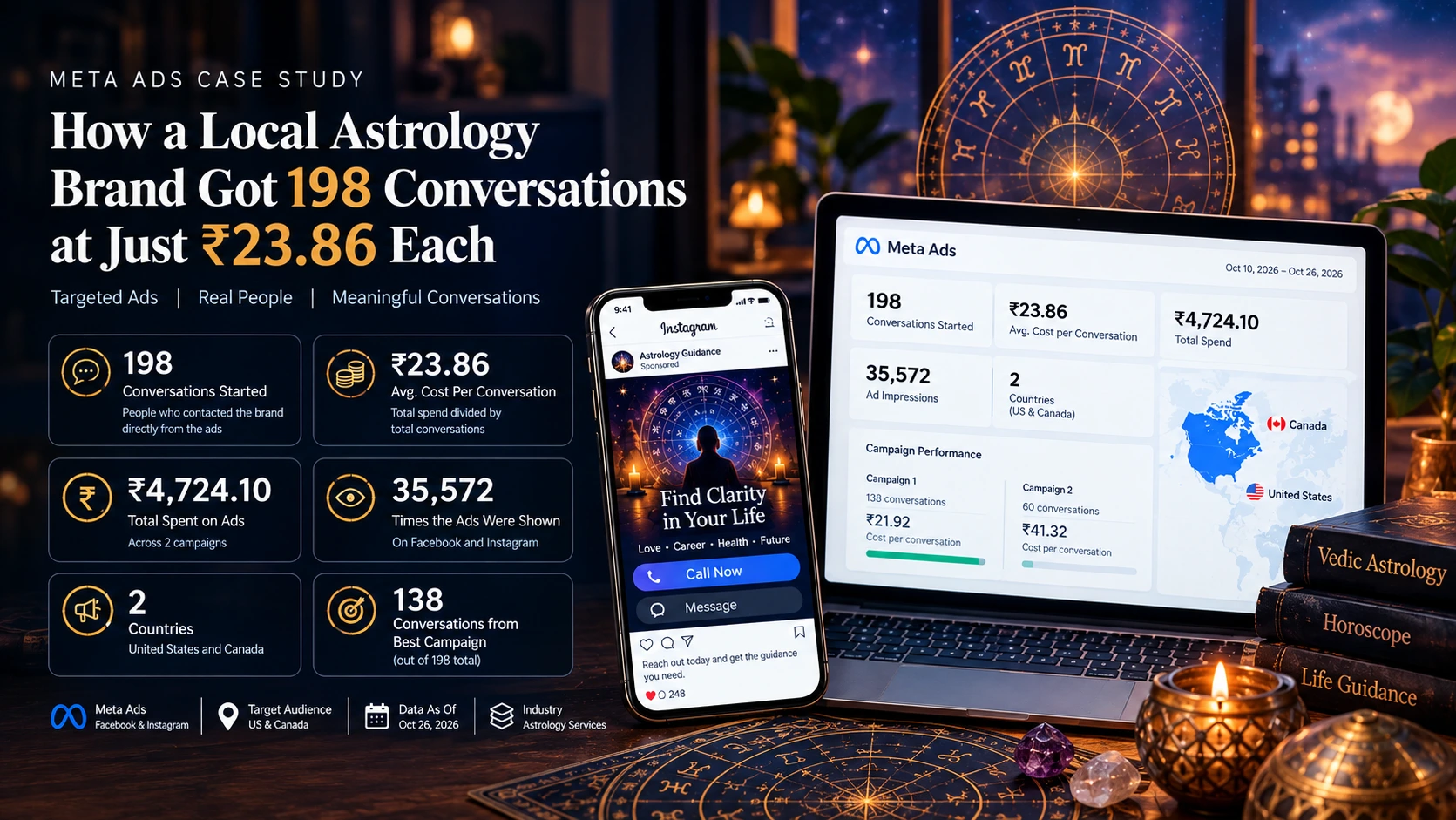
| 198Conversations Started138 from one campaign and 60 from the other | ₹4,724.10Total Spent₹3,025.44 plus ₹1,698.66 |
| ₹23.86Average Cost Per ConversationTotal spend divided by 198 | 69.7%Conversations From the Better CampaignIt used only 64.0% of the money |
| ₹132.80Cost to Show the Ad 1,000 TimesAverage across both campaigns | 1 in 100People Reached Who Started a ConversationAbout 1 conversation for every 100 people reached |
198 conversations for ₹4,724.10 is a good result for a small local brand trying to reach people in two of the most crowded ad markets in the world. The better campaign gave us 138 of the 198 conversations. That is almost 70% of all the conversations, and it used only 64% of the money. In plain words, it got more for each rupee. Here is the part we found most interesting. The weaker campaign was actually cheaper to show. It cost ₹115.02 to show the ad 1,000 times, while the better campaign cost ₹145.43. If we had only looked at that number, we would have picked the wrong campaign. But the better campaign got people to start a conversation much more often, so each conversation cost less in the end.
06 Campaign by Campaign Breakdown
Here is every campaign in the account, with its own numbers. We have hidden the real campaign names to protect the client.
| Campaign | Status | Conversations | Cost Per Conversation | Spent | Times Shown | People Reached | Times Each Person Saw It |
| Campaign A | Running | 138 | ₹21.92 | ₹3,025.44 | 20,804 | 10,222 | 2.04 |
| Campaign B | Switched off | 60 | ₹28.31 | ₹1,698.66 | 14,768 | 9,558 | 1.55 |
| Total | — | 198 | ₹23.86 average | ₹4,724.10 | 35,572 | 19,780* | — |
Side-by-Side Comparison
| What We Looked At | Campaign A | Campaign B | Both Together |
| Cost per conversation | ₹21.92 | ₹28.31 | ₹23.86 |
| Cost to show the ad 1,000 times | ₹145.43 | ₹115.02 | ₹132.80 |
| Conversations for every 100 people reached | 1.35 | 0.63 | 1.00 |
| People we had to reach for one conversation | About 74 | About 159 | About 100 |
Look at the last two rows. Campaign A turned about 1.35 out of every 100 people into a conversation. Campaign B turned only 0.63 out of every 100. That means Campaign A needed to reach about 74 people to start one conversation, while Campaign B needed about 159. That is more than double the difference. Campaign A simply reached people who were more ready to talk, and that is why it cost less per conversation even though it cost more to show.
7 What the Numbers Taught Us
Cheap views are not the same as cheap conversations
Campaign B cost less to show, but it cost more to get a conversation. If we had picked a winner by how cheaply the ad was shown, we would have kept the wrong campaign. The number that matters is the cost of the result you actually want.
Running two campaigns side by side is worth it
If we had only run Campaign B, we would have seen ₹28.31 per conversation and thought that was normal. It was only by running Campaign A next to it that we saw it could be done for ₹21.92. One campaign alone can never show you that.
Stop what is not working, early
Campaign B had spent ₹1,698.66 when we switched it off. Campaign A kept going. The sooner a weaker campaign is stopped, the more of the budget is left for the one that works.
What these numbers do not show
To be clear about what this data says it shows how many people started a conversation, and what each one cost. It does not show how many of those people went on to become paying clients. That depends on how the brand follows up on each conversation. This is also a small budget over a short time, so we see these results as a strong start, not the final word.
8 Real Ad Results Screenshot
Here is the real screenshot, taken straight from Meta Ads Manager. The numbers have not been changed. We have only blurred the campaign names.

9 The Dizispark Way vs. the Usual Way
| The Usual Way | The Dizispark Way | |
| Goal | Get more likes and views | Get real conversations with real people |
| Where ads show | Everywhere, to anyone | Only in the US and Canada |
| Testing | One campaign and a guess | Two campaigns side by side with the same ₹200 a day |
| How we pick a winner | By how cheaply the ad is shown | By what each conversation costs: ₹23.86 on average |
| Weak campaigns | Left running until the money is gone | Weaker one (₹28.31) switched off, stronger one (₹21.92) kept running |
| How people reach out | Click to a website and fill a form | Call or message straight from the ad |
10 Key Numbers
Two campaigns ran, each with ₹200 a day. Together they spent ₹4,724.10 and led to 198 conversations. That works out to ₹23.86 for each conversation. The better campaign gave 138 conversations at ₹21.92 each. The other gave 60 conversations at ₹28.31 each, and was then switched off. The ads were shown 35,572 times in total. The two campaigns reached 10,222 and 9,558 people. The better campaign got about 1.35 conversations for every 100 people it reached, and the other got 0.63.
11 Conclusion
Reaching people in the United States and Canada is not cheap, and a local brand starts with no name to lean on. What a small brand can control is who sees the ads, what the ad asks people to do, and how fast it stops spending on what is not working. That is what we did here. With ₹4,724.10, we got 198 people to contact the brand directly, at ₹23.86 each on average. The best campaign did it for ₹21.92. We judged each campaign by the cost of a conversation, not by how cheaply it was shown, and we switched off the weaker one. Now the daily budget sits behind the campaign that has proven itself. The brand now knows something useful which campaign gets people talking, and what a conversation costs. That is a much better place to plan the next step from than a guess. Dizispark did this for a local astrology brand reaching two of the toughest ad markets in the world. The same simple plan can work for any local brand or service business that wants real conversations instead of empty views: show ads in the right places, make it easy to call or message, test two versions, and keep the one that works.
Your Ads Get Views. Do They Get Calls?
A local astrology brand came to us with a small budget and one goal: get people in the US and Canada to actually talk to them. Here is what happened 198 conversations. ₹23.86 each. Just ₹200 a day for each campaign We did not do anything fancy. We showed the ads only in the places the brand wanted to reach. We made it easy to call or message from the ad. We ran two versions side by side, and we switched off the one that was not working. If you run a local brand or a service business, we can do the same for you.
What happens when you get in touch
- You tell us about your business and where you want to reach people.
- We tell you honestly what your budget can and cannot do.
- If it is a good fit, we set up your ads. If not, no hard feelings.
Send us a message today. It takes two minutes.