
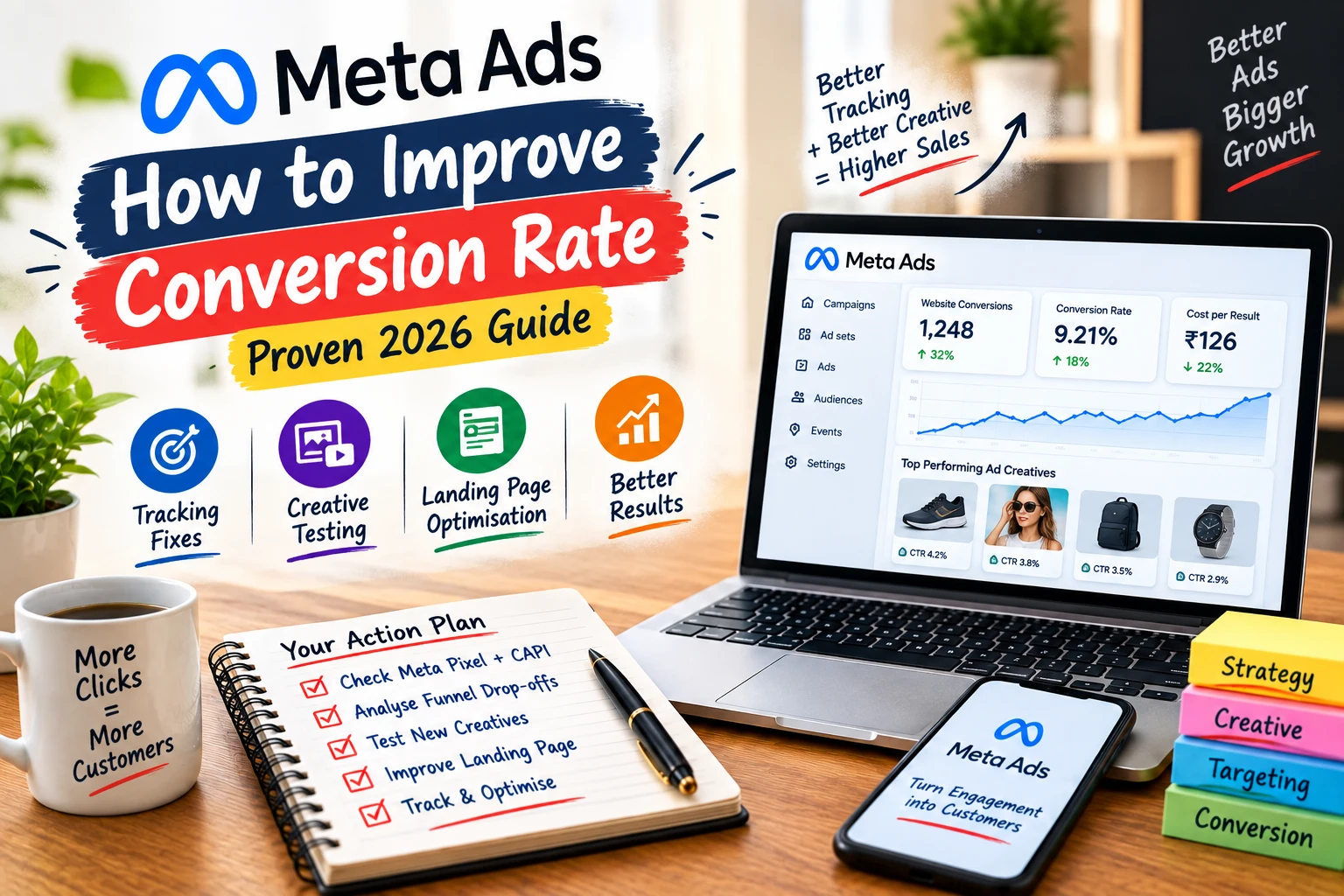
Learning how to improve Meta Ads conversion rate is the difference between an account that wastes budget and one that turns clicks into paying customers. AdensLab confirms that better conversion rates mean lower cost per acquisition and higher return on ad spend, and this single relationship drives almost every decision covered in this guide.
Channable adds that advertising costs keep rising, which makes a smart approach to how to improve Meta Ads conversion rate more valuable every year rather than less. Industry benchmark data from 2026 confirms the average Meta Ads conversion rate sits around 9.21 percent, though the median across thousands of real accounts is closer to 1.46 percent, meaning most advertisers still have significant room to improve.
Table of Contents
ToggleFix Your Tracking Before Anything Else
Every serious guide to how to improve Meta Ads conversion rate starts with tracking, not creative. AdensLab quotes agency 27Five directly, noting that across every underperforming account they onboarded, tracking issues were one of the most common root causes rather than bad creative or wrong audiences.
Relying on Meta Pixel alone captures only 60 to 70 percent of conversions in 2026, while combining it with the Conversions API raises match rates to 85 to 95 percent. Running both together, with proper event deduplication using matching order IDs, delivers a 13 percent improvement in cost per result compared to Pixel alone, which is one of the fastest wins available for anyone trying to improve Meta Ads conversion rate this month.
Find Exactly Where Your Funnel Is Leaking
Once tracking is accurate, the next step in how to improve Meta Ads conversion rate is identifying precisely where users drop off between click and purchase. AdensLab recommends checking click through rate for ad quality, landing page view rate for load speed problems, add to cart rate for pricing fit, and checkout abandonment rate for payment friction.
Meta needs roughly 50 conversion events per ad set per week to exit the learning phase and optimise properly. Attribution windows also matter, with a 7 day click window suiting most ecommerce products while high consideration items like furniture often perform better measured over a 28 day window.
Refresh Creative Before Fatigue Kills Performance
Creative fatigue is one of the most predictable threats to how to improve Meta Ads conversion rate over time. AdensLab confirms performance can dip within 3 to 5 days of an ad going live, click through rates often fall 20 to 40 percent by day 7, and cost per acquisition can spike 25 to 50 percent by day 14 if nothing is refreshed.
Channable adds that user generated style content can increase click through rates by up to 300 percent while cutting cost per acquisition by 50 percent, because genuine customer footage feels trustworthy in a way polished product shots rarely match. Rotating creative every 2 to 4 weeks is the baseline recommendation from both sources for keeping campaigns fresh.
Creative Fatigue Warning Signs at a Glance
This table summarises the exact thresholds AdensLab uses to decide when a creative needs replacing as part of any plan to improve Meta Ads conversion rate.
| Signal | Threshold | Action |
| CTR drop over 7 days | 10 percent decline | Schedule a creative refresh this week |
| CTR drop over 14 days | 20 percent decline | Refresh immediately, do not wait |
| Frequency for prospecting | Above 2.5 to 3.5 | Audience is saturated, rotate creative |
| Frequency for retargeting | Above 4.0 to 6.0 | Still acceptable, monitor CPA closely |
| Hook rate drop on video | 15 to 25 percent fall | Rewrite the first 3 seconds of the video |
Target Smarter with Lookalike and Broad Audiences
Channable warns that overly narrow targeting can limit Meta’s ability to optimize, recommending an audience size between 2 and 10 million people for the delivery system to find genuine buyers efficiently. AdensLab agrees but adds nuance for anyone working out how to improve Meta Ads conversion rate through audience selection.
A clean seed list of 1000 to 5000 high value repeat customers consistently outperforms a larger unfiltered list of 30000 mixed buyers when building lookalikes. Value based lookalikes that weight customer lifetime value can lift ROAS by 15 to 30 percent, and in some 2026 tests broad targeting actually beat lookalikes outright, delivering 113 percent ROAS against 76 percent, though this trade off demands stronger creative to filter the right buyers naturally.
Align Your Landing Page with Your Ad Promise
A mismatched landing page quietly destroys every gain made elsewhere in how to improve Meta Ads conversion rate. AdensLab cites a KlientBoost test showing that simply aligning ad and landing page messaging boosted conversions by 66 percent without changing the offer or targeting at all.
With 83 percent of landing page visits now happening on mobile, checkout friction matters enormously, since mobile conversion rates average just 1.8 percent against 3.9 percent on desktop. Limiting forms to 2 or 3 fields, compressing images so pages load in under 3 seconds, and placing trust signals near the call to action are the fastest fixes for this specific gap.
Scale Gradually to Protect Learning Phase Stability
The final piece of how to improve Meta Ads conversion rate at scale is disciplined budget growth. AdensLab recommends increasing daily budgets by no more than 15 to 20 percent every 3 to 4 days, since larger jumps can push a stable ad set back into the learning phase and temporarily spike costs.
Advantage Plus Shopping Campaigns that combine prospecting and retargeting automatically report a 12 percent lower CPA and 15 percent higher ROAS than manual setups on average. Structured A B testing that changes one variable at a time, following concept first then hook then format, produces 28 percent higher ROAS than random unplanned testing.
Conclusion
Improving Meta Ads conversion rate in 2026 comes down to five connected disciplines rather than one clever trick. Tracking accuracy through Pixel and CAPI together comes first, since nothing else can be trusted without it.
Funnel analysis, creative refresh cycles, sharper audience selection, and a landing page that matches every ad promise round out the system. AdensLab’s own summary confirms these five areas work together to create a seamless path from click to purchase.
Start with tracking this week. Add one funnel review, one creative refresh, and one landing page fix before the month ends, and the compounding effect on how to improve Meta Ads conversion rate becomes visible fast.
How Dizispark Can Help
Dizispark is a Delhi based Meta Ads agency that fixes exactly the issues covered in this guide, from Pixel and Conversions API setup to funnel diagnosis, creative refresh scheduling, and landing page alignment audits.
We also manage a fully optimized Google My Business Profile alongside every Meta campaign we run, strengthening local trust signals that support conversion rate on every platform we touch.
Reach out to Dizi spark today and let our team show you exactly how to improve Meta Ads conversion rate for your specific account this month.
Frequently Asked Questions
How do I improve Meta Ads conversion rate quickly?
The fastest way to learn how to improve Meta Ads conversion rate is to fix tracking before changing your ads. Set up Meta Pixel and Conversions API correctly so your conversion data is reliable. Then review the funnel to identify whether users are dropping off because of weak creative, slow landing pages, or checkout friction. These fixes provide a stronger foundation for improving Meta Ads conversion rate.
What is a good Meta Ads conversion rate in 2026?
A good Meta Ads conversion rate depends on your industry, offer, audience, and campaign objective. If you are learning how to improve Meta Ads conversion rate, compare your results with relevant industry benchmarks instead of using one universal target. The article reports a 2026 average of around 9.21 percent and a median of 1.46 percent across thousands of accounts. Your own historical performance is also important when measuring improvement.
Why is my Meta Ads conversion rate suddenly dropping?
A sudden drop in conversion rate can come from creative fatigue, tracking problems, audience saturation, or landing page changes. When working on how to improve Meta Ads conversion rate, check Event Match Quality and your conversion events first. Then review CTR, frequency, landing page performance, and checkout behavior. Finding the exact point where performance changed makes it easier to fix the underlying problem.
Does landing page speed affect Meta Ads conversion rate?
Yes, landing page speed can directly affect Meta Ads conversion rate because slow pages create friction after someone clicks an ad. A key part of how to improve Meta Ads conversion rate is making sure the landing page loads quickly and matches the promise made in the ad. Compress images, reduce unnecessary elements, and keep important information and trust signals visible. A faster and more relevant landing page can help turn more ad clicks into conversions.
How often should I refresh Meta Ads creative to protect conversion rate?
Refreshing creative every 2 to 4 weeks is a useful baseline, but you should refresh sooner when performance warning signs appear. Anyone learning how to improve Meta Ads conversion rate should monitor CTR, frequency, CPA, and engagement for signs of creative fatigue. A significant CTR decline can indicate that the audience is becoming less responsive. Testing new concepts, hooks, and formats can help maintain campaign performance.
Should I use broad or lookalike targeting to improve conversion rate?
Both broad and lookalike audiences can work, depending on your campaign, account maturity, and creative strength. When deciding how to improve Meta Ads conversion rate, test both approaches rather than assuming one audience type will always perform better. Clean customer data can make lookalike audiences useful, while strong creative can allow broad targeting to find relevant buyers. Compare the results using conversion rate, CPA, and ROAS.
How does the learning phase affect Meta Ads conversion rate?
The learning phase can affect delivery and conversion performance while Meta gathers enough data to optimize an ad set. Understanding this is an important part of how to improve Meta Ads conversion rate because frequent edits can disrupt campaign stability. Avoid making large budget changes or unnecessary targeting edits during this period. Gradual budget increases can help maintain more stable performance while you scale.
What role does ad copy alignment play in conversion rate?
Ad copy alignment is an important part of how to improve Meta Ads conversion rate because the message users see in the ad should continue naturally on the landing page. If an ad promises a specific benefit, discount, or solution, that same message should be clearly visible after the click. Consistent messaging reduces confusion and helps maintain user trust. Improving the connection between the ad and landing page can therefore support a higher conversion rate.