
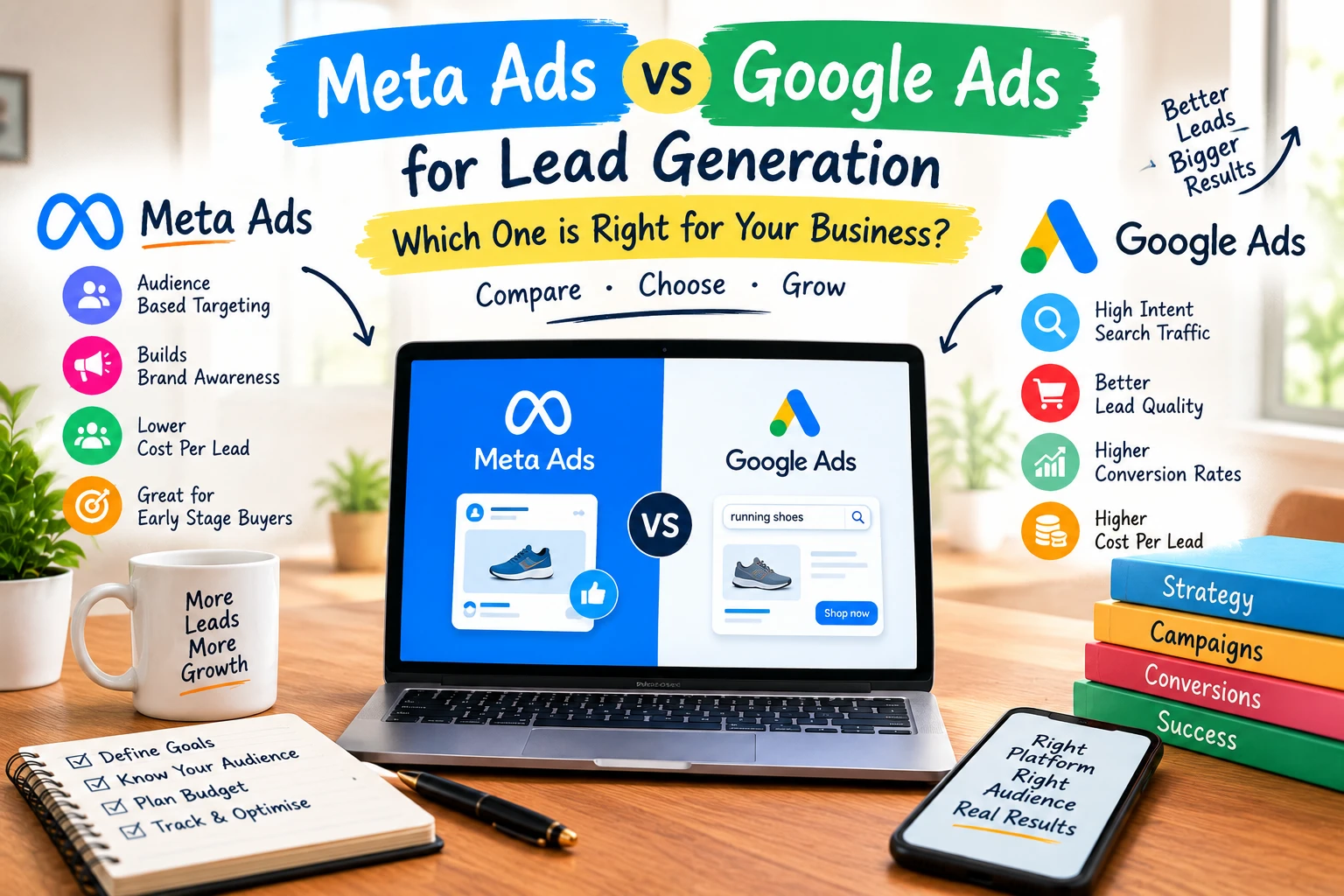
Meta Ads vs Google Ads for lead generation is one of the most common decisions business owners and marketing managers face when planning paid advertising in 2026. Lemonade Digital confirms that Google Ads captures demand that already exists while Meta Ads helps create and shape demand earlier in the buyer journey, and this single distinction drives almost every other difference between the two platforms. Scalify Labs adds the practical India context, noting that most Indian businesses should not choose one over the other but should instead understand when to use each. GrowthByte confirms that companies running both platforms together tend to see 15 to 30 percent better ROI than those betting everything on a single channel.
Table of Contents
ToggleThe Fundamental Difference Between Meta Ads and Google Ads
The core difference in the Meta Ads vs Google Ads for lead generation debate comes down to intent versus discovery. Google Search Ads reach people who are already actively typing a query because they know what they want and are looking for who to buy from, which Scalify Labs describes as demand capture.
Meta Ads reach people based on who they are, what they are interested in, and what behaviour patterns they show, often before they have started searching at all, which Scalify Labs calls demand creation. Lemonade Digital confirms this same split from a UK perspective, noting that Google Ads is built primarily around intent while Meta Ads is designed to help businesses reach audiences based on interests, behaviours, and demographics.
Lead Quality Comparison Between the Two Platforms
Lead quality is where the Meta Ads vs Google Ads for lead generation comparison becomes most practical for business owners. Scalify Labs reports that Google Search leads carry higher intent by default, with lead to appointment conversion rates typically between 15 and 30 percent for well run campaigns. Meta leads show more variable intent because a Facebook Lead Ad makes it easy to submit a form, meaning both genuinely interested prospects and casually curious people will complete it. Without qualification forms and fast follow up, Meta leads convert at only 4 to 10 percent, but with proper qualification and automation this improves to 12 to 20 percent, narrowing the gap significantly with Google.
Cost Comparison for Meta Ads and Google Ads in India 2026
Scalify Labs provides detailed India specific cost benchmarks that make the Meta Ads vs Google Ads for lead generation comparison concrete rather than theoretical. The table below shows real cost ranges across common lead generation industries, confirming that Meta is almost always cheaper per lead at equivalent industries while Google typically carries higher intent per click.
| Metric | Meta Ads India | Google Search Ads India |
| CPM per 1000 impressions | INR 20 to 80 | INR 200 to 600 on Display network |
| CPC per click | INR 3 to 15 | INR 15 to 120 depending on keyword competition |
| CPL education and coaching | INR 60 to 200 | INR 100 to 400 |
| CPL real estate | INR 150 to 600 | INR 200 to 800 |
| CPL healthcare | INR 80 to 300 | INR 150 to 500 |
| CPL financial services | INR 100 to 400 | INR 200 to 700 |
Audience Scale and Targeting Capabilities
Audience reach is a decisive factor in the Meta Ads vs Google Ads for lead generation decision, especially for businesses in newer categories. Scalify Labs confirms Meta reaches over 400 million active users in India across Facebook and Instagram combined, with unmatched targeting through demographics, interests, behaviours, custom audiences built from CRM data, and lookalike audiences.
Google Search Ads are limited to people actively searching, which is a feature rather than a limitation since those users represent the highest intent audience available in digital advertising, but search volume caps how many leads a business can generate. GrowthByte adds that Apple privacy changes have weakened some of Meta’s targeting precision, making first party data increasingly important for both platforms going forward.
Which Industries Win with Meta Ads for Lead Generation
Scalify Labs identifies specific industries where Meta wins decisively in the Meta Ads vs Google Ads for lead generation comparison. Coaching and education businesses benefit because parents and students discover institutes on Instagram before they ever search for them by name. Real estate developers reach aspirational buyers who are not yet actively searching, with Instagram’s visual format suiting property showcase content particularly well. Beauty and wellness businesses need to create desire first since customers rarely proactively search for an aesthetics clinic. Events and experiences including wedding venues, resorts, and luxury travel rely on visually driven discovery that only a feed based platform like Instagram can deliver at scale.
Which Industries Win with Google Ads for Lead Generation
High urgency services consistently favour Google in the Meta Ads vs Google Ads for lead generation comparison, since someone needing a plumber, pest control, or emergency hospital care searches immediately rather than scrolling Instagram. GrowthByte confirms that urgent categories including locksmiths, HVAC repair, and same day legal consults belong almost entirely to Google Search. High intent B2B categories including software purchases, professional services, legal, and accounting also favour Google because decision makers search with specific and declared intent. Scalify Labs adds that local service businesses with strong existing search volume for their category capture buyers at the exact moment those buyers are ready to act, which Meta cannot replicate as reliably.
Why Most Businesses Should Run Both Platforms Together
Every source in this comparison arrives at the same conclusion about Meta Ads vs Google Ads for lead generation. Lemonade Digital confirms that using Google Ads and Meta Ads together often delivers the best results, with Meta building awareness and engagement while Google captures demand when users search, an effect it calls the halo effect where Meta driven awareness increases branded search volume on Google.
GrowthByte’s own client work shows a D2C brand achieving 4x revenue growth in 90 days through an integrated push across social content, paid ads, and email, a result no single channel produced alone. Scalify Labs recommends retargeting website visitors who clicked a Google ad but did not convert with Meta ads featuring social proof and testimonials to close that gap.
Decision Framework for Choosing Your Platform Mix
Combining guidance from all three sources produces a practical decision framework for the Meta Ads vs Google Ads for lead generation choice based on business situation rather than platform preference alone.
| Business Situation | Recommended Approach |
| Limited budget under INR 20000/month | Start with Meta Ads for lower CPL and better testing tools, add Google once offer is validated |
| Urgent or emergency services | Prioritise Google Search Ads since buyers search immediately when the need arises |
| New market or new city launch | Start with Meta since search volume may not yet exist for the specific category |
| High intent B2B software or services | Prioritise Google Search where decision makers already search with clear intent |
| Visual or lifestyle products | Prioritise Meta Ads where scroll stopping creative outperforms text based search ads |
| Budget above INR 5,00,000/month | Run both platforms together, using Meta for awareness and Google for capture |
Conclusion
The Meta Ads vs Google Ads for lead generation question in April 2026 is not about choosing a single winner but about understanding what each platform does best. GrowthByte frames the choice precisely, noting that businesses are not picking a winner but choosing between capturing demand that already exists and creating demand that does not exist yet.
Google wins when prospects are already searching for a specific solution, while Meta wins when a business needs to interrupt feeds and build desire for something the prospect had not yet consciously considered. Scalify Labs confirms that businesses generating the most leads for the lowest cost per acquisition in India are running both platforms in coordinated roles rather than treating them as competitors.
How Dizispark Can Help
Dizispark is a Delhi-based performance marketing agency that runs coordinated Meta Ads and Google Ads campaigns for lead generation across every business category discussed in this guide, from high intent local services and B2B companies to visually driven D2C and real estate brands.
We build separate strategies for demand capture on Google Search and demand creation on Meta, connect both platforms through retargeting and shared conversion tracking, and manage a fully optimized Google My Business Profile that strengthens local search visibility alongside every paid campaign we run.
We report transparently on cost per lead and cost per acquisition across both platforms every month so budget always flows toward the channel and campaign actually producing customers rather than just cheap clicks. Reach out to Dizispark today and let us build the right Meta and Google Ads mix for your specific lead generation goals.
Frequently Asked Questions
Which is better for lead generation, Meta Ads or Google Ads?
Growth Byte confirms that Google Ads typically wins for high intent lead generation since users are actively searching for solutions to a problem they already recognize. Meta works better for building awareness among people who have not yet identified themselves as potential buyers. Salify Labs adds that Meta leads are almost always cheaper to generate in India, but they carry lower intent by default and need a stronger follow up system to convert at rates comparable to Google. The honest answer depends heavily on what is being sold, who is buying it, and how far along that buyer already is in their decision process when they first see the ad.
Which platform has a lower cost per click, Meta or Google?
Meta Ads consistently deliver a lower cost per click than Google Ads across almost every industry benchmark available in 2026. Growth Byte reports Meta clicks typically cost 30 to 50 percent less than Google clicks, while Salify Labs confirms Meta CPCs in India range from roughly INR 3 to 15 compared with INR 15 to 120 for Google depending on keyword competition. However, a lower cost per click does not automatically mean a lower cost per lead or a better return on investment, because Google’s pricier clicks generally carry stronger purchase intent and convert into leads and customers at a noticeably higher rate.
How much budget do I need for Google Ads versus Meta Ads?
Growth Byte recommends budgeting at least INR 50,000 to INR 1,00,000 per month for Google Ads in competitive categories, since that range is roughly what it takes to gather enough data for the algorithm to optimize properly. Meta Ads can start smaller, typically around INR 30,000 to INR 50,000 per month, because impression costs run lower on the platform. Salify Labs advises businesses with a limited monthly budget under INR 20,000 to start with Meta first for cheaper testing and audience building, then add Google Search once the offer and conversion rate have been validated through real customer data.
Can Meta Ads generate high-quality B2B leads?
Meta Ads can generate B2B leads when targeting is approached correctly, though the platform is generally considered secondary to Google for this specific use case. Growth Byte confirms that job title and employer filters allow advertisers to put messaging directly in front of actual decision makers on Facebook and Instagram. However, both Growth Byte and Salify Labs recommend using Meta primarily for awareness and retargeting in B2B contexts rather than expecting strong direct response from cold traffic, since B2B audiences on Meta tend to be harder to build precisely and generally convert at lower rates than equivalent Google Search campaigns targeting declared buyer intent.
What industries perform best on Google Ads for lead generation?
Businesses with clear existing search intent consistently perform best on Google Ads according to Growth Byte, including legal services, healthcare providers, home services, and B2B software companies. Someone searching for a specific service like a divorce lawyer or emergency plumber wants to act immediately, and Google captures that moment reliably. Salify Labs adds that high urgency categories including hospital emergency care, pest control, and car repair belong almost entirely to Google Search because urgent needs drive people to search rather than passively scroll social feeds. Ecommerce also competes well on Google, though crowded product categories tend to push cost per click higher across the board.
How long does it take to see results from Google Ads compared to Meta Ads?
Growth Byte confirms that Google Ads typically show traffic within hours of campaign launch, with meaningful lead data usually stabilizing within two to four weeks as the algorithm learns which keywords and ads perform best. Real optimization generally happens between weeks three and eight of a live campaign. Meta Ads often need a similar or slightly longer learning period, especially for cold prospecting campaigns that rely on interest and lookalike targeting rather than declared search intent. Scarify Labs adds that Meta campaigns particularly benefit from a fast follow up system, since leads generated through Meta lose interest more quickly than leads that arrived through active Google search.
Should I run Meta Ads and Google Ads at the same time?
Yes, running both platforms together is generally the strongest approach once budget allows for it properly. GrowthByte confirms that companies running both platforms together tend to see 15 to 30 percent better return on investment compared with businesses betting entirely on one channel. However, GrowthByte also warns against splitting a small budget evenly across both platforms too early, since each platform needs sufficient spend to actually learn and optimise. The recommended sequence for most businesses is starting with the platform that best matches immediate business needs, pushing it as far as it profitably goes, then adding the second platform once the first is performing consistently.
How do I measure ROI accurately across Meta Ads and Google Ads?
GrowthByte recommends tracking cost per lead and lead to customer conversion rate separately for each platform using consistent UTM parameters so every lead can be traced back to its true source channel. Many businesses stop measuring at cost per lead alone, but cost per acquired customer reveals the actual acquisition cost once conversion rates are factored in properly. Lemonade Digital adds that assisted conversions and customer lifetime value matter just as much as last click attribution, since Meta driven awareness frequently increases branded search volume on Google later, a pattern known as the halo effect that simple last click reporting tends to miss entirely.