
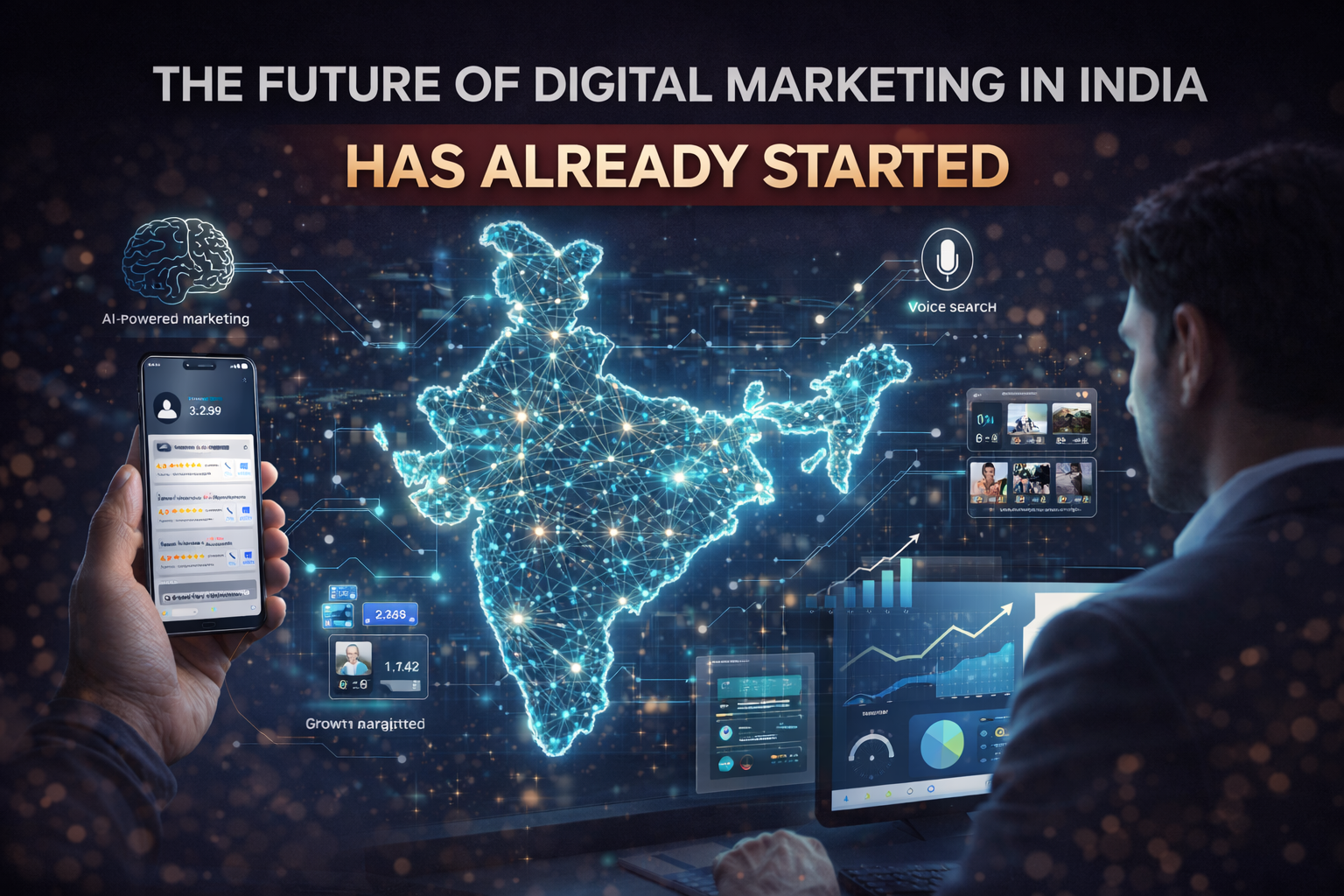
India’s digital marketing landscape is at an inflection point in 2026 with over 900 million active internet users, a digital advertising market growing at 23.49% CAGR, and a government-backed Digital India initiative accelerating adoption in every corner of the country, the future of digital marketing in India has never looked brighter or more complex. The businesses and professionals who understand the structural shifts happening right now will capture disproportionate growth over the next 3 to 5 years.
This guide covers the 8 most important trends defining the future of digital marketing in India, with verified 2026 data, practical implications for businesses, and what every marketer, founder, and brand manager in India needs to act on today.
Table of Contents
ToggleWhy the Future of Digital Marketing in India Is Unique
Understanding the future of digital marketing in India requires recognizing what makes India a structurally different market from the US or Europe. No other country combines 900 million internet users with 22 official languages, a 500 million online shopper base, 5G-accelerated rural internet access, and a generation of first-time digital consumers concentrated in tier-2 and tier-3 cities. India’s advertising expenditure is projected to reach Rs. 1,476 billion by 2026, with digital advertising forecast to reach Rs. 69,856 crores, representing 61% of total ad spend, according to India Digital Advertising research.
- India will have around 900 million active internet users by 2026, according to IAMAI research, creating the largest digital consumer base in the world by volume.
- Digital marketing in India is growing at 25% to 30% annually, with the industry projected to reach Rs. 620 billion by 2026 at a CAGR of 23.49%, according to Battersea Web Expert’s 2026 India digital marketing research.
- 73% of Indian internet users now consume content in regional languages, representing a Rs. 4.5 lakh crore market opportunity, according to Social Beat’s 2026 digital marketing trends analysis.
- Over 50% of Indian users now use voice search, at twice the global average, according to Artisan Creatives’ 2026 state of digital marketing in India report.
- India’s influencer marketing industry is projected to grow 25% annually, with the creator economy reaching Rs. 3,375 crore by 2026 according to the EY and Collective Artists Network report.
Key Takeaway:
The future of digital marketing in India is not a scaled-up version of Western digital marketing. It is a structurally different opportunity driven by linguistic diversity, mobile-first behaviour, vernacular content consumption, voice search dominance in regional languages, and first-time digital buyers from tier-2 and tier-3 cities who have never been reached by traditional marketing.
8 Trends Defining the Future of Digital Marketing in India in 2026
Here are the 8 structural shifts shaping the future of digital marketing in India, each with verified data and practical actions for Indian businesses:
1. AI-Powered Marketing: From Tool to Infrastructure
Artificial intelligence is no longer a premium add-on for large enterprises in the future of digital marketing in India. It has become infrastructure available to businesses of every size. Indian businesses using AI for content creation have reduced content creation time by 60%, research time by 45%, and reporting time by 50%, according to Cloud9 Digital’s 2026 AI marketing statistics survey of 500+ Indian businesses.
The critical distinction in 2026 is not whether to use AI, but how the 73% of Indian businesses that failed to see ROI from AI content all had one thing in common. They published AI-generated content directly without human review, editing, or oversight. The 27% that saw positive ROI used AI to generate first drafts, then refined the content with genuine human insight and domain expertise.
Action
Use AI tools (Claude, ChatGPT, Gemini) for first-draft content creation, keyword research, ad copy variations, and performance report summaries. Always add a specific local example, a genuine client insight, or original expert commentary before publishing.
Set a minimum standard: every AI-generated piece of content must contain at least one element that the AI could not have generated from public information alone.
2. Vernacular and Regional Language Marketing
Vernacular content is the single most important structural shift in Indian digital marketing in 2026. Over 73% of Indian internet users consume content in regional languages, representing a Rs. 4.5 lakh crore market opportunity, according to Social Beat’s 2026 digital marketing trends research. Tier-2 and tier-3 cities show 156% higher growth in vernacular AI content in Hindi, Telugu, and Tamil compared to English-only content in metros, according to Cloud9 Digital’s survey. Businesses optimized only for English keywords are now invisible to a significant and rapidly growing portion of India’s buyer base. Voice queries in Hindi and Telugu are now dominating regional search volume.
Action
Create dedicated content in at least 2 regional languages relevant to your target customer base. Do not simply translate existing English content. Localize: use culturally relevant examples, references, and idioms. Optimize your Google Business Profile and product pages for regional language keywords. Use tools like Google’s Speech-to-Text for transcription and regional language keyword research tools for authentic vernacular SEO.
3. Voice Search and Conversational SEO
One of the most distinctive characteristics of the future of digital marketing in India is the scale of voice search adoption. Over 50% of Indian users now use voice search, at twice the global average, driven by affordable devices, improved regional language NLP, and users who find voice more convenient than typing in regional languages. Voice queries are conversational, long-tail, and intent-driven: ‘best Vedic astrologer near me’, ‘sasta phone dikhao’, ‘nearest doctor in Delhi’.
Brands optimized only for typed English keywords are invisible to this audience. According to Mocaup’s 2026 online marketing trends research, since 60% of rural Indian users use voice commands, content must be structured with long-tail conversational keywords, FAQ formats, and schema markup to capture this fast-growing segment.
4. Short-Form Video Dominance
Short-form video is the highest-engagement content format in India and a defining pillar of the digital marketing future. Video consumption accounts for approximately 55% of mobile activity in India, according to Artisan Creatives’ 2026 research. Instagram Reels have emerged as the leading short-form format and are now part of daily content habits across all demographics. Critically, what is driving engagement in 2026 is not production quality. It is authenticity, specificity, and personality. A founder talking directly to the camera about their business challenges consistently outperforms a polished branded video with high production value. For Indian businesses, Reels on Instagram, Shorts on YouTube, and video on WhatsApp Status are the three most impactful content channels available today.
Action
Publish a minimum of 2 Reels per week on Instagram.
Content types that consistently perform for Indian business accounts: a 60-second ‘how we helped a client’ story, a product demonstration in under 45 seconds, a 30-second local market insight or data point, and a founder-led ‘behind the scenes’ video. No professional production needed. Consistency and authenticity outperform quality every time.
5. Generative Engine Optimization (GEO): Beyond Traditional SEO
Traditional SEO is undergoing its most significant transformation in the future of digital marketing in India. Google’s Search Generative Experience and AI-powered search engines like Perplexity and ChatGPT are changing how Indians find information. Instead of showing a list of 10 links, AI synthesises a single answer from multiple sources. Brands cited in AI Overviews earn 35% more organic clicks, and AI-referred visitors convert at 4.4x the rate of traditional organic visitors, according to upGrowth’s 2026 digital marketing strategy research.
GEO (Generative Engine Optimisation) is the discipline of ensuring your brand gets cited inside AI-generated answers. It requires E-E-A-T compliant content, structured schema markup, direct answer formatting, and building the kind of brand authority that AI systems trust enough to cite.
6. Quick Commerce as a Marketing and Discovery Channel
Quick commerce has moved far beyond grocery delivery in India’s digital marketing landscape of 2026. Platforms like Blinkit, Zepto, and Swiggy Instamart have built sophisticated digital advertising infrastructure that now directly competes with Google and Meta for brand discovery budgets. Over 45% of impulse purchases in India are expected to happen via social-quick commerce platforms in 2026, according to Mocaup’s online marketing trends research. Brands like Nykaa, Licious, and Myntra have adapted fast to this trend, integrating social commerce with instant delivery to close the loop between content discovery and product delivery within minutes. For product-based Indian businesses, quick commerce advertising is now a distinct channel requiring its own budget and strategy.
7. Micro and Nano Influencer Marketing
The influencer marketing component of the future of digital marketing in India has matured significantly. Mega-influencers with millions of followers are losing trust and ROI while nano-influencers (1,000 to 10,000 followers) with hyper-local community relevance are generating the strongest conversions. India’s creator ecosystem is expanding rapidly, with millions of creators producing content in regional languages across YouTube, Instagram, and Share Chat. The industry is growing at approximately 25% annually, according to Social Beat’s 2026 trends research. Regional creators producing content in Hindi, Tamil, Bengali, and other languages consistently see higher watch time, better retention, and stronger conversion rates than English-language celebrity influencers.
Action
Identify 15 to 20 nano-influencers with 1,000 to 10,000 followers in your specific product category and target city. Check their engagement rate (target above 3%) and genuine regional audience relevance. Provide product access in exchange for authentic reviews. Track sales through custom discount codes per creator. Scale relationships with the top 3 to 5 performers to regular monthly collaborations.
8. Privacy-First Marketing and First-Party Data
India’s Digital Personal Data Protection Act 2023 (DPDP Act) is reshaping the foundational data infrastructure of digital marketing across the country. Third-party cookies are declining, Apple’s App Tracking Transparency has reduced Meta ad targeting precision, and explicit data consent requirements are tightening. According to Design Rush’s 2026 statistics, 66% of marketers expect major challenges tracking users across channels due to privacy changes.
The future belongs to brands that own their audience directly through consented first-party data: email lists, WhatsApp opt-in broadcasts, loyalty programmer databases, and CRM-based customer records. Businesses that have invested in building these owned channels are insulated from algorithm changes, platform policy shifts, and rising ad costs.
Career Scope in the Future of Digital Marketing in India
The career opportunity embedded in the future of digital marketing in India is substantial and growing. Hiring for digital marketing roles is rising in Surat, Jaipur, Indore, Coimbatore, and Kochi alongside traditional metro hiring in Delhi, Mumbai, and Bengaluru, according to Techeasify’s 2026 scope research. Entry-level digital marketing professionals in India earn Rs. 3 to Rs. 6 lakh per year. Experienced managers reach Rs. 12 to Rs. 18 lakh or more depending on specialization and city. The highest-demand skills in 2026 are SEO and GEO, performance marketing, content strategy, AI tools integration, data analytics, vernacular content creation, and social media management.
| Role | Key Skills | Salary Range (India 2026) |
|---|---|---|
| SEO and GEO Specialist | Keyword research, technical SEO, schema, AI search | Rs. 4L to Rs. 15L per year |
| Performance Marketer | Google Ads, Meta Ads, ROAS optimisation, analytics | Rs. 5L to Rs. 20L per year |
| Content Strategist | Content planning, SEO writing, AI tools, regional | Rs. 3.5L to Rs. 14L per year |
| Social Media Manager | Reels, community management, paid social, analytics | Rs. 3L to Rs. 12L per year |
| Digital Marketing Manager | Full-funnel strategy, team management, reporting | Rs. 8L to Rs. 25L per year |
| Vernacular Content Creator | Regional language content, voice search, video | Rs. 3L to Rs. 10L per year |
Conclusion
The future of digital marketing in India is defined by scale, complexity, and extraordinary opportunity. Nine hundred million internet users, a vernacular content revolution, AI-powered personalization, voice search dominance, short-form video as the primary engagement format, and the rise of tier-2 and tier-3 city consumers are all reshaping what works. The businesses and individuals who invest in understanding and responding to these structural shifts today are the ones who will dominate their markets in the next 3 to 5 years.
The future of digital marketing in India does not belong to the biggest brands or the biggest budgets. It belongs to the most adaptive, the most locally relevant, and the most honest communicators. Whether you are a business owner, a marketer, or a student, the moment to invest in your digital marketing understanding is right now.
How Dizispark Can Help
Dizispark builds digital marketing strategies for Indian businesses that are built on the exact trends defining the future of digital marketing in India in 2026: AI-assisted content with genuine human expertise, vernacular and regional language campaigns for tier-2 and tier-3 reach, Google Business Profile optimization for local map pack dominance, short-form video strategies for Instagram and YouTube, performance-led Google and Meta Ads with weekly ROI reporting, WhatsApp and email marketing for first-party data ownership, and GEO-ready content that earns citations in AI-generated search answers. We do not offer generic campaigns. We build growth systems that align with how Indian consumers actually search, discover, and decide in 2026.
Frequently Asked Questions
What is the future of digital marketing in India?
The future of digital marketing in India is defined by eight structural shifts in 2026: AI-powered personalization at scale, vernacular and regional language content driving 73% of Indian internet consumption, voice search adoption exceeding 50% of Indian users, short-form video dominating 55% of mobile activity, Generative Engine Optimization replacing traditional SEO, quick commerce evolving into a major brand discovery channel, micro and nano influencer marketing outperforming celebrity partnerships, and privacy-first first-party data strategies driven by India’s DPDP Act 2023. India’s digital advertising market is projected to reach Rs. 69,856 crore in 2026, representing 61% of all advertising spend in the country.
Is digital marketing a good career in India in 2026?
Yes, digital marketing is one of the best career choices in India in 2026. Hiring is rising across all major cities including Surat, Jaipur, Indore, and Kochi alongside traditional metro hubs. Entry-level salaries range from Rs. 3 to Rs. 6 lakh per year. Experienced digital marketing managers earn Rs. 12 to Rs. 18 lakh or more. The highest-demand skills are SEO and GEO, performance marketing, content strategy, AI tools integration, data analytics, and vernacular content creation. The field rewards continuous learning and practical skills more than formal degrees, making it accessible to graduates from any background.
What is the scope of digital marketing in India in 2026?
The scope of digital marketing in India in 2026 is exceptionally broad. India’s digital advertising market is growing at 23.49% CAGR and is projected to reach Rs. 620 billion by 2026. Industries actively hiring digital marketers include e-commerce, IT, finance, edtech, healthcare, travel, media, real estate, and automobiles. Every small and large business now needs digital marketing capabilities. The scope extends beyond metropolitan cities to tier-2 and tier-3 cities where new internet users are being added faster than any other segment. Digital marketing skills apply equally to employment, freelancing, agency work, and building your own business, making the scope wider than most other career paths in India today.
How is AI changing digital marketing in India?
AI is changing digital marketing in India by enabling personalization at scale, reducing content creation time by 60%, and making sophisticated marketing accessible to businesses in tier-2 cities with budgets as low as Rs. 45,000 per month. Dynamic ad creative optimization allows the same ad to appear completely different to a college student in Delhi versus a businessperson in Mumbai, based on real-time behavioral data. However, a Cloud9 Digital survey of 500+ Indian businesses found that 73% of those using AI for content saw no ROI because they published without human review. Successful AI implementation requires human-led quality control, cultural localization, and genuine domain expertise layered over AI-generated first drafts.
Why is vernacular content important for digital marketing in India?
Vernacular content is critical for digital marketing in India because 73% of Indian internet users now consume content in regional languages, according to Social Beat’s 2026 digital marketing trends research. This represents a Rs. 4.5 lakh crore market opportunity that businesses communicating only in English cannot access. Tier-2 and tier-3 cities are adding new internet users faster than metros, and these users overwhelmingly prefer content in Hindi, Tamil, Bengali, Marathi, Telugu, and Kannada. Vernacular content in India consistently shows higher watch time, better retention, and stronger conversion rates than English-language content targeting the same audiences. Regional SEO and vernacular voice search optimization are now non-negotiable for any business targeting Bharat users.
What is GEO and why does it matter for Indian digital marketing?
Generative Engine Optimization (GEO) is the practice of optimizing your content and brand to be cited inside AI-generated search answers from Google’s Search Generative Experience, ChatGPT, Perplexity, and other AI search tools. It matters for Indian digital marketing because AI search is replacing traditional blue-link search results, especially for informational queries. Brands cited in AI Overviews earn 35% more organic clicks, and AI-referred visitors convert at 4.4x the rate of traditional organic visitors. GEO requires E-E-A-T compliant content, structured schema markup, direct answer formatting, and building genuine topical authority that AI systems trust. For Indian businesses, GEO is the most important emerging SEO discipline of 2026.
How much does digital marketing cost for a small business in India in 2026?
Digital marketing costs for a small Indian business in 2026 range from Rs. 10,000 to Rs. 1,50,000 or more per month depending on services and goals. For a bootstrapped business starting out, a budget of Rs. 10,000 to Rs. 20,000 per month covering basic local SEO and Google Business Profile optimization can show significant results in local visibility within 60 to 90 days. A more comprehensive strategy covering SEO, Google Ads, and social media typically costs Rs. 30,000 to Rs. 75,000 per month. According to Atom Comm’s 2026 Indian startup marketing cost research, starting with Rs. 50,000 per month covering SEO, content, and social media provides a meaningful test of digital marketing across the most important channels.
What skills are needed for the future of digital marketing in India?
The skills most in demand for the future of digital marketing in India in 2026 are: SEO and Generative Engine Optimization (GEO) for AI search visibility, performance marketing including Google Ads and Meta Ads, content strategy including AI tools integration with human editorial oversight, data analytics using Google Analytics 4 and platform dashboards, vernacular content creation for regional Indian languages, social media management with short-form video expertise, WhatsApp and email marketing automation for first-party data building, and understanding of India’s DPDP Act 2023 for privacy-compliant campaign management. Professionals who combine technical digital skills with genuine domain knowledge and strong communication skills consistently earn the highest salaries and career growth rates in India’s digital marketing sector.