
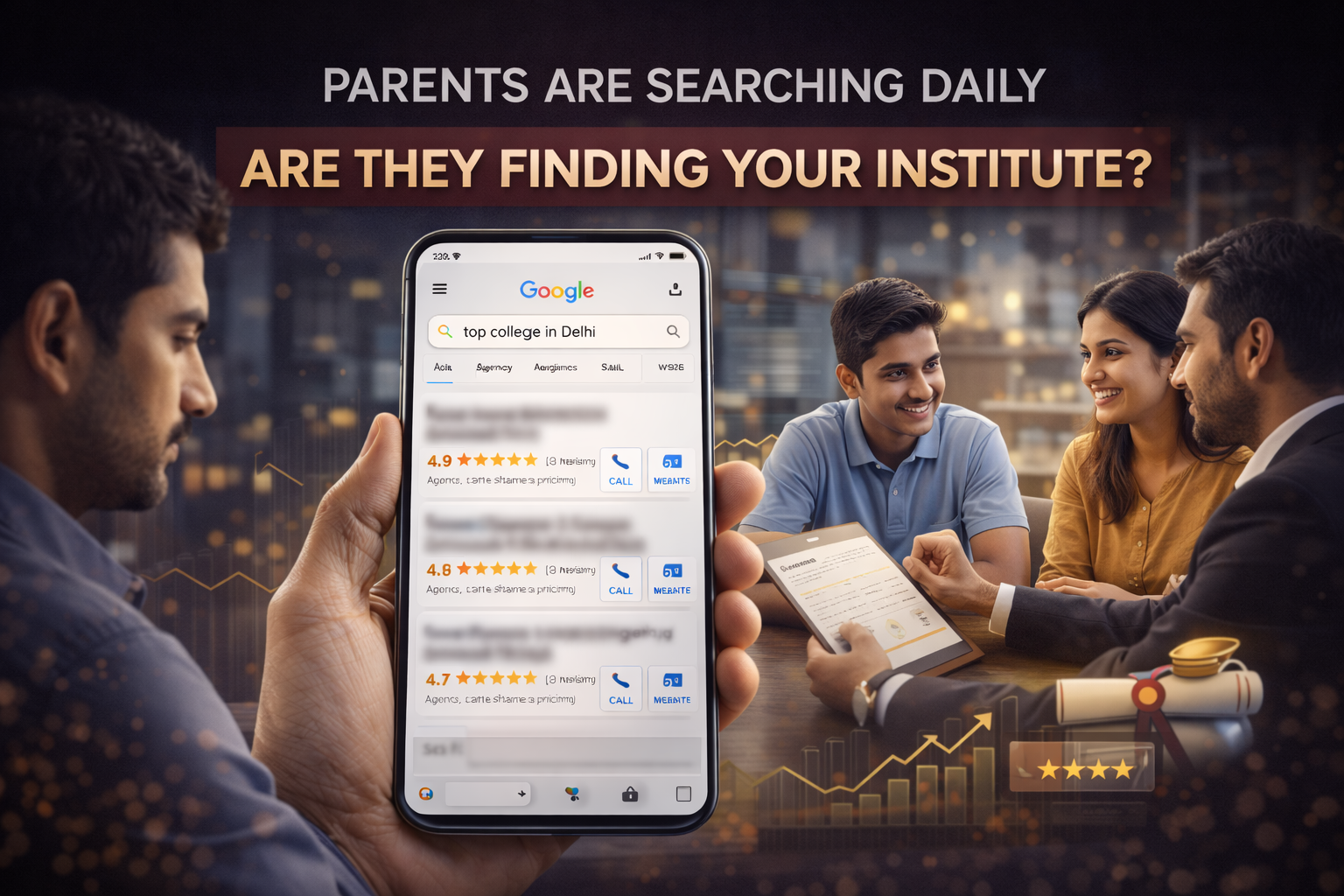
Digital marketing for educational institutions has shifted from an optional add-on to an absolute operational necessity in April 2026. Parents and students today do not rely on word-of-mouth or newspaper advertisements to choose a school, college, coaching centre, or university. They search Google, read social media reviews, watch campus tour videos on YouTube, compare institutions on listing platforms, and form strong opinions about an institute’s quality and credibility before ever making an enquiry.
According to Global EDU’s research on digital marketing for education institutes, the student population is the most prevalent group in terms of internet usage, and schools would be better served by advertising their programmer on relevant digital channels rather than waiting for traditional outreach to work. Mediagarh’s education marketing analysis confirms that parents, students, and teachers have switched to using the internet as a significant source to find quality education, and that many new technologies and marketing trends are now helping schools, colleges, institutes, and online academies grow exponentially.
This guide explains the full landscape of digital marketing for educational institutions in 2026: why it matters, which strategies produce results, which channels to prioritise, and how to measure what is actually working.
Table of Contents
ToggleWhy Digital Marketing for Educational Institutions Is Non-Negotiable in 2026
The education sector operates in one of the most competitive and trust-sensitive markets in India. A family’s decision about which school or college to enrol their child in is one of the highest-stakes purchasing decisions they make, and they approach it with the same research intensity they bring to major financial decisions.
Neekan Consulting’s analysis of digital marketing for educational institutes describes this shift precisely: parents and students spend enough time browsing for schools online, reading reviews, and comparing schools before they decide on one, creating a strong need for educational institutions to develop an appropriate and compelling online presence.
Global EDU’s study of digital marketing for education institutes in India identifies the structural advantages that digital marketing offers over traditional methods.
Online responses are almost always immediate: digital platforms allow brands to interact with their audience and respond instantly to enquiries. Digital conversion rates are greater because emails, WhatsApp messages, and personalised ad retargeting reach prospective students on a more personal level and motivate them to take action. Digital marketing also costs significantly less than traditional newspaper, billboard, or radio advertising, meaning educational institutions can reach a larger, better-targeted audience at a lower investment.
Key Takeaway:
The student population is the most internet-active demographic in India. Schools without digital visibility lose prospective students to competitors who appear first in search results, who have active Instagram profiles showing campus life, and who run targeted Facebook and Google Ads reaching parents at the exact moment they are searching for admissions. (Source: Global EDU, Mediagarh)
Core Digital Marketing Strategies for Educational Institutions
Effective digital marketing for educational institutions does not mean being active on every platform or running every type of campaign simultaneously. It means selecting the right combination of strategies for your institution’s specific audience, admission cycle, and budget, and executing each with consistency and measurement discipline.
1. Search Engine Optimization (SEO)
SEO is the foundation of digital marketing for educational institutions because it determines whether your school or college appears when a parent or student searches for a relevant term. Neekan Consulting’s guide identifies SEO as helping schools come up at the top of search results when parents are looking, noting that parents are most likely to consider institutions that rank high on search results pages.
The strategy involves including keywords that describe your institution, such as ‘best CBSE school in Delhi’, ‘top engineering college near me’, or ‘online coaching for IIT JEE’, ensuring your website is mobile-friendly, and building the site speed and authority that Google rewards with consistent visibility. Mediagarh’s education marketing guide notes that SEO is one of the low-cost methods of digital marketing for educational institutions where the budget can sometimes be near-zero to implement organically, while delivering long-term compounding returns.
2. Social Media Marketing and Advertising
Social media has become one of the most important channels in digital marketing for educational institutions because it is where students and parents spend their daily attention.
Neekan Consulting identifies social media engagement as a direct trust-building mechanism: posting updates of school events, student achievements, and important milestones keeps the community updated and fosters a feeling of belonging and credibility. Global EDU notes that social media presence is one of the most effective forms of digital marketing for educational institutions and is a surefire method to win over today’s adolescents by posting material that is simultaneously relevant and interesting to the target audience. Facebook and Instagram allow institutions to run highly targeted paid advertising by location, age, parental status, and interests, ensuring campaigns reach exactly the families most likely to make an enquiry.
3. Content Marketing and Video Production
Content marketing is one of the highest-return strategies in digital marketing for educational institutions because it builds authority and trust at no additional paid distribution cost. Neekan Consulting’s guide recommends using content marketing to create and publish blogs, videos, and infographics on the key offerings of the school, noting that a well-made video tour of the campus, classrooms, sports facilities, and labs will have a lasting impact on prospective parents and students.
Global EDU identifies video content as a critical strategy: investing in a high-quality film that details various features of the institution gives the audience a clearer picture and piques their curiosity far more effectively than static text. Mediagarh confirms that video ad production is one of the core services in education digital marketing, alongside landing page optimization, Google Ads, and lead automation.
4. Testimonials, Reviews, and Reputation Management
In the education sector, trust is the deciding factor in an admission decision, and digital marketing for educational institutions that does not actively manage online reputation is leaving conversion rates on the table. Global EDU identifies testimonials from current and former students as among the most powerful social proof available to educational institutions, recommending their incorporation into both the website and social media content.
Neekan Consulting’s guide emphasizes that in modern fierce educational competition, building credibility and earning trust among targets through online reputation is how institutions stand out. Schools and colleges should actively ask satisfied parents and alumni to leave Google reviews, publish regular alumni success stories on social media, and respond promptly to any negative feedback to demonstrate institutional accountability.
5. Lead Automation, Email, and WhatsApp Nurturing
Digital marketing for educational institutions must include a systematic process for capturing and converting enquiries into confirmed admissions. Neekan Consulting recommends using digital marketing channels like email newsletters and social media for swift and direct communication, keeping both students and parents updated about admissions deadlines, fee information, and new education initiatives with minimal delay.
They also recommend making the admissions section of the website easy to navigate, including downloadable forms and chatbots or live chat for parents who have questions during the process. Mediagarh identifies lead automation and nurturing as a core service in education digital marketing, which involves automated follow-up sequences that keep warm leads engaged across the admission cycle without requiring manual effort from admissions staff for every single interaction.
Platform Guide: Where to Focus Your Education Digital Marketing
Not every digital channel delivers the same results for every type of educational institution. The right platform mix depends on your institution’s target audience, whether you are marketing to students, parents, or both, and what stage of the admission funnel you are targeting.
| Channel | Primary Goal | Who It Reaches | Best For | Timeline |
|---|---|---|---|---|
| Google Search (SEO) | Long-term organic visibility for high-intent search queries | Parents/students actively searching for specific schools or courses | Any school, college, coaching centre, university | 3-6 months, compounding long-term value |
| Google Ads (PPC) | Instant search visibility during admission season | High-intent searchers ready to enquire | Any institution, especially during peak admission periods | Immediate, requires ongoing spend |
| Facebook and Instagram Ads | Targeted paid reach to parents and students by location and demographics | Parents 30-50, students 16-25, based on interests and behaviors | Schools, colleges, coaching centres needing volume leads | Results within days, requires creative content |
| Instagram (Organic) | Brand building and student community engagement | Students 14-25 primarily, parents increasingly active | Coaching centres, colleges, online academies | 2-4 months of consistent posting |
| YouTube | Campus tours, faculty introductions, student journey videos | All age groups doing research, high-anxiety first-time parents | Universities, professional colleges, boarding schools | Long-term trust building, content ranks in Google |
| Email and WhatsApp | Nurturing warm leads and maintaining parent-institution communication | Existing leads, current parents, alumni networks | All institutions, best for lead conversion and retention | Immediate delivery, highest open rates |
Measuring the Success of Digital Marketing for Educational Institutions
One of the defining advantages of digital marketing for educational institutions over traditional advertising is the ability to track exactly what is working and what is not, in real time.
Mediagarh identifies campaign monitoring as a core benefit: every marketing campaign is trackable and customizable, which allows educational institutions to set goals and change campaigns that are not working, trimming losses and redirecting spend to high-performing activities. Neekan Consulting recommends leveraging web traffic analytics, social media engagement rates, and ad conversion rates as the primary measurement framework, using this data as continuous insight to change marketing strategies and improve outcomes.
The most important metrics for digital marketing for educational institutions are: enquiry volume by channel (which source is generating the most admission interest), cost per enquiry (how much is being spent to generate each lead from each channel), enquiry-to-admission conversion rate (what percentage of leads become enrolled students), website traffic from organic search (a direct measure of SEO performance), social media engagement rate (a proxy for content quality and audience relevance), and Google review rating and volume (a measure of institutional reputation online). Tracking these consistently and reviewing them monthly allows institutions to continuously improve their digital marketing investment return across every admission cycle.
Conclusion
Digital marketing for educational institutions in April 2026 is no longer a competitive advantage: it is the minimum requirement for remaining visible and credible in the market where parents and students are making their choices. Institutions that invest in a well-planned combination of SEO, social media, video content, paid advertising, and lead automation consistently outperform those still relying on traditional outreach, pamphlets, and walk-in enquiries. The institutions growing fastest in admissions are not necessarily the ones with the best programmes: they are the ones that do the best job of communicating their strengths to the right audience through the right digital channels at the right time in the admission cycle.
How Dizispark Can Help
Grow your business with proven Digital Marketing Agency for Startups strategies that put you in front of customers ready to buy. Dizispark helps startups build strong online visibility, generate high-quality leads, and scale faster through expert SEO, performance marketing, and social media campaigns. We focus on data-driven execution so every rupee you invest delivers measurable growth, from traffic to conversions.
Whether you are launching a new startup or struggling to gain traction, our team creates tailored strategies that align with your business goals and target audience. From ranking on Google to running high-converting ads and optimizing your funnels, we handle everything so you can focus on building your product and growing your business. Get your free Digital Marketing Agency for Startups audit today and start turning clicks into real customers.
Frequently Asked Questions
What is digital marketing for educational institutions?
Digital marketing for educational institutions refers to the use of online channels and digital tools to promote a school, college, coaching centre, or university to prospective students and their parents. It includes SEO to improve Google search visibility, paid advertising on Google and Meta platforms, social media content and community management, email and WhatsApp communication, video marketing, content creation, online reputation management, and lead automation. The goal is to attract prospective students, build institutional trust, guide enquiries through the admission funnel, and ultimately convert digital interest into confirmed enrolments.
Why is digital marketing important for schools and colleges?
Digital marketing is important for schools and colleges because parents and students now use the internet as their primary source for researching and choosing educational institutions. Neekan Consulting’s analysis confirms that this process involves browsing for schools online, reading reviews, and comparing institutions before making a decision. Schools without a strong digital presence are effectively invisible to a large portion of their potential admission audience. Beyond visibility, digital marketing builds trust through testimonials and social proof, communicates the institution’s distinctive strengths through content and video, and enables cost-effective targeted advertising that reaches the right families at the right moment.
How do schools use social media for marketing?
Schools use social media for marketing in several ways as part of their broader digital marketing for educational institutions strategy. They post regular updates about school events, student achievements, sports competitions, and cultural programmers to create a sense of community and belonging. They share content showcasing campus facilities, faculty qualifications, and curriculum highlights. They run targeted paid advertisements on Facebook and Instagram reaching local parents within specific demographics. They publish student and parent testimonials as social proof. They use Instagram Reels and YouTube Shorts for short-form video content that builds familiarity and trust, and they maintain active comment and message management to respond promptly to parent enquiries.
How much does digital marketing cost for educational institutions?
The cost of digital marketing for educational institutions in India varies significantly by scope and service mix. A basic package covering social media management, basic SEO, and monthly content typically starts from INR 15,000 to INR 30,000 per month. A mid-level package including paid Google and Meta Ads management, video content production, lead automation, and regular reporting typically range from INR 40,000 to INR 80,000 per month. Comprehensive full-service education marketing packages covering all digital channels can range from INR 1,00,000 per month or more. Ads spend on Google and Meta is always charged separately on top of agency management fees. Mediagarh’s education marketing analysis emphasizes that even paid advertising on digital platforms is significantly less expensive than traditional advertising methods.
What is the role of SEO in education marketing?
SEO plays a central role in digital marketing for educational institutions by ensuring that the institution’s website appears at the top of Google search results when parents or students search for relevant terms. Neekan Consulting’s SEO guide for schools explains that parents are most likely to consider schools that rank highly in search results. A strong SEO strategy for an educational institution includes keyword research around admission-related search terms, on-page optimization of programmer and course pages, technical website performance improvements, local SEO to appear in ‘schools near me’ searches, and regular content creation that keeps the website fresh and authoritative. SEO generates continuous organic traffic without the ongoing cost of paid advertising, making it one of the highest long-term ROI activities in education digital marketing.
How can digital marketing increase student admissions?
Digital marketing increases student admissions for educational institutions through multiple simultaneous mechanisms. SEO ensures the institution appears when parents actively search for schools or courses. Paid Google Ads capture high-intent enquiries immediately during admission season. Social media campaigns build familiarity and trust among parents over time. Video content gives prospective families a virtual experience of the campus, faculty, and student community that builds emotional connection before they visit. Lead automation ensures every enquiry receives a prompt, personalized follow-up that keeps the institution front of mind. Reputation management through reviews and testimonials provides the social proof that converts consideration into a confirmed admission decision. Global EDU’s study confirms that digital conversion rates are higher than traditional methods because digital channels reach prospective students more personally and motivate them to take action.
What type of content works best for school and college marketing?
The most effective content types in digital marketing for educational institutions are video campus tours and faculty introductions that give prospective families a real sense of the learning environment, student and parent testimonials that provide authentic social proof, achievement and result announcements that demonstrate institutional quality, behind-the-scenes content showing daily school life that builds emotional connection, admission guide content that answers the practical questions parents have about the process, and educational blog content that positions the institution as an authority in its academic field. Neekan Consulting recommends using content marketing specifically to showcase the school’s distinctive strengths, noting that a well-made video tour of campus facilities will have a lasting impact on prospective parents and students.
Which digital marketing channel is best for school admissions?
The most effective channel combination for school admissions in digital marketing for educational institutions is a three-layer approach.
Google Ads and SEO together capture parents who are actively searching for schools and have high purchase intent: these are the highest-converting enquiries. Facebook and Instagram paid advertising generates awareness and consideration among parents who are not yet actively searching but are in the right demographic for your school’s intake. WhatsApp and email marketing then nurture those warm leads through the admission process, providing timely information about open days, application deadlines, and fee structures. Mediagarh’s education marketing guide confirms that using all three layers together maximizes both the volume and the quality of admission enquiries compared to relying on any single channel.