

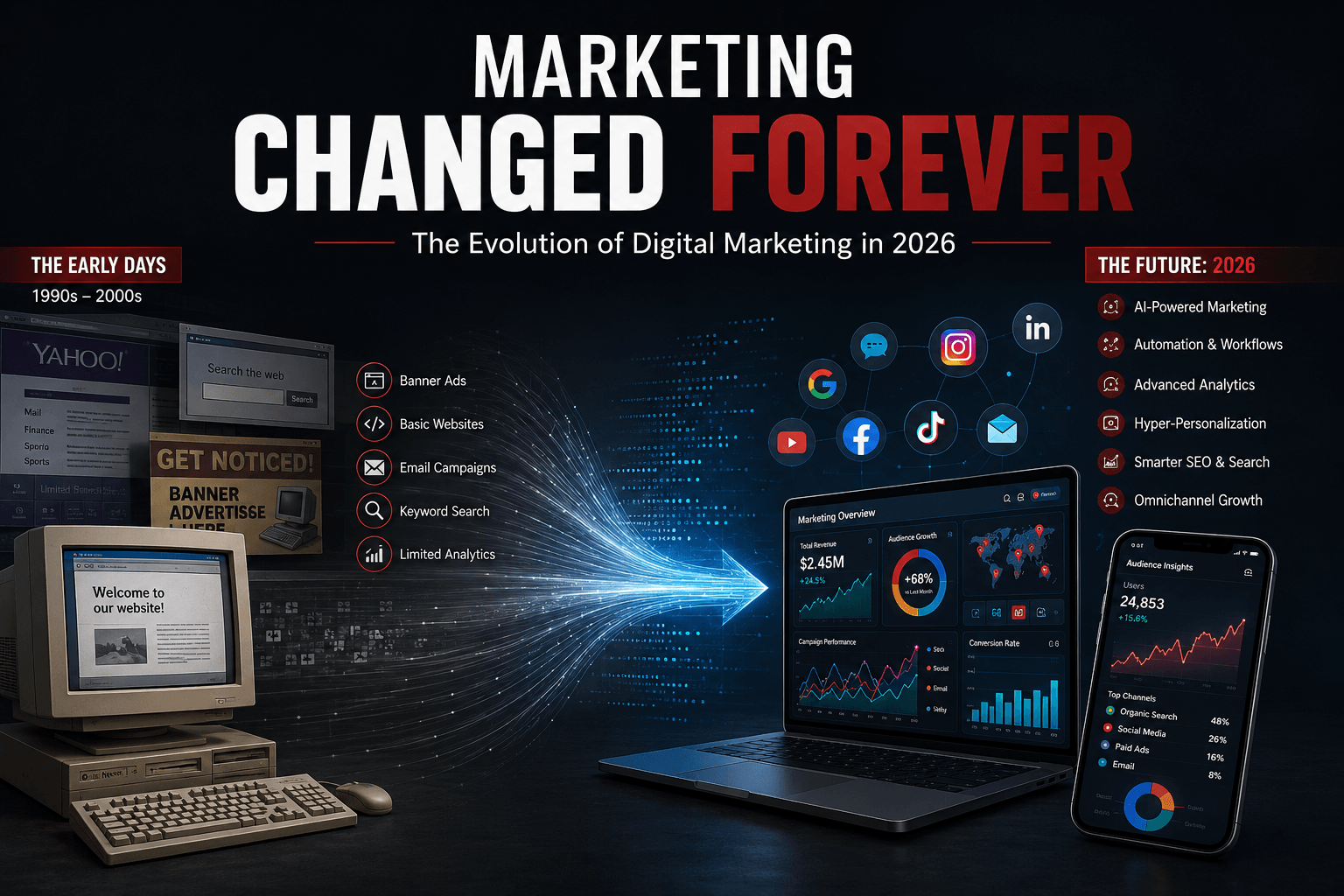
The evolution of digital marketing is one of the most consequential stories in modern business history. Simplilearn’s comprehensive digital marketing history guide confirms that the term digital marketing was first used in the 1990s, and from that point, the discipline evolved through a series of disruptive technological shifts that permanently changed how brands reach and engage their customers.
Velocitize’s evolution analysis frames the study of this history as commercially essential: knowing where you have been important to finding your way forward. Understanding the evolution of digital marketing is necessary to figure out how to best leverage current technologies and practices in 2026.
ResearchGate’s peer-reviewed analysis of digital marketing’s 21st century evolution identifies three distinct periods of transformation, each driven by a specific technological breakthrough that fundamentally restructured how consumers discover, evaluate, and purchase from brands. This guide covers the 5 key turning points in the evolution of digital marketing, the complete timeline from the 1990s to 2026, and the future developments that will define the next phase.
Table of Contents
ToggleWhat Is Digital Marketing and Why Its Evolution Matters
Before tracing the evolution of digital marketing, a clear definition grounds the entire discussion.
Simplilearn cites the Digital Marketing Institute’s definition: digital marketing is the use of digital channels to promote or market products and services to targeted consumers and businesses.
Velocitize adds that the goal of digital marketing is the same as traditional marketing: to create awareness of a brand and its products among the general public. What changed through the evolution of digital marketing is not the goal but the mechanism, scale, and measurability of how that goal is pursued.
The study of the evolution of digital marketing matters for businesses in 2026 because each phase of its development left behind tools, strategies, and audience expectations that are still active today. A business that understands the full history makes better platform choices, content investments, and budget decisions.
Evolution of Digital Marketing: Complete Timeline from 1990 to 2026
Simplilearn’s verified timeline covers each decade of the evolution of digital marketing in detail. This table consolidates the key milestones from Simplilearn, Velocitize, and ResearchGate into a single reference.
| Year | Milestone | What Changed |
|---|---|---|
| 1991 | World Wide Web launched | Digital presence begins. First company websites appear. Internet access limited to academic and research communities. |
| 1993 | First clickable banner ad | HotWired purchases banner ads. The beginning of paid digital advertising and the commercial internet. |
| 1994 | Netscape browser and Yahoo launch | First popular browser makes the web accessible to general public. Yahoo launched, receives 1 million hits in first year. |
| 1996 | New search engines emerge | HotBot, LookSmart, and Alexa launch. SEO begins to develop as businesses compete for search visibility. |
| 1998 | Google and MSN launch | Google launches and rapidly dominates search. Microsoft launches MSN Search. SEO becomes a strategic discipline. |
| 2000 to 2002 | Dot-com bubble and crash | Overinflated internet valuations collapse. More sustainable digital business and marketing models emerge from the wreckage. |
| 2002 to 2004 | Social media foundations | LinkedIn launches in 2002, MySpace and WordPress in 2003, Facebook in 2004. Community-driven marketing begins. |
| 2006 | Search traffic surges | Simplilearn confirms search engine traffic reaches 6.4 billion visits in a single month. Digital advertising becomes essential. |
| 2007 to 2010 | Mobile marketing emergence | Smartphone adoption accelerates. Mobile apps, SMS marketing, and location-based campaigns become viable channels. |
| 2010 to 2015 | Content and influencer marketing | Content becomes the primary SEO and trust-building strategy. Influencer partnerships emerge as a significant revenue channel. |
| 2015 to 2020 | Data-driven programmatic advertising | Big data, CRM integration, programmatic display, retargeting, and GDPR reshape how campaigns are targeted and measured. |
| 2020 to 2026 | AI, automation, and generative search | Performance Max, ChatGPT, Google AI Overviews, Answer Engine Optimisation, and AI-driven personalisation define the current era. |
5 Key Turning Points in the Evolution of Digital Marketing
Velocitize identifies five key turning points in the evolution of digital marketing that had the most lasting commercial impact. Each one changed not just how marketers operated but what audiences expected from brands online.
01. Search Engines and the Birth of SEO
The World Wide Web launched in 1991, but the evolution of digital marketing as a commercial discipline truly began when search engines arrived in the mid-1990s. Velocitize confirms that as more people began to use the web, search engines such as Google made appearances between the 1990s and early 2000s, giving rise to Search Engine Marketing (SEM) and SEO as the first systematic digital marketing strategies.
Simplilearn documents the commercial scale: when Yahoo launched in 1994, it received close to 1 million hits in its first year. This prompted wholesale changes in the digital marketing space, with companies optimising their websites to pull in higher search engine rankings. By 2006, Simplilearn confirms that search engine traffic had grown to 6.4 billion visits in a single month, making organic and paid search the primary battleground of the evolution of digital marketing through the 2000s.
02. The Social Media Revolution
The launch of Facebook in 2004 and the subsequent explosion of social platforms marked the second major turning point in the evolution of digital marketing. Velocitize documents the commercial development: Facebook attained a user base of one million by the end of 2004. In 2007, it launched its first self-service advertising platform and business pages, with overall ad revenue growing to 700 million USD by 2009.
Simplilearn confirms the broader trend: social networking sites beginning with MySpace, then Facebook, opened fresh avenues for business and signaled the beginning of a new chapter for the entire evolution of digital marketing. The social media era also gave rise to content marketing and influencer marketing. Simplilearn notes that the rise of bloggers and Instagram created a 1 billion USD influencer industry that continues to grow.
03. Mobile-First Marketing
The third turning point in the evolution of digital marketing arrived with the smartphone and the shift of internet usage from desktop to mobile. Velocitize confirms the scale of the shift: in 2019, 52.2 percent of all web traffic came from mobile phones, compared to just 16.2 percent in 2013. This made mobile optimisation not an option but a requirement for any business investing in digital marketing.
Simplilearn documents that this mobile shift expanded the evolution of digital marketing into new channels: mobile apps, WhatsApp marketing, Instagram and Snapchat-native campaigns, and location-based advertising all emerged as a direct result of smartphone adoption. Google’s Accelerated Mobile Pages project and its mobile-first indexing policy, confirmed by Velocitize, made mobile performance a direct determinant of search rankings, permanently connecting mobile optimisation to SEO strategy.
04. Data-Driven Marketing and CRM Integration
The fourth turning point in the evolution of digital marketing was the rise of data as the primary input for every campaign decision. Velocitize identifies Customer Relationship Management (CRM) as one of the key developments: CRM tools let marketers work iteratively based on performance analytics data, making it possible to predict customers’ purchasing habits and further define target audiences.
Simplilearn documents an earlier data milestone: the cookie, which began as a way to track common browsing habits and was used to tailor promotions to individual users’ tastes. Cookie-based targeting laid the foundation for the personalised digital advertising that followed. ResearchGate’s 21st century evolution analysis confirms that by 2004, internet advertising and marketing in the US alone brought in around 2.9 billion USD, reflecting how rapidly data-driven digital marketing had monetised across the first decade of the evolution.
05. AI, Voice Search, and Generative Discovery
The fifth and current turning point in the evolution of digital marketing is the integration of artificial intelligence across every channel and platform simultaneously. Velocitize’s analysis, even from 2020, correctly predicted this shift: the use of AI technologies would become more pervasive in content creation, product recommendations, and ecommerce transactions, as well as in chatbots providing customer engagement at scale.
In 2026, Simplilearn confirms that a digital marketing professional must find ways to keep up with constantly evolving search engine algorithms and emerging AI-driven capabilities. Performance Max, AI Overviews in Google, and generative AI tools have restructured how campaigns are built and how content is discovered. Voice search, identified by Velocitize as one of the most important marketing trends, has further expanded the evolution of digital marketing into conversational and intent-driven discovery modes that traditional keyword-based SEO did not address.
The 5 Ds of Digital Marketing: A Framework for the 2026 Landscape
Simplilearn identifies five foundational dimensions that define digital marketing as a system in 2026. These 5 Ds reflect what the evolution of digital marketing has produced in terms of the touchpoints, data, and technology available to modern marketers.
| The 5 Ds | What It Means | What to Do in 2026 |
|---|---|---|
| Digital Devices | The hardware through which audiences engage with digital marketing, including smartphones, tablets, laptops, smart TVs, and wearables. Mobile now accounts for over half of all web traffic globally. | Target campaigns specifically to device types. Ensure full mobile responsiveness and fast loading for all creative. |
| Digital Platforms | The software environments where brands reach their audiences, including search engines, social media platforms, email clients, and streaming services. Each platform has its own algorithm, format, and audience behaviour. | Choose platforms where your specific target audience actually spends time. Master one or two before expanding. |
| Digital Media | The paid, earned, and owned media channels through which brands deliver their messages, including SEO, PPC, social media content, influencer partnerships, and email campaigns. | Build an integrated media mix that combines immediate paid reach with long-term organic authority compounding simultaneously. |
| Digital Data | The audience insights and behavioural signals collected through campaign analytics, CRM systems, first-party data, and cookies. Data powers personalisation, targeting, and performance optimisation. | Invest in first-party data collection as third-party cookies continue to be phased out. Use GA4 and CRM integration. |
| Digital Technology | The tools and technologies including AI, automation, AR, VR, and programmatic systems that marketers use to deliver personalised, efficient, and scalable campaigns across all the above. | Evaluate AI tools for content creation, bidding automation, and personalisation. Stay current with platform AI features. |
The Future of the Evolution of Digital Marketing Beyond 2026
The evolution of digital marketing does not stop at the current moment.
Velocitize’s forward analysis identifies three forces that will shape the next phase: greater AI pervasiveness across all marketing functions, expanded chatbot deployment for customer engagement, and the continued rise of voice and conversational search.
Simplilearn confirms that digital marketing professionals in 2026 must be able to keep an eye out for emerging trends and the development of newer and smarter search engine algorithms. The platforms and tools that define digital marketing in 2026 will look significantly different in 2028.
ResearchGate’s three-period analysis of the evolution of digital marketing concludes that each new period is characterised by a collapse of previous boundaries, whether geographic, demographic, or format-based, followed by new rules that reward those who adapt earliest.
Conclusion
The evolution of digital marketing from the early 1990s to April 2026 is a story of five compounding technological shifts: search engines giving brands organic reach, social media giving them community, mobile giving them always-on access, data giving them targeting precision, and AI giving them personalisation at scale.
Velocitize’s conclusion is one worth carrying forward: knowing where you have been important to finding your way forward. Understanding the evolution of digital marketing is not academic. It is a practical advantage for every business deciding how to invest its marketing budget.
The businesses succeeding in 2026 are not those that adopted every new platform as it emerged. They are the ones that understood which stage of the evolution of digital marketing their customers were in and built their strategy accordingly.
How Dizispark Can Help
Dizispark is a Delhi-based digital marketing agency that applies every stage of the evolution of digital marketing to build complete, results-driven strategies for businesses across India, covering SEO, Google Ads, Meta Ads, social media content, email marketing, website development, and a fully optimised Google My Business Profile that connects your local search visibility to every other digital channel we manage, producing a coordinated growth system where each channel reinforces the others rather than operating in silos.
We measure every campaign against real business outcomes, report transparently every month, and continuously apply the latest developments in the evolution of digital marketing to keep your brand competitive as the landscape changes. Reach out to the Dizispark team today and start building a digital marketing strategy that compounds.
Frequently Asked Questions
What is the evolution of digital marketing?
The evolution of digital marketing refers to the progression of digital marketing from its origins in the 1990s, when the term was first used following the launch of the World Wide Web, through a series of major technological turning points including the rise of search engines and SEO, the social media revolution, the shift to mobile-first marketing, the adoption of data-driven personalization, and the current integration of AI, automation, and generative search. Simplilearn’s updated history confirms that each stage of the evolution of digital marketing was triggered by a specific technological breakthrough that permanently changed how brands reach audiences, with the transition from traditional one-way broadcasting to real-time, two-way, personalized digital communication being the overarching story of the entire evolution.
When did digital marketing start evolving?
The evolution of digital marketing began in the early 1990s with the launch of the World Wide Web in 1991, and the commercial phase of the evolution accelerated significantly in 1993 when the first clickable web banner went live and Hotwired purchased banner ads for their advertising. Simplilearn confirms that 1994 saw Yahoo launch, receiving close to 1 million hits in its first year, and prompted companies to begin optimizing websites for search engine rankings. The evolution of digital marketing then progressed through the search engine era of the late 1990s, the social media explosion of the mid-2000s, the mobile revolution of the late 2000s, and the data and AI-driven era that defines marketing strategy in 2026.
What are the 4 stages of the evolution of marketing?
Simplilearn identifies four eras in the broader evolution of marketing: the Production Era, where demand outpaced supply and simply making products was sufficient; the Sales Era, where supply grew and businesses needed to actively convince customers to buy; the Marketing Era, where understanding customer needs became the strategic focus; and the Marketing Company Era, where the entire organization aligns around customer-centricity. The evolution of digital marketing fits into the Marketing and Marketing Company Eras as a technology-driven acceleration of both: digital channels made customer understanding more precise and customer communication more personalized, scalable, and measurable than any previous marketing system had allowed.
How has digital marketing changed over the years?
The evolution of digital marketing has changed the discipline across five key dimensions over three decades. First, reach expanded from local to global as internet access spread. Second, targeting moved from broad demographic segments to precise individual-level personalization enabled by cookies, CRM data, and AI. Third, measurability transformed from estimated impressions and circulation figures to real-time tracking of every click, visit, conversion, and revenue attribution. Fourth, the channel mix expanded from simple banner ads and email to include SEO, social media, influencer marketing, programmatic display, mobile apps, voice search, and AI-generated content discovery. Fifth, the cost model shifted from fixed upfront spend with no guaranteed return to performance-based models including PPC, affiliate marketing, and AI-optimised programmatic campaigns where payment is tied to confirmed outcomes.
What were the 5 key turning points in the evolution of digital marketing?
Velocitize identifies five key turning points in the evolution of digital marketing: first, search engines and the birth of SEO in the mid-1990s, which created the first systematic digital marketing strategy; second, the social media revolution beginning with Facebook in 2004, which gave brands direct community-building and targeting capabilities; third, mobile-first marketing driven by smartphone adoption, which moved the majority of internet usage to small screens and made mobile optimisation a ranking factor; fourth, data-driven marketing and CRM integration, which made personalization, behavioral targeting, and precise attribution possible at scale; and fifth, AI and voice search, which is the current and ongoing turning point in the evolution of digital marketing reshaping content discovery, campaign optimisation, and audience engagement in 2026.
What is the role of AI in the evolution of digital marketing?
AI represents the fifth and most recent turning point in the evolution of digital marketing and is reshaping every dimension of the discipline simultaneously in 2026. Velocitize’s forward analysis, confirmed by Simplilearn’s updated guide, identifies AI as pervasive across content creation, product recommendations, ecommerce personalisation, chatbot customer engagement, and programmatic ad bidding. Google’s AI Overviews and Performance Max campaigns are direct manifestations of AI in search and paid advertising. Generative AI tools including ChatGPT and Google Gemini are creating a new channel in the evolution of digital marketing, Answer Engine Optimisation (AEO), where brands must appear in AI-generated answers rather than just traditional search results. Simplilearn confirms that a digital marketing professional in 2026 must keep up with these constantly evolving AI-driven search engine algorithms to stay competitive.
Why is understanding the history of digital marketing important?
Understanding the history and evolution of digital marketing is important because each stage of its development left behind tools, audience expectations, and strategic principles that are still active in the current landscape. Velocitize frames this directly knowing where you have been important to finding your way forward, and understanding the history of digital marketing is necessary to figure out how to best leverage current technologies and practices. Businesses that understand why SEO emerged from search engine architecture, why social media advertising works differently from search advertising, and why mobile-first design is a ranking factor are better equipped to make platform choices, content investments, and budget allocation decisions that align with how their audiences actually behave. ResearchGate’s peer-reviewed analysis confirms that each period of the evolution of digital marketing created rules that rewarded early adopters and disadvantaged latecomers.
What is the future of the evolution of digital marketing?
The future of the evolution of digital marketing in 2026 and beyond will be defined by greater AI integration across all campaign functions, the continued expansion of voice and conversational search, increased use of augmented and virtual reality for immersive brand experiences, and the growth of first-party data strategies as third-party cookies continue to be deprecated. Velocitize confirms that the use of AI technologies will be more pervasive in content creation, product recommendations, ecommerce transactions, and chatbot customer engagement. Simplilearn adds that digital marketers in 2026 must keep an eye out for emerging trends and newer search engine algorithms to avoid falling behind. ResearchGate’s three-period analysis concludes that each new phase of the evolution of digital marketing collapses previous boundaries and creates new ones, meaning the landscape of 2028 will look meaningfully different from 2026 and will reward those who begin adapting now.