

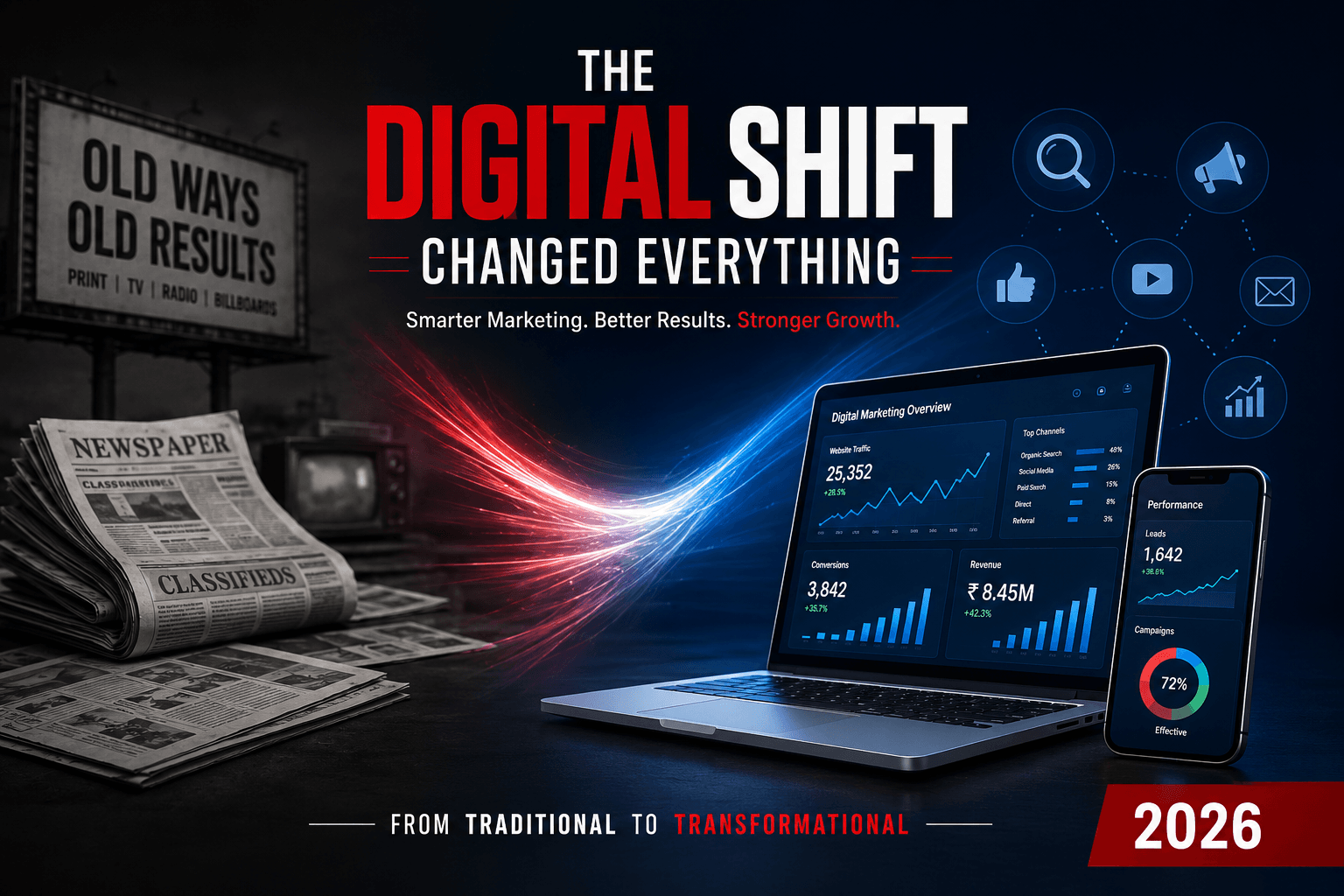
The emergence of digital marketing as a tool has fundamentally changed how businesses reach, engage, and convert customers in 2026.
Esta Global’s January 2026 analysis frames the transformation precisely: the global business market today has moved from broad, generic, and one directional outreach to customer oriented, niche based, two-way communication. Digital marketing, which began as just another wing of traditional marketing, is now considered an essential tool of business growth.
JIMS Kalkaji’s digital age marketing evolution confirms the scale of the shift: from the days of print ads and broadcast media to the era of social media, search engines, and influencer partnerships, the way businesses reach and engage with their audiences has transformed dramatically.
Brandstory’s emergence analysis identifies what makes this transformation different from previous marketing evolutions: the emergence of digital marketing as a tool is not merely a channel shift. It is a structural change in how brand and customer interact, enabled by the internet, mobile devices, and data.
This guide covers the 7 key forces driving the emergence of digital marketing as a tool, the stages of its evolution, the tools that define it in 2026, and what it means for businesses that have not yet fully embraced it.
Table of Contents
ToggleWhat the Emergence of Digital Marketing as a Tool Actually Means
The emergence of digital marketing as a tool is not just the replacement of print ads with digital ads.
Esta Global identifies the core conceptual shift: traditional marketing was not interactive and was meant for a wide section of customers without making any real-time interaction. Digital marketing changed that entirely. When using digital marketing, brands interact with targeted audiences in real time through multiple touchpoints simultaneously.
JIMS Kalkaji’s evolution analysis confirms that digital marketing brought measurability to an industry previously dependent on estimation. The ability to check how many people visited a website, how long they spent there, and which pages they clicked was unprecedented. Traditional marketing such as billboards and posters offered no comparable real-time, accurate data.
Brandstory frames the distinction in practical business terms: digital marketing works as the medium that bridges the gap between the business and its customers, helping in creating brand relationships that extend far beyond the moment of purchase.
The word ‘tool’ in the emergence of digital marketing as a tool is deliberate and important. Digital marketing is not a single channel. It is a system of interconnected platforms, strategies, and analytics that businesses wield to achieve specific commercial outcomes.
7 Key Forces Behind the Emergence of Digital Marketing as a Tool
Esta Global, JIMS Kalkaji, and Brandstory each identify specific forces that enabled and accelerated the emergence of digital marketing as a tool. The following 7 forces consolidate the key drivers from all three sources.
01. The Birth of the Internet and World Wide Web
The emergence of digital marketing as a tool begins with a single moment: the birth of the World Wide Web in the early 1990s.
JIMS Kalkaji’s evolution guide identifies this as the starting point. Initially, marketing efforts were limited to simple online directories and basic electronic mail. However, the potential for reaching a vast global audience was quickly realised.
Esta Global confirms the commercial logic: businesses recognized early that the internet was a platform where customers were present, searchable, and reachable at a fraction of the cost of traditional media.
This first wave of digital presence, however basic, established the infrastructure that every subsequent stage of the emergence of digital marketing as a tool would build upon.
02. The Explosion of Internet and Smartphone Adoption
The single most powerful driver of the emergence of digital marketing as a tool is the sheer scale of internet and smartphone adoption globally.
Esta Global cites verified statistics: approximately 6 billion people, representing around 73 percent of the global population, are now using the internet. Around 7.43 billion people are now using smartphones.
JIMS Kalkaji confirms that the introduction of smartphones brought a new dimension to digital marketing entirely. Mobile apps, location-based marketing, and SMS marketing became essential tools. Businesses started optimising their websites for mobile devices, acknowledging the growing trend of on-the-go internet usage.
The implication is direct: when the majority of the world’s population carries a connected device at all times, the emergence of digital marketing as a tool is not just possible but commercially inevitable.
03. The Rise of Search Engines and SEO
The late 1990s saw the rise of search engines like Yahoo and Google, and this single development changed the way information was indexed and found on the internet permanently.
JIMS Kalkaji identifies this as one of the most significant moments in the emergence of digital marketing as a tool: the birth of Search Engine Optimisation as a key strategy, with businesses vying for top spots in search results to attract customers actively looking for their products.
Esta Global confirms that SEO helps businesses improve their website visibility on search engines, bringing organic traffic and long-term growth that no traditional marketing channel can replicate in terms of compounding return.
Today SEO remains one of the foundational pillars of the emergence of digital marketing as a tool, generating traffic and leads for businesses long after the original investment in content and optimisation is made.
04. The Social Media Explosion
The mid-2000s witnessed the emergence of social media platforms including Facebook, Twitter, LinkedIn, and Instagram, and these platforms transformed digital marketing fundamentally.
JIMS Kalkaji identifies the transformation: social media provided businesses with tools to engage directly with their customers, create communities, and personalise their marketing messages in ways that mass advertising never could.
Esta Global confirms the scale of social media’s role in the emergence of digital marketing as a tool: more than 3.5 billion people use social media, and among them lies every brand’s target customer base.
Social media also gave rise to content marketing and influencer marketing. JIMS Kalkaji confirms that content became the core currency of the social media era, with brands partnering with social media personalities to reach broader and more engaged audiences.
05. Changing Consumer Behaviour and the Research-First Buyer
Consumer behaviour changed in parallel with the rise of digital platforms, and this behavioural shift is itself a driver of the emergence of digital marketing as a tool.
Esta Global identifies the specific pattern: the majority of people now love to research products, look at reviews, compare options, and read about recommendations on social media before making any purchase decision.
JIMS Kalkaji confirms that the focus on the customer journey and omnichannel marketing became central to digital strategy as a result. Understanding and mapping the customer journey from awareness to purchase became crucial, with businesses tailoring their digital marketing strategy at each stage.
Brandstory adds that this research-first buyer behaviour makes personalisation one of the most valuable capabilities of digital marketing: when brands understand what customers have searched, viewed, and compared, they can present the right message at the right moment with far greater precision than any traditional channel allows.
06. Data, Analytics, and Measurable Results
The ability to measure every marketing action is one of the defining characteristics of the emergence of digital marketing as a tool and one of its most commercially significant advantages.
JIMS Kalkaji identifies the role of big data: businesses began leveraging big data to gain insights into consumer behaviours, preferences, and trends, leading to more targeted and effective campaigns. This data-driven approach is not possible in traditional marketing.
Esta Global makes the practical comparison directly: checking how many people visited your website, how much time they spent there, and which pages they clicked on is entirely routine in digital marketing. That level of attribution is simply unavailable for a billboard or a print ad.
Data also enabled the emergence of digital marketing as a tool for continuous optimisation: when a campaign underperforms, the data reveals why and where, enabling real-time adjustments that traditional advertising does not allow.
07. Artificial Intelligence and Marketing Automation
AI and automation represent the most recent and arguably the most transformative phase of the emergence of digital marketing as a tool in 2026.
JIMS Kalkaji confirms that AI and machine learning technologies have taken digital marketing to new heights. From chatbots providing customer service to AI-driven content creation and programmatic advertising, these technologies are making marketing more efficient and deeply personalised.
Esta Global’s 2026 analysis adds that the integration of more immersive technologies continues to advance, with AI enabling brand communication and customer interactions to become smoother, more efficient, and more tailored to individual behaviour than any previous marketing system.
Brandstory confirms that automation amplifies every other aspect of the emergence of digital marketing as a tool: personalised email sequences, automated bidding in Google Ads, dynamic ad creative optimisation, and AI-generated content all allow businesses to operate sophisticated marketing systems with smaller teams than traditional approaches required.
The Evolution Timeline: Emergence of Digital Marketing as a Tool
JIMS Kalkaji’s 2024 evolution analysis provides one of the most complete historical timelines for the emergence of digital marketing as a tool. This table traces each stage from the early internet to AI-driven marketing in 2026.
| Era | Stage | Key Developments | Context and Notes |
|---|---|---|---|
| Early 1990s | Birth of the World Wide Web | Online directories, basic email marketing, first company websites | Internet access limited to academics and early adopters |
| Late 1990s | Rise of Search Engines and SEO | Google and Yahoo launch, SEO emerges, keyword-based advertising begins | Dot-com boom and subsequent crash reshapes digital business models |
| Early 2000s | Email Marketing Matures | Newsletter campaigns, drip email sequences, list building as a strategy | The first CAN-SPAM laws regulate commercial email in 2003 |
| Mid 2000s | Social Media Explosion | Facebook (2004), YouTube (2005), Twitter (2006), LinkedIn expands | Brands begin managing social pages and community engagement |
| Late 2000s | Mobile Marketing Emergence | Smartphone adoption accelerates, mobile-optimised sites become essential | iPhone launched 2007; app economy begins transforming access patterns |
| 2010 to 2015 | Content and Influencer Marketing Rise | Blogs, video content, influencer partnerships, inbound marketing | Google Panda and Penguin penalise low-quality content and links |
| 2015 to 2020 | Data-Driven and Programmatic Advertising | Big data analytics, programmatic display, retargeting, CRM integration | GDPR introduced in 2018, reshaping data privacy across digital marketing |
| 2020 to 2026 | AI, Automation, and Omnichannel | AI-generated content, Performance Max, ChatGPT, AR/VR, voice search | AI Overviews in Google, generative search, Answer Engine Optimisation |
Core Digital Marketing Tools Driving the 2026 Landscape
Esta Global identifies five core tool categories that define the emergence of digital marketing as a tool in practice. This table provides a verified 2026 summary of each category, its function, and its role in the overall digital marketing system.
| Tool Category | Primary Function | Key Activities |
|---|---|---|
| Search Engine Optimisation (SEO) | Improve website visibility on Google and other search engines, generating organic traffic and long-term compounding growth | Keyword research, on-page optimisation, link building, technical SEO, local SEO, content strategy |
| Social Media Marketing | Direct audience engagement, community building, brand awareness, and paid social lead generation across Facebook, Instagram, LinkedIn, and YouTube | Content calendar, community management, paid social campaigns, Reels and short-form video, influencer partnerships |
| Content Marketing | Educate customers, establish brand authority, support buying decisions, and improve SEO through blogs, videos, infographics, and guides | Editorial calendar, SEO-optimised articles, video production, infographic design, pillar and cluster content strategy |
| Email Marketing | Nurture leads through the buying journey, retain existing customers, and drive direct promotional revenue through personalised automated sequences | List building, segmentation, automated drip sequences, A/B testing, CRM integration, performance tracking |
| Paid Advertising (PPC) | Generate immediate high-intent traffic and qualified leads through Google Ads, Meta Ads, LinkedIn Ads, and programmatic display campaigns | Keyword bidding, audience targeting, ad copy creation, landing page alignment, conversion tracking, ROAS optimisation |
Challenges in the Emergence of Digital Marketing as a Tool
Esta Global’s 2026 analysis identifies four challenges that accompany the emergence of digital marketing as a tool that businesses must plan for alongside the opportunities.
| Challenge | What Businesses Need to Plan For |
|---|---|
| Overly Competitive Market | As more businesses invest in digital marketing, competition for audience attention, keyword rankings, and social media reach intensifies every year. Strategy quality and content depth increasingly determine who wins. |
| Constant Algorithm Changes | Social media platforms and search engines update their algorithms continuously. A strategy optimised for one algorithm cycle may require adjustment within months. Staying current requires active monitoring and willingness to adapt. |
| Data Privacy and Security Concerns | Increasing data collection raises real concerns about breaches, misuse, and regulatory compliance. GDPR in Europe and India’s Digital Personal Data Protection Act 2023 require businesses to handle user data carefully and transparently. |
| Continuous Skill Upgrade Requirements | The emergence of digital marketing as a tool has produced a rapidly evolving skill set. AI tools, new ad formats, platform updates, and shifting consumer behaviour all require teams and agencies to invest continuously in learning. |
Conclusion
The emergence of digital marketing as a tool is one of the most significant transformations in the history of commerce.
Esta Global’s conclusion captures it well: digital marketing has made the interaction between brand and customer smooth, easy, and seamless. Unlike traditional marketing, digital marketing helps businesses target only those audiences with the highest potential for conversion, working as a tool for conversion, communication, and brand building simultaneously.
JIMS Kalkaji confirms the trajectory: from the early days of email marketing to the sophisticated use of AI and big data, digital marketing has continuously adapted and evolved. As the landscape continues to change, new opportunities and challenges for marketers emerge.
Brandstory adds the strategic imperative for 2026: to lead the market tomorrow, businesses need to build strong digital marketing strategies today. The emergence of digital marketing as a tool is not a trend that has peaked. It is a structural shift that continues to accelerate.
How Dizispark Can Help
Dizispark is a Delhi-based digital marketing agency that helps businesses across India navigate every stage of the emergence of digital marketing as a tool, building the complete digital strategy their specific business needs in 2026: SEO for long-term organic authority, Google Ads and Meta Ads for immediate high-intent customer acquisition, social media content and community management, email marketing automation, website development built for conversion, and a fully optimized Google My Business Profile that strengthens local search visibility alongside every digital channel we manage.
Frequently Asked Questions
What is the emergence of digital marketing as a tool?
The emergence of digital marketing as a tool refers to the process by which digital channels including search engines, social media, email, content platforms, and paid advertising evolved from experimental online extensions of traditional marketing into the primary strategic system through which businesses reach, engage, and convert customers in the modern era. Esta Global’s 2026 analysis defines this emergence as the transformation of a broad, generic, one-directional marketing model into a customer-oriented, niche-based, two-way communication system where brands interact with targeted audiences in real time across multiple touchpoints simultaneously. JIMS Kalkaji confirms that this emergence is directly tied to technology adoption, particularly the growth of internet access, smartphone penetration, social media platforms, and AI-driven marketing tools that have progressively made digital channels more powerful, measurable, and accessible for businesses of every size.
When did digital marketing emerge as a major marketing tool?
Digital marketing began to emerge as a major marketing tool in the early 1990s with the birth of the World Wide Web, which JIMS Kalkaji identifies as the starting point for the entire evolution. The first significant commercial wave was email marketing in the mid-1990s, followed by the rise of search engines and SEO in the late 1990s. Social media platforms accelerating adoption from 2004 onward marked the next major phase. JIMS Kalkaji’s evolution timeline confirms that each subsequent decade brought a transformative new layer: mobile marketing in the late 2000s, content and influencer marketing in the early 2010s, programmatic advertising and big data in the mid-2010s, and AI-driven automation and personalisation from 2020 onward. By April 2026, the emergence of digital marketing as a tool is not a historical event but a continuing acceleration.
Why has digital marketing become important as a business tool?
Digital marketing has become important as a business tool because it solves the three fundamental limitations of traditional marketing: cost, measurability, and targeting precision. Esta Global confirms that digital marketing campaigns are significantly more cost-effective than traditional channels, can be measured in real time with tools like Google Analytics tracking visits, session duration, and conversion rates, and can target specific audiences by demographics, behaviour, location, and intent rather than broadcasting to mass audiences with significant wastage. JIMS Kalkaji adds that the sheer scale of digital adoption makes presence on digital channels commercially essential: with approximately 6 billion internet users and 7.43 billion smartphone users globally as of 2026, the emergence of digital marketing as a tool is inseparable from the emergence of the internet-connected consumer.
What are the key factors that drove the emergence of digital marketing?
The 7 key factors driving the emergence of digital marketing as a tool are: the birth of the internet and World Wide Web in the early 1990s, the explosion of internet and smartphone adoption to billions of users globally, the rise of search engines and SEO as a commercial strategy, the social media explosion beginning with Facebook and YouTube in the mid-2000s, the shift in consumer behaviour toward research-first purchasing driven by online reviews and social recommendations, the growth of data analytics enabling real-time campaign measurement that traditional media cannot replicate, and the emergence of AI and marketing automation making personalised, scalable campaigns accessible to businesses of all sizes. Esta Global and JIMS Kalkaji both identify internet and smartphone growth as the most commercially decisive of these factors because it created the audience that makes every digital marketing channel viable.
What are the main tools of digital marketing in 2026?
The five main tools of digital marketing in 2026 identified by Esta Global are Search Engine Optimisation (SEO) for organic search visibility and long-term traffic growth, Social Media Marketing for direct audience engagement and community building across Facebook, Instagram, LinkedIn, and YouTube, Content Marketing for brand authority and SEO support through blogs, videos, and infographics, Email Marketing for lead nurturing and customer retention through personalised automated sequences, and Paid Advertising (PPC) through Google Ads and Meta Ads for immediate high-intent traffic and targeted lead generation. JIMS Kalkaji adds programmatic advertising, AI-driven content tools, and omnichannel marketing platforms as additional tools that have become central to the emergence of digital marketing as a tool in the current era.
How has AI changed the emergence of digital marketing as a tool?
AI has accelerated the emergence of digital marketing as a tool by enabling levels of personalisation, automation, and optimisation that were previously impossible or impractical for most businesses. JIMS Kalkaji’s 2024 digital age analysis confirms that AI and machine learning technologies have taken digital marketing to new heights, from chatbots providing customer service to AI-driven content creation and programmatic advertising that makes campaigns more efficient and personalised at scale. Esta Global’s 2026 analysis adds that AI and automation are now integrated into the core of digital marketing, with further immersive technologies expected to deepen this integration in the near future. AI also enables the emergence of digital marketing as a tool in generative search environments with ChatGPT, Google Gemini, and other AI systems surfacing brand recommendations in answers, appearing in AI-generated responses has become a new dimension of the digital marketing landscape.
What are the challenges of digital marketing as a tool?
Esta Global identifies four key challenges accompanying the emergence of digital marketing as a tool in 2026: an overly competitive market where increasing business investment in digital channels raises the bar for content quality and strategy depth, constant algorithm changes across social media and search engine platforms that require continuous adaptation, data privacy and security concerns driven by regulations like GDPR and India’s Digital Personal Data Protection Act 2023, and the requirement for continuous skill upgrades as new platforms, AI tools, and consumer behaviour patterns emerge. JIMS Kalkaji adds that ethical marketing practices and data transparency have become increasingly important as consumer awareness of digital data practices grows, making trust-building a competitive advantage rather than simply a compliance requirement.
What is the future of digital marketing as a business tool?
Esta Global’s 2026 analysis confirms that the future of digital marketing as a business tool will be bigger, more advanced, and more customer-centric than the current landscape. AI integration will deepen, enabling smoother brand communication and more efficient customer interactions at scale. JIMS Kalkaji identifies emerging technologies including augmented reality, virtual reality, and the Internet of Things as set to further revolutionise how businesses engage with customers and create immersive brand experiences. Continued focus on hyper-personalisation, where AI enables individualised content recommendations and experiences for each user, is identified by both sources as the primary direction of the emergence of digital marketing as a tool in the coming years. Brandstory adds that businesses that build strong digital marketing foundations now will compound their advantage as these technologies mature, while those that delay will face increasingly difficult entry points in markets where digital authority has already been established by competitors.