
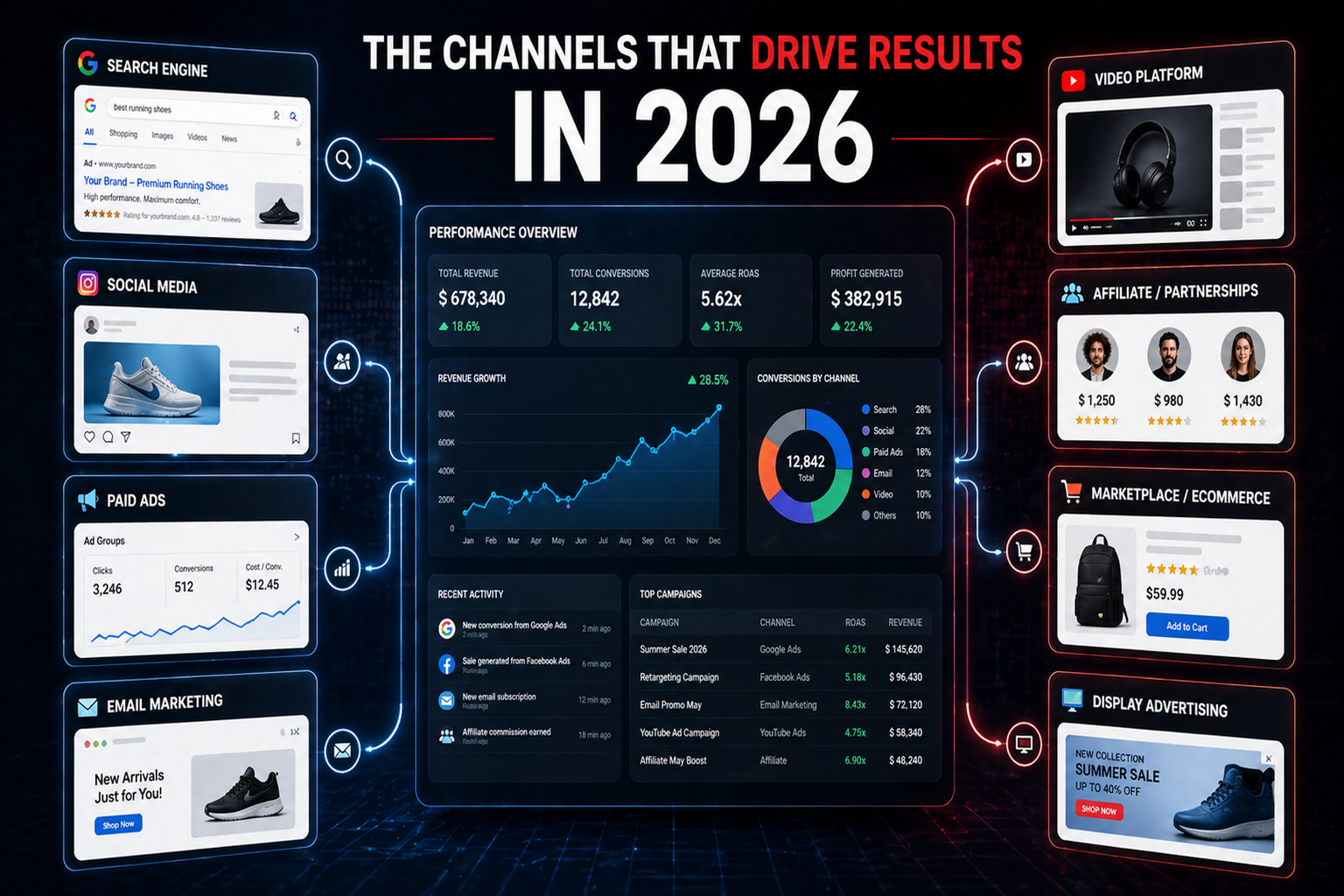
Understanding performance marketing channels is one of the most strategically important decisions any business can make about its digital marketing budget in 2026. Performance marketing channels are digital platforms and networks where advertisers pay only when a specific, measurable action is completed a click, a lead, a sale, or a sign-up, rather than paying upfront for impressions or ad placement with no guaranteed results. Salesforce’s performance marketing guide defines performance marketing as a digital marketing strategy where advertisers pay only when a specific action is completed, making it one of the most cost-efficient, data-driven, and directly accountable approaches to growing a business online.
The performance marketing channels available to businesses in April 2026 range from paid search and social media advertising to affiliate marketing, native ads, email campaigns, influencer partnerships, programmatic display, and emerging AI-powered generative search placements. Taboola’s 2026 performance marketing channels analysis confirms that while paid social, paid search, and email have historically dominated, newer channels including native advertising, connected TV (CTV), and AI generative search placements are rapidly reshaping how and where brands deliver their performance marketing channels strategy. This guide covers the 8 most important performance marketing channels in 2026, with the key metrics, cost models, use cases, and selection criteria that help businesses choose the right channel mix for their specific goals and budget.
Table of Contents
ToggleWhat Are Performance Marketing Channels and Why Do They Matter?
Performance marketing channels are the specific digital networks, platforms, and systems through which performance-based campaigns are launched, tracked, and optimised in real time.
What distinguishes performance marketing channels from traditional advertising channels is the payment model: advertisers invest only in confirmed outcomes.
Salesforce confirms the core mechanics: businesses can monitor performance through tracking platforms that capture every interaction, a click, a completed form, a purchase, and payment is tied directly to those outcomes.
This pay-for-results structure makes performance marketing channels theoretically more efficient than brand advertising on TV or radio, where budgets are committed with no guarantee of commercial return.
The practical advantage of performance marketing channels compounds as data accumulates. Because every action on every channel is tracked, businesses can identify which performance marketing channels produce the lowest cost per acquisition, which audience segments convert at the highest rates, and which ad creatives outperform their variations. Salesforce notes that AI-driven systems can sift through campaign data automatically, spotting trends and identifying winning ad variations faster than any manual review process. This data-driven agility, applied across all performance marketing channels simultaneously, is what makes the approach so powerful for businesses at every scale in 2026.
Fix
Key Performance Marketing Metrics to track across all channels:
CPC (Cost Per Click): Amount paid per click on an ad. CPA (Cost Per Acquisition): Amount paid per confirmed customer action. CTR (Click-Through Rate): Percentage of impressions that result in a click. ROAS (Return on Ad Spend): Revenue generated per rupee/dollar of ad investment. LTV (Lifetime Value): Total revenue a customer generates over their relationship with the brand. CPL (Cost Per Lead): Amount paid per qualified lead. Conversion Rate: Percentage of visitors who complete the desired action. (Source: Salesforce 2026, Taboola 2026)
The 8 Most Important Performance Marketing Channels in 2026
Based on Salesforce’s channel breakdown, Taboola’s 2026 performance marketing channels ranking, and Omnisend’s multi-channel marketing guide, here are the 8 performance marketing channels delivering the highest measurable ROI for businesses in April 2026.
01. Paid Search (PPC Google Ads and Bing Ads)
Paid search is one of the most established and highest-intent performance marketing channels available to businesses in 2026. Salesforce’s performance marketing guide identifies paid search the sponsored results appearing at the top of Google and Bing when users search specific terms as a channel where advertisers pay only when an action is completed, typically a click (pay-per-click) or a sale.
The fundamental commercial logic of paid search as a performance marketing channel is purchase intent: users actively searching for a product or service are far closer to a buying decision than users passively scrolling a social media feed, making each click significantly more valuable. Google Ads dominates this performance marketing channel, operating on a CPC model where advertisers bid on keywords relevant to their target customer’s searches. Taboola confirms that paid search remains one of the most reliable performance marketing channels for businesses selling products or services with clear search demand.
Best for: eCommerce brands, service businesses, local businesses, and any company whose customers actively search for what they offer.
Key metrics: CPC, Quality Score, Conversion Rate, ROAS.
02. Social Media Advertising (Meta Ads, Instagram, LinkedIn)
Social media advertising is one of the fastest-growing performance marketing channels because of its unmatched audience targeting capability. Salesforce identifies social media platforms Facebook, Instagram, LinkedIn, and others as performance marketing channels that let advertisers target specific audience segments using demographics, interests, and behaviours.
This targeting precision transforms social ads into one of the most powerful performance marketing channels for businesses that have defined buyer personas: instead of paying to reach a broad general audience, social ads can be shown exclusively to users who match the exact profile of a likely buyer. Facebook and Instagram through Meta’s advertising platform are the dominant social performance marketing channels for consumer brands and local businesses, while LinkedIn performs best as a performance marketing channel for B2B campaigns targeting professionals by job title, industry, and company size. Meta Ads operate on CPC, CPM, and CPA models.
Salesforce notes that social media advertising accommodates this specificity and empowers businesses to target a narrow audience paying only for measurable actions like clicks, lead form submissions, or reservations.
Best for: consumer brands, local businesses, D2C companies, B2B organisations.
Key metrics: CPC, CPM, CTR, Cost Per Lead, ROAS.
03. Affiliate Marketing
Affiliate marketing is a performance marketing channel in which advertisers partner with third-party publishers, bloggers, review sites, or influencers called affiliates who earn a commission for every confirmed sale or lead they generate. Salesforce identifies affiliate marketing as a subset of performance marketing: the advertiser pays only when a successful action occurs, typically a purchase made through the affiliate’s unique referral link. Taboola’s 2026 performance marketing channels report confirms that approximately 80 percent of brands now use affiliate marketing as one of their active performance marketing channels, with the affiliate industry projected to exceed 17 billion USD in revenue in 2026.
The core commercial advantage of this performance marketing channel is that the affiliate takes on the marketing risk: they invest time and resources creating content, and only earn if that content converts. Affiliates promote through their websites, YouTube channels, Instagram posts, TikTok content, email newsletters, and product review platforms. Omnisend confirms affiliate marketing is projected to reach 42.6 billion USD globally in 2026.
Best for: eCommerce brands, subscription services, SaaS platforms, digital products.
Key metrics: Commission Rate, EPC (Earnings Per Click), Conversion Rate, Average Order Value.
04. Native Advertising
Native advertising is a performance marketing channel in which paid content is designed to blend seamlessly with the editorial look, feel, and function of the website or platform on which it appears. Salesforce identifies native ads as a type of paid content that takes on the style of editorial articles, recommended content, or social posts appearing as ‘sponsored content’ or ‘recommended for you’ links on news sites, lifestyle platforms, and content networks. The commercial advantage of native advertising as one of the performance marketing channels is relevance: because the ad matches the surrounding editorial environment, it generates higher engagement and lower scepticism than intrusive display banners.
Outbrain and Taboola are the two dominant platforms managing native advertising networks. Taboola’s performance marketing channels guide confirms that native advertising is gaining rapid adoption alongside traditional performance marketing channels because it reaches audiences in the ‘messy middle’ of the buying journey the consideration phase where display ads have limited impact and paid search has not yet captured active intent. Advertisers pay on CPC or CPM models and can target by topic, audience interest, and content category.
Best for: content-driven brands, publishers, eCommerce, financial services.
Key metrics: CPC, CTR, Engagement Rate, Time on Page.
05. Email Marketing (Performance-Based)
Email marketing occupies a unique position among performance marketing channels because its payment model differs from channels like paid search or affiliate marketing. Salesforce clarifies the distinction: most standard email marketing platforms charge a monthly subscription fee rather than a pay-per-conversion model, meaning standard email campaigns are not technically ‘pay-for-results’ performance marketing channels in the strictest sense.
However, email becomes a genuine performance marketing channel when structured through affiliate networks or agency partnerships where the partner manages the email send to their own audience and is paid only on confirmed sales or leads. Taboola’s 2026 analysis confirms that three quarters of marketers plan to maintain or increase email marketing spend in 2026, and one in five marketers rate email as their top ROI-driving channel.
The advantage of email as one of the performance marketing channels is its direct reach: algorithms do not control inbox delivery the way they control social media feeds.
Best for: customer retention, re-engagement campaigns, subscription products, abandoned cart recovery.
Key metrics: Open Rate, CTR, Conversion Rate, Revenue Per Email.
06. Influencer Marketing (Performance-Based)
Influencer marketing has evolved from a brand awareness play into one of the most measurable performance marketing channels in 2026. Salesforce confirms that when treated as performance-based, influencers receive compensation only when they reach agreed-upon outcomes like clicks, sign-ups, or sales, ensuring accountability for both brand and creator. The 2026 performance marketing channels landscape for influencer marketing is now dominated by hybrid deals combining a base fee with performance-based commissions, with 53 percent of brands using performance-based models as their primary influencer structure according to CreatorIQ’s 2026 report cited by Taboola.
Micro-influencers with 10,000 to 100,000 followers are emerging as one of the most cost-effective performance marketing channels within the influencer category, delivering 7 to 20 percent engagement rates at 60 to 70 percent lower cost than macro-influencers. Instagram re-entered affiliate commerce in April 2026 allowing creators to tag products directly in Reels and earn commissions on resulting sales, significantly expanding this performance marketing channel’s trackability.
Best for: consumer brands, beauty, fashion, food and beverage, lifestyle products.
Key metrics: Commission Rate, Conversion Rate, EPC, Reach-to-Conversion Ratio.
07. Programmatic Display Advertising
Programmatic display is a performance marketing channel in which automated systems buy and place display advertisements across thousands of websites in real time, targeting users based on behavioural data, demographic profiles, and purchase intent signals rather than selecting specific websites manually. As one of the data-driven performance marketing channels, programmatic display allows advertisers to reach their exact target audience wherever they browse online, rather than only on specific chosen platforms. The technology behind programmatic performance marketing channels uses demand-side platforms (DSPs) to bid for individual ad impressions at millisecond speed, ensuring that only impressions shown to relevant audience segments are purchased.
Programmatic display excels as a retargeting performance marketing channel: users who have visited a website without converting can be shown targeted ads across the web as they continue browsing, keeping the brand present until the user is ready to return and complete the purchase.
Best for: retargeting, brand awareness at scale, eCommerce, travel, real estate.
Key metrics: CPM, CTR, CPA, View-Through Conversion Rate.
08. AI Generative Search and Answer Engine Placements
AI generative search placements are the newest and fastest-growing addition to the performance marketing channels landscape in 2026. As users increasingly turn to AI chatbots including ChatGPT, Google Gemini, Claude, and Grok for product recommendations, purchasing guidance, and research, appearing prominently in AI-generated answers has become a new category of performance marketing channel.
Taboola’s 2026 performance marketing channels analysis identifies this emerging channel by name: ChatGPT held more than 60 percent of AI chatbot market share in early 2026, and results appearing in Google’s AI Overviews drive significant traffic. Taboola notes that gaining AI mentions can dramatically shorten the lead funnel, pushing users from research to purchase in what is described as the era of ‘no-click’ search. Optimising for this performance marketing channel requires Answer Engine Optimisation (AEO) and Generative Engine Optimisation (GEO), focusing on building authoritative, structured, easily quotable content that AI systems reference in their answers.
Best for: brands in competitive search categories, eCommerce, SaaS, professional services.
Key metrics: AI citation frequency, organic search visibility, brand mention volume.
Performance Marketing Channels Comparison: Quick Reference 2026
Use this table to compare all 8 performance marketing channels across the dimensions that matter most to businesses choosing their 2026 digital marketing channel mix.
| Channel | ROI Potential | Cost Model | Business Size | Best Audience Context | Key Challenge |
|---|---|---|---|---|---|
| Paid Search | High | CPC / CPA | Any | High-intent search queries | Competitive keyword costs |
| Social Media Ads | Medium-High | CPC / CPM / CPA | Any | Demographic and interest targeting | Creative fatigue; rising CPM |
| Affiliate Marketing | High | CPA / Commission | SME – Enterprise | Content-driven audiences, eCommerce | Fraud risk; partner management |
| Native Advertising | Medium | CPC / CPM | Any | Consideration-phase audiences | Slower conversion vs. paid search |
| Email Marketing | Very High | Subscription + CPA | Any | Existing subscribers, retargeting | List building requires other channels |
| Influencer Marketing | Medium-High | CPA / Hybrid | SME – Enterprise | Niche community audiences, awareness | Attribution complexity |
| Programmatic Display | Medium | CPM / CPA | Medium – Enterprise | Retargeting, broad reach | Ad blocking; viewability issues |
| AI Generative Search | Emerging | AEO / GEO (organic) | Any | Research-phase, high-intent buyers | Takes time; no direct payment model yet |
How to Choose the Right Performance Marketing Channels for Your Business
Choosing between performance marketing channels is not a one-size-fits-all decision. Salesforce’s performance marketing guide recommends researching where your audience spends time as the primary selection criterion performance marketing channels only deliver results when the audience present on that channel matches the business’s target customer profile. The following framework helps businesses shortlist and prioritise performance marketing channels based on their specific situation.
| Decision Step | Guidance |
|---|---|
| Define your primary goal | Lead generation → Paid Search + Social Ads. Brand-driven sales → Influencer + Native. Retargeting → Programmatic Display. Long-term authority → Email + Affiliate + AI Search. eCommerce conversion → Paid Search + Social Ads + Affiliate. |
| Identify where your audience is | Use Google Analytics audience reports, customer surveys, and social listening to determine which performance marketing channels your target customers use most frequently before and during their purchase journey. |
| Set a realistic budget per channel | Salesforce recommends starting with one or two performance marketing channels well rather than spreading budget across all options simultaneously. Each channel has a minimum viable investment to produce meaningful data. |
| Start with one channel, optimise, then expand | Salesforce’s performance marketing how-to guide recommends launching one channel, tracking results, iterating, and adding additional performance marketing channels only after the first delivers consistent ROI. |
| Measure the right KPIs per channel | Each performance marketing channel has its own primary metric: Paid Search → ROAS and CPA. Social Ads → CPL and CTR. Affiliate → Commission Rate and EPC. Email → Conversion Rate. Influencer → Reach-to-Conversion Ratio. |
Conclusion
The 8 performance marketing channels covered in this guide paid search, social media advertising, affiliate marketing, native advertising, email marketing, influencer marketing, programmatic display, and AI generative search placements represent the most important, most measurable, and most commercially proven options available to businesses in April 2026.
The most successful businesses in 2026 do not rely on a single performance marketing channel: they build an integrated multi-channel strategy that combines the high-intent capture of paid search with the community reach of social ads, the zero-risk commission model of affiliate marketing, and the direct audience access of email marketing, all tracked under a single attribution system that attributes revenue correctly across every touchpoint. Salesforce frames the underlying principle well: performance marketing channels work best when every channel selected genuinely connects with the target audience, and every campaign is continuously optimised using data rather than assumptions.
How Dizispark Can Help
Dizispark is a Delhi-based performance marketing and digital growth agency helping businesses across India build and manage the right mix of performance marketing channels from Google Ads and Meta Ads to affiliate partnerships, native advertising, email campaigns, influencer collaborations, and a fully optimised Google My Business Profile that delivers verified local search leads alongside every paid campaign we manage, ensuring your performance marketing channels strategy drives both immediate ROI and long-term organic authority. We track every click, lead, and conversion across all performance marketing channels in transparent monthly reports that show exactly which channels are working, what each lead costs, and how to optimise budget allocation for maximum return.
Frequently Asked Questions
What are the main performance marketing channels?
The 8 main performance marketing channels in 2026 are paid search (Google Ads and Bing Ads), social media advertising (Meta Ads, Instagram, LinkedIn), affiliate marketing, native advertising, email marketing, influencer marketing, programmatic display advertising, and AI generative search placements.
Salesforce confirms that all of these performance marketing channels share one defining characteristic: advertisers pay only when a specific measurable action is completed a click, a lead, a sale, or a sign-up rather than paying for impressions or ad space with no guaranteed results.
What is the most effective performance marketing channel?
The most effective performance marketing channel depends on the business model, target audience, and campaign goal. Paid search consistently delivers the highest purchase intent of all performance marketing channels because users are actively searching for a product or service at the moment of the ad. Social media advertising delivers the most precise demographic targeting. Affiliate marketing delivers the lowest risk because payment is tied only to confirmed sales. Email marketing consistently delivers the highest ROI of any channel for businesses with established subscriber lists. Taboola’s 2026 analysis recommends combining multiple performance marketing channels rather than relying on a single one for a complete and resilient strategy.
What is the difference between performance marketing and digital marketing?
Digital marketing is a broad term covering all marketing activities conducted through digital channels including SEO, social media, content marketing, email, and paid advertising. Performance marketing is a specific subset of digital marketing where payment is tied directly to measurable outcomes. Salesforce explains that performance marketing channels focus on tangible, short-term results including clicks, leads, and sales, while broader digital marketing also includes brand marketing aimed at long-term awareness and emotional connection that does not always tie directly to a specific paid action. All performance marketing is digital marketing, but not all digital marketing is performance marketing.
How does affiliate marketing work as a performance marketing channel?
Affiliate marketing works as a performance marketing channel by partnering advertisers with third-party affiliates bloggers, influencers, review sites, or content creators who promote the advertiser’s products through their own platforms using unique tracking links. When a customer completes a purchase or desired action through that link, the affiliate earns a commission. Salesforce identifies affiliate marketing as a subset of performance marketing because the advertiser pays only when a successful action occurs, making it a zero-upfront-cost performance marketing channel from the advertiser’s perspective. Taboola’s 2026 performance marketing channels data shows approximately 80 percent of brands now use affiliate marketing and the industry is projected to exceed 17 billion USD in revenue in 2026.
What are the key metrics to track in performance marketing?
The key metrics to track across performance marketing channels depend on the specific channel and campaign goal. The most universally important performance marketing metrics are Cost Per Click (CPC), Cost Per Acquisition (CPA), Click-Through Rate (CTR), Return on Ad Spend (ROAS), Cost Per Lead (CPL), Conversion Rate, and Lifetime Value (LTV).
Salesforce recommends selecting metrics that align directly with the campaign goals set at the outset: if the goal is lead generation, CPL and conversion rate are primary, if the goal is eCommerce sales, ROAS and CPA are most important. Measuring the right KPIs per channel ensures performance marketing spend is evaluated accurately.
How does AI affect performance marketing channels in 2026?
AI is transforming performance marketing channels in two distinct ways in 2026. First, AI tools are being embedded within existing performance marketing channels Google Ads’ automated bidding, Meta’s Advantage+ campaigns, and programmatic display platforms all use machine learning to automatically optimise bids, audiences, and ad placements in real time. Salesforce confirms that AI-driven systems can sift through campaign data in an instant, automatically spotting trends and identifying winning ad variations without manual review.
Second, AI generative search is emerging as a new standalone performance marketing channel: as users ask ChatGPT, Google Gemini, and other AI systems for recommendations, appearing prominently in AI-generated answers drives high-intent traffic without traditional paid placements.
How much does it cost to run performance marketing campaigns?
The cost of running performance marketing campaigns across different performance marketing channels varies significantly by channel and competition level. Google Ads (paid search) typically costs between INR 20 and INR 200 or more per click depending on keyword competition. Meta Ads social media campaigns typically range from INR 50 to INR 500 or more per thousand impressions. Affiliate marketing has no upfront cost but commission rates typically range from 5 to 30 percent of each sale. Email marketing platform subscriptions typically start from INR 1,000 per month. Influencer performance marketing deals in 2026 commonly use hybrid base-plus-commission models. The right budget depends on the specific performance marketing channels chosen, the industry, the competition level, and the target cost per acquisition.
Can small businesses use performance marketing channels?
Yes, performance marketing channels are well-suited for small businesses because the pay-for-results model means budgets are only spent on confirmed outcomes rather than on impressions or placements with no guaranteed return. Salesforce confirms that performance marketing can suit businesses of any size, even small businesses and freelancers, because even modest budgets can go far when only charged for completed actions. Small businesses in India typically start with Google Ads or Meta Ads social media campaigns targeting specific local postcodes or demographic audiences, then expand to affiliate marketing or email performance campaigns as their digital presence and budget grow. Starting with one well-managed performance marketing channel and scaling based on measurable results is the most effective approach for small business budgets.