
If you run an online store, you have probably asked yourself this question at least once: should I spend my marketing budget on Meta Ads or Google Ads? This is one of the biggest decisions in Meta Ads vs Google Ads for ecommerce planning, and there is no single “correct” answer for every business. Both platforms work in very different ways, target customers at different moments, and both can bring excellent results when used the right way.
In this detailed guide, we will break down the full Meta Ads vs Google Ads for ecommerce comparison in simple, easy words. We will cover cost, targeting, user intent, creative formats, attribution and tracking challenges, industry-specific recommendations, common mistakes, and real strategies that ecommerce brands are using in 2026. By the end of this blog, you will know exactly which platform fits your store, or how to combine both for the strongest possible growth.
Table of Contents
ToggleWhy the Meta Ads vs Google Ads for Ecommerce Debate Matters More in 2026
Digital advertising has changed a lot in the last few years. Privacy updates, AI-driven automation, and rising competition have made it harder to just “throw money” at ads and hope for the best. Both Meta and Google have grown into massive advertising ecosystems, and the gap between them keeps shifting year after year.
In fact, recent industry forecasts show just how close this competition has become. Meta is expected to generate close to $243 billion in global ad revenue in 2026, slightly ahead of Google’s projected $239 billion, marking a shift from the previous year when Google was still clearly in the lead. This shows that advertisers are not just spending more overall, they are actively rethinking how much budget goes to each platform. This makes the Meta Ads vs Google Ads for ecommerce decision even more important today than it was a few years ago.
What is Meta Ads?
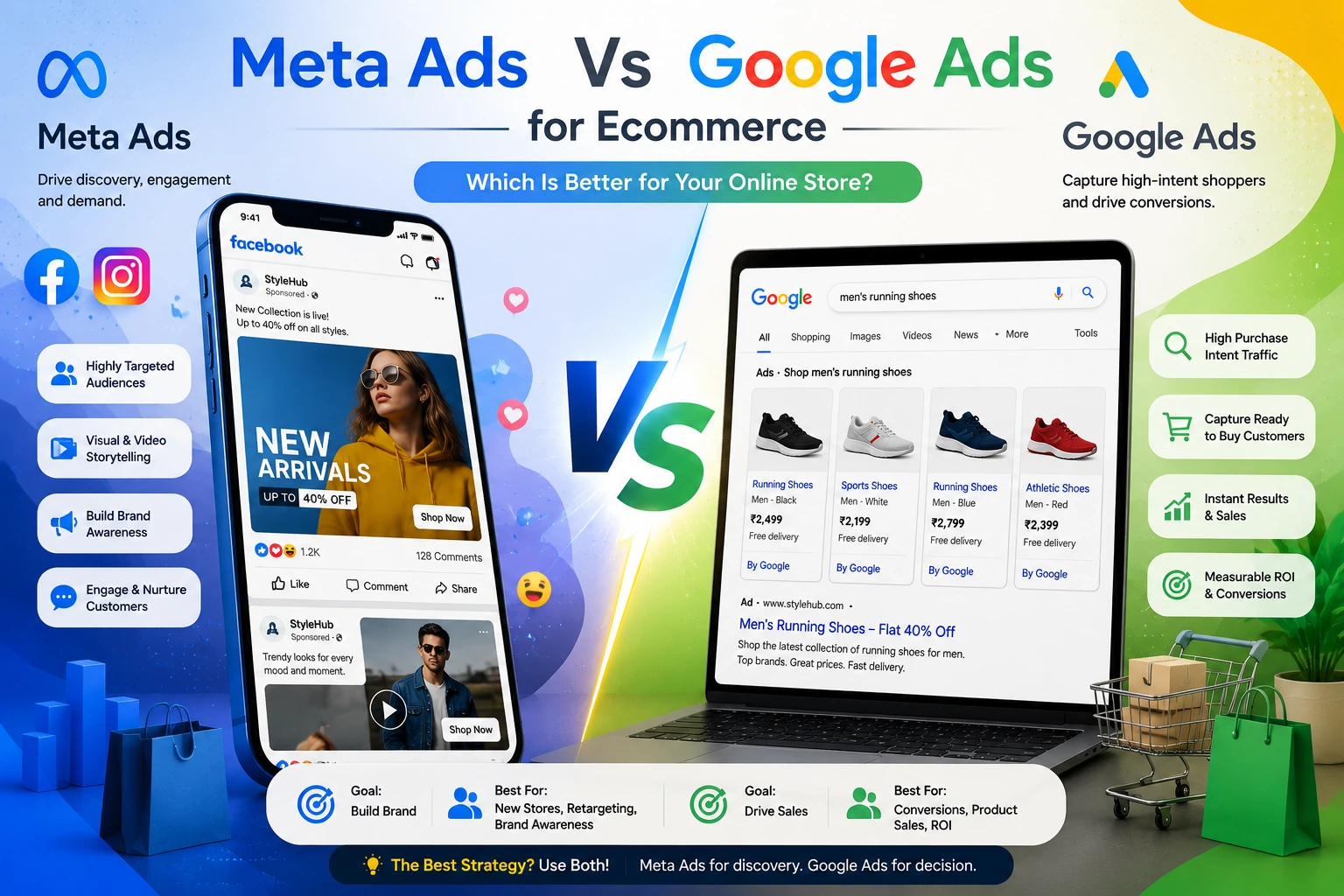
Meta Ads is the advertising system used across Facebook, Instagram, Messenger, and the Meta Audience Network. When people talk about Meta Ads vs Google Ads for ecommerce, they are usually comparing Meta’s social media reach against Google’s search power.
Meta Ads work on an “interruption” model. This means people are not searching for a product when they see your ad. They are scrolling through their feed, watching Reels, or checking stories, and your ad appears in front of them. The goal of Meta Ads is to create desire for a product that the person may not even know they need yet. In 2026, Meta continues to operate across more than 3 billion daily active users across its family of apps, which gives ecommerce sellers an enormous pool of potential customers to reach.
How Meta Ads Works for Ecommerce
For online stores, Meta Ads offers several useful ad formats:
- Dynamic Product Ads (DPA): These automatically pull products from your catalog and show them to people who are likely to buy them, based on browsing behavior and interests.
- Advantage+ Shopping Campaigns: Meta’s AI-driven, largely automated system that handles targeting, placement, and budget optimization for ecommerce sellers with minimal manual input.
- Retargeting Ads: Shown to people who already visited your website, viewed a product, or added items to their cart without checking out.
- Video and Reels Ads: Short-form video content that blends naturally into the user’s feed and tends to get stronger engagement than static images.
- Collection Ads: A cover image or video followed by a set of product images, letting users browse your catalog without leaving the app.
- Meta Lead Ads: These let users share their details without leaving Facebook or Instagram, which can be useful for pre-launch waitlists or exclusive drops.
Meta is especially strong for brands that rely on visual products, impulse buying, short-form video content, and building brand awareness from scratch.
The Algorithm Behind Meta Ads
Meta’s advertising system is built around machine learning. The algorithm studies signals like past purchases, page interactions, video watch time, and interests, then predicts which users are most likely to respond to your ad. The more data Meta collects about conversions on your website, the smarter its targeting becomes over time. This is why new ecommerce stores sometimes see slower results in their first few weeks. Meta’s algorithm needs a “learning phase” of enough conversion data before it can optimize efficiently.
What is Google Ads?
Google Ads is the advertising platform connected to Google Search, Google Shopping, YouTube, Gmail, and the Google Display Network. In the Meta Ads vs Google Ads for ecommerce debate, Google’s biggest advantage is intent.
When someone types a search query like “buy running shoes online” or “best skincare products for oily skin,” they already have a need. Google Ads places your product right in front of that ready-to-buy customer at the exact moment they are searching. Google still captures the vast majority of global search traffic, which means it remains one of the most direct paths from customer interest to purchase.
How Google Ads Works for Ecommerce
Google Ads offers several formats that work particularly well for online stores:
- Google Shopping Ads: Product images, prices, ratings, and store names shown directly inside search results, letting shoppers compare products before they even click.
- Performance Max Campaigns: AI-powered campaigns that automatically run across Search, Shopping, YouTube, Display, Gmail, and Maps from a single campaign setup.
- Search Ads: Text-based ads shown when someone searches a keyword related to your product or service.
- YouTube Ads: Video ads that reach people while they watch content, useful for both awareness and remarketing.
- Display Ads: Banner-style ads shown across millions of partner websites and apps, useful for retargeting people who already visited your store.
- Demand Gen Campaigns: A newer, more visual ad format designed to compete directly with social platforms like Meta and TikTok, shown across YouTube, Discover, and Gmail.
Google Ads works best for products that people actively search for, and for brands that want to capture existing demand rather than create new demand from scratch.
Smart Bidding and Automation
By 2026, Google has pushed most of its ecommerce advertising toward automation through Smart Bidding and Performance Max. Instead of manually choosing keywords and bids, advertisers now feed Google their product feed, budget, and goals, and the AI decides where and when to show your ads. This has made Google Ads more accessible for beginners, but it also means less manual control compared to older, keyword-based campaigns.
Meta Ads vs Google Ads for Ecommerce: Key Differences
Now let’s compare both platforms side by side, since this is the core of any Meta Ads vs Google Ads for ecommerce decision.
1. Cost Comparison
Cost is usually the first thing ecommerce sellers check. On a raw per-click basis, Meta Ads tend to look cheaper than Google Ads. Industry data from 2026 shows Google Ads averaging somewhere between $2 to $9 per click for most businesses, while highly competitive categories such as legal or financial services can go far higher. Meta Ads, on the other hand, are usually measured in cost per 1,000 impressions (CPM), which tends to fall in the $8 to $14 range.
However, the number that actually matters is not the cost per click or the CPM. It is the cost per acquisition (CPA), meaning how much you pay for an actual sale. A cheap Meta click that never converts can cost you more in the long run than a slightly expensive Google click that leads to a direct purchase. Always judge cost by what a customer costs you, not by what a click costs you.
2. Targeting Method
- Meta Ads targets people based on who they are: their interests, behavior, demographics, past purchases, and connections.
- Google Ads targets people based on what they are actively searching for at that moment.
This single difference is the heart of the entire Meta Ads vs Google Ads for ecommerce debate. Meta finds the right audience. Google finds the right moment. One helps you discover buyers before they know they need you; the other captures buyers who already know exactly what they want.
3. User Intent
On Google, the customer already knows what they want. On Meta, you are introducing a product to someone who was not looking for it. This means Meta ads usually need stronger, more attention-grabbing creative to stop the scroll, while Google ads can rely more on relevance, pricing, and clear product information.
4. Creative Format
Meta rewards scroll-stopping, native-feeling content such as short videos, Reels, and carousel ads that don’t feel like traditional advertising. Google rewards relevance and clear product data, especially in Shopping ads where the image, title, and price need to match exactly what the customer searched for.
5. Conversion Timeline
Google Ads often drives faster, more direct conversions because of the existing purchase intent behind every search. Meta Ads often work earlier in the customer journey, building awareness and interest that leads to a conversion later, sometimes helped along by a follow-up Google search or a retargeting ad days afterward.
6. Attribution and Tracking Challenges
This is one of the most important, and most overlooked, parts of the Meta Ads vs Google Ads for ecommerce comparison in 2026. Apple’s App Tracking Transparency (ATT) update, along with newer browser privacy protections, has made it much harder for advertising platforms to track users across apps and websites. Many iOS users choose not to allow tracking, which means both Meta and Google now see an incomplete picture of the customer journey.
To deal with this, most ecommerce advertisers now rely on:
- Meta’s Conversions API (CAPI): Sends conversion data directly from your server to Meta, bypassing browser-based tracking limits.
- Google’s Enhanced Conversions: Uses secure, hashed first-party customer data to improve match rates between clicks and conversions.
- First-party data collection: Building your own customer database (emails, phone numbers, purchase history) instead of relying only on platform pixels.
Without proper server-side tracking set up, ecommerce sellers often see reports that understate real performance, which can lead to wrong budget decisions. If you are serious about scaling either platform in 2026, setting up CAPI and Enhanced Conversions early is no longer optional, it is a foundational step.
Industry-Wise Recommendations
Different product categories tend to perform differently on each platform. Here is a general breakdown for the Meta Ads vs Google Ads for ecommerce decision by industry:
Fashion and Apparel
Highly visual, impulse-driven purchases. Meta Ads usually perform strongly here because of Reels, carousel ads, and influencer-style content. Google Shopping can still work well for branded searches and specific item searches like “black leather jacket men.”
Beauty and Skincare
A mix of both platforms tends to work best. Meta builds awareness and trust through video demonstrations and testimonials, while Google captures customers who are already comparing specific products or ingredients.
Electronics and Gadgets
Google Ads usually leads here, since buyers often research extensively and search for specific models, specifications, or comparisons before purchasing. Meta can still support with retargeting and new product launches.
Home Decor and Furniture
Meta Ads tend to perform well due to the visual, aspirational nature of these products. Google Shopping is also useful once a customer has decided what style or type of furniture they want.
Health, Wellness, and Subscription Products
Often need a combination. Meta introduces the product and educates the audience, while Google Search captures people actively looking for solutions to a specific health or wellness need.
When Should You Use Meta Ads for Ecommerce?
Meta Ads may be the better starting point if:
- You are launching a new product that people don’t already search for.
- Your product is highly visual, such as fashion, home decor, beauty, or accessories.
- You want to build brand awareness and a loyal audience over time.
- You have engaging video or image content ready to use.
- Your budget is limited and you want a wider reach at a lower upfront cost.
- You want to build a retargeting funnel using website visitors and cart abandoners.
When Should You Use Google Ads for Ecommerce?
Google Ads tends to work better when:
- Customers are already searching for your product category.
- You sell items with clear buyer intent, such as electronics, tools, or replacement parts.
- You want to appear at the exact moment someone is ready to buy.
- You are running Google Shopping to compete on price and product visibility.
- Your business depends on capturing demand rather than creating it.
- You want to compete directly against a competitor’s brand name in search results.
Can You Use Both Meta Ads and Google Ads Together?
Yes, and most successful ecommerce brands in 2026 do not choose one over the other. Instead, they combine both. Research on cross-channel performance suggests that brands running both Meta and Google together tend to see a noticeably higher overall conversion rate compared to advertisers who rely on a single platform alone, although this naturally depends on having enough budget to run both properly.
Suggested Budget Split for Ecommerce
| Platform | Suggested Allocation | Purpose |
|---|---|---|
| Meta Ads | 60–70% | Prospecting, catalog ads, retargeting, video creatives |
| Google Ads | 25–35% | Shopping ads, brand search, Performance Max |
| Experimental (YouTube, TikTok) | 5–10% | Testing new channels and formats |
The typical strategy is simple: Meta Ads introduce your brand and create interest, while Google Ads captures the sale when the customer later searches for your product or your brand name directly. This combined approach often produces a stronger overall result than relying on a single platform alone, because each platform covers a different stage of the buying journey.
Common Mistakes Ecommerce Sellers Make
Even with a good budget, many ecommerce brands make avoidable mistakes in the Meta Ads vs Google Ads for ecommerce setup:
- Judging performance too early. Both platforms need a learning or optimization phase before the algorithm stabilizes. Judging results after two or three days is usually too soon.
- Ignoring server-side tracking. Skipping CAPI or Enhanced Conversions setup leads to inaccurate reporting and poor budget decisions.
- Using the same creative on both platforms. Meta needs native, scroll-friendly content, while Google Shopping needs clean, accurate product feeds. Copy-pasting the same assets rarely works well on both.
- Not retargeting cart abandoners. This is often the highest-converting, lowest-cost audience available on both platforms, yet many sellers skip it.
- Choosing only one platform permanently. Relying on a single channel makes your entire business vulnerable to that one platform’s algorithm changes or rising costs.
Meta Ads vs Google Ads for Ecommerce: Pros and Cons
Meta Ads
Pros:
- Lower cost per impression
- Strong visual and video ad formats
- Great for building brand awareness
- Powerful audience targeting through interests and behavior
- Effective retargeting for cart abandoners
Cons:
- Lower purchase intent compared to search
- Needs strong, frequently refreshed creative
- Conversions can take longer to happen
- More affected by privacy and tracking limitations
Google Ads
Pros:
- High purchase intent
- Faster, more direct conversions
- Strong for Shopping and price-based competition
- AI-driven automation through Performance Max
- Captures branded searches from customers Meta already introduced
Cons:
- Higher cost per click in competitive categories
- Limited reach for brand-new or unknown products
- Less effective for pure brand-building
- Requires a solid product feed and account structure to perform well
Final Verdict: Meta Ads vs Google Ads for Ecommerce
There is no universal winner in the Meta Ads vs Google Ads for ecommerce comparison. The right choice depends on your product, your budget, your industry, and your goal.
- If your goal is discovery and brand building, start with Meta Ads.
- If your goal is capturing ready-to-buy customers, start with Google Ads.
- If you want the best long-term results, use both together in a structured way, letting Meta build awareness and Google close the sale.
Conclusion
Choosing between Meta Ads and Google Ads for your ecommerce store does not have to be a difficult decision. Instead of asking “which one is better,” a smarter question is “which one fits my current business stage.” New and visually strong brands often benefit more from Meta Ads, while brands with clear search demand often see faster results from Google Ads. Over time, running both platforms together, with a smart budget split and proper tracking in place, tends to give ecommerce businesses the strongest and most consistent growth in 2026 and beyond. If you want more details and want to Grow your Store with Proper funnel connect with Dizispark.
Frequently Asked Questions
Is Meta Ads cheaper than Google Ads for ecommerce?
On a raw cost-per-click basis, Meta Ads usually looks cheaper. But the real cost that matters is cost per sale, which depends heavily on your product, creative, and targeting, not just the platform.
Which platform is better for a brand-new ecommerce store?
Meta Ads is often a good starting point for new stores, since it can build awareness for a product people don’t already search for. Google Ads works best once there is some existing search demand for your brand or product.
Can a small ecommerce business run both platforms at once?
Yes, even a modest budget can be split between both, though many small stores start with one platform, build consistent results, and then expand into the second once they understand their numbers.
Do I need special tracking setup for these platforms in 2026?
Yes. Because of privacy changes like Apple’s App Tracking Transparency, setting up Meta’s Conversions API and Google’s Enhanced Conversions is now considered essential for accurate reporting.