

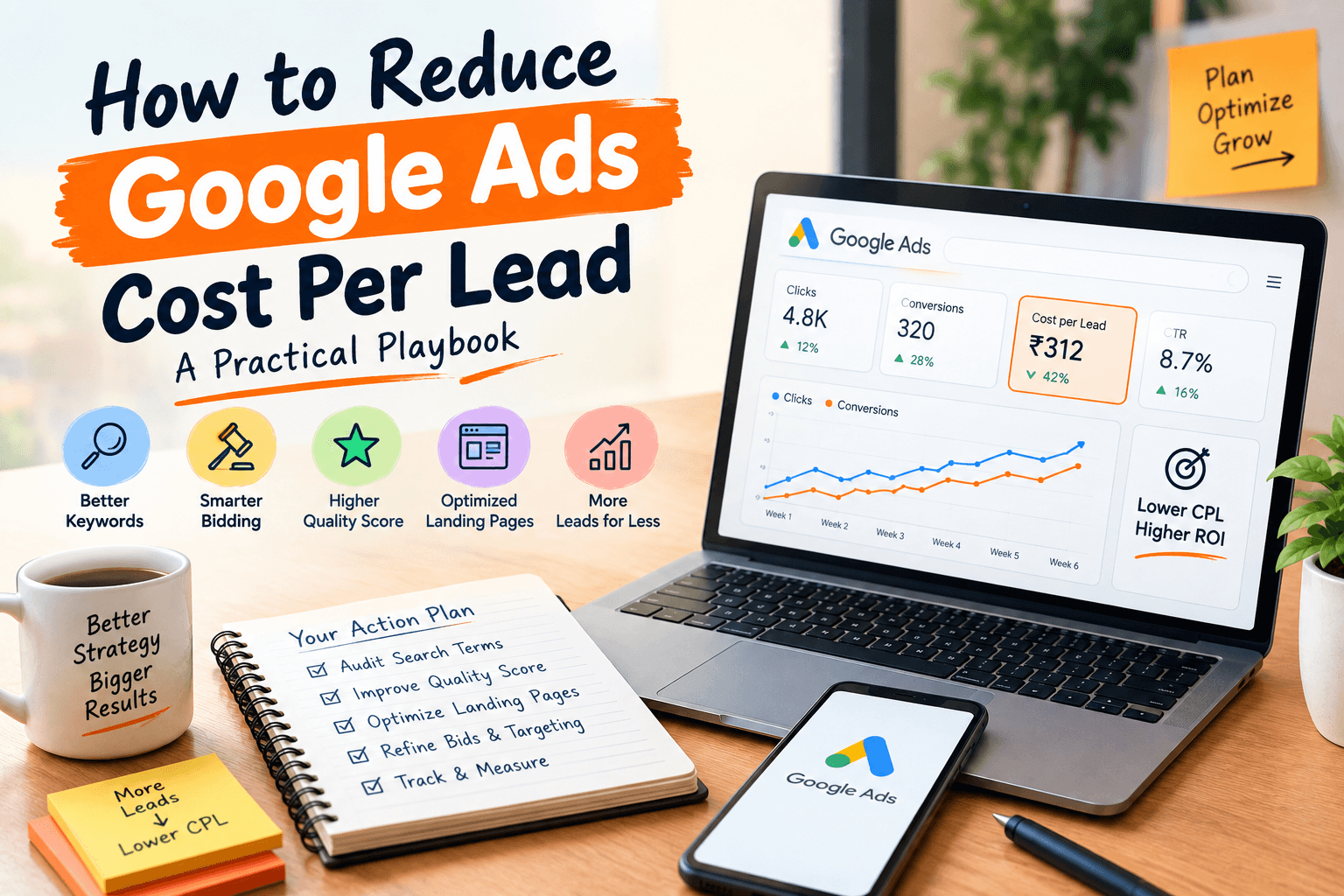
Every advertiser eventually hits the same wall. Leads are coming in, but each one costs more than it did last month. Before changing anything, it helps to understand exactly what’s driving that number up. This guide breaks down how to reduce Google Ads cost per lead with a structured playbook rather than random bid changes. It covers the diagnostic steps first, then the specific levers that move CPL down without sacrificing lead quality. If you’ve searched for how to reduce Google Ads cost per lead before and only found vague tips, this walkthrough is meant to be more concrete.
Table of Contents
ToggleWhat Cost Per Lead Actually Measures
Cost per lead (CPL) is calculated by dividing total ad spend by the number of conversions generated. If you spend ₹20,000 and get 100 leads, your CPL is ₹200. It’s also called cost per action or cost per conversion.
Lowering CPL means either generating more conversions from the same spend or spending less to generate the same number of conversions. In practice, most accounts need a mix of both, applied to specific campaigns and keywords rather than the account as a whole.
Good CPL benchmarks vary enormously by industry. Furniture, legal, and business services often average CPLs above $70 in the US, while automotive repair and pet-related categories often sit under $20. In India, average CPLs commonly range from roughly ₹800 to ₹6,000 depending on sector, with fintech and B2B SaaS running higher than local services.
Why Your Google Ads CPL Is Higher Than It Should Be
High CPL rarely comes from one single mistake. It’s usually two or three structural problems compounding each other inside the same account.
The most common culprits are broad match keywords with no negative-keyword hygiene, campaigns organized by product line instead of buyer intent, landing pages that don’t match the ad’s promise, audience overlap between campaigns bidding against each other, and conversion tracking gaps that feed bad data into automated bidding. Most underperforming accounts have at least three of these running at once.
Step-by-Step Ways to Reduce Google Ads Cost Per Lead
1. Audit Your Search Term Report First
Open your search term report for the last 90 days and sort by cost. For every term at the top, ask whether someone searching it would actually buy from you. This single exercise typically cuts wasted spend by 15 to 25 percent in the first week. It’s the fastest lever available because it stops you paying for clicks that were never going to convert in the first place.
2. Fix “Limited by Budget” Campaigns
“Limited by budget” means your bids are strong enough to win more auctions, but your daily budget is capping how often you show up. For high-value campaigns in this state, increasing budget can add conversions, but only if spend growth doesn’t outpace conversion growth. For lower-value campaigns, lowering bids can pull in cheaper clicks at a lower position. Watch conversion volume closely. A 30 percent drop in CPA isn’t worth it if it comes with a 50 percent drop in leads.
3. Improve Your Quality Score
Quality Score directly affects how much you pay per click. A score of 10 instead of 5 can mean paying roughly half as much for the same ad position. It’s built from three factors: expected click-through rate, ad relevance, and landing page experience. Improving any one of the three tends to lift the others, since they all reward tighter alignment between what a searcher wants and what your ad and page deliver.
4. Restructure Campaigns Around Buyer Intent
Someone searching “what is Google Ads management” and someone searching “hire Google Ads agency Delhi” are not the same buyer. Grouping them into one campaign confuses both your messaging and Google’s bidding algorithm. A cleaner structure splits keywords into intent tiers: high-intent transactional terms that get the highest bids and dedicated landing pages, solution-aware terms that earn a softer offer like a guide or audit, and problem-aware terms that are better suited to lower bids and retargeting.
5. Tune Your Bids and Targets
If you’re on manual or enhanced CPC, check bid adjustments by device, location, demographic, network, and time of day. Segments with weak conversion rates should get lower bids or be excluded outright. If you’re on an automated strategy like Target CPA, set a realistic starting target rather than an aggressive one. Cutting a ₹3,000 CPL straight to a ₹1,000 target usually just starves the campaign of impressions instead of producing cheaper leads.
6. Clean Up Keywords and Negatives
Within your existing structure, look for patterns. Keywords with strong click-through rates and low CPLs deserve more budget. Keywords with three or more conversions but a CPA three to four times your target deserve a pause. Maintain a negative keyword list as an ongoing habit, not a one-time cleanup. Thirty minutes a week reviewing new search terms is usually enough to keep waste from creeping back in.
7. Fix Your Landing Pages
A landing page that doesn’t match the ad’s headline is one of the most common reasons for a high CPL despite solid traffic. A 1 percent lift in landing page conversion rate can reduce effective CPL by 20 to 30 percent without touching a single bid. Stick to one clear call to action per page, keep forms short, and make sure the headline mirrors the specific promise made in the ad. Mobile performance matters just as much as desktop, since a slow or cramped mobile page can push mobile CPL two to three times higher than desktop.
8. Get Conversion Tracking Right Before Smart Bidding
Smart bidding strategies need at least 30 conversions per campaign in the last 30 days and accurate tracking to work well. Without that, they tend to make CPL worse, not better. Set up offline conversion tracking where possible, syncing CRM data back into Google Ads so the algorithm learns from actual sales quality, not just form fills. Always set conversion values, even outside ecommerce, so you get a fuller picture of account performance.
How Long It Takes to See Results
Search term cleanup and negative keyword additions usually show measurable results within one to two weeks. Landing page changes need two to four weeks to reach statistical significance given typical traffic volumes. Campaign restructuring and smart bidding adjustments take longer, often six to eight weeks for full impact, since the algorithm needs a fresh learning period after any major structural change. Change one variable at a time and give each change its own window before judging it.
When Lowering CPL Isn’t the Real Fix
Sometimes a high CPL is a symptom of a deeper issue that no amount of campaign optimization will solve. Weak product-market fit shows up as high CPL and low conversion rates no matter how good the landing page is. A small total addressable market with heavy competition will also keep CPL structurally high for that category. In these cases, the number that actually matters isn’t CPL in isolation. It’s cost per acquired customer relative to what that customer is worth over time.
Conclusion
Reducing Google Ads cost per lead is rarely about one dramatic fix. It’s a sequence, audit the search term report first, tighten account structure around intent, get conversion tracking accurate, then layer in smart bidding once there’s enough clean data to support it. Businesses that treat CPL reduction as a systematic process, rather than a single lever to pull, are the ones that manage to lower cost per lead while scaling spend, not just shrinking it. If you take one thing from this guide on how to reduce Google Ads cost per lead, start with the search term audit. It’s the fastest win and the one most accounts skip.
How Dizispark Can Help
Dizispark runs Google Ads accounts through the same diagnostic sequence outlined above, search term audits, intent-based restructuring, conversion tracking checks, and landing page review, before ever touching a bid strategy. The goal is a lower cost per lead that holds up as spend scales, not a short-term dip that disappears the moment budgets increase. For local and multi-location businesses, this often includes aligning paid campaigns with GMB so that search, maps, and ad performance reinforce each other instead of competing for the same budget. Every account gets a scope built around its actual structure and history rather than a templated checklist applied to every client the same way.
Frequently Asked Questions
How do I lower my cost per lead in Google Ads?
To learn how to reduce Google Ads cost per lead, start by reviewing your search term report and removing irrelevant queries. Improve your campaign structure and target high-intent keywords. Make sure your ads match your landing pages and offers. Accurate conversion tracking is also important before using automated bidding.
What is a good cost per lead for Google Ads?
There is no universal CPL benchmark because costs vary by industry, location, and deal value. When learning how to reduce Google Ads cost per lead, compare your current CPL with your historical performance. Also consider lead quality and conversion rates. A higher CPL can still be profitable when customers have strong lifetime value.
Why is my Google Ads cost per lead going up?
Your CPL can increase because of higher CPCs, irrelevant traffic, weak conversion rates, or poor landing pages. If you want to know how to reduce Google Ads cost per lead, review your search terms and negative keywords first. Check whether your ads match user intent and landing-page messaging. Conversion tracking should also be tested for accuracy.
Does Quality Score affect cost per lead?
Yes, Quality Score can indirectly affect your cost per lead by influencing the cost you pay for clicks. Improving ad relevance, expected CTR, and landing page experience can help reduce CPC. These improvements are useful when applying how to reduce Google Ads cost per lead strategies. However, Quality Score should support better performance rather than become the only optimisation goal.
Should I reduce my budget to lower CPL in Google Ads?
Generally, reducing your budget does not automatically reduce your actual CPL. A better approach is to remove wasted spend and improve targeting, ads, and landing pages. These are more effective methods for how to reduce Google Ads cost per lead while maintaining lead volume. Budget changes should be based on campaign performance and conversion data.
How does landing page quality affect cost per lead?
Landing page quality directly affects conversion performance and can influence your overall CPL. A page should match the promise made in the ad and provide one clear call to action. Improving message match, forms, and mobile performance can support how to reduce Google Ads cost per lead. Even small conversion-rate improvements can reduce the effective cost of each lead.
When should I use smart bidding to reduce cost per lead?
Smart bidding works best when conversion tracking is accurate and the campaign has enough conversion data. Your article recommends at least 30 conversions in the previous 30 days before relying heavily on automated bidding. This makes smart bidding a useful part of how to reduce Google Ads cost per lead once the data is reliable. Start with a realistic Target CPA and adjust it gradually.
How long does it take to reduce cost per lead in Google Ads?
Search-term cleanup and negative keyword updates can show results within one to two weeks. Landing page improvements may require two to four weeks to produce reliable results. Larger campaign or bidding changes can take six to eight weeks to show their full impact. For how to reduce Google Ads cost per lead, make changes systematically and evaluate each change separately.