
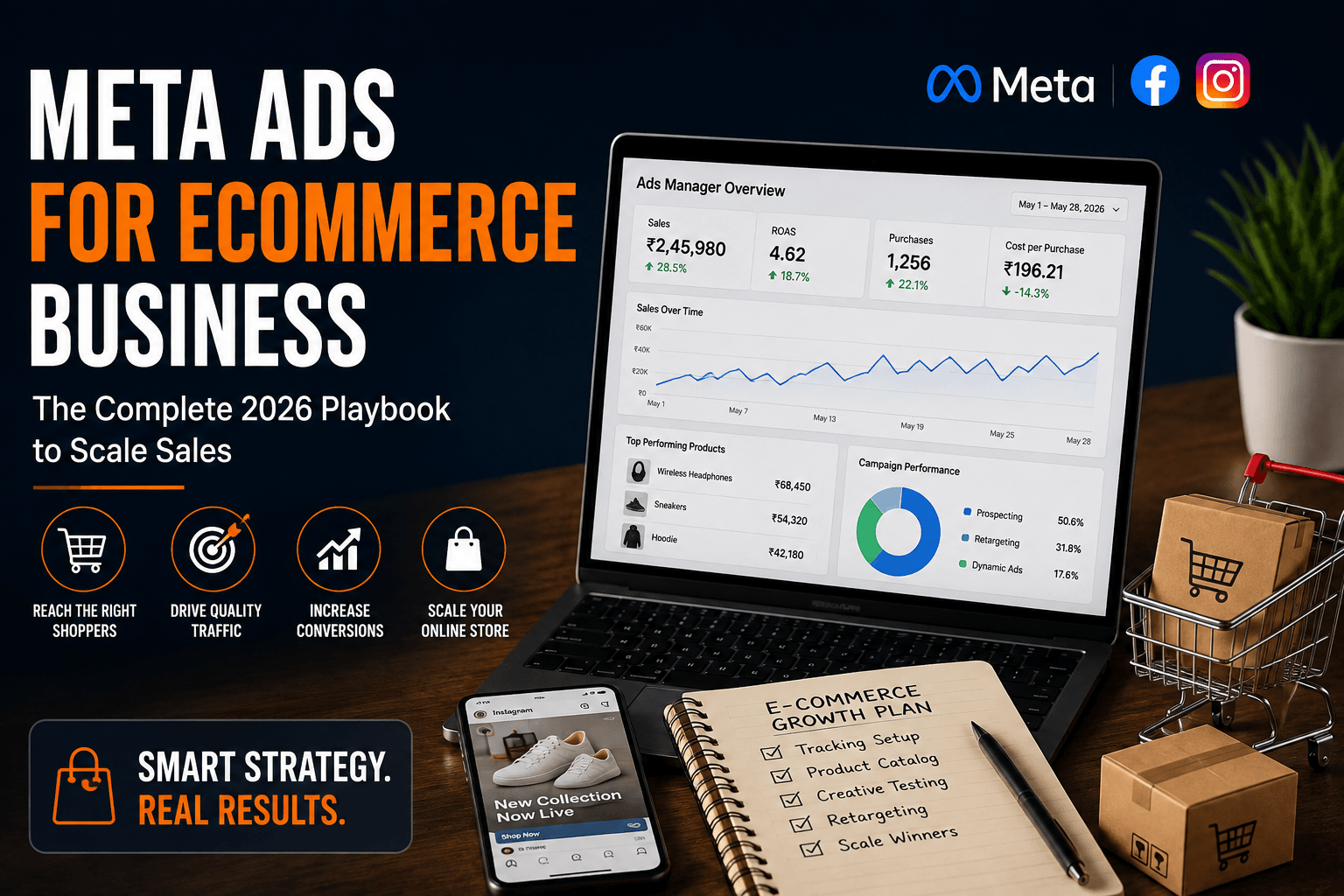
Meta Ads for ecommerce business have become one of the fastest ways for online stores to turn cold browsers into paying customers, provided the account is built on the right foundation. Unlike lead generation, ecommerce advertisers on Meta get to run purchase-focused campaigns directly against a product catalog, using dynamic ads, retargeting layers, and Meta’s own machine learning to find buyers at scale. But running ads is not the same as running ads that actually sell products; the brands that consistently profit from Meta are the ones treating it as a system of tracking, creative, and testing, not a single campaign they launch once and forget.
Why Meta Ads Matter for Ecommerce Businesses
Meta ads for ecommerce business owners work because Facebook, Instagram, and Messenger together reach billions of active users, and the platform’s targeting goes far beyond simple demographics. An ecommerce brand can show ads to people who already visited its website, viewed a specific product, or bought something similar from a competitor, all before that shopper ever types a search query. This matters because most shoppers are not ready to buy the first time they see a brand; they need to be attracted, engaged, and gradually walked through the buying journey until they trust the store enough to check out.
The advantage compounds over time. A Meta ads account with clean tracking, a synced product catalog, and a real testing habit gets smarter with every purchase event it processes, while an account without those basics stays stuck guessing. That gap is exactly why some ecommerce brands treat Meta as an unpredictable expense while others treat it, in the words of more than one agency, as close to an ATM for the business.
10 Proven Strategies to Run Meta Ads for Ecommerce Business Growth
1. Install Meta Pixel and Conversions API First
Before spending a rupee or a dollar on ads, the technical foundation needs to be solid. The Meta Pixel is a small piece of code that tracks product views, add-to-cart events, and purchases on the website, and it is the single most important step in setting up Meta ads for ecommerce business accounts correctly.
Server-side tracking through the Meta Conversions API sends that same purchase data directly from the store’s server to Meta, bypassing browser restrictions and ad blockers that have made Pixel-only tracking less reliable. Running both together gives Meta the clearest possible picture of who actually buys.
Skipping this step means the algorithm is optimizing on incomplete data from day one, which quietly caps performance no matter how good the creative or targeting is.
2. Choose Catalog Sales or Advantage+ Shopping as the Objective
Ecommerce advertisers on Meta get an option most other industries do not: purchase-focused campaign objectives built directly around a product catalog. Selecting Catalog Sales lets Meta pull products from a synced feed and show the right item to the right shopper automatically.
Advantage+ Shopping, introduced as a broader campaign type, takes this further by limiting manual audience targeting in exchange for letting Meta’s system search more freely for buyers across the entire platform.
Many ecommerce brands see stronger results with Advantage+ Shopping once their Pixel data is clean, since the system can lean on purchase signals rather than guesswork; excluding recent purchasers from the audience while leaving the rest of the targeting open is a common, effective starting configuration.
3. Build Dynamic Product Ads From Your Catalog
Dynamic Product Ads pull directly from a synced product catalog and automatically show the exact item a shopper viewed or added to cart, without anyone manually building an ad for every product in inventory.
This format is especially strong for both cold audiences and retargeting: a shopper who viewed a pair of shoes and left the site can be shown that exact pair again, often alongside similar items, without a single manual edit from the ad account.
Setting up product sets by category or season, sneakers, boots, holiday bundles, makes it easier to benchmark performance and refine which products deserve more ad budget over time.
4. Use Carousel, Collection, and Video Ad Formats Together
No single ad format wins for every ecommerce brand, which is why testing across formats matters. Carousel ads let a brand show up to ten images or products in one unit, each with its own link, which works well for showcasing a range or telling a sequential story.
Collection ads combine a cover image or video with a grid of product images beneath it, letting shoppers move from discovery to purchase inside an Instant Experience without ever leaving the app.
Short-form video, whether Reels-style clips, UGC-style testimonials, or a simple product demo, consistently earns strong attention because it matches how people already consume content on Instagram and Facebook, and it pairs naturally with Dynamic Product Ads for retargeting.
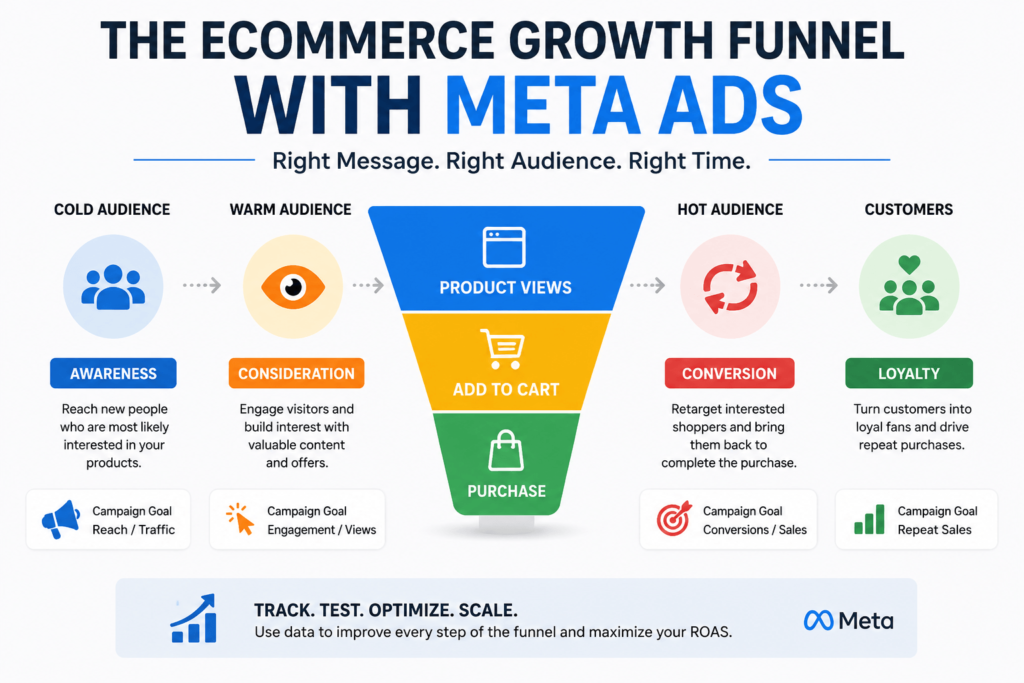
5. Build a Full Funnel, Not Just a Retargeting Machine
Retargeting alone can lift conversion rates dramatically, but leaning on it exclusively starves the top of the funnel of new visitors to eventually retarget. An ecommerce account needs a steady stream of cold traffic feeding into the system, or the retargeting pool simply dries up.
Reaching cold audiences works best with story-driven, detailed product, or video content that makes a strong first impression, since these shoppers have never heard of the brand and need a reason to pay attention.
Layering lookalike audiences built from high-value existing customers on top of this cold outreach helps Meta find new shoppers who resemble the people already spending the most, keeping the funnel replenished rather than shrinking over time.
6. Shoot Authentic, Mobile-First Creative
Polished, studio-shot product photography still has a place, but mobile-shot visuals that look like they came from a customer’s own phone consistently perform well because they read as authentic rather than as an obvious ad.
Since the large majority of Facebook’s ad revenue comes from mobile placements, every element, image crop, video orientation, and even where the most important copy sits, needs to be designed for a phone screen first, not adapted from a desktop layout afterward.
This kind of content is also cheap and fast to produce, which makes it easy to keep a steady pipeline of fresh creative without needing a full production budget for every test.
7. Test Hooks and Messaging Angles Every Week
A shopper decides whether to keep watching or scrolling past within the first three seconds of an ad, which makes the opening hook one of the highest-leverage elements to test. A single change to the first line or opening visual can meaningfully change click-through rate almost overnight.
The same product can also be positioned multiple ways, pain-point-driven copy, aspirational lifestyle copy, feature-heavy explanation, urgency-led offers, since different buyers respond to different angles for the exact same item.
Running several messaging angles side by side, rather than settling on one and hoping it works for everyone, is usually the fastest way to discover which persona is actually driving the most profitable sales.
8. Test Audience Types Deliberately
Meta’s targeting system is powerful, but it still needs structure and direction from the advertiser rather than being left entirely alone. Broad targeting, just country and age, can scale efficiently once tracking is clean, while narrower interest-based audiences are useful for testing specific hunches about who might buy.
Lookalike audiences built from a brand’s best, highest-value buyers, rather than from every past customer indiscriminately, tend to find new shoppers who behave more like the customers actually worth acquiring.
Retargeting layers, warming up past visitors, video viewers, and cart abandoners who already know the brand, round out the audience mix and usually deliver the lowest cost per purchase of any segment tested.
9. Test Landing Pages, Product Pages, and Offers Together
An ecommerce brand can have excellent ad creative and still see weak results if the page the ad sends people to is the actual bottleneck. Sending traffic to a dedicated landing page instead of a standard product page, or the reverse, can produce meaningfully different conversion rates depending on the product and price point.
Pricing psychology matters just as much as page layout: a flat 20% discount, a buy-one-get-one offer, free shipping over a threshold, and a 48-hour flash sale can all move the exact same product at very different rates, even though the underlying value is similar.
Because even a 1% lift in landing page conversion rate can meaningfully change overall profitability, testing pages and offers deserves the same rigor as testing ad creative, not an afterthought once the ads are already running.
10. Scale Winners Gradually, Not Emotionally
Once a campaign proves itself, the instinct to scale fast is understandable but usually counterproductive. Increasing daily budget too aggressively resets Meta’s learning phase and can spike costs right when a campaign was finally performing well.
Vertical scaling, slowly raising the daily budget on a winning campaign, and horizontal scaling, duplicating the ad set or campaign into a new one, are both valid approaches, and testing which one holds up better for a given account is worth doing deliberately rather than guessing.
Campaign Budget Optimization can help distribute spend automatically across ad sets based on performance, but scaling decisions should still be based on several days of clean, reliable data rather than a single strong day that might not repeat.
Quick Reference: 10 Strategies Compared
| Strategy | What to Do | Best For | Key Insight |
|---|---|---|---|
| Pixel & Conversions API | Install both together for clean tracking | Every ecommerce account | Foundation before any ad spend |
| Catalog Sales / Advantage+ | Use catalog-based purchase objectives | Stores with a synced product feed | Advantage+ works best with clean Pixel data |
| Dynamic Product Ads | Auto-show the exact product a shopper viewed | Cold and retargeting audiences | No manual ad building per product |
| Carousel / Collection / Video | Mix formats instead of one static image | Product ranges and storytelling | Video pairs well with retargeting |
| Full-Funnel Strategy | Balance cold reach with retargeting | Accounts over-relying on retargeting | Retargeting needs fresh top-of-funnel traffic |
| Authentic Mobile Creative | Shoot on phones, design mobile-first | Brands wanting lower production cost | 94% of ad revenue is mobile |
| Hook & Messaging Testing | Test 3 to 5 angles weekly | Any brand with more than one buyer persona | First 3 seconds decide the ad’s fate |
| Audience Testing | Compare broad, interest, lookalike, retargeting | New and scaling accounts alike | Retargeting layers often win on cost |
| Landing Page & Offer Testing | Test pages and pricing structure together | Accounts with good CTR, weak conversion | 1% CVR lift can change profitability |
| Gradual Scaling | Raise budget 20 to 30% at a time | Proven, stable campaigns | Aggressive scaling resets algorithm learning |
Conclusion
Meta Ads for ecommerce business success rarely comes down to one clever tactic, it comes from stacking the fundamentals correctly, clean Pixel and Conversions API tracking, a well-built product catalog feeding Dynamic Ads, a full funnel rather than retargeting alone, and a genuine weekly habit of testing creative, audiences, and offers. Brands that treat Meta advertising as a repeatable system, rather than a one-time campaign launch, are consistently the ones who turn an unpredictable ad account into a reliable, scalable source of revenue.
How Dizispark Can Help
Dizispark, a Delhi-based digital marketing agency, sets up and manages Meta Ads for ecommerce business clients end to end, from Pixel and Conversions API implementation and catalog syncing to Dynamic Product Ads, creative testing, and weekly optimization, alongside Google My Business support for brands that also serve customers locally. For ecommerce founders who would rather focus on product and fulfillment than ad account mechanics, having a team run this testing and scaling process consistently is usually what separates a Meta ads account that plateaus from one that keeps growing.
Frequently Asked Questions
Are Meta Ads worth it for a small ecommerce business?
Yes, Meta Ads can work for small ecommerce businesses because targeting and budgets scale down as easily as they scale up. The key is getting Pixel tracking and catalog setup right early, since a small budget spread across a messy account performs far worse than the same budget in a clean one.
What is the difference between Catalog Sales and Advantage+ Shopping?
Catalog Sales lets an advertiser manually control targeting while pulling products from a synced feed, while Advantage+ Shopping hands more control to Meta’s algorithm in exchange for broader reach. Advantage+ tends to perform best once Pixel data is already clean and reliable.
How often should I test new ad creative for ecommerce?
High-performing ecommerce brands typically launch 2 to 4 new creatives every week and fully refresh their creative library every 14 to 21 days. This cadence keeps ads from fatiguing while still gathering enough data to know what is actually working.
Should I rely only on retargeting for my Meta Ads?
No. Retargeting produces strong conversion rates, but relying on it exclusively shrinks the funnel over time since there is no fresh traffic to eventually retarget. A healthy account balances cold-audience campaigns with a retargeting layer.
Do I need the Meta Pixel if I already have the Conversions API?
It is best to use both together rather than choosing one. The Conversions API adds reliability that the Pixel alone can miss due to browser restrictions, but running them together gives Meta the most complete data picture.
What ad format works best for ecommerce, Dynamic Ads or Carousel?
Neither format is universally best; they serve different purposes. Dynamic Product Ads automate personalized retargeting from a catalog, while Carousel and Collection ads are stronger for storytelling and showcasing a wider product range to cold audiences.
How much should I spend testing before scaling a Meta ecommerce campaign?
There is no fixed number, but decisions should be based on at least 3 to 5 days of clean, consistent data rather than a single strong or weak day. Scaling or killing a campaign too early on limited data usually leads to the wrong conclusion.
Can Meta Ads work well alongside Google Ads for an ecommerce store?
Yes, and most established ecommerce brands run both. Meta is generally stronger at creating demand among people who were not searching yet, while Google captures people who are already actively searching to buy.