
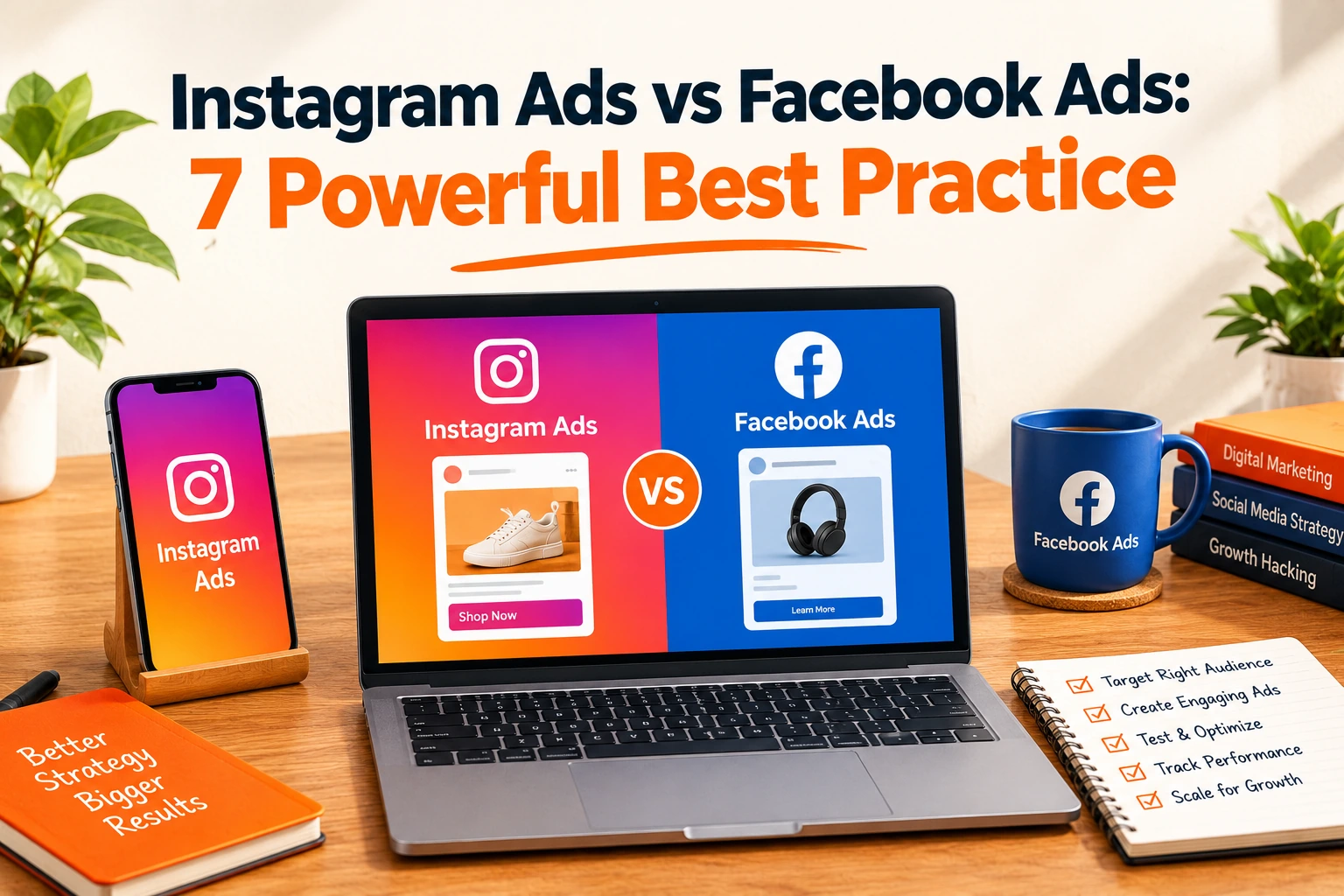
Instagram ads vs Facebook ads is the question every business with a limited social budget eventually faces. Both platforms belong to Meta and run through the same Ads Manager, yet the people, content habits, and results on each are very different.
Sprout Social says the honest answer is that it depends, because the same ad running on both platforms will not yield the same results. Marin Software and Search lab reach the same conclusion and add that goals, audience, content, and industry should drive the decision. This guide compares Instagram ads vs Facebook ads on audience, formats, cost, engagement, ecommerce, and B2B fit, then closes with seven best practices you can apply in 2026.
Table of Contents
ToggleWhat Is the Difference Between Instagram Ads vs Facebook Ads ?
In the instagram ads vs facebook ads comparison, Searchlab explains that the technical targeting options are identical, but user behavior and content culture differ. Facebook is the platform of community, conversation, and information, while Instagram is the platform of visual inspiration and discovery. Facebook users are used to clicking links and leaving the app to read, shop, or fill in forms. Instagram users prefer to stay inside the app, which makes it stronger for awareness, discovery, and in-app shopping.Sprout Social sums up the practical split. If you want an easy way into advertising, start with Instagram, and if you need detailed control over every part of the ad, use Facebook.
Instagram Ads vs Facebook Ads at a Glance
The table below uses Searchlab’s 2026 benchmarks. They are averages from a Dutch agency in US dollars, so treat them as a guide and test your own numbers.
| Aspect | Facebook Ads | Instagram Ads |
|---|---|---|
| Primary age group | 30 to 65 plus | 18 to 44 |
| Global monthly users | 3.07 billion | 2.04 billion |
| Average CPC | USD 0.50 to 1.00 | USD 0.60 to 1.40 |
| Average CPM | USD 6 to 14 | USD 7 to 16 |
| Engagement rate | 0.06% | 0.83% |
| Strongest formats | Link ads, lead ads, video | Reels, Stories, Shopping |
| Best for | Leads, traffic, audiences 35 plus | Branding, ecommerce, audiences 18 to 34 |
Audience and Demographics in Instagram Ads vs Facebook Ads
Marin Software calls the audience the biggest factor in the instagram ads vs facebook ads choice, since advertising where your customers are absent is like throwing dollars to the wind. It notes that Facebook is more than twice the size of Instagram, while Instagram users tend to be younger. Searchlab puts Facebook’s core age group at 30 to 65 plus and Instagram’s at 18 to 44.
It also says about 65 percent of Instagram users also use Facebook, so overlap is highest among 25 to 44 year olds and ad fatigue is a risk. Sprout Social adds a useful distinction. Demographics describe a network’s whole user base, while your audience is your own followers, and you need both to plan reach and engagement.
Ads Management and Targeting
Instagram ads vs Facebook ads can both be managed from Meta’s Ads Manager, which Sprout Social says makes it easy to choose multiple audiences and placements in one place. Facebook offers many objectives, ad sets, and previews, while Instagram’s in-app tools keep things simple. Facebook’s audience targeting is more detailed, according to Sprout Social and Marin Software. Brands with hyper-specific audiences may therefore find more success on Facebook.
Sprout Social suggests that advertising newcomers test the water on Instagram first, then move to Facebook once they understand the options. Its caution is that advertising directly in the Instagram app gives you no choice of objective.
Ad Formats and Content
With instagram ads vs facebook ads, the two platforms share the main formats, namely carousels, single image or video, and boosted existing posts. Marin Software points out one key difference, which is that Facebook captions can hold clickable links while Instagram captions cannot. On Instagram you must use call-to-action buttons, and you can send people to only one link. Searchlab adds that Instagram leans on Reels, Stories, Explore, and Shopping ads, while Facebook adds lead ads, Messenger ads, Marketplace ads, and right column ads. Content should drive the choice. Sprout Social says visual content belongs on Instagram, while varied or written content such as blog posts, news, and case studies suits Facebook.
Cost Comparison for Instagram Ads vs Facebook Ads
In instagram ads vs facebook ads cost comparisons, Searchlab reports that Facebook is on average 25 to 40 percent cheaper per click, and slightly cheaper on CPM. Costs rise sharply in busy seasons, with CPMs up 40 to 80 percent around Black Friday and Christmas. Cost per acquisition tells a different story. The table shows Searchlab’s ranges by campaign type.
| Campaign Type | Facebook CPA | Instagram CPA |
|---|---|---|
| Ecommerce | USD 20 to 40 | USD 17 to 35 |
| Lead generation | USD 10 to 30 | USD 14 to 40 |
| App installs | USD 3 to 6 | USD 2.50 to 5 |
Industry also changes price. Sprout Social and Marin Software both note that a platform with a small industry presence may cost less, but only if your target audience is actually there.
Engagement and Reach
In instagram ads vs facebook ads engagement tests, Searchlab reports an Instagram engagement rate of 0.83 percent against 0.06 percent on Facebook. Reels reach the highest figure at 1.23 percent. Facebook wins on clicks. Searchlab puts link ad click through rates at 1.2 to 2.0 percent on Facebook versus 0.6 to 1.1 percent on Instagram. The lesson is to build platform-native creative. An ad copied unchanged from one platform to the other almost always performs worse.
Goals and Industry
On goals, Marin Software says Facebook is best for website clicks or views of written content, while Instagram is great for brand awareness with visuals. Some advertisers claim Facebook is best for leads and sales, yet Marin stresses that it depends on industry and audience. Sprout Social favors visual industries such as food, fashion, and consumer products on Instagram. Searchlab’s table maps common industries to a primary platform.
| Industry | Primary Platform | Secondary Platform |
|---|---|---|
| Fashion and beauty | ||
| B2B and SaaS | ||
| Food and hospitality | ||
| Home and interior | ||
| Finance and insurance | ||
| Education and coaching |
Instagram Ads vs Facebook Ads for Ecommerce and B2B
Marin Software notes that Instagram is leaning into ecommerce with Instagram Shopping, where users can buy without leaving the app. For ecommerce, Searchlab says Instagram suits visually attractive products, while Facebook’s strengths are retargeting, Dynamic Product Ads, and Marketplace. Searchlab reports an average order value of USD 85 via Facebook versus USD 68 via Instagram. It also finds Facebook lead ads strongest for B2B, with Instagram useful for thought leadership and retargeting. Marin Software adds that Facebook’s groups help brands that rely on community to make sales. Reviewing your own analytics is the best way to confirm which platform fits.
Should You Run Instagram Ads vs Facebook Ads Together
The sources disagree slightly here. Marin Software says you could split spend, but you may get a better return by putting the whole budget on the single most effective platform. Searchlab argues for combining both, with Advantage+ Placements as a starting point and platform-specific creative on top. It suggests 60 percent Instagram for visual ecommerce, 65 percent Facebook for B2B, and a 70, 20, 10 split between proven campaigns, tests, and experiments. A sensible middle path is to start with one platform, learn from the data, and add the second once the first is profitable.
How Instagram Ads vs Facebook Ads Fit the Marketing Funnel ?
Searchlab recommends using each platform where it is strongest in the customer journey. This turns instagram ads vs facebook ads from a choice into a sequence. At the awareness stage, Instagram Reels and Stories reach new audiences with broad targeting and low CPM. At the consideration stage, carousels and collection ads on both platforms share product detail, and people who engaged earlier are retargeted. At the conversion stage, Facebook lead ads or Dynamic Product Ads and Instagram Shopping ads close the sale. For retention, Facebook custom audiences support upsell, cross-sell, and loyalty campaigns.
Creative Tips for Instagram Ads vs Facebook Ads
Searchlab says the biggest creative mistake in instagram ads vs facebook ads is running the same ad unchanged on both. Facebook creative can carry more text, an informational angle, and a clear call-to-action button. Instagram creative should be image first, with minimal on-image text and a native, less ad-like feel in vertical 4:5 or 9:16 formats. Searchlab also recommends user generated or influencer style video. For Reels on both platforms, it suggests a hook in the first three seconds, subtitles, and a length of 15 to 30 seconds. Sprout Social adds that if the content does not match the goal, the ad goes nowhere however good the copy is.
Common Mistakes in Instagram Ads vs Facebook Ads
The most common error is copying one creative to both platforms and expecting equal results. The second is choosing a platform before defining a goal, which Sprout Social says makes metrics and targeting impossible to set. Another mistake is spreading a small budget across both platforms. Searchlab warns that too little budget leaves the algorithm without enough data to optimize. Finally, many advertisers skip testing. Sprout Social points out that both platforms let you adjust running ads, so weak ads can be stopped and strong ones scaled.
7 Best Practices for Instagram Ads vs Facebook Ads
The sources point to seven habits that improve instagram ads vs facebook ads results on either platform.
1. Start with your goal. Pick awareness, traffic, leads, or sales before choosing a platform, as Sprout Social stresses.
2. Check where your audience lives. Match your target demographic to the platform, as Marin Software advises.
3. Build native creative. Use vertical video for Reels and Stories and text-rich formats for Facebook feeds.
4. Use the right link method. Add links in Facebook captions and call-to-action buttons on Instagram.
5. Test one variable at a time. Sprout Social points to A/B testing in Ads Manager.
6. Watch overlap and fatigue. Rotate creative when the same people see ads on both platforms.
7. Review analytics and reallocate. Shift budget toward the placements and content that produce results.
Conclusion
Instagram ads vs Facebook ads is not a contest with one winner. Instagram wins on visual discovery, engagement, and younger audiences, while Facebook wins on reach, link clicks, lead generation, and detailed targeting. The three sources agree that goals, audience, content, and industry decide the right mix. Testing and analytics settle the rest. Start with the platform that fits your audience, measure results, and let your own instagram ads vs facebook ads data decide when to expand.
How Dizispark Can Help ?
Dizispark is a Delhi-based performance marketing agency that plans, builds, and manages Instagram and Facebook ad campaigns for lead generation and ecommerce. We choose placements, creative, and budgets based on your audience and goals, then report transparently on cost per lead and cost per sale.
We also manage a fully optimized Google My Business Profile that strengthens local search visibility alongside your paid social work, and we connect it with your SEO strategy and paid campaigns for one consistent growth plan.
Reach out to Dizispark today and let us build the right Instagram and Facebook ads mix for your business.
Frequently Asked Questions
Which is better, Instagram ads vs Facebook ads?
In the instagram ads vs facebook ads debate, neither wins for every business, because the answer depends on your goal, audience, content, and industry. Sprout Social says the same ad on both platforms will not deliver the same results. Instagram usually suits visual brands, younger audiences, and awareness campaigns, while Facebook suits older audiences, lead generation, and link driven traffic. Searchlab advises choosing the platform that fits your target customer and campaign objective, then testing. Start with one platform, track cost per result, and add the second only after the first is working well for your business. Review the results every month and keep testing new creative on whichever platform you choose.
Are Instagram ads or Facebook ads cheaper?
Searchlab reports that Facebook is usually cheaper on average, with CPC of USD 0.50 to 1.00 against USD 0.60 to 1.40 on Instagram, and CPM of USD 6 to 14 against USD 7 to 16. However, Instagram can deliver a lower cost per acquisition for visual ecommerce products. Costs also rise 40 to 80 percent in peak shopping seasons. Your industry, audience, and creative matter more than the platform, so run a small test on both and compare cost per result rather than relying on averages alone. A lower click cost does not guarantee a lower cost per sale or lead.
Which platform is better for ecommerce?
Searchlab says Instagram suits visually attractive products thanks to Shopping ads, product tags, and a discovery mindset. Marin Software also notes that Instagram Shopping lets people buy without leaving the app. Facebook is stronger for retargeting, Dynamic Product Ads, and Marketplace, and Searchlab reports a higher average order value there. Most successful stores use both, with Instagram for discovery and Facebook for conversion and retargeting. Begin with the platform where your customers already browse, then expand once you understand which products and creatives earn a profitable return. Check cost per sale, not just clicks, before scaling spend.
Can I run the same ad in instagram ads vs facebook ads campaigns?
Yes, because Meta Ads Manager lets one campaign run on both platforms, and Advantage+ Placements lets the algorithm choose placements. Sprout Social warns that the same ad will not yield the same results on each platform. Searchlab recommends platform-specific creative, with vertical video for Reels and Stories and square or horizontal formats for the Facebook feed. Upload several sizes so the system can pick the best fit. Avoid showing identical creative to the same people on both platforms, because overlap can cause ad fatigue and wasted budget. Rotate fresh versions regularly.
Which is better for B2B, Instagram ads or Facebook ads?
Facebook is usually the stronger choice for B2B. Searchlab says Facebook lead ads, behavioral targeting, and higher link click behavior suit lead generation, with B2B cost per lead of USD 10 to 30. Instagram still helps with thought leadership, employer branding, and retargeting. Marin Software adds that Facebook groups help brands that depend on community. A practical approach is to start with Facebook for leads and use Instagram to build authority and re-engage visitors. Measure cost per qualified lead on each platform before shifting budget between them, and ask sales which leads actually closed.
Which age group should I target on each platform?
When planning your budget for instagram ads vs facebook ads, Searchlab says you can start with USD 5 to 10 per day, but it recommends at least USD 500 to 1,000 per month per platform so the algorithm collects enough data. For a combined strategy, it suggests about USD 1,500 per month. These figures are in dollars from a European agency, so adjust for your market and margins. Marin Software advises that a tight budget may perform better on one platform rather than splitting it across both. When comparing instagram ads vs facebook ads cost, begin small, learn quickly, and scale only the campaigns that already return profit. Keep a reserve for testing new creative and audiences.
How much budget do I need for Instagram and Facebook ads?
Searchlab says you can start with USD 5 to 10 per day, but it recommends at least USD 500 to 1,000 per month per platform so the algorithm collects enough data. For a combined strategy it suggests about USD 1,500 per month. These figures are in dollars from a European agency, so adjust for your market and margins. Marin Software advises that a tight budget may perform better on one platform rather than split across two. Begin small, learn quickly, and scale only the campaigns that already return profit. Keep a reserve for testing new creative and audiences.
Should I split my budget between Instagram ads and Facebook ads?
When comparing instagram ads vs facebook ads, the right budget split depends on your campaign goals and current results. Marin Software says you may get a better return by putting the full budget on the single most effective platform. Searchlab prefers combining both, suggesting 60 percent Instagram for visual ecommerce and 65 percent Facebook for B2B, plus a 70, 20, 10 split between proven campaigns, tests, and experiments. If your budget is small, start with one platform and learn. Once results are stable, add the second platform for retargeting and wider reach, and keep reviewing cost per result by placement. Treat any split as a starting hypothesis and let your own data adjust it.