
Open any SEO tool and two numbers show up almost immediately, sitting right next to a domain name DA and PA. Everyone in the industry seems to reference them constantly, yet very few people outside the field actually know what they measure or why they matter.
This guide answers what is DA and PA in SEO in plain terms, how both scores are calculated, whether Google actually uses them, and what realistically moves the needle on either one. It’s based on how Moz, the company that created both metrics, actually built them.
Table of Contents
ToggleWhat Is Domain Authority (DA)
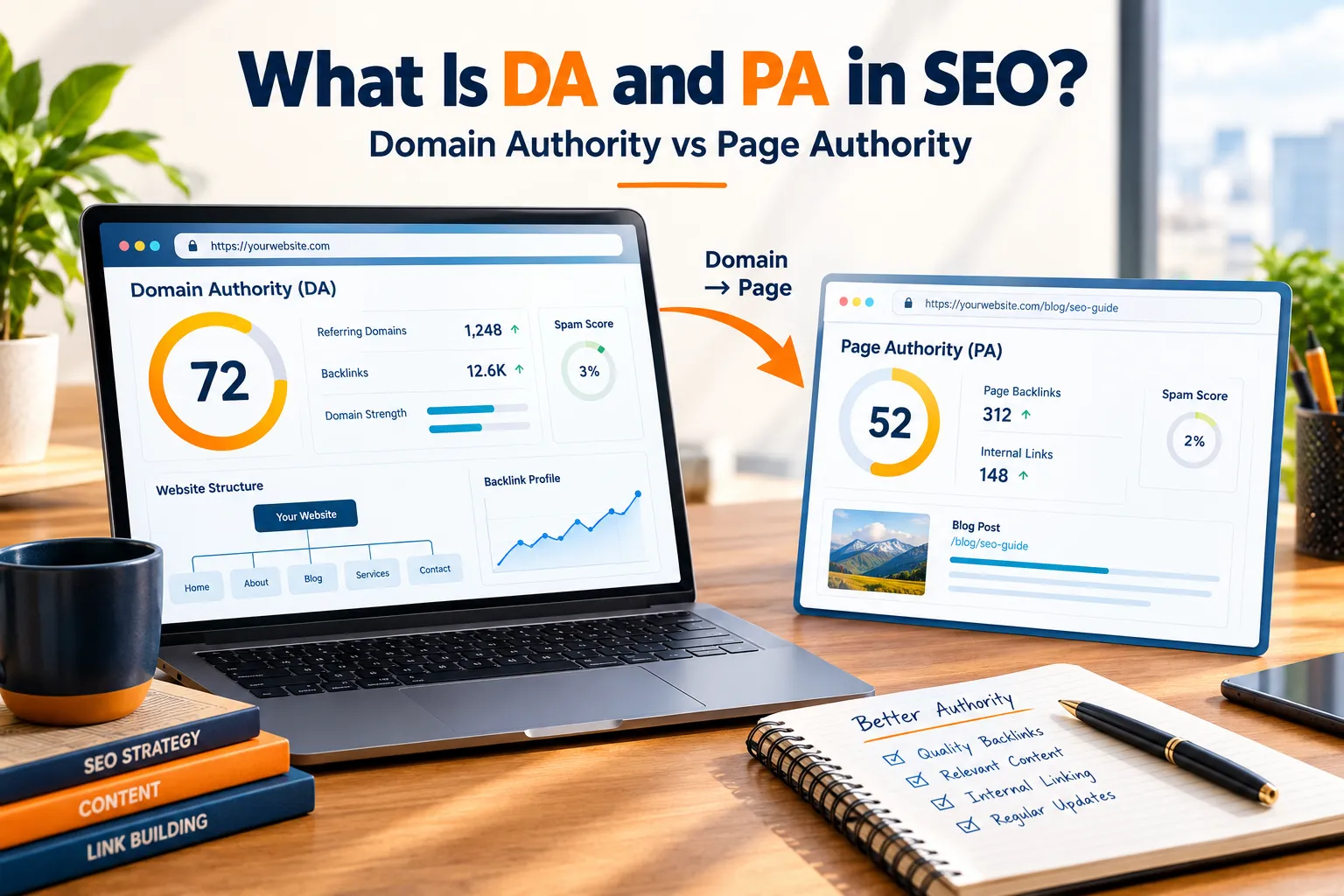
Domain Authority is a metric developed by Moz that predicts how likely an entire website is to rank in search engine results pages. It’s scored on a scale from 1 to 100, and a higher score indicates a stronger overall chance of ranking well.
DA measures how much trust and authority a website has earned as a whole, taking into account every page and all the content sitting on that domain. It’s built primarily from the quantity and quality of links pointing to the site, combined with the site’s age and overall content quality.
Because DA looks at the entire domain rather than one page, it’s most useful for comparing the overall strength of different websites against each other, particularly when deciding where to pursue a backlink or sizing up a competitor’s overall authority.
What Is Page Authority (PA)
Page Authority works on the exact same 1 to 100 scale as DA, but instead of scoring an entire domain, it scores one specific page. A homepage might carry a PA of 60 while a single blog post two years old sits at a PA of just 22, each building its own independent score based on the links pointing directly at it.
PA predicts how likely one particular URL is to rank well for relevant search terms, based mainly on the quality and quantity of backlinks that page specifically has earned. Strong internal linking and genuinely good content on that page also contribute to the score.
A page with a high PA can rank well even if the overall site’s DA isn’t particularly strong, since enough individual, high-quality links pointing directly at that one page can carry it on its own merit.
How DA and PA Are Actually Calculated
Both metrics come from Moz’s own link index, built by crawling the web and analyzing backlink patterns across billions of pages. Neither score is a single simple number, it’s the output of a machine learning model trained to predict ranking likelihood based on dozens of underlying signals.
For DA, the model weighs the total number of linking root domains pointing at a site, the overall quality of those domains, and the site’s broader link profile and age. For PA, the same general approach applies, but narrowed to the specific links pointing at just that one page, along with that page’s own content quality.
Both scores update periodically as Moz recrawls the web and retrains its model, which means DA and PA for any given site can shift over time even without the site itself changing anything.
DA vs. PA at a Glance
| Aspect | Domain Authority (DA) | Page Authority (PA) |
|---|---|---|
| What it measures | Trust and authority of an entire website | Trust and authority of one specific page |
| Scale | 1 to 100 | 1 to 100 |
| Main driver | Site-wide backlinks, domain age, overall quality | Links pointing directly at that one page |
| Best used for | Comparing overall site authority, prospecting backlinks | Evaluating or improving a single page’s ranking potential |
| Changes when | Site-wide link profile or content shifts | That specific page gains links or gets updated |
Do Google Rankings Actually Use DA and PA
This is the single most common misconception around both metrics, and the answer is clear no, Google does not use DA or PA as a direct ranking factor anywhere in its algorithm. Both scores are entirely Moz’s own creation, built to estimate ranking potential, not pulled from or confirmed by Google itself.
That said, the underlying signals both metrics are built from, link quality, site authority, content strength, do genuinely correlate with how well sites tend to perform in actual search results. That’s exactly why DA and PA remain useful as a proxy, even though neither one is something Google’s algorithm reads or responds to directly.
The practical takeaway is simple: treat DA and PA as a helpful comparative signal, not as a score to chase for its own sake. A site with a high DA built on thin, low-quality links won’t outrank a lower-DA competitor with genuinely stronger content and relevance for a given search.
What Is a Good DA and PA Score
Both metrics are relative rather than absolute, which means there’s no single universal number that counts as “good” across every industry. A score should always be judged against your direct competitors in the same niche, not against some fixed external benchmark.
That said, general bands are widely used as rough reference points. A DA under 20 typically reflects a new or still-developing site, 21 to 40 is considered average and growing, 41 to 60 is solid for an established business, and anything above 60 generally represents a genuinely strong, well-established domain. PA tends to follow similar bands relative to the specific competition for that page’s target keywords.
A newer site shouldn’t expect to match a decade-old, heavily linked competitor’s DA within months. Consistent, patient improvement over time matters far more than any single snapshot score.
What Is Spam Score, and Why It Matters Alongside DA and PA
Spam Score is a separate metric, also developed by Moz, that estimates how closely a site’s characteristics resemble sites that have previously been penalized or removed from Google’s index. It’s expressed as a percentage, with higher percentages indicating greater risk.
The score is built from a set of common spam-associated signals found repeatedly across sites search engines have flagged in the past. A higher match count against those patterns pushes the percentage up, though it’s worth stressing this flags risk rather than confirming actual guilt or a penalty.
Smart SEO practitioners check all three numbers together rather than DA or PA in isolation. A domain with a high DA but an alarmingly high Spam Score deserves real caution before pursuing a link from it, since that combination often signals a site inflated through manipulative tactics rather than genuine authority.
How to Check Your DA and PA
Moz’s own Link Explorer remains the official, authoritative source for both scores, since Moz is the company that created and maintains the underlying model. A free account provides limited lookups, while a paid Moz subscription unlocks deeper, unrestricted access.
Several free third-party checker tools also pull this same data for quick lookups, useful for a fast check without needing a full Moz account. Many SEO suites, including tools like Ahrefs and SEMrush, display their own comparable authority metrics alongside Moz’s figures, though these use different underlying models and won’t match DA and PA exactly.
For agencies and larger sites managing multiple domains or evaluating many backlink prospects at once, bulk checker tools let you analyze dozens of URLs simultaneously rather than looking each one up individually.
How to Improve DA and PA
Quality backlinks remain the single most influential factor behind both scores. Earning links from genuinely authoritative, relevant websites in your niche, through guest posting, digital PR, or content that naturally attracts citations, moves both numbers more than almost anything else available.
Strong on-page SEO contributes meaningfully too. Well-optimized title tags, clean site structure, fast page speed, and genuinely high-quality content all support the broader signals these scores are built from, even though they’re not the single biggest lever on their own.
Internal linking is a frequently underused strategy worth real attention. Distributing authority across a site by linking strategically between related pages helps lift PA on specific pages that matter most, pages targeting your highest-value keywords.
Removing or disavowing low-quality, spammy backlinks protects both scores from the kind of damage that drags down overall trust. Regular backlink audits catch these issues before they meaningfully affect either DA or Spam Score.
Consistency matters more than any single big push. Publishing fresh, genuinely valuable content regularly, combined with patient, ongoing link building, compounds steadily over months rather than producing an overnight jump.
Common Misconceptions About DA and PA
The biggest misconception is believing these scores directly cause higher Google rankings. They don’t, since Google’s algorithm has never confirmed using either metric, and treating them as a direct ranking lever leads to misdirected SEO effort.
A second common mistake is treating DA and PA as fixed, unchangeable numbers. Both scores shift over time as link profiles and content evolve, meaning deliberate, consistent effort genuinely can and does move them upward.
A third misconception assumes more links automatically means a higher score regardless of quality. Link quantity matters far less than link quality, and a handful of genuinely authoritative, relevant links consistently outperforms hundreds of low-quality, spammy ones.
Why Businesses and Marketers Actually Use These Metrics
Despite not being a direct ranking factor, DA and PA remain genuinely useful for several practical, everyday SEO tasks. Comparing a site’s DA against direct competitors reveals how much authority-building work still separates you from the top of your specific niche.
Link prospecting relies heavily on these numbers too. Before pursuing a guest post or backlink opportunity, checking a prospective site’s DA, that specific page’s PA, and its Spam Score together gives a quick, reasonably reliable read on whether that link is actually worth pursuing.
Competitor analysis and client reporting round out the common use cases. Agencies frequently track DA and PA trends over time as one data point among several, demonstrating genuine authority growth to clients even though it’s never presented as the sole measure of SEO success.
DA and PA Versus Other Authority Metrics
Moz isn’t the only company measuring site authority, and it’s worth knowing that DA and PA have direct equivalents from other major SEO tools. Ahrefs uses Domain Rating and URL Rating, while SEMrush has its own Authority Score, each built on different data sets and slightly different underlying models.
These scores are not interchangeable with DA and PA, even though they measure a conceptually similar idea. A site might show a DA of 45 in Moz while showing a noticeably different Domain Rating in Ahrefs, simply because each tool crawls a different slice of the web and weighs signals differently.
This matters practically when evaluating a link prospect or reporting results to a client. Comparing a DA score pulled from one tool against a Domain Rating pulled from another produces a misleading picture, since the two numbers were never meant to be read on the same scale. Sticking to one consistent tool and metric across an entire analysis avoids this confusion.
Conclusion
What is DA and PA in SEO ultimately comes down to two Moz-built metrics that estimate ranking potential, DA for an entire domain and PA for one specific page, both scored from 1 to 100 based primarily on backlink quality and quantity. Neither is a direct Google ranking factor, but both correlate meaningfully with the kind of authority and trust search engines genuinely do reward.
Used correctly, alongside Spam Score and real competitive context, these metrics are a useful compass for link building and authority tracking. Used incorrectly, chased as a goal in themselves, they distract from the content quality and genuine relevance that actually drive rankings.
How Dizispark Can Help
Dizispark builds link building and authority strategies around genuine quality signals, not inflated DA or PA numbers that mean little without real relevance and trust behind them. Every backlink prospect gets checked against DA, PA, and Spam Score together before outreach begins, protecting clients from toxic or manipulative link sources.
Ongoing backlink audits catch harmful links early, before they drag down either authority score or trigger a genuine search penalty. For local businesses, Dizispark also keeps Google My Business management integrated with broader authority-building work, since local trust signals and domain authority often reinforce each other over time.
Frequently Asked Questions
What is DA and PA in SEO?
If you want to understand what is DA and PA in SEO, DA means Domain Authority and PA means Page Authority. What is DA and PA in SEO is essentially a comparison between the authority of an entire domain and the authority of one specific page. Understanding what is DA and PA in SEO helps marketers evaluate backlink strength and ranking potential.
What is the difference between DA and PA?
When explaining what is DA and PA in SEO, remember that DA measures the overall authority of a website, while PA measures the authority of one page. What is DA and PA in SEO becomes easier to understand when you compare domain-level authority with page-level authority. In practical SEO, what is DA and PA in SEO is useful for competitor analysis and backlink evaluation.
How are DA and PA calculated?
The answer to what is DA and PA in SEO starts with how Moz defines these metrics. What is DA and PA in SEO refers to two scores that predict ranking potential, with DA focused on a domain and PA focused on an individual URL. Learning what is DA and PA in SEO also helps you understand why backlink quality matters to both scores.
Is DA a Google ranking factor?
If you are researching what is DA and PA in SEO, neither DA nor PA is a direct Google ranking factor. What is DA and PA in SEO is based on Moz’s own metrics, which estimate ranking potential using signals such as backlinks. Therefore, what is DA and PA in SEO should be treated as a comparative SEO measurement rather than a Google ranking score.
What is a good DA and PA score?
For anyone asking what is DA and PA in SEO, there is no universal score that is automatically good for every website. What is DA and PA in SEO should be evaluated against direct competitors in the same niche. In other words, what is DA and PA in SEO is most useful when the scores are viewed in the right competitive context.
How do I increase my DA and PA?
If your goal is to understand what is DA and PA in SEO and improve these metrics, focus on quality backlinks, strong content, on-page SEO, and strategic internal linking. What is DA and PA in SEO also shows why removing low-quality backlinks can protect authority signals. A practical understanding of what is DA and PA in SEO keeps the focus on sustainable authority growth rather than chasing a number.
How can DA and PA help with SEO?
The key to understanding what is DA and PA in SEO is knowing that DA measures an entire domain while PA measures a specific page. What is DA and PA in SEO also includes the role of backlink quality, quantity, and relevance in these Moz metrics. By learning what is DA and PA in SEO, marketers can use the scores for link prospecting and competitor analysis.
Are DA and PA the same as other authority metrics?
What is DA and PA in SEO can also be compared with other authority metrics such as Ahrefs Domain Rating and URL Rating. These tools use different datasets and models, so what is DA and PA in SEO should not be treated as directly interchangeable with those metrics.