
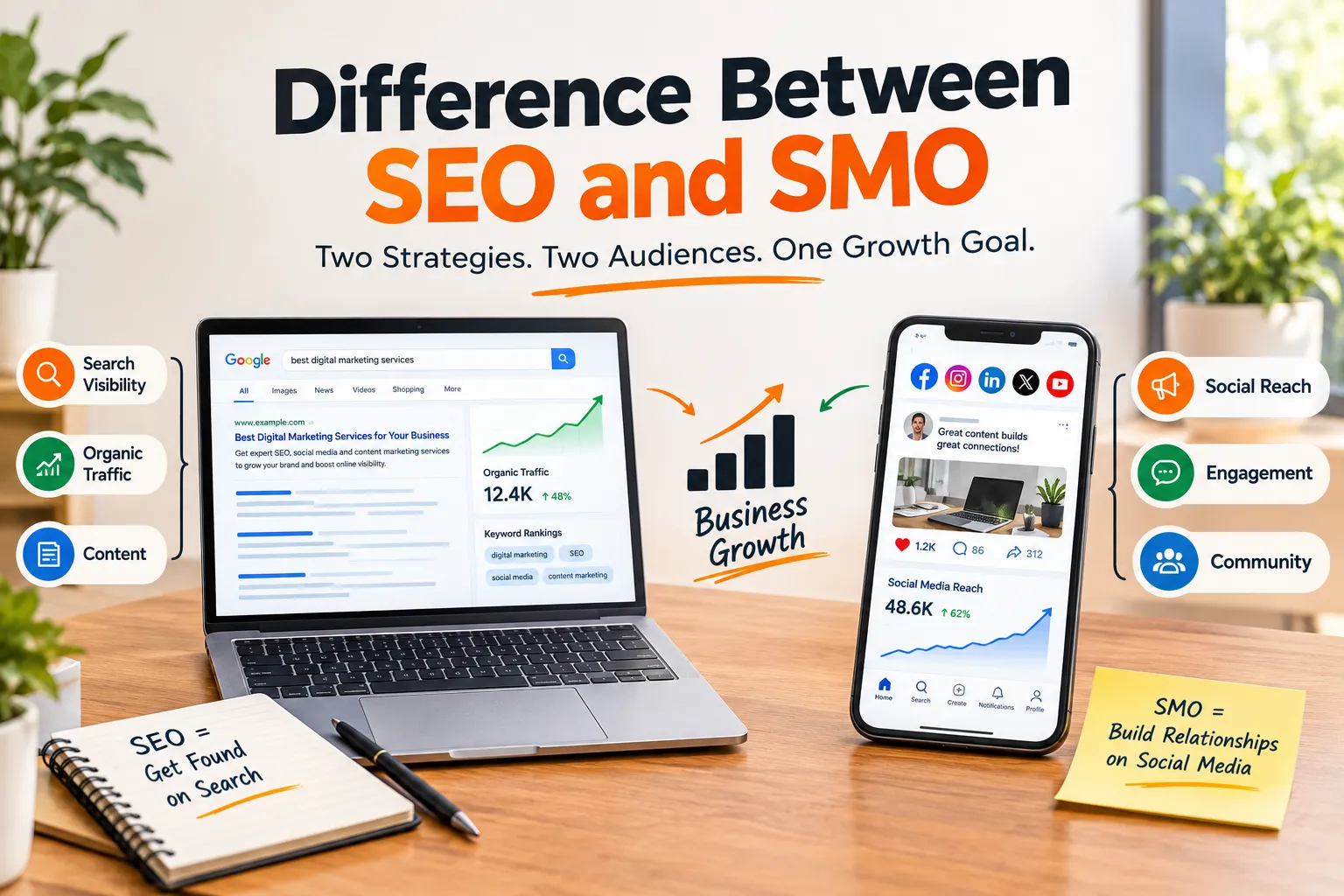
Two businesses can both be active online and still get completely different results. One shows up when someone searches for exactly what it sells. The other gets liked, shared, and talked about on social media, but barely registers in Google. Understanding the difference between SEO and SMO is what explains why, and more importantly, why a business usually needs both rather than picking just one. This guide breaks down what each discipline actually does, how they work, and when to prioritize one over the other.
Table of Contents
ToggleWhat Is SEO ?
SEO, or Search Engine Optimization, is the technical and content work done so a website appears first when people search for relevant information or services on engines like Google and Bing. It captures intent-driven traffic, people who are actively looking for something specific right now.
Getting this right depends on several things working together accurate, genuinely useful information, strong experience and expertise signals, a well-structured website, and quality backlinks from other authoritative sites. When these elements align, search engines prioritize that page, sending real visitors its way.
SEO is fundamentally an unpaid, organic channel. It excludes direct traffic and paid placements, focusing entirely on earning visibility through relevance and quality rather than buying it.
This is also why SEO is often described as both an on-site and off-site discipline. On-site work covers everything within direct control, page structure, content, and technical performance, while off-site work covers signals earned elsewhere, primarily backlinks from other trusted websites pointing back to your own.
What Is SMO ?
SMO, or Social Media Optimization, is the practice of promoting a business through social platforms like Facebook, Instagram, LinkedIn, and X, building brand awareness and audience relationships organically. Where SEO shows your website to people actively searching, SMO puts your brand in front of people based on their broader interests, whether or not they were looking for you specifically.
It also covers optimizing a website and its content to encourage sharing, making it easier for visitors to spread a link across their own social networks. This dual focus, your own social presence plus a shareable website, is what makes SMO distinct from simple social media posting.
SMO is largely an off-site optimization technique, built around visual content, community engagement, and the kind of material people actually want to share with others.
Unlike SEO, coding and technical structure barely matter here. What matters instead is visual attention and genuine shareability, since a platform’s own algorithm, not a search engine’s crawler, decides how far a given post actually travels.
Difference Between SEO and SMO at a Glance
| Dimension | SEO | SMO |
|---|---|---|
| Core goal | Rank higher in search engine results | Build awareness and engagement on social platforms |
| Audience | People actively searching with intent | People browsing based on general interest |
| Content type | Blogs, articles, optimized web pages | Photos, videos, shareable social posts |
| Speed of results | Slower, but long-lasting once achieved | Faster, but requires continuous effort |
| Optimization scope | Both on-site and off-site | Mostly off-site |
| What matters most | Site structure, keywords, backlinks | Visual appeal, shareability, community |
| Platforms involved | Google, Bing, Yahoo | Facebook, Instagram, LinkedIn, X |
How SEO Actually Works ?
Effective SEO starts with finding what people actually search for and weaving those terms naturally into a website’s content, rather than forcing them in unnaturally. Technical fixes matter just as much, ensuring a site loads quickly, works properly on mobile, and is structured in a way search engines can easily understand.
Building credibility through links from other reputable websites strengthens a site’s authority over time, while writing content that’s genuinely easy to understand and useful keeps visitors engaged once they arrive. None of these pieces work well in isolation, they compound together.
The real business benefit is direct, intent-driven traffic. When someone searches to buy a product or find a service, a well-optimized site appears in front of them at exactly the right moment, which is what makes SEO such a reliable long-term growth channel.
How SMO Actually Works ?
Strong SMO centers on posting photos and videos people genuinely want to engage with and share, rather than purely promotional content. Riding relevant trends and using the right hashtags helps content reach a wider audience beyond just existing followers.
Direct engagement matters enormously here. Responding to comments, building a real community, and adapting content based on what the audience actually responds to all strengthen the relationship between a brand and its audience over time.
The core business benefit goes beyond visibility alone. SMO lets a business become part of the platforms people already use every day, creating direct interaction that search engine visibility alone can’t replicate.
SEO vs. SMO vs. SEM vs. SMM, Clearing Up the Confusion
These terms get thrown around interchangeably, which creates real confusion for anyone newer to digital marketing. SEO focuses on organic search visibility through content and technical optimization, a long-term strategy aimed at driving unpaid traffic.
SEM, or Search Engine Marketing, covers paid search advertising like Google Ads, where businesses bid on keywords to display ads directly in search results for immediate traffic. SMM, or Social Media Marketing, is the paid counterpart to SMO, covering paid social campaigns and promoted content rather than purely organic engagement.
PPC, or Pay-Per-Click, is a broader paid advertising model where a business pays each time someone clicks their ad, whether that ad runs on a search engine, a social platform, or elsewhere. SMO sits specifically in the organic, unpaid social space, distinct from SMM’s paid approach even though both operate on the same platforms.
Each one has a different cost structure and timeline. SEO and SMO are generally cost-effective but slower to show results, while SEM, SMM, and PPC deliver faster visibility in exchange for ongoing ad spend. Understanding the difference between SEO and SMO specifically, as the two organic, unpaid channels in this list, helps clarify which paid add-on, SEM or SMM, actually makes sense once a business is ready to accelerate results.
Which One Should You Prioritize First ?
For a brand-new business with no existing audience or search visibility, starting SEO work early matters, since it takes longer to show results and compounds the earlier it begins. Getting technical foundations and core content in place from day one avoids losing months of potential organic growth.
SMO can start producing visible engagement faster, making it useful for building initial brand awareness and audience trust while SEO work builds in the background. A business launching a new product with no existing search demand often benefits more from SMO first, generating interest before anyone is actively searching for that product by name.
An established business with decent search visibility but a weak social presence faces the opposite priority. In that case, SMO deserves more immediate attention, since the search foundation already exists and social engagement is the gap actually limiting growth.
Budget and team size realistically shape this decision too. A business with limited resources often gets more value focusing deeply on one channel first and doing it well, rather than splitting a small budget thinly across both and doing neither one effectively.
Why the Best Results Come From Combining Both ?
SEO and SMO are not competing strategies, they’re complementary ones that reinforce each other when run together. A good way to think about it: SEO gets your business found by google search, while SMO builds trust and relationship with the people who find you, through every other channel they use daily.
Think about a realistic customer journey. Someone searches for a product and lands on a business’s website through SEO. Before buying, they check that business’s Instagram page, see genuine engagement and positive comments from other customers, and that social proof is what tips them from visitor to buyer.
Running both together also protects reputation more effectively than either alone. Strong SEO combined with an active, well-managed social presence gives a business more surface area to shape how it’s perceived, rather than leaving that entirely to search results or social mentions outside its control.
A Real-World Example
A retail business selling a specific product category ran SEO on its website so it would appear when people searched for that exact product by name. At the same time, it ran a poll on Instagram and partnered with a few relevant influencers to promote the same products.
The results compounded rather than running in parallel. Search-driven website visits increased as expected, but purchases coming directly through Instagram also rose noticeably, as social proof and influencer trust reinforced what people were already discovering through search.
This pattern repeats across industries. SEO and SMO working together consistently outperform either channel running in isolation, since each one reinforces the credibility the other is trying to build.
A service-based business often sees a similar effect in reverse. Clients find the business through a Google search for a specific service, then check its Instagram or LinkedIn before reaching out, looking for recent work, client reactions, and signs the business is genuinely active. Without that social presence, even a strong search ranking can lose a prospect at the last step of consideration.
Common Mistakes When Comparing SEO and SMO
Treating these as competing budgets, where improving one necessarily means cutting the other, is one of the most common and costly mistakes businesses make. They serve genuinely different purposes and rarely compete for the exact same customer moment.
Expecting SMO to produce SEO-level long-term stability is another frequent error. Social engagement requires continuous, ongoing effort to maintain, unlike SEO gains, which tend to hold steady for longer once genuinely earned.
Ignoring SEO entirely because social media feels faster and more immediate is a mistake many newer businesses make. Social platforms are ultimately rented space, subject to algorithm shifts outside a business’s control, while a well-optimized website remains a owned, stable asset over the long run.
A final, less obvious mistake is applying identical content across both channels without adapting it. Content written for a search engine’s expectations, longer, keyword-aware, structured, rarely performs well dropped unchanged into a social feed built for fast, visual consumption, and the reverse is equally true.
How to Measure Success in Each ?
SEO and SMO are judged by genuinely different numbers, and using the wrong metric for the wrong channel leads to confusing, misleading conclusions about what’s actually working. Organic traffic, keyword rankings, backlink count, and conversion rate from search are the core numbers that matter for SEO.
SMO success looks different. Engagement rate, follower growth, shares, comments, and social-driven website visits are the metrics that actually reflect whether social efforts are working, rather than raw follower count alone, which can be misleadingly inflated without real engagement behind it.
Mixing these up causes real confusion. Judging an SMO campaign by search rankings, or judging an SEO campaign by social shares, measures the wrong outcome entirely and can lead a business to abandon a channel that was actually working, simply because it was never going to move the metric being checked. Keeping the difference between SEO and SMO clear in how you measure each one avoids exactly this mistake.
Conclusion
The difference between SEO and SMO comes down to this SEO earns visibility in search engines through content quality and technical optimization, while SMO builds awareness and trust through genuine engagement on social platforms. One captures intent-driven demand, the other builds the relationship that turns a stranger into a customer. Businesses that treat these as two wheels of the same car, rather than competing priorities, consistently build stronger, more resilient online presence than those focused on just one.
How Dizispark Can Help ?
Dizispark runs SEO and SMO as a coordinated strategy, not two disconnected services billed separately with no shared plan behind them. That includes technical SEO, content optimization, and link building alongside social content planning, community engagement, and platform-specific creative built around what each audience actually responds to.
Every engagement starts with a clear read on which side, search visibility or social engagement, is genuinely holding a specific business back, rather than applying the same package to every client. For local businesses, Dizispark also keeps Google My Business management integrated with both SEO and social strategy, since local search and social proof consistently reinforce each other in the same buying decision.
Frequently Asked Questions
What is the difference between SEO and SMO?
The difference between SEO and SMO starts with their primary purpose. The difference between SEO and SMO is that SEO focuses on improving visibility in search engines, while SMO focuses on building visibility and engagement through social platforms. Understanding the difference between SEO and SMO helps businesses choose the right channel for their marketing goals.
Is SEO better than SMO?
The difference between SEO and SMO does not mean one is always better than the other. The difference between SEO and SMO is mainly about where and how a business reaches its audience. When considering the difference between SEO and SMO, SEO generally supports longer-term organic search visibility, while SMO can build faster engagement and brand awareness.
What does SMO stand for in digital marketing?
SMO stands for Social Media Optimization and focuses on improving social visibility, engagement, and shareability. The difference between SEO and SMO is that SEO targets search engine visibility, while SMO focuses primarily on social platforms. Understanding the difference between SEO and SMO makes it easier to see why both channels require different content and optimization approaches. The difference between SEO and SMO is especially important when planning content for search and social audiences.
Can a business use SEO and SMO together?
Yes, businesses can use both strategies together. The difference between SEO and SMO shows that SEO can attract people actively searching for products or services, while SMO can build trust and engagement through social platforms. Understanding the difference between SEO and SMO allows businesses to create a coordinated strategy instead of treating the channels as competitors.
How long does SEO take compared to SMO?
The difference between SEO and SMO is also visible in how quickly results can appear. SEO generally takes longer to produce meaningful results, while SMO can generate visible engagement faster through social content and community interaction. The difference between SEO and SMO therefore includes both the type of visibility and the expected timeline for results. Businesses should understand the difference between SEO and SMO before setting unrealistic expectations for either channel.
What is the difference between SMO and SMM?
SMO refers to organic social media optimization, while SMM generally refers to paid social media marketing. The difference between SEO and SMO is different from the difference between SMO and SMM because SEO operates around search visibility and SMO around organic social engagement. Understanding the difference between SEO and SMO helps clarify where organic search and organic social activities fit within a broader digital marketing strategy.
Which should a small business start with, SEO or SMO?
The difference between SEO and SMO should be considered according to the business’s current goals and audience. A new business may start SEO early because search visibility can take time to build, while SMO can run alongside it to generate awareness and engagement. The difference between SEO and SMO becomes useful when deciding which channel deserves greater attention based on the business’s immediate needs. Knowing the difference between SEO and SMO can help a small business allocate its limited marketing resources more effectively.
Does SMO help with SEO rankings?
SMO does not directly influence Google’s ranking algorithm in the same way as core SEO signals such as relevant content and backlinks. The difference between SEO and SMO is important here because social activity can support visibility indirectly through brand awareness, traffic, and potential link opportunities. Understanding the difference between SEO and SMO helps businesses avoid treating social engagement as a direct Google ranking factor.