
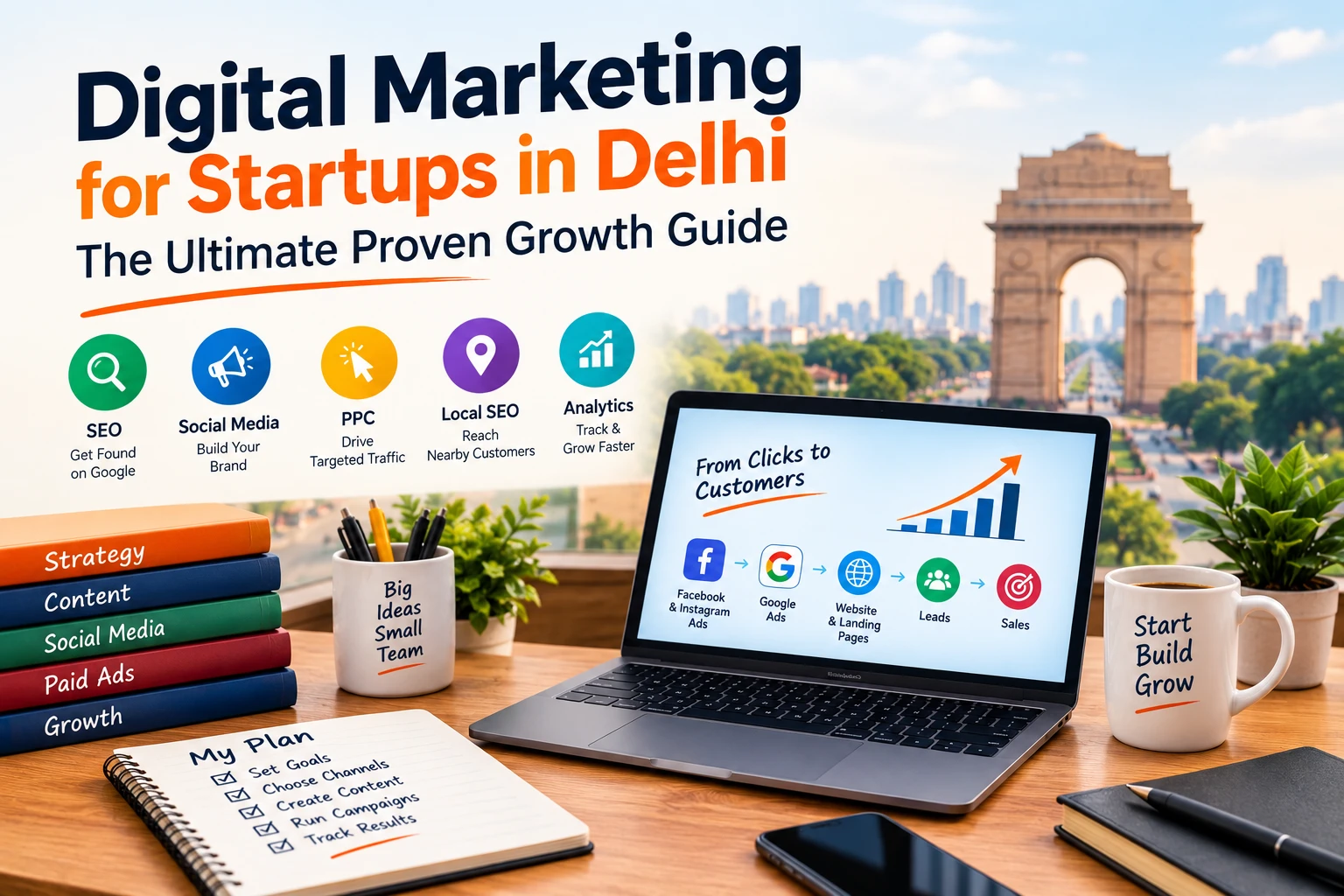
Delhi has one of the densest startup ecosystems in South Asia, which is both an opportunity and a problem. For every idea you’re building, five or ten other founders in the same city are likely building something similar. Digital marketing for startups in Delhi is what decides which of those founders actually gets found first.
This guide covers how to prioritize channels by startup stage, what results realistically cost, and how long each channel takes to pay off. It draws on published guidance from Delhi-based agencies and industry listings, so the numbers reflect what’s actually happening in this market rather than generic advice.
Table of Contents
ToggleWhy Delhi Startups Need a Different Marketing Approach
Startups do not operate like established businesses. Budgets are tighter, timelines are faster, and every rupee needs to justify itself against a growth target, not just a brand awareness goal. That difference changes what a marketing plan should look like. A pre-revenue founder testing an idea needs something entirely different from a Series A team with a working sales funnel trying to scale lead volume.
Consumer behavior has also shifted. Customers now search online, compare brands, read reviews, and interact through social platforms before ever contacting a business directly. A startup invisible in that search is invisible to the customers it’s trying to reach, no matter how good the product actually is.
The Two Mistakes That Waste Most Startup Marketing Budgets
The most common mistake isn’t spending too little. It’s spending without a clear plan behind it. A social media page with sporadic posts, a Google Ads campaign set up once and never touched again, a website that took months to build and hasn’t changed since launch, these patterns show up constantly when startup accounts get audited. Money gets spent, but nothing compounds. Each channel operates in isolation instead of building toward a larger result over time.
The second mistake is trying to run every channel at once. SEO, PPC, Instagram, LinkedIn, WhatsApp, influencer partnerships, running all of them simultaneously with a small team sounds thorough, but it usually means everything gets done halfway. A lot of activity happens with very little actual revenue to show for it.
Where to Start: Prioritizing Channels by Startup Stage
The right channel mix depends heavily on where a startup actually is right now, not where the founder eventually wants to be. Getting digital marketing for startups in Delhi right starts with matching effort to stage, which prevents wasted spend on channels that aren’t ready to pay off yet. Pre-revenue founders usually get the most value from a credible website, foundational SEO, and a consistent social presence, since the immediate goal is establishing trust rather than scaling volume. Startups with product-market fit and a working sales funnel benefit more from PPC, since it can generate qualified leads within days rather than months.
Scaling startups need a genuine combination: SEO compounding in the background, PPC delivering consistent lead volume, content marketing building category authority, and social media keeping the brand visible and trusted. Layering channels in this order, rather than all at once, tends to produce far better results per rupee spent.
SEO for Delhi Startups: The Long-Term Compounding Asset
For most Delhi startups, SEO is the highest-leverage long-term investment available. Done properly, it builds a traffic asset that keeps generating organic leads every month without ongoing per-click cost. The process typically starts with a technical audit, fixing structural issues that hold rankings back before anything else. On-page optimization across key pages follows, along with a properly configured Google Business Profile for local intent searches.
A smart approach for budget-constrained startups is targeting hyper-specific, low-competition keywords tied to their exact niche and city, rather than competing head-on against national players for broad terms. A B2B SaaS startup might target “invoice software for small businesses in Delhi” instead of a generic, heavily contested phrase, generating early traffic wins that expand as domain authority grows. Results generally take three to five months to become visible, and industry guidance suggests a minimum three-month commitment is realistic before expecting meaningful movement. Search engines simply need time, and there are no reliable shortcuts around that timeline.
PPC and Google Ads: Getting Leads Fast
When a startup needs leads immediately, before SEO has had time to compound, Google Ads is the most reliable lever available. Campaigns can go live within roughly seven to ten days of onboarding and start generating traffic almost immediately. Effective PPC for Delhi startups means geo-targeted campaigns focused on high-intent search terms that signal actual buying readiness, not just casual browsing. Conversion tracking, landing page alignment, and ongoing A/B testing all matter more for a startup than for a larger business, since every wasted rupee has a bigger relative impact on runway.
Reported return on ad spend for well-managed startup campaigns in this market commonly falls in the range of three to eight times spend, though this varies significantly by industry and competition level. The ideal approach for most startups pairs PPC for immediate pipeline with SEO building steadily in the background, letting paid leads fund the business while organic growth becomes self-sustaining over time.
Social Media: Instagram vs. LinkedIn for Different Startup Types
Choosing the right platform depends entirely on who the startup is actually trying to reach, not which platform feels trendiest. Consumer-facing, visually driven startups tend to perform best on Instagram, using Reels, carousels, and story ads for product discovery. B2B and service-focused startups typically see stronger results on LinkedIn instead, where founder-led content and thought leadership carry more weight than polished product photography. A fintech or SaaS startup targeting enterprise buyers will usually get more qualified engagement from LinkedIn than from a consumer platform.
Whichever platform fits, consistency matters more than volume. A realistic content mix includes product updates, behind-the-scenes moments, customer testimonials, and genuine engagement with comments and messages, rather than a high-frequency posting schedule with no real interaction behind it.
Website and Landing Pages: Your First Impression
Many startup websites look like they were built in a weekend, largely because they were. A slow-loading site, unclear messaging about what the business actually does, or a missing obvious next step for the visitor all quietly reduce conversion rate every single day the site stays live. For an early-stage company, the website is often the first real impression an investor, partner, or customer gets. It needs to load quickly, explain the offer clearly, and include on-page SEO, schema markup, and analytics tracking from the start rather than bolted on later.
A simple, focused landing page built to test one specific offer is often more valuable early on than a full multi-page site with sections nobody reads. Getting this piece right before scaling paid traffic to it prevents a common and expensive failure mode where ads succeed but the destination page quietly kills the conversion.
Influencer Marketing on a Startup Budget
Delhi’s creator economy is large and increasingly accessible, even for startups without significant budgets. Micro and mid-tier influencers, generally with smaller but highly engaged followings, often deliver stronger returns than a single expensive celebrity partnership. The value comes from audience fit rather than follower count alone. A regional creator whose audience closely matches a startup’s actual target customer tends to produce more genuine engagement and conversion than a larger, more generic account.
Managing these relationships still requires the same rigor as any paid channel: clear briefing, content approval, and actual performance measurement against real business outcomes rather than just impressions or reach.
GEO: The New Frontier for Startup Visibility
A meaningful shift is underway in how people discover businesses. Alongside traditional Google search, a growing share of users, including many of the investors, enterprise buyers, and early adopters a startup is trying to reach, now use AI tools like ChatGPT, Perplexity, and Google’s AI Overviews for recommendations.
This is where Generative Engine Optimization, or GEO, comes in. When someone asks an AI tool which digital marketing agency or product to consider in a given category, the answer they receive depends on which businesses have built genuine topical authority and a consistent, credible digital footprint that these systems recognize and cite. Most agencies in Delhi have not started building this deliberately for their clients yet, which creates a real, time-sensitive opportunity for startups willing to invest early. Being recommended by an AI tool before competitors even realize this matters can meaningfully shorten the trust-building process for an early-stage brand.
What Digital Marketing Actually Costs for a Delhi Startup
Budgeting for digital marketing for startups in Delhi starts with realistic ranges rather than guesswork. Published startup-focused packages in this market commonly start around ₹8,000 per month for focused social media management alone. Full-funnel strategies covering SEO, PPC, content, and influencer marketing tend to run ₹60,000 or more per month once a startup is ready to scale across multiple channels.
Website development for a professional, conversion-ready site can start from roughly ₹12,000, though costs scale with complexity and the number of pages required. These figures vary meaningfully by agency, but they give a realistic sense of the range a founder should expect when budgeting. Rather than fixating on a fixed price list, the more useful question is what specific outcome a given budget is expected to produce, whether that’s a completed technical SEO audit, a live PPC campaign, or a defined number of qualified leads per month.
Choosing the Right Marketing Partner
A crowded market of agencies, freelancers, and in-house hires all claim they can deliver results for a Delhi startup. Finding the right fit for digital marketing for startups in Delhi depends on stage, budget, and how much hands-on management the founder can realistically provide. Look for evidence of actual industry experience rather than generic claims, along with transparent monthly reporting that ties activity back to real business outcomes like leads and revenue, not just impressions or follower counts. A dedicated point of contact who responds quickly matters more for a startup than for a larger business, since fast iteration is often the difference between a campaign that works and one that quietly burns budget.
Data and asset ownership deserves a direct question before signing anything. Ad accounts, website access, and analytics should remain under the startup’s own control throughout the engagement, regardless of which agency or freelancer is doing the work.
A Realistic Timeline for Results
Different channels move at genuinely different speeds, and setting expectations correctly from the start avoids the common trap of abandoning something right before it starts working. PPC campaigns typically go live within seven to ten days and can produce initial leads almost immediately. SEO moves slower by nature. First measurable improvements, better rankings, more organic sessions, early enquiries from search, generally appear within three to five months, with niche and location-specific keywords moving faster than broad industry terms.
Broader brand-building efforts through content and social media tend to compound over a similar three to six month window. Reviewing progress monthly, rather than judging any single channel after only a few weeks, gives a far more accurate picture of what’s actually working.
Conclusion
Digital marketing for startups in Delhi works best as a sequenced plan rather than an all-at-once effort. Start with the channel that matches your current stage, whether that’s foundational SEO and a credible website, or PPC when you need leads immediately. Layer in social media, content, and eventually GEO as budget and bandwidth allow, and resist the urge to run every channel simultaneously from day one. Founders who treat this as a system, with clear ownership of data and monthly review of real business metrics, consistently outperform those chasing every new tactic without a plan behind it.
The city’s competitive density cuts both ways. It means more rivals fighting for the same customer’s attention, but it also means more proof, more agencies, more case studies, and more data on what actually works here, all available for a founder willing to look past the marketing pitch and focus on the underlying numbers.
How Dizispark Can Help
Dizispark builds digital marketing plans for Delhi startups around actual stage and budget, sequencing SEO, PPC, and social media rather than launching everything at once with limited resources spread too thin. Every engagement includes transparent reporting tied to leads and revenue, not vanity metrics, with startup founders retaining full ownership of their ad accounts and data throughout.
For startups with a physical office or storefront presence, Dizispark also optimizes GMB alongside the broader strategy, since local visibility often reaches the same investors, partners, and customers a startup is trying to build trust with online. Every plan is scoped to where the founder actually is right now, not a generic template built for an established brand.
Frequently Asked Questions
What is digital marketing for startups in Delhi?
Digital marketing for startups in Delhi is the use of online channels to help new businesses reach potential customers and build visibility. Digital marketing for startups in Delhi can include SEO, social media, Google Ads, Meta Ads, content marketing, and local search. A focused approach to digital marketing for startups in Delhi helps startups choose channels based on their audience, goals, and budget.
Why is digital marketing for startups in Delhi important?
Digital marketing for startups in Delhi can help startups build online visibility in a competitive local market. A structured digital marketing for startups in Delhi plan can help businesses attract relevant traffic, generate leads, and measure campaign performance. Consistent digital marketing for startups in Delhi also gives startups opportunities to test different channels and improve their marketing based on results.
How much does digital marketing for startups in Delhi cost?
The cost of digital marketing for startups in Delhi depends on the startup’s industry, goals, competition, and selected marketing channels. A digital marketing for startups in Delhi campaign can begin with organic activities such as SEO and content before expanding into paid advertising. The budget for digital marketing for startups in Delhi should be based on realistic acquisition goals and measurable results.
Which channels are best for digital marketing for startups in Delhi?
The right channels for digital marketing for startups in Delhi depend on where the target audience searches and interacts online. SEO, Google Business Profile, social media, Google Ads, Meta Ads, content marketing, and WhatsApp can all be part of digital marketing for startups in Delhi. A practical digital marketing for startups in Delhi strategy should prioritize the channels most relevant to the startup’s customers.
Is SEO useful for digital marketing for startups in Delhi?
Yes, SEO can be an important part of digital marketing for startups in Delhi because it helps startups appear for relevant search queries. Local SEO can strengthen digital marketing for startups in Delhi when a startup serves customers in specific areas of Delhi. A consistent digital marketing for startups in Delhi approach can combine SEO with useful website content and Google Business Profile optimization.
Can Google Ads help with digital marketing for startups in Delhi?
Google Ads can support digital marketing for startups in Delhi by helping businesses reach people who are actively searching for relevant products or services. Properly managed digital marketing for startups in Delhi campaigns should track clicks, leads, conversions, and advertising costs. Google Ads can therefore become one component of digital marketing for startups in Delhi when paid search matches the startup’s customer journey.
How can social media support digital marketing for startups in Delhi?
Social media can strengthen digital marketing for startups in Delhi by helping startups communicate with potential customers and build awareness. Instagram and Facebook can be used within digital marketing for startups in Delhi for educational content, product information, engagement, and paid campaigns. A social media plan can make digital marketing for startups in Delhi more consistent when the startup focuses on platforms used by its target audience.
How should startups measure digital marketing for startups in Delhi?
Startups should measure digital marketing for startups in Delhi using metrics connected to their business objectives. Website traffic, leads, inquiries, conversions, customer acquisition cost, and return on advertising spend can help evaluate digital marketing for startups in Delhi campaigns. Regular reporting allows digital marketing for startups in Delhi activities to be adjusted based on actual performance.