
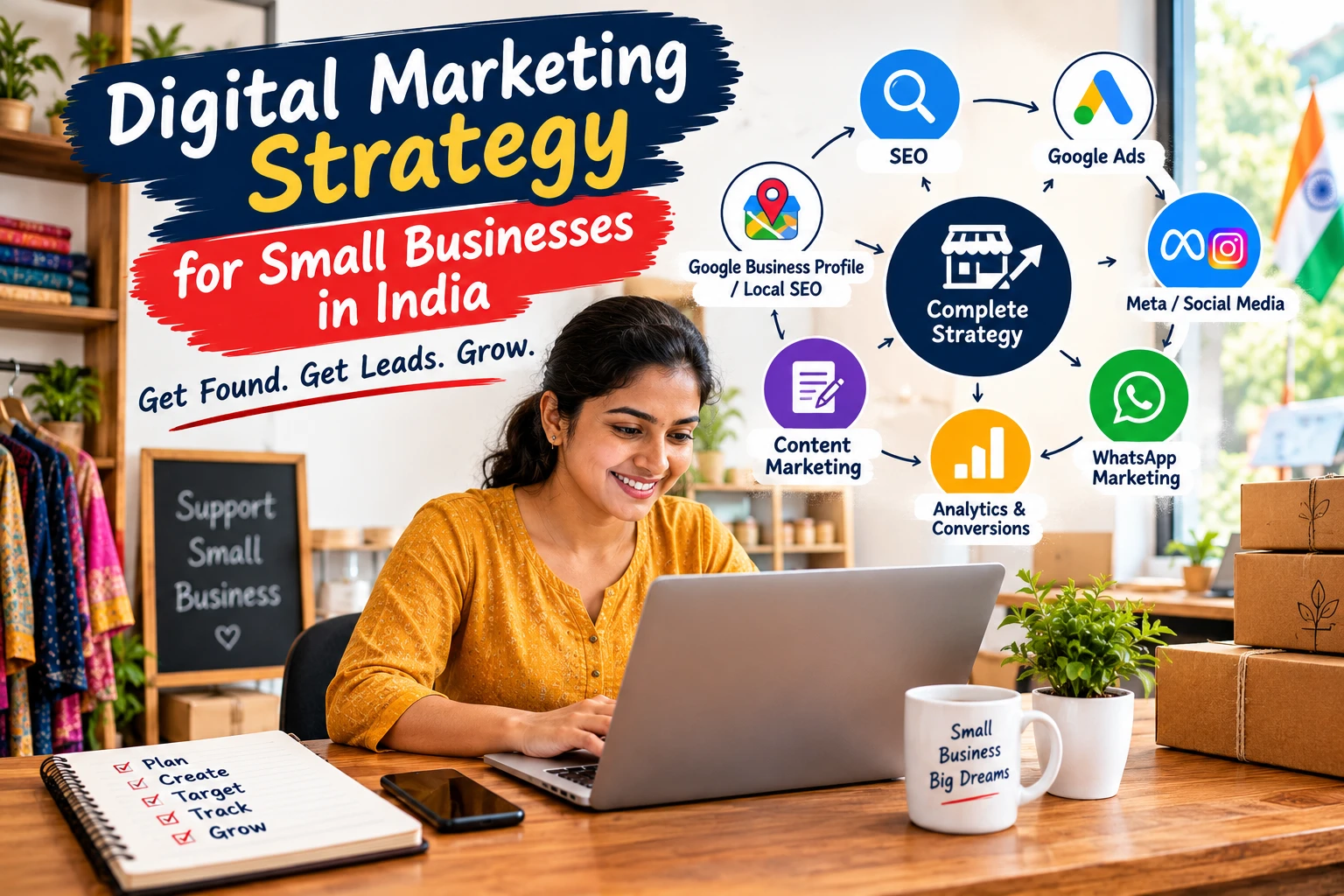
Most small business owners in India already know they should be online. The harder question is where to put limited time and money first. A clear digital marketing strategy for small businesses in India answers that question before a single rupee gets spent.
This guide walks through the channels that matter, the order to tackle them in, and the numbers worth tracking. It draws on published research from Salesforce and Digiaccel, along with Indian market guidance from Maya Digital Desk, so the advice stays practical rather than theoretical.
A practical digital marketing strategy for small businesses in India can help turn this challenge into a measurable growth opportunity.
Table of Contents
ToggleWhy a Digital Marketing Strategy for Small Businesses in India Matters Now
India has more than 700 million internet users, and a large share of buying decisions now start with a search, a scroll, or a WhatsApp message. Customers compare options on Instagram, read reviews on Google, and often need several touchpoints before they trust a business enough to buy.
The opportunity is bigger than the current adoption suggests. One Maya Digital Desk analysis notes that India has roughly 63.4 million MSMEs contributing about 30 percent of GDP, yet fewer than 8 percent have an effective digital presence. That gap is a real advantage for any small business willing to act.
Adoption also pays off. A survey cited by Digiaccel found that 73 percent of MSMEs reported business growth after adopting digital tools, driven largely by UPI and smartphones. Digital media now captures close to 46 percent of India’s advertising spend, so the audience is already there.
What Digital Marketing Actually Means for a Small Business
Digital marketing is simply the use of online channels to promote your products, attract prospects, and turn them into paying customers. For a small business, that usually means search engine optimization, content, social media, email, and paid advertising working together.
Unlike newspaper ads or hoardings, every rupee can be tracked. You can see which campaign brought a call, an order, or a store visit. That measurability is what makes this approach so valuable when budgets are tight.
It also levels the playing field. A local bakery in Chennai and an ecommerce startup in Bengaluru can both reach the right customers with tools that once belonged only to large brands. Salesforce research adds that small businesses often have a real edge, since they sit closer to their customers than big corporations do.
Start With SMART Goals and a Written Plan
A digital marketing strategy for small businesses in India works best when it starts with a written plan. Vague goals like “get more online sales” give you nothing to measure. SMART goals fix that by being specific, measurable, achievable, relevant, and time-bound.
Good examples include “add 200 email subscribers in one month” or “raise online revenue by 20 percent this quarter.” Each one tells you exactly what success looks like and when to check.
Documentation matters more than most owners expect. One study cited by Digiaccel found that businesses with a documented marketing plan were far more likely to report success than those without one. Indian guidance from Nevatrix similarly suggests that a written strategy can multiply lead generation.
Before building anything, answer three questions. Who is your target customer? What problem do they need solved? What single outcome do you want from this quarter’s marketing?
Local SEO and Google Business Profile: The Best Place to Start
For most small businesses, local search delivers the fastest and cheapest results. Your Google Business Profile is a free asset that puts you in front of nearby customers at the exact moment they search. Indian marketing guides consistently rank it as the highest-ROI first step.
The numbers support this. Research cited by Digiaccel says about 76 percent of local searches lead to a store visit within 24 hours. It also notes that businesses with complete, accurate profiles receive several times more clicks than those with thin listings.
Fill in every field: business name, address, phone number, hours, categories, services, and at least ten quality photos. Post weekly updates with offers or tips, and reply to every review, good or bad. Reviews build the trust that turns a search into a visit.
Beyond your profile, add city and neighborhood terms to your website titles, headings, and meta descriptions. A phrase like “vegetarian café in Jodhpur” is far more useful than a generic keyword. List your business on trusted Indian directories such as JustDial, Sulekha, and IndiaMART to strengthen local signals.
Keyword research does not need expensive tools. Google Keyword Planner and free search suggestions reveal what customers actually type. Focus on long-tail, high-intent phrases, and write for people first, since stuffing keywords hurts more than it helps.
For many local businesses, a digital marketing strategy for small businesses in India should include an optimized Google Business Profile.
Content Marketing on a Small Budget
A digital marketing strategy for small businesses in India does not require a big team to produce effective content. It requires useful, relevant material that speaks to your audience’s real questions. Indian small businesses have a natural advantage here, since local stories and authentic voices are hard for large brands to copy.
The economics are attractive. Content marketing Institute figures cited by Digiaccel suggest it costs far less than outbound marketing while producing leads that convert at higher rates. For a small business, that makes it one of the best long-term investments available.
Start by auditing what you already have. Look for gaps between what customers ask and what your website answers. If time is short, focus on evergreen content that stays useful for years rather than chasing daily posts.
Choose formats your audience actually consumes. That might be blog posts, short videos, Instagram Reels, or simple infographics. A content calendar keeps you consistent, which matters more than volume.
Repurposing multiplies your effort. A single blog post can become a short video, a carousel, an email, and several social posts. Refreshing older high-performing content can also lift traffic quickly, often faster than writing something new.
Social Media Marketing That Fits Indian Audiences
Around 96 percent of small businesses already use social media in their marketing, according to figures cited by Digiaccel. Being present is no longer the advantage. Being consistent and relevant is.
A digital marketing strategy for small businesses in India should pick platforms based on where your customers spend time, not where you think you should be. Visual businesses like boutiques, restaurants, and beauty brands tend to do well on Instagram. Consultants, law firms, and B2B services often get better results on LinkedIn.
Short-form video deserves special attention. About 86 percent of brands now use video as a marketing tool, and Reels perform well for product discovery. Adding local-language subtitles and customer-made content makes videos feel authentic to regional audiences.
A simple content mix works well. Combine product updates, behind-the-scenes moments, customer testimonials, and relevant industry news. Respond to every comment and message promptly, since engagement is what builds community around a small brand.
Contests, polls, and challenges encourage user-generated content and give you free insight into what customers like. Keep the tone friendly and professional, and address complaints with empathy rather than defensiveness.
WhatsApp and Email: Retention on a Budget
Winning a new customer costs far more than keeping an existing one. Digiaccel cites research showing retention costs roughly five times less than acquisition, and repeat customers are meaningfully more likely to buy again. This is where small businesses can earn outsized returns.
WhatsApp is especially powerful in India and can become an important part of a digital marketing strategy for small businesses in India. Studies cited by Digiaccel report that a majority of WhatsApp messages get a response within a minute. Use it for order updates, quick support, and personal offers, always with customer consent.
Email remains one of the highest-return channels. Digiaccel reports figures around ₹42 returned for every ₹1 spent when email is done well. Build your list by offering a discount, a free guide, or exclusive updates in exchange for a sign-up.
Segment subscribers by purchase history, location, or interest, then send messages that match. Personalized emails tend to earn noticeably higher open rates. Since most emails are opened on mobile, use short subject lines, responsive templates, and one clear call to action.
Loyalty programs add another layer. A simple points or rewards scheme tied to real customer behavior can lift retention significantly. Even a basic “tenth coffee free” style offer keeps customers coming back.
Micro-Influencers and Paid Ads
Influencer marketing in India is now a multi-thousand-crore industry, but small businesses do not need celebrity budgets. Micro-influencers with roughly 10,000 to 50,000 followers often deliver better returns for far less money.
Regional creators bring cultural relevance and language authenticity that generic campaigns miss. Their audiences tend to trust their recommendations, which shortens the path from awareness to purchase.
Paid advertising gives the fastest visible results, often within days, while SEO and organic social usually take three to six months to build momentum. That makes ads useful for testing offers quickly and generating early leads.
On Facebook and Instagram, carousel and collection ads work well for product discovery. Retargeting visitors and cart abandoners converts at much higher rates than cold traffic. One well-known example: a Raymond campaign using location-focused Facebook lead ads reportedly drove a 78 percent increase in store sales within the target radius.
Start small with paid ads. Test one offer, one audience, and one landing page, then scale only what works. Click-to-WhatsApp ads are worth trying in India, since they move the conversation straight to the channel customers prefer.
Paid advertising gives a digital marketing strategy for small businesses in India a way to reach targeted audiences without waiting entirely for organic traffic.
Measuring What Matters: KPIs and Analytics
Marketing without measurement is guesswork. Any digital marketing strategy for small businesses in India should track a small set of numbers consistently rather than drowning in dashboards. Website traffic, conversion rate, cost per customer, and return on investment cover most needs.
Google Analytics 4 is free and shows traffic sources, engagement, and conversion paths. Set up conversion tracking for purchases, form fills, and calls. Add UTM tags to email and social links so you know exactly which channel produced each result.
Conversion rate deserves close attention. Averages across industries hover around 2.9 percent, according to a figure Digiaccel cites. You can beat that by improving call-to-action placement, matching landing pages to ads, and simplifying checkout.
Customer acquisition cost shows whether your spending is efficient. Add up all marketing costs for a period and divide by the number of new customers. A falling number means your targeting is improving.
Return on investment is the ultimate test. Subtract total marketing spend from the revenue it generated, then divide by the spend. Review results monthly, cut what underperforms, and move budget toward what works.
A Realistic Six-Month Roadmap
Trying everything at once is the fastest way to burn out and waste money. Maya Digital Desk advises starting with one or two strategies, mastering them, then expanding gradually. A phased digital marketing strategy for small businesses in India keeps effort manageable and results easy to trace.
In months one and two, focus on foundations. Fix technical website issues, complete keyword research, and fully optimize your Google Business Profile. Install Google Analytics and set up basic conversion tracking.
In months three and four, work on on-page optimization and start publishing helpful content. Build local citations, request reviews from happy customers, and launch a simple email sign-up offer. Begin testing one small paid campaign.
In months five and six, expect first-page rankings for lower-competition keywords. Start link building through directories, guest posts, and local partnerships. Review your numbers, double down on the best channel, and add a second channel only once the first is stable.
Common Mistakes That Waste Small Business Budgets
Even a well-planned digital marketing strategy for small businesses in India can stall because of a few avoidable habits. Switching channels or agencies every few weeks is one of the costliest. Every channel needs time to produce data, and constant changes reset the learning process before results appear.
Ignoring lead capture is another frequent error. Traffic that never becomes a contact detail is traffic wasted. Every page should offer a clear next step, whether that is a call, a form, or a WhatsApp message.
Slow follow-up quietly kills conversions. Leads who wait hours for a reply often buy elsewhere. Respond quickly, even if it is just an acknowledgment with a promise of details.
Skipping mobile optimization hurts too, since most Indian users browse on phones. A slow or cramped site loses visitors before they read a word. Finally, chasing every trend instead of mastering fundamentals scatters effort and dilutes results. A realistic budget allows a digital marketing strategy for small businesses in India to focus spending on channels that can be measured and improved.
Conclusion
A strong digital marketing strategy for small businesses in India does not require a large budget. It requires clarity: written goals, a few well-chosen channels, and steady measurement.
Start with the free, high-return basics like Google Business Profile, local SEO, and WhatsApp. Layer in content, email, and small paid tests as results come in. Keep the customer at the center, and review your numbers every month so decisions come from data instead of guesswork.
The right digital marketing strategy for small businesses in India should focus on consistent execution, measurable results, and continuous optimization rather than trying every channel at once.
How Dizispark Can Help
Dizispark helps small businesses across India build a focused digital marketing plan around their real budget and goals, rather than a generic package. That includes local SEO, paid campaigns, conversion tracking, and reporting that ties spend to actual leads and sales.
For businesses that depend on nearby customers, Dizispark also optimizes GMB alongside the rest of the plan, so search visibility, reviews, and ads all reinforce each other. Every engagement starts with the numbers that matter to the owner, not vanity metrics.
Frequently Asked Questions
What is a digital marketing strategy for small businesses in India?
A digital marketing strategy for small businesses in India is a planned approach to reaching customers through search engines, websites, social media, paid advertising, content, and direct communication channels. A digital marketing strategy for small businesses in India should focus on the channels that match the business audience and budget. The goal of a digital marketing strategy for small businesses in India is to generate measurable traffic, leads, and sales.
Why is a digital marketing strategy for small businesses in India important?
A digital marketing strategy for small businesses in India helps businesses build visibility where potential customers are already searching and spending time online. A well-planned digital marketing strategy for small businesses in India can combine SEO, Google Business Profile, social media, content marketing, and paid campaigns. A consistent digital marketing strategy for small businesses in India also makes it easier to measure which activities are producing results
How much does a digital marketing strategy for small businesses in India cost?
The cost of a digital marketing strategy for small businesses in India depends on the business goals, industry, competition, and selected channels. A digital marketing strategy for small businesses in India can start with organic activities such as SEO, content, and social media before adding paid advertising. Businesses can adjust their digital marketing strategy for small businesses in India as they collect performance data and understand which channels generate valuable results.
Which channels should be included in a digital marketing strategy for small businesses in India?
A digital marketing strategy for small businesses in India can include SEO, Google Business Profile, content marketing, social media, WhatsApp, email marketing, Google Ads, and Meta Ads. The right digital marketing strategy for small businesses in India depends on where the target customers search and how they make purchasing decisions. A practical digital marketing strategy for small businesses in India should prioritize a manageable number of channels instead of trying everything at once.
Is SEO important for a digital marketing strategy for small businesses in India?
Yes, SEO can be an important part of a digital marketing strategy for small businesses in India because it can help businesses appear when potential customers search for relevant products or services. Local SEO is particularly useful when a digital marketing strategy for small businesses in India targets customers in specific cities or service areas. A strong digital marketing strategy for small businesses in India can combine SEO with Google Business Profile optimization and useful website content.
How can social media support a digital marketing strategy for small businesses in India?
Social media can make a digital marketing strategy for small businesses in India more effective by helping businesses communicate with their audience consistently. Instagram and Facebook can support a digital marketing strategy for small businesses in India through educational content, product information, customer engagement, and paid campaigns. A social media plan within a digital marketing strategy for small businesses in India should focus on platforms that customers actually use.
Can small businesses use Google Ads and Meta Ads in their digital marketing strategy for small businesses in India?
Yes. Google Ads and Meta Ads can be included in a digital marketing strategy for small businesses in India when paid traffic supports the business objective. Google Ads can help a digital marketing strategy for small businesses in India reach people with existing search intent, while Meta Ads can help reach targeted audiences on Facebook and Instagram. A digital marketing strategy for small businesses in India should track leads, conversions, and return on advertising spend when using paid campaigns.
How should a digital marketing strategy for small businesses in India be measured?
A digital marketing strategy for small businesses in India should be measured using metrics connected to the business goal, such as website traffic, leads, calls, inquiries, conversions, and sales. Tracking these metrics helps a digital marketing strategy for small businesses in India identify which channels are contributing to growth. Regular reporting allows a digital marketing strategy for small businesses in India to be adjusted based on actual performance rather than assumptions.