
Advertising has arrived inside ChatGPT. OpenAI began testing sponsored placements in the US in February 2026, opening a new channel for brands to show up at the exact moment someone is comparing options or making a decision.
This guide explains what ChatGPT Ads actually are, who sees them, how targeting and ranking work, and what a business needs to know before setting up a campaign. It’s based on OpenAI’s own advertiser and help documentation, not speculation.
Table of Contents
ToggleWhat Is ChatGPT Ads
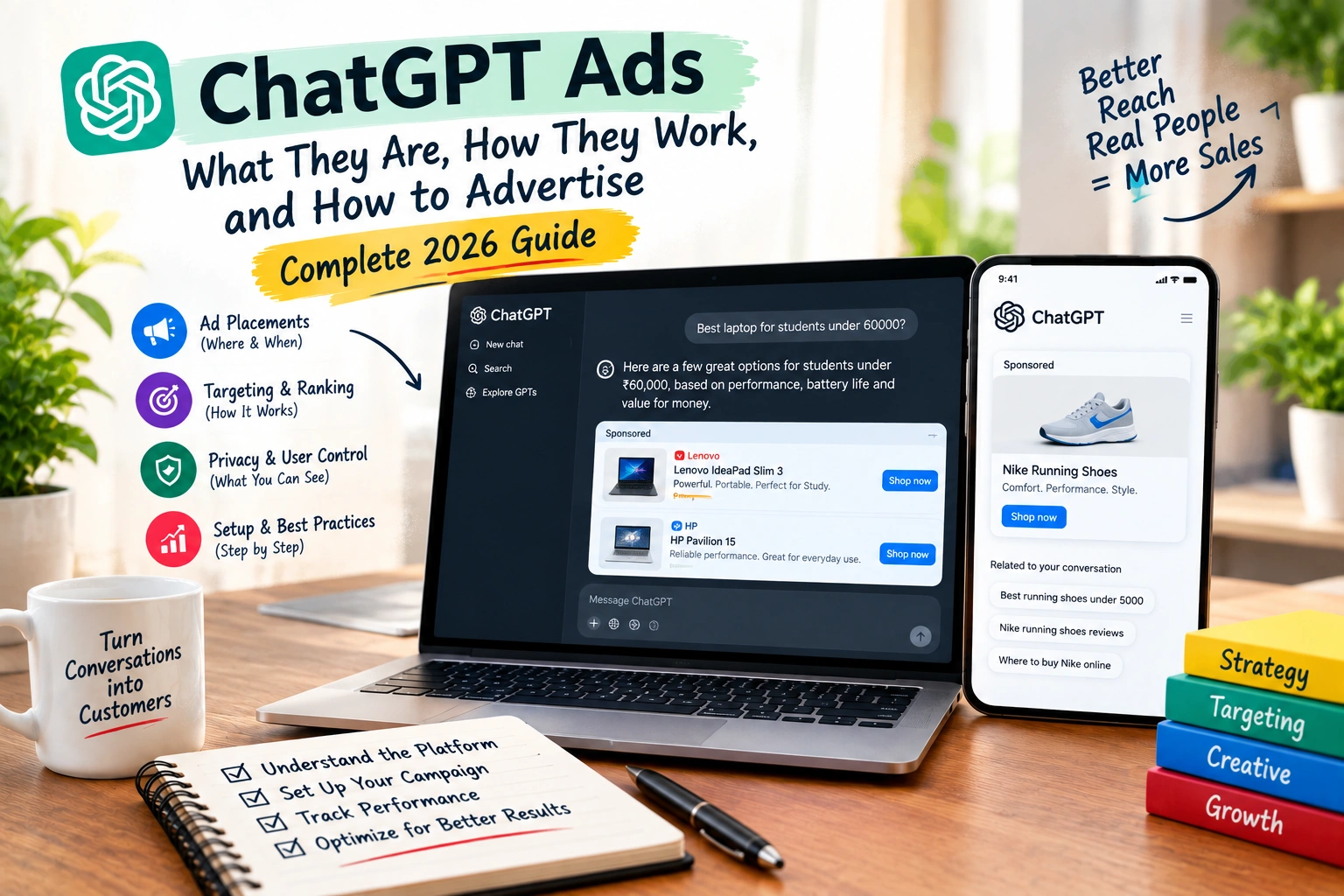
ChatGPT Ads is OpenAI’s advertising system, letting businesses place sponsored content inside conversations on the Free and Go plans. Ads appear below the end of a ChatGPT response, clearly labeled as sponsored and visually separated from the answer itself.
The pitch to advertisers is simple. People don’t just search on ChatGPT, they explore options, weigh tradeoffs, and make decisions in real time, which creates moments of genuine intent that a static search results page can’t fully replicate.
Unlike traditional search advertising, this system can draw on richer conversational context rather than a single typed query. A person asking for help building a backyard fence might see a relevant ad for cedar privacy panels appear directly beneath that response.
Why OpenAI Is Testing Advertising in ChatGPT
Running ChatGPT at the scale of hundreds of millions of users costs real infrastructure money. OpenAI has been direct about this being the reason for introducing a sponsored tier rather than raising subscription prices across the board.
The stated goal is supporting broader, free access to the product, not changing how it fundamentally works. Free and Go plan users get a way to keep using ChatGPT at scale, funded partly by advertising rather than entirely by subscriptions.
Paid plans stay untouched by this shift. Plus, Pro, Business, Enterprise, and Edu accounts do not see sponsored content at all, which keeps the monetization pressure isolated to the free tier specifically.
When and Where Ads Appear
Sponsored content shows up below the end of a ChatGPT response, never inside the answer text itself. A visible disclosure label marks it clearly as an ad, and it’s kept visually distinct from anything ChatGPT generated on its own.
During this test phase, sponsored placements do not appear inside the ChatGPT Atlas browser. That distinction matters for advertisers trying to understand exactly where their budget can and can’t reach right now.
A single response can surface one or more sponsored units when there’s a relevant match to the conversation. Each unit may feature a single advertiser or multiple advertisers, and for longer conversations, OpenAI also factors in overall context to avoid overloading the experience.
Who Actually Sees Ads
Eligibility is tied directly to plan type. Free and Go plan users may see sponsored content, while Plus, Pro, Business, Enterprise, and Edu accounts will not, regardless of how they use the product.
Age matters too. Accounts identified as belonging to users under 18 never see sponsored content, based on a mix of account-level age information and age-prediction signals where available.
Content sensitivity also affects visibility. Placements shown to logged-out users are kept appropriate for all audiences, while anything involving mature content is restricted to eligible logged-in adults only. Temporary Chats never show sponsored content at all.
How Ad Targeting and Ranking Works
The system selects placements based on expected relevance and likely outcomes, not just a matched keyword. It weighs several signals together: the context and intent of the current conversation, the advertiser’s landing page and copy, targeting selections the advertiser made, and, when personalization is enabled, select signals from the person’s broader usage history.
When multiple eligible placements compete for the same moment, ranking considers both relevance and advertiser bids together, similar in spirit to how traditional auction-based ad systems work. It’s not simply the highest bidder who wins every slot.
Personalization plays a meaningful role but isn’t required. Even with personalization turned off, someone still sees sponsored content relevant to their current chat thread, just without other chat history or interaction data factored in.
What Advertisers Can and Cannot See About You
Privacy protections here are stricter than many advertisers might expect. OpenAI does not share user conversations with advertisers, and it does not sell user data to advertisers under any circumstance.
Businesses running campaigns receive only aggregated, non-identifying performance data, things like total views or clicks. They never get access to a user’s chat history, memories, name, email, precise location, or IP address.
There’s one narrow exception worth knowing. If someone chooses to message an advertiser directly through a sponsored unit, for example to ask a product question, the advertiser only sees the messages that person sends them directly, nothing from the surrounding conversation.
User Controls: Personalization, Hiding, and Going Ads-Free
People aren’t stuck with whatever shows up. Settings under Ad Controls let a user turn personalization on or off, dismiss individual placements, see why a specific one was shown, and clear the data used to select them at any time.
Turning off personalization doesn’t remove sponsored content entirely, it just narrows what informs the selection down to the current chat thread alone. Full removal requires a different path.
Free plan users who’d rather not see any sponsored content can switch to an Ads-Free option, which trades sponsored content for lower usage limits and reduced feature access, including fewer daily messages and no access to certain tools. Anyone wanting both full features and zero sponsored content needs to upgrade to Plus or Pro instead.
OpenAI’s Stated Principles for Advertising
OpenAI has published a short set of principles guiding how this system was built, aimed at preserving user trust as monetization expands. Five ideas anchor the approach.
Mission alignment ties advertising directly to funding broader access to the product. Answer independence guarantees that sponsored content never shapes or influences what ChatGPT actually tells someone, since the two systems run separately.
Conversation privacy keeps chats fully private from advertisers, with no data ever sold. Choice and control means people can manage personalization and clear their data whenever they want. Long-term value means the company says it isn’t optimizing for time spent, prioritizing trust over pure revenue growth.
Categories That Are Off-Limits
Not every business can buy space here, and not every topic is eligible to carry a placement regardless of who’s paying. Certain sensitive and regulated categories face restrictions on both sides of the equation.
Placements are never shown near personal health conversations, mental health discussions, or political topics, no matter how relevant an advertiser’s product might technically be. Some advertisers in categories like health and financial services can qualify if they meet strict eligibility criteria, but even then, their content still won’t appear next to sensitive personal conversations.
Political advertising isn’t currently permitted on the platform at all. This is a meaningfully tighter restriction than what exists on most traditional search and social advertising platforms today.
Early Results From Advertisers
A handful of major retailers have already run early campaigns, including Newegg, Best Buy, Lowe’s, and VistaPrint. Newegg’s performance marketing team described wanting to be part of the conversation when someone is actively researching a purchase, treating this new surface as a consideration-building moment rather than a simple bottom-funnel click channel.
Best Buy and Lowe’s fall into a similar pattern: large retailers with broad catalogs who see value in appearing during the exploratory, comparison-heavy stage of a purchase decision, well before someone has settled on a specific product or brand. VistaPrint’s participation points to interest from mid-sized ecommerce brands as well, not just the largest national retailers with the biggest ad budgets.
These are still early, limited-scale tests rather than mature, benchmarked campaign data. Businesses evaluating whether to get in early should treat published case studies as directional signals of intent and interest, not as guaranteed performance numbers for their own category.
How to Get Started Advertising in ChatGPT
Getting a campaign live follows three broad stages, all managed through OpenAI’s dedicated Ads Manager platform rather than through ChatGPT itself.
The first stage is account and campaign setup. Sign up at the advertiser portal, then set your budget and campaign goal inside Ads Manager, choosing what outcome you’re actually optimizing for, whether that’s clicks, conversions, or another defined action.
The second stage is creative. Ad details can be bulk-uploaded through a CSV file for advertisers managing many products or offers at once, or built directly inside the tool for a simpler, single-campaign setup. This includes the landing page URL, headline, supporting copy, and any relevant targeting hints.
The third stage is measurement and iteration. Once live, advertisers can track impressions, clicks, and conversions through built-in analytics, then adjust campaigns based on what’s actually working rather than guessing. Because the available performance benchmarks are still thin compared to mature channels, it’s worth checking results weekly in the early going rather than waiting a full month to make the first round of adjustments.
Availability currently varies by country, and businesses in regions not yet supported can still create an account to get notified once access opens. New advertisers signing up have also been offered promotional ad credit as an incentive to test the platform early, which lowers the practical risk of running a first test campaign.
What This Means for Small and Local Businesses
Most of the public case studies so far come from large national retailers with sizable budgets and broad product catalogs. That doesn’t mean smaller, local businesses are excluded, but it does mean the playbook looks different for them.
A local service business is less likely to win from a broad, top-of-funnel placement and more likely to benefit from tightly scoped campaigns tied to specific, high-intent conversations, the kind where someone is actively comparing local providers rather than researching a product category in general. Budget efficiency matters more here than it does for a retailer with national reach and deep pockets.
Because targeting draws on conversational context rather than a fixed keyword list, smaller advertisers need clear, specific ad copy and landing pages that leave no ambiguity about what they offer and where they operate. Vague positioning that might work in a broad search campaign is less likely to trigger a relevant match in a context-driven system like this one.
How ChatGPT Ads Compares to Search Advertising
The closest comparison for most marketers is Google Search ads, but the mechanics differ in a few important ways. Traditional search ads match against a typed keyword query, while this system matches against the fuller context of an ongoing conversation.
That richer context is the core pitch: instead of guessing intent from three or four words typed into a search box, the system can draw on what someone has actually been discussing and comparing. In theory, this allows for more precisely relevant placements than keyword matching alone.
The tradeoff is data volume and maturity. Search advertising has two decades of benchmarking data across nearly every industry, while this newer channel has only a handful of public case studies so far. Early movers get access to lower competition and promotional incentives, but also less certainty about what a “good” cost per click or conversion rate actually looks like in their specific category.
Conclusion
ChatGPT Ads represents a genuinely different advertising surface, built around conversational context rather than keyword matching, with meaningfully stricter privacy protections than most existing ad platforms offer today. Ads only appear on Free and Go plans, stay clearly separated from ChatGPT’s actual answers, and are excluded entirely from sensitive personal topics and political content.
For advertisers, the appeal is reaching people in a genuine moment of research and decision-making, something search ads have always chased but rarely captured with this much conversational context. The tradeoff right now is limited historical performance data and country-by-country availability that’s still expanding, so early campaigns should be treated as tests, not guaranteed wins, while the platform matures.
How Dizispark Can Help
Dizispark helps businesses evaluate whether ChatGPT Ads fits their marketing mix alongside existing Google Ads and Meta campaigns, rather than treating it as a separate experiment run in isolation. That includes setting up Ads Manager accounts, building initial creative and targeting, and tracking early performance against a business’s actual cost-per-lead benchmarks from other channels.
For local businesses testing this new channel, Dizispark typically keeps GMB and other core listings optimized in parallel, since consideration-stage traffic from a new platform still needs a strong local presence to convert once someone searches directly. Every setup is scoped to the client’s specific category, since eligibility and available inventory still vary meaningfully by country and industry.
Frequently Asked Questions
What are ChatGPT Ads?
ChatGPT Ads are sponsored placements that appear inside ChatGPT conversations. ChatGPT Ads are clearly labeled as sponsored content and are visually separated from ChatGPT’s own answers. Businesses can use ChatGPT Ads to reach eligible users during moments of research, comparison, and decision-making. The ChatGPT Ads system is designed around conversational context rather than only traditional keyword matching.
Who can see ChatGPT Ads?
ChatGPT Ads are currently shown to eligible Free and Go plan users. Plus, Pro, Business, Enterprise, and Edu users do not see sponsored content. The visibility of ChatGPT Ads can also depend on age, content sensitivity, and whether the conversation is eligible for advertising. This means ChatGPT Ads do not automatically appear in every ChatGPT conversation.
How do ChatGPT Ads work?
ChatGPT Ads use several signals to determine which sponsored placement is relevant. These include the current conversation context, user intent, advertiser targeting, landing page, and ad copy. When multiple ChatGPT Ads compete for the same placement, relevance and advertiser bids both contribute to ranking. This makes ChatGPT Ads different from traditional search advertising that primarily relies on typed keyword queries.
How does ChatGPT Ads targeting work?
ChatGPT Ads targeting considers the context and intent of the current conversation. Advertisers can also provide targeting selections and relevant campaign information through Ads Manager. When personalization is enabled, selected signals from broader ChatGPT activity may also inform ad selection. As a result, ChatGPT Ads can match advertising opportunities with conversational intent rather than relying only on keywords.
Can advertisers see my conversations through ChatGPT Ads?
No. ChatGPT Ads do not give advertisers access to users’ private conversations. OpenAI states that conversations are not shared with advertisers and user data is not sold to advertisers. Advertisers receive aggregated performance information from ChatGPT Ads, such as views and clicks, rather than individual chat histories. This privacy structure is an important part of how ChatGPT Ads operate.
How do I advertise on ChatGPT?
Businesses can advertise using OpenAI’s dedicated Ads Manager. Setting up ChatGPT Ads involves creating a campaign, choosing a budget and goal, and adding the required creative and landing page information. Advertisers can then monitor impressions, clicks, and conversions from their ChatGPT Ads campaigns. Availability for ChatGPT Ads currently varies by country.
Are ChatGPT Ads available for small businesses?
Small businesses can potentially use ChatGPT Ads if advertising access is available in their market and their business meets the relevant requirements. A smaller advertiser should focus on specific customer needs, clear ad messaging, and relevant landing pages. ChatGPT Ads may be useful for reaching people during high-intent conversations, but the available performance data is still limited compared with mature advertising channels. Businesses testing ChatGPT Ads should therefore evaluate results carefully.
How do I advertise on ChatGPT?
Businesses sign up through OpenAI’s dedicated Ads Manager platform, where they set up a campaign, budget, and goal, then add creative either through bulk CSV upload or directly inside the tool. Once live, performance can be tracked and campaigns adjusted through built-in analytics covering impressions, clicks, and conversions. Availability currently varies by country, and businesses in unsupported regions can still create an account to be notified when access opens.