
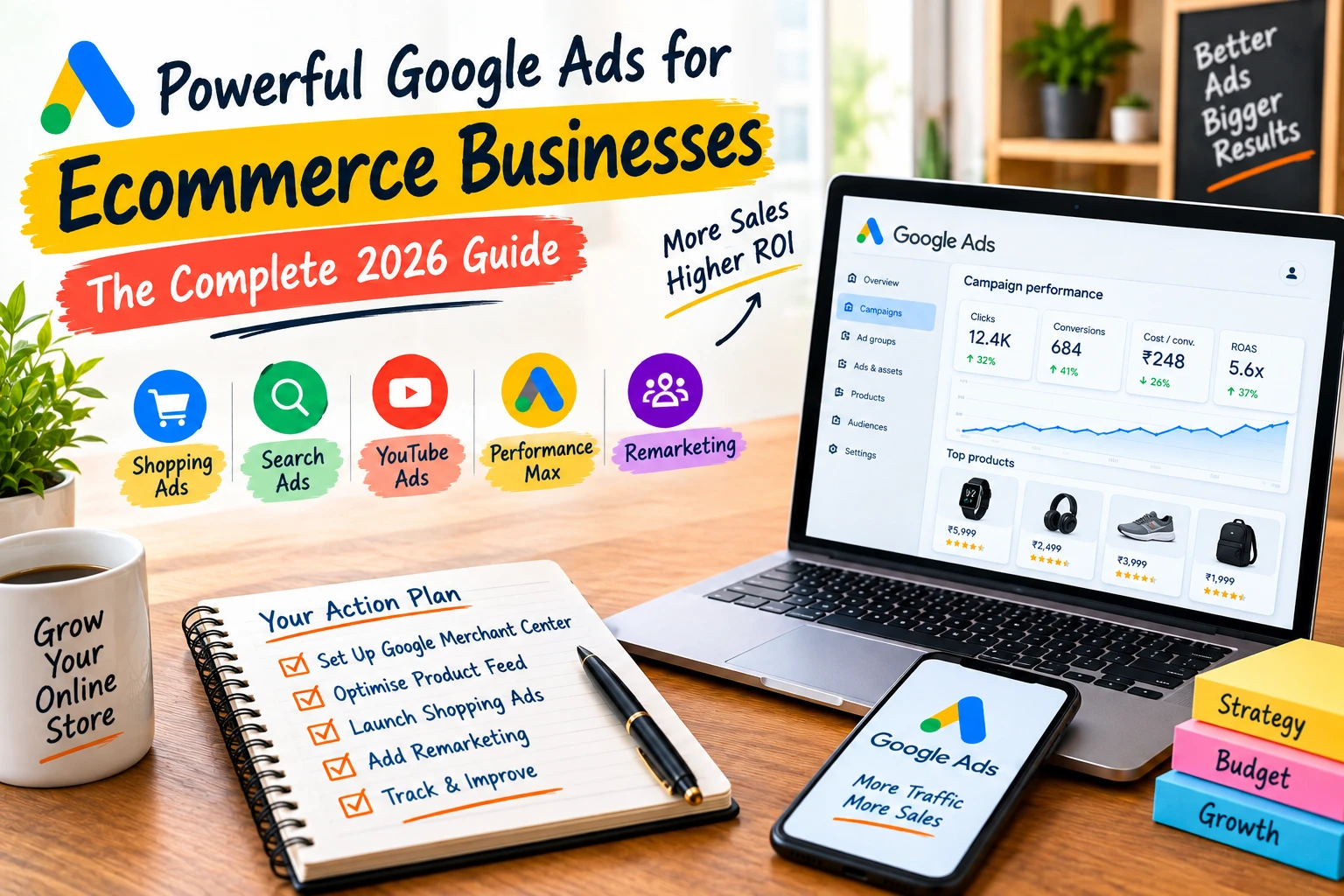
Google Ads for ecommerce businesses remains one of the highest-intent, most measurable paid channels available to online stores of any size in 2026. Store Growers confirms that as much as 18 percent of all ecommerce revenue is a direct result of running ecommerce ads on Google’s platform, based on 12 years of managing campaigns. Google’s official Ads Help documentation identifies Shopping campaigns, remarketing lists, and ecommerce tracking as the three advanced tools every ecommerce business should activate.
Real small business advice from the Shopify Community confirms a practical starting point, if the budget is tight, standard shopping gives more control over which search terms trigger ads compared to fully automated options. This guide covers exactly how to set up, budget, and scale google ads for ecommerce businesses of every size in 2026, from first campaign to full remarketing strategy.
Table of Contents
ToggleWhy Google Ads for Ecommerce Businesses Works So Well
Google’s official Ads Help documentation identifies Shopping ads as producing significantly higher click-through rates compared to text ads shown in the same position for the same search. This happens because Shopping ads display a product picture, price, and store name directly in the search results, giving shoppers the information they need before they even click.
Google confirms a second advantage: a Shopping ad and a text ad can appear for the same search simultaneously, which can double a business’s reach for a single query. Store Growers adds the intent dimension that separates Google Ads from social platforms: a user searching a specific product term is not looking to be entertained, they are looking to solve a problem and are often ready to transact.
This combination of visual product information, broader search real estate, and high purchase intent is what makes google ads for ecommerce businesses consistently outperform other paid channels for direct product sales.
How Much Budget Do Ecommerce Businesses Need for Google Ads?
Store Growers, who has managed over 5 million dollars in ad spend across 12 years, recommends a bare minimum of 10 dollars per day for the first month of testing. The ideal starting minimum is 1,000 dollars per month, which gives enough room to gather meaningful performance data without spreading too thin.
The right budget depends on three factors: how competitive the industry is, how long the typical sales cycle takes, and how much profit margin exists per sale. Store Growers stresses that businesses should not expect a profitable campaign from day one, and the first objective should be understanding what results are achievable before optimising further.
For businesses with a genuinely small budget, the advice from small-scale ecommerce sellers matches Store Growers directly keep the number of products or keywords low rather than spreading a small budget across too many items.
Standard Shopping vs Performance Max for Small Ecommerce Businesses
One of the most common questions from small ecommerce businesses is whether to start with Standard Shopping or Performance Max campaigns. Real advice shared in ecommerce seller communities confirms the practical guidance, if the budget is tight, start with Standard Shopping because it allows control over exactly which search terms trigger ads.
Performance Max can be excellent, but its full automation can quickly drain a limited budget before enough data accumulates to optimize properly. Store Growers confirms this exact recommendation from a professional standpoint, Performance Max campaigns need at least 30 conversions over 30 days to learn effectively, a threshold small business often have not yet reached.
For businesses just starting google ads for ecommerce businesses campaigns with a limited monthly budget, Standard Shopping remains the safer and more controllable starting point.
How to Set Up Shopping Campaigns for Google Ads for Ecommerce Businesses
Google’s official Ads Help documentation outlines the exact requirements for running a Shopping campaign, which is the recommended starting campaign type for most ecommerce businesses.
| Requirement | What It Means |
| Google Merchant Center Account | Link a Merchant Center account to the Google Ads account before any Shopping campaign can run |
| Product Feed | Set up a structured feed listing every product with title, price, image, and availability attributes |
| Automated Targeting | Shopping ads use product attributes from the feed to match relevant searches instead of manual keyword selection |
| Broader Search Coverage | A Shopping ad and a text ad can both appear for the same search, potentially doubling visibility for one query |
| Higher Quality Leads | Featuring price and product information directly in the ad helps shoppers arrive at the site already informed and ready to buy |
Remarketing: The Highest-ROI Tool for Google Ads for Ecommerce Businesses
Google’s official documentation confirms that remarketing shows ads specifically to people who have already visited the website, and returning visitors tend to be more receptive to tailored offers. Setting up remarketing requires a small code snippet, called a remarketing tag, placed on every page of the website to build the audience list automatically.
Google identifies three common list types of every ecommerce business should build, general site visitors as the simplest starting point, product category visitors for more targeted messaging, and shopping cart abandoners. Cart abandoners are identified specifically as a high-value audience because these shoppers have already added items to their cart and are very close to completing a purchase.
Store Growers confirms the important technical detail, audience segments should be added to campaigns as Observation, not Targeting, because Targeting would exclude every visitor outside that specific audience from seeing ads at all.
Ecommerce Tracking: The Data Foundation Every Campaign Needs
Google’s official Ads Help identifies Ecommerce tracking through Google Analytics as essential for understanding exactly what visitors buy through the website. Product-level data reveals which products sell well and, by inference, which products are genuinely well-suited to the customer base versus which ones simply have strong marketing behind them.
Transaction data including revenue per transaction and products per transaction reveals opportunities such as quantity discounts or free shipping thresholds if basket sizes are lower than desired. Time-to-purchase data shows the number of days and visits it typically takes a customer to buy, which helps forecast revenue and identify whether the site design needs improvement to shorten that journey.
Without this tracking foundation in place, optimising google ads for ecommerce businesses campaigns becomes guesswork rather than a data-driven process.
Common Mistakes Small Ecommerce Businesses Make with Google Ads
Store Growers and real small business feedback both identify the same recurring mistakes that prevent google ads for ecommerce businesses campaigns from becoming profitable.
| Mistake | What Goes Wrong |
| Spreading budget too thin | Running 200 products at 5 dollars a day for a month instead of focusing spend on the products most likely to sell |
| Expecting profit from day one | Treating the first month as a test phase to understand what results are achievable before demanding profitability |
| Choosing full automation too early | Selecting Performance Max before the account has enough conversion data, draining budget before the algorithm can learn |
| Skipping negative keywords | Not excluding irrelevant search terms, which wastes budget on clicks that will never convert to sales |
| No remarketing audience built | Missing the highest-ROI opportunity by not tagging the website and building cart abandoner and visitor lists |
| No ecommerce tracking configured | Making bidding and budget decisions without transaction data, which turns optimisation into guesswork |
Conclusion
Google Ads for ecommerce businesses in April 2026 works best when built in the right order, Shopping campaigns first, remarketing built early, and ecommerce tracking configured before scaling spend. Store Growers confirms that Shopping ads typically take the largest share of ecommerce ad budgets because they bring in high-quality visitors that convert well.
Google’s own documentation confirms that remarketing and ecommerce tracking are the two advanced tools that turn a basic campaign into a data-driven, continuously improving system. Real small business guidance from the ecommerce seller community reinforces the professional advice, start with Standard Shopping for control, keep the product or keyword list focused if budget is limited, and expand once data supports it.
Businesses that follow this sequence consistently outperform those that jump straight to full automation before their account has the data needed to make it work.
How Dizispark Can Help
Dizispark is a Delhi-based Google Ads and ecommerce performance marketing agency that sets up and manages complete google ads for ecommerce businesses campaigns for online stores across India, covering Google Merchant Center configuration, Shopping campaign structure, remarketing audience building, ecommerce tracking setup, budget planning by product category, and a fully optimised Google My Business Profile that strengthens local search visibility alongside every paid campaign we manage.
We start every account with the disciplined foundation that actually produces profitable results:correct feed setup, focused product targeting matched to real budget, and remarketing built in from day one rather than added as an afterthought. Reach out to Dizispark today and start running Google Ads for your ecommerce business with a strategy built to scale profitably.
Frequently Asked Questions
How do I start Google Ads for my ecommerce business?
Start by linking a Google Merchant Center account to Google Ads and uploading a structured product feed with accurate titles, prices, and images. Store Growers recommends launching with Standard Shopping campaigns first before adding Search or Performance Max, because Shopping ads bring in high-quality visitors that convert well. Set a realistic testing budget of at least 10 dollars per day and expect the first month to be about learning rather than immediate profit.
How much should a small ecommerce business spend on Google Ads?
Store Growers recommends a bare minimum of 10 dollars per day for the first month of testing, with an ideal starting minimum of 1,000 dollars per month. The right amount depends on industry competitiveness, sales cycle length, and profit margin per sale, with more competitive or lower-margin products needing a higher budget. Small business advice from ecommerce seller communities confirms that if budget is tight, it is better to keep the product or keyword list focused rather than spreading a small budget across too many items.
Should I use Shopping ads or Performance Max for a small ecommerce business?
For small businesses with a limited budget, Standard Shopping is the recommended starting point because it allows control over exactly which search terms trigger ads. Real seller advice confirms that Performance Max, while powerful, can quickly drain a limited budget before enough data has accumulated to optimize properly. Store Growers confirms professionally that Performance Max needs at least 30 conversions over 30 days to learn effectively, a threshold many small accounts have not yet reached.
What is remarketing and why does it matter for ecommerce Google Ads?
Remarketing shows ads specifically to people who have already visited the website, and Google confirms these returning visitors tend to be more receptive to tailored offers. Setting it up requires placing a remarketing tag on every page of the website to automatically build audience lists over time. Google identifies shopping cart abandoners as the most valuable remarketing audience because these shoppers already added items to their cart and are close to completing a purchase.
What is ecommerce tracking and do I need it for Google Ads?
Ecommerce tracking, set up through Google Analytics, shows exactly what visitors buy through the website including which products sell, revenue per transaction, and time to purchase. Google’s official documentation confirms this data helps identify which products are genuinely well-suited to the customer base versus which ones simply have strong marketing behind them. Without ecommerce tracking configured, optimizing bids and budgets for google ads for ecommerce businesses becomes guesswork rather than a data-driven process.
Why are my Google Shopping ads not getting clicks?
The most common causes are an unoptimized product feed with weak titles, Google Merchant Center errors that prevent ads from showing, or a budget spread across too many products at once. Store Growers confirms that product titles are the most important feed attribute since Google matches search queries to titles rather than manually chosen keywords. Reviewing and fixing all flagged errors in Merchant Center, along with focusing budget on fewer, higher-priority products, typically resolves low click volume quickly.
What is a good first campaign structure for a new ecommerce business on Google Ads?
Store Growers recommends starting with a single, well-organized Standard Shopping campaign built around a clean, accurate product feed rather than launching multiple complex campaigns at once. Once the Shopping campaign has enough performance data, Search campaigns targeting high-intent keywords can be added as a second layer. Remarketing should be built in from the very beginning by installing the tracking tag, rather than treated as an advanced feature to add later.
How long does it take for Google Ads to become profitable for an ecommerce business?
Store Growers is direct on this point businesses should not expect a profitable campaign from day one, and the first month should be treated as a learning period. The timeline to profitability depends heavily on the factors identified earlier, industry competitiveness, sales cycle length, and profit margin, with lower-margin products generally needing more testing time. Building remarketing audiences and ecommerce tracking early shortens this timeline because the campaign gains access to higher-converting audiences and better optimization data sooner.