
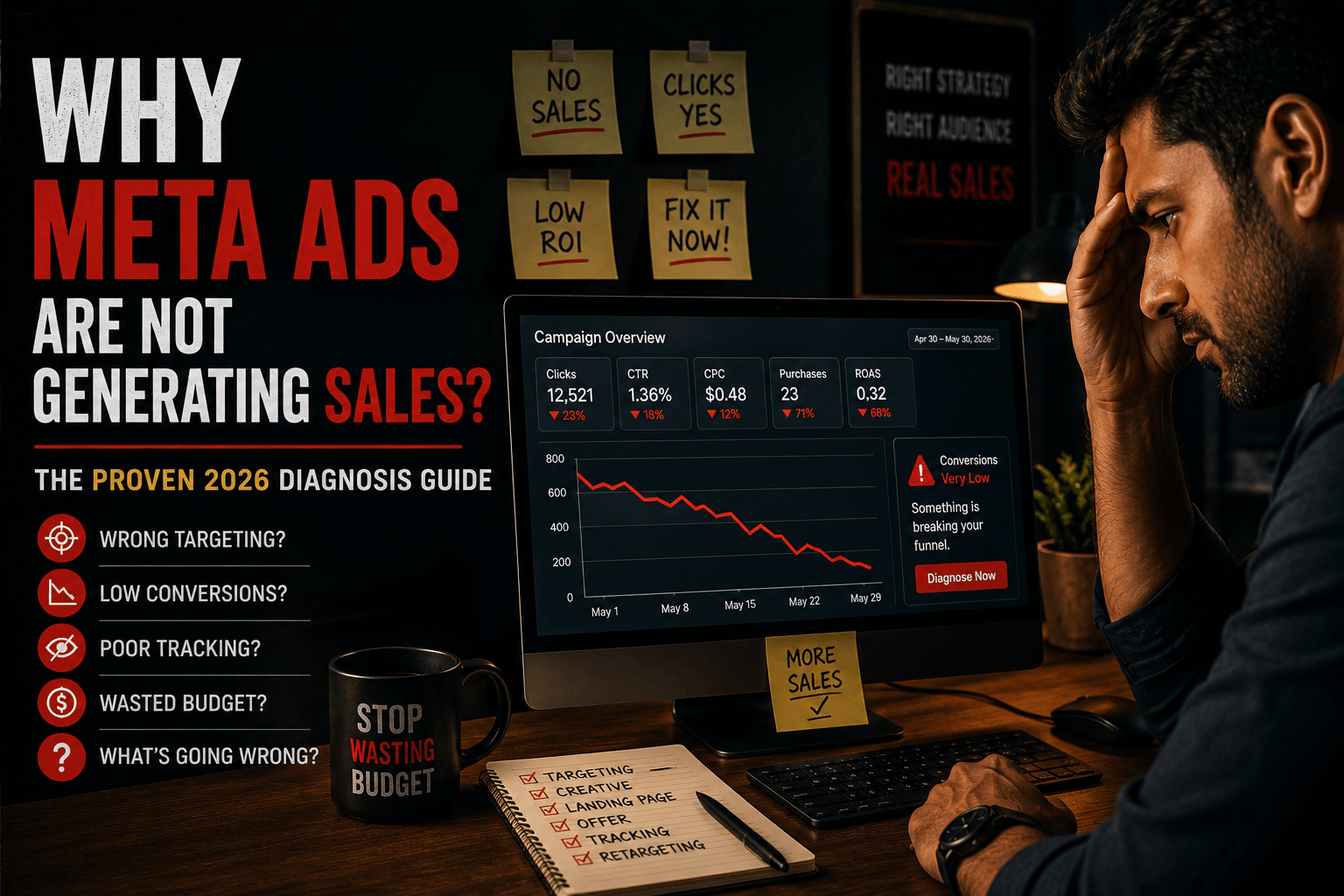
Why Meta Ads are not generating sales is one of the most common frustrations in paid social right now: the campaign shows traffic, the click-through rate looks fine, the cost per click looks cheap, and the ad account looks active, yet revenue stays flat. This usually is not a sign that Meta, Facebook, or Instagram advertising has stopped working. It is a sign that somewhere between the click and the completed purchase, the buying path is breaking, whether that is the campaign objective, the offer, the tracking, or the landing page, and the good news is that this breakage is almost always diagnosable once you know where to look.
Why Meta Ads Are Not Generating Sales: The Core Problem
A click only proves that someone was curious enough to visit. It does not prove the person was ready to buy, that the offer made sense, or that Meta received a clean signal once a purchase happened. That gap is exactly why “Meta Ads get clicks but no sales” is such a common, easy-to-misread problem CTR, CPC, and impressions can all look healthy while the deeper buying path is quietly broken.
The instinct when sales stall is usually to blame the algorithm or throw more budget at the problem. That instinct is almost always wrong. The real issue sits in one of a handful of predictable places, covered in the Meta Business Help Center and explored in more depth in our Meta Ads for Local Businesses guide, and finding the actual break is far cheaper than guessing.

10 Real Reasons Meta Ads Are Not Generating Sales
1. Wrong Campaign Objective
The single most common reason Meta Ads get clicks but no sales is a mismatched campaign objective. If the account is optimizing for Traffic, Engagement, or Landing Page Views, Meta will find people who are likely to click, not people who are likely to buy. This happens because Meta genuinely does exactly what it is told. A Traffic campaign is trained to find clickers, and clickers are not the same audience as buyers, even though the two groups overlap somewhat.
Add-to-cart campaigns carry the same trap. Training the algorithm on add-to-cart behavior signals that add-to-carts are valuable, whether or not those carts ever convert into a completed purchase.
The fix is straightforward once diagnosed: move the campaign to a Sales or Purchase objective once tracking and event quality are clean, and stop judging purchase performance from a campaign that was never optimizing for purchases in the first place.
2. Not Enough Budget to Generate Purchase Signal
Even a correctly configured Sales campaign can stall if the daily budget is too thin relative to the target cost per acquisition. Meta needs enough purchase events flowing through the account to actually learn who buys. A useful rule of thumb is to keep daily spend above roughly one and a half times the target CPA, with three times or more giving the account a stronger chance of generating consistent feedback.
Below that threshold, the campaign is technically optimizing for the right event but starving for data, which leaves Meta guessing rather than learning. When clicks are coming in but sales feel rare, checking budget-to-CPA fit before touching creative or targeting again is one of the fastest ways to find the real bottleneck.
3. Cheap Clicks Are Curiosity, Not Buying Intent
A high click-through rate and a low cost per click can look like a win on the dashboard while hiding the actual problem underneath. Cheap clicks are not automatically valuable clicks. Creative that leans on a strange visual, a bold claim, or a quick emotional hook earns attention, but attention is not the same thing as purchase intent once someone actually lands on the page.
The tell is usually in the numbers past the click: strong CTR paired with a weak add-to-cart rate or a near-empty checkout rate points to curiosity traffic rather than qualified buyers.
Revising the creative to pre-qualify buyers, showing the price or offer clearly, making the use case obvious, and cutting vague curiosity hooks, usually improves the ratio of clicks that actually turn into sales.
4. Ad Promise Does Not Match the Landing Page
Once objective and click quality are ruled out, the next place to check is embarrassingly simple and often skipped: the exact URL the ad actually sends people to. If the ad promises a discount, a bundle, or a specific product, and the landing page shows something different, undiscounted pricing, an unavailable bundle, a generic homepage, the sale dies the moment the page loads.
This is not only a Meta problem. Whether it is called ad-to-page match or landing page alignment, a break here means the ad built the expectation and the page failed to confirm it. Opening the live ad link regularly and comparing it against the promise in the creative catches this before it quietly drains the budget for days or weeks.
5. Weak Offer or Inventory Gone
A landing page can look completely fine and still be broken from a conversion standpoint if the actual offer behind it has changed. A discount can expire, a bundle can disappear, or a product can go out of stock while the ad keeps running unchanged. This is exactly what happened to one D2C brand running a bundle offer: performance had been strong at a healthy return on ad spend, then dropped sharply when the discounted bundle quietly reverted to full price.
From inside Ads Manager, this looks like an algorithm problem or ad fatigue. It is neither. It is an offer continuity problem that ads reporting alone cannot reveal. Keeping a live inventory and offer check between whoever runs the ads and whoever manages the product catalog prevents this exact kind of silent, costly mismatch.
6. Broken Pixel and Conversion API Tracking
Sometimes sales genuinely are happening, but Meta never finds out about them cleanly, which leaves the algorithm optimizing on incomplete or duplicated data. Both under-reporting and over-reporting distort the diagnosis. As browser-based tracking has grown less reliable, server-side tracking through the Meta Conversions API has become the more dependable way to send purchase events back to the platform, but only if it is configured correctly.
Shopify, custom checkout flows, and app or payment experiences can show a completed order in the CMS while Meta receives that same event late, incompletely, or not at all, which quietly weakens what the campaign learns from real buyers. Testing Pixel and CAPI events, checking for duplicates, and cross-referencing orders against UTM parameters closes this gap and gives Meta the clean signal it needs to actually improve.
7. Audience Too Broad or Built on Basic Demographics Only
Targeting “All India, Age 18 to 50” or a similarly wide net brings volume, not relevance, and relevance is what actually produces sales rather than impressions. The opposite mistake, relying only on basic demographic filters like age and gender inside a saved audience, is just as limiting, since simple demographic data rarely identifies people who are actually ready to buy.
Audiences built from real signals, website visitors captured through the Pixel, an uploaded customer list, people who engaged with the Page or Instagram profile, consistently outperform demographic guesswork because they reflect actual behavior instead of assumptions. A tightly built lookalike audience, often at the smaller 1 percent size rather than a broad 10 percent, has repeatedly been shown to produce a meaningfully lower cost per result than a larger, looser audience built the same way.
8. Ads Are Not Click-Worthy or Compelling
If the objective, tracking, and offer are all in order, weak creative itself can still be the ceiling on performance. Meta is a visual, fast-scrolling platform, and generic stock imagery rarely earns a second look. Ad copy that leads with a feature instead of a problem, “join our program today” instead of speaking to a real frustration, fails to give anyone a reason to stop scrolling in the first place.
Native, feed-style formats consistently outperform polished, agency-looking creative: real people, a strong hook in the first second, vertical video with subtitles, and a clear single call to action.
Testing several creative variations at once, different hooks, different formats, different angles, is the only reliable way to find out which version actually earns both the click and the sale.
9. Interrupting the Learning Phase Too Soon
Meta’s algorithm needs a meaningful number of conversion events, roughly fifty per ad set, before it exits the learning phase and starts delivering consistently. Judging a campaign before that point usually leads to the wrong conclusion. Editing the budget, swapping creative, or adjusting the audience within the first day or two resets this learning process and wastes whatever data had already been collected.
The instinct to “fix” an underperforming campaign after 48 hours is understandable but usually counterproductive, since the algorithm has not yet had a fair chance to find the right audience. Letting campaigns run for at least 72 to 96 hours, and ideally seven to fourteen days for accounts still building purchase history, gives Meta the room it actually needs to convert clicks into consistent sales.
10. No Retargeting or Frequency Strategy for Cold Traffic
Most first-time visitors are not ready to buy, and treating every visitor the same as a warm, ready-to-purchase lead wastes a large share of the ad budget on people who simply need more time. A large share of eventual conversions come from retargeting rather than cold prospecting, which means an account with no retargeting layer is leaving a substantial share of achievable sales on the table.
Cookie and lookback windows matter here too: the default 30-day window is often too short for slower-moving purchase decisions, and extending it to 60 or 90 days can capture buyers who simply needed a longer runway to decide.
Layering in frequency, prioritizing people who have visited a site two or more times, or watched a meaningful share of a video, builds a warmer, more responsive audience than treating every past visitor identically.
Quick Reference: 10 Reasons Compared
| Reason | What It Looks Like | Fastest Fix | Where to Check |
|---|---|---|---|
| Wrong Campaign Objective | Clicks or engagement rise, sales stay flat | Switch to a Sales or Purchase objective | Campaign-level settings |
| Budget-to-CPA Mismatch | Few or no purchase events despite steady spend | Raise budget to 1.5 to 3 times target CPA | Ads Manager reporting |
| Curiosity Clicks | High CTR, weak add-to-cart or checkout rate | Make price and offer clear in the creative | Funnel metrics, CTR vs ATC vs Purchase |
| Ad-to-Page Mismatch | Visitors bounce right after clicking | Match the landing page to the ad promise | Open the live ad URL directly |
| Offer or Inventory Gone | Sudden drop with no account changes made | Restore or update the discount or bundle | Live product and discount page |
| Broken Tracking | CMS shows sales, Meta shows very few | Fix Pixel and CAPI, test events | Events Manager, UTM cross-check |
| Audience Too Broad or Basic | Huge audience size, low relevance | Build a lookalike from real customer data | Audience size and source |
| Weak Creative or Copy | Low CTR, generic stock visuals | Test native, benefit-led creative variations | Ad-level CTR benchmarks |
| Learning Phase Interrupted | Erratic results, frequent manual edits | Stop editing for 72 to 96 hours | Ad set “Learning” status |
| No Retargeting | Cold-only traffic, one-time visitors | Add retargeting and extend lookback window | Custom Audiences setup |
Conclusion
Why Meta Ads are not generating sales almost never comes down to one single broken setting. It is usually a chain: an objective that trains the algorithm toward the wrong behavior, a budget too thin to generate clean signal, an offer or landing page that no longer matches the ad, tracking that fails to report purchases cleanly, or an audience and creative combination that earns attention without earning trust.
Working through the ten reasons above in order, starting with objective and tracking before touching creative or targeting, is consistently the fastest way to find where the buying path is actually breaking. Once the basics are clean and sales still are not following clicks, the issue usually sits deeper in signal quality or audience saturation, which is worth a dedicated account review rather than another round of guesswork.
How Dizispark Can Help
Dizispark, a Delhi-based digital marketing agency, runs a structured Meta Ads audit for brands stuck at clicks but no sales, checking campaign objective, Pixel and CAPI tracking, offer alignment, and creative performance in one pass, alongside Google My Business optimisation so paid and local search visibility reinforce each other rather than working in isolation. For business owners who suspect something in the funnel is broken but cannot pinpoint exactly where, having a team run this diagnosis end to end is usually faster and cheaper than testing changes one at a time.
Frequently Asked Questions
Why is my Meta Ads getting clicks but no sales?
Meta Ads can get clicks without sales when the objective is not aligned with purchases, traffic is low intent, the landing page does not match the ad, or tracking is broken. Checking objective, offer, and tracking first usually finds the issue faster than changing creative.
What campaign objective should I use if I want purchases?
A Sales or Purchase objective is almost always the right starting point when the goal is revenue rather than traffic or awareness.
How much budget do I need for Meta Ads to convert?
A helpful benchmark is daily spend at 1.5 to 3 times your target cost per acquisition, since the account needs enough purchase events to generate reliable learning.
Why do my Facebook ads have a high CTR but no conversions?
A high CTR with few conversions usually means the creative earns curiosity clicks rather than buying intent. Comparing CTR against add-to-cart and checkout rate reveals whether traffic is actually qualified.
Can bad tracking cause Meta Ads to show no sales?
Yes. If Pixel or Conversions API events are missing, delayed, or duplicated, Meta may never learn from real purchases even when those purchases are genuinely happening.
How long should I wait before judging a Meta Ads campaign?
Most campaigns need at least 72 to 96 hours, and often a full week or two, to exit the learning phase and generate enough data.
Does audience targeting affect whether Meta Ads convert?
Yes. Targeting that is too broad brings volume without relevance, while audiences built only on basic demographics miss real buying signals.
Should I use retargeting if my Meta Ads are not converting?
Almost always, yes. A meaningful share of eventual sales come from retargeting rather than cold traffic, so an account without a retargeting layer is likely leaving sales on the table.