
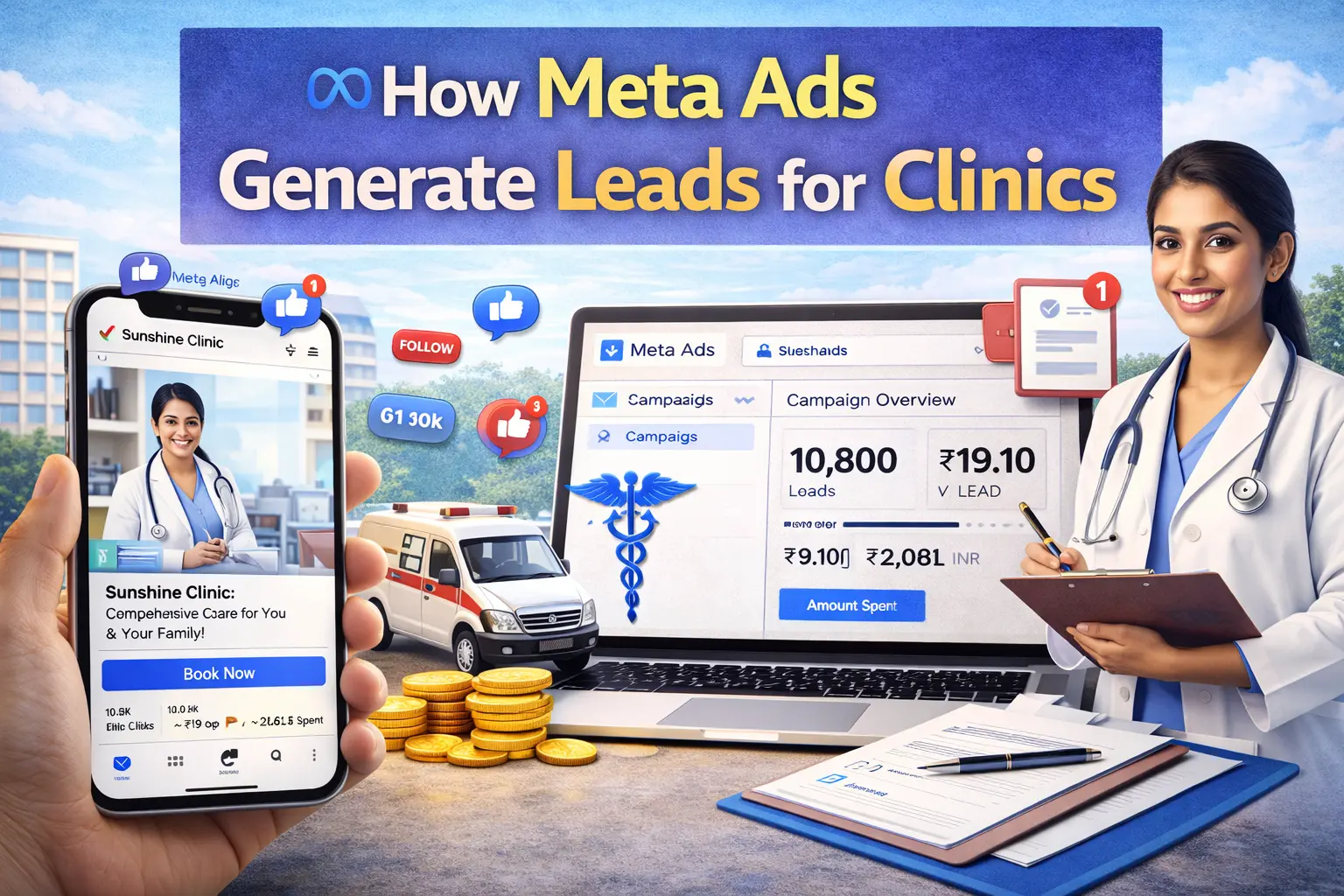
“Meta ads don’t work for clinics” is a statement you hear often. But here’s the truth: when clinics say this, they’re usually running ads without the structure required to convert. The platform works. The execution is what fails.
Consider this: 70% of users now research healthcare providers through social media before deciding. And in January 2026, the average cost per lead for clinics in India crossed ₹200, with small clinics spending ₹1,500+ daily just to maintain steady patient flow. This is the reality of healthcare advertising today. Understanding how meta ads generate leads for clinics isn’t about finding a single hack. It’s about building a complete system: compelling offers, tight targeting, authentic creative, speed to lead, and compliant messaging. In this guide, we’ll break down exactly how successful clinics are using Meta platforms to fill their appointment books with quality patients.
Why Meta Ads Are Essential for Clinics in 2026
1. The Shift in Patient Discovery
Patients no longer depend only on referrals or newspaper ads. They actively seek information online, compare options, and make decisions within minutes. With billions of active users across Facebook and Instagram, Meta platforms have become where patients discover, evaluate, and choose healthcare providers.
2. The Power of Local Targeting
Meta’s hyper-granular targeting allows clinics to reach patients within specific geographic areas. A physiotherapy clinic generated 150+ local leads per month using just a 4-mile radius. Another local clinic reduced CPL by 28% and confirmed 120+ appointments in 30 days. ZIP code targeting, radius-based ads, and behavioral filters ensure your budget reaches the right people.
3. High Conversion Potential
Meta Ads average conversion rate for lead generation campaigns is 8.78%. Dental services report rates near 9.8%. Multi-channel campaigns deliver 24% higher conversion rates than single-channel approaches. When done right, the numbers prove that meta ads generate leads for clinics effectively and consistently.
Campaign Types That Work for Clinics
Meta offers six core campaign objectives. Choosing the right one depends on your clinic’s goals:
| Campaign Type | Purpose | Best For |
|---|---|---|
| Awareness | Brand visibility | New clinics, service launches |
| Traffic | Drive to website | Appointment forms, educational blogs |
| Engagement | Post interactions | Patient testimonials, trust building |
| Leads | Direct inquiries | Appointment bookings, consultations |
| App Promotion | App downloads | Clinic apps for scheduling |
| Sales | Conversions | Well-optimized booking systems |
For most clinics, a combination of Awareness and Leads campaigns works best. Start with Awareness to introduce your brand, then run Leads campaigns to capture patient inquiries directly through Facebook and Instagram forms.
Campaign Types That Work for Clinics
1. Meta’s 6 Core Campaign Objectives
Meta streamlined its campaign objectives in 2022, reducing 11 options to 6 simplified types. Each serves a specific purpose in how meta ads generate leads for clinics.
Awareness campaigns increase brand visibility among people who may not know you yet. These are ideal for new clinics, service launches, or brand building campaigns. They introduce your clinic to the local community and establish presence before you ask for appointments. Traffic campaigns drive users to your website, landing pages, or blog. Use these to promote service pages, appointment forms, or educational content. If you publish regular healthcare blogs or resources, traffic campaigns bring readers to your site and build authority over time. Engagement campaigns encourage interactions on your posts or page.
They’re great for building trust and showcasing patient success stories. When someone likes, comments, or shares your content, it signals to their network that your clinic is worth considering. Leads campaigns collect patient inquiries directly through Facebook or Instagram forms. These are perfect for appointment bookings, free consultation offers, or newsletter signups. Lead forms reduce friction because Meta pre fills contact information, making it easier for patients to reach out. App promotion campaigns help if you have a mobile app for appointment scheduling. They drive downloads and increase patient engagement through your platform.
Sales campaigns focus on conversions and measurable actions like bookings or purchases. These are advanced options for well optimized campaigns aimed at generating high quality leads.
2. Which Campaign Type Should You Choose?
If you’re a new clinic or launching a new service, start with Awareness campaigns. Introduce your brand and build credibility among your local community before asking for appointments. If you already have brand recognition and want to increase patient inquiries, run Leads campaigns. Collect appointment requests, consultations, or signups directly through forms.
If you want to create buzz around patient testimonials or success stories, use Engagement campaigns. Drive likes, comments, and shares to deepen patient trust. If you have a well optimized online booking system and want to maximize conversions, try Sales campaigns focused on driving bookings or registrations.
3. Case Study: 271 Leads in 30 Days with Instant Forms
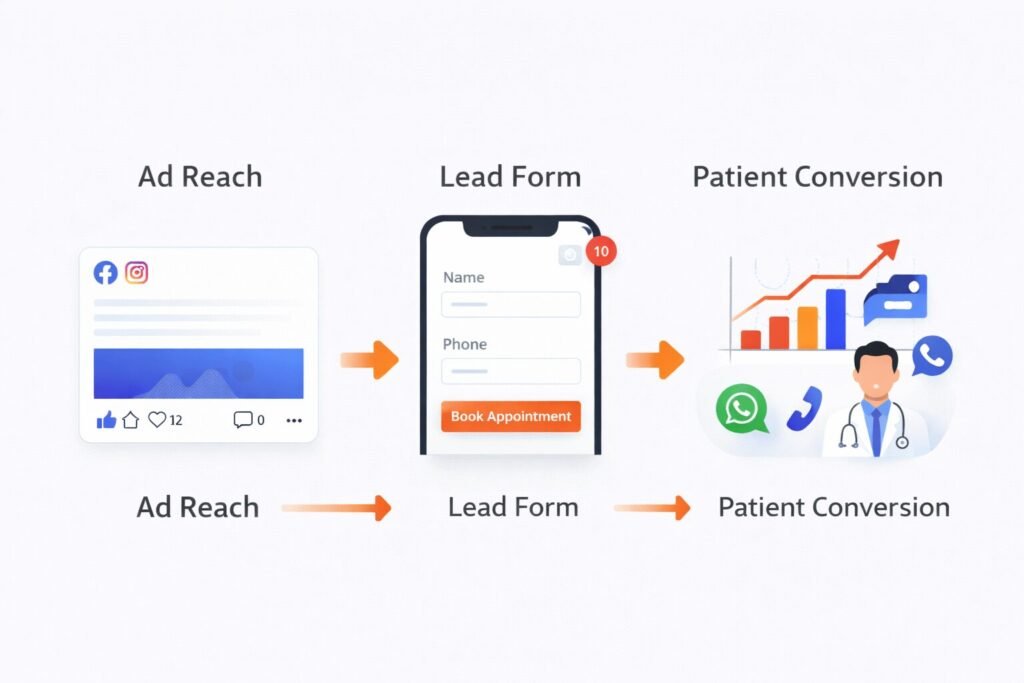
A health clinic used Meta Lead Ads with native Instant Forms to test how meta ads generate leads for clinics with minimal friction. They added one qualification question to filter intent while keeping the form easy to complete. The results speak for themselves. They generated 271 leads across three campaigns at $4.86, $4.99, and $9.52 per lead. That’s consistent, predictable lead flow at a cost that makes business sense.
Strategy 1: Raw User Generated Content (UGC) Ads
The average person sees over 60 ads daily. If your ad looks like an ad, it won’t sell. Video ads that blend with normal content convert much better than traditional polished spots. Self-shot videos beat studio shoots. Phone cameras, imperfect lighting, and real-life backgrounds signal authenticity. People trust what feels real, not what feels produced.
To create UGC ads that convert:
Start with first person language. Use “I,” “me,” and “my” instead of “we” and “us.” First person narratives remove the brand from the conversation and create connection.
Use proven formats like “This is what happened when I tried this,” “Nobody told me this about,” or “I tried this for 14 days.” Time bound experiments and shared journeys trigger curiosity and credibility.
The first 2-3 seconds must feel familiar, not interruptive. This prevents immediate scrolling and gives your ad a chance.
Meta’s algorithm rewards ads that generate watch time, reactions, and comments. When users engage longer, distribution improves and CPL decreases. Content that feels organic is treated more favorably, even when it’s paid promotion.
Strategy 2: Direct Response Creatives
Strong direct response creatives drive immediate action while building memory and trust. They combine three essential elements: a clear problem, a targeted solution, and a direct CTA. Viewers must understand your entire offer in just 2 seconds. No confusion. No detours.
To create hooks that convert:
Interrupt the scroll instantly. Call out the pain point in the first sentence. Challenge a common belief. Show a surprising visual. Focus on outcomes: comfort, confidence, speed, relief, and savings.
Build brand memory through performance ads. Show the same problem in different ways. Use consistent brand colors, ad formats, and design. Push audiences to remember the pain, the solution, and even the same voice. The goal is to build recall through performance, then leverage that recall to lower future costs.
Lead with problem, outcome, and clear CTA. Add testimonials, UGC, and expert POVs. Create urgency with limited time offers. Use bold problem statements and contrasting colors for visibility.
Strategy 3: Master Hook Rate and Hold Rate
Hook rate measures how many people watch the first 3 seconds of your ad. Those first 3 seconds are your audition. Meta uses them to decide if your content deserves distribution. Low hook rate means higher costs, regardless of offer strength. Hold rate measures how long people stay after the hook. Longer watch time signals content quality and relevance. Meta rewards quality with cheaper, broader reach.
To improve both metrics:
Start with disruption visually or verbally. An unexpected opening line or visual slows the scroll. State the pain point immediately. No warm up. No teasing. Avoid slow intros, logos, or greetings. “Hi, my name is” is dead in Meta advertising. You have 1-2 seconds to convince viewers to take action.
Strategy 4: Speed to Lead and Follow Up Systems
Generating a lead is only step one. What happens in the first 5-10 minutes determines whether that lead becomes an appointment. The first clinic to respond usually wins. Every new lead must be contacted immediately. Not the next day. Not when someone has time. Immediately. Even if patients book online on their own, call them anyway. A quick phone call increases show up rate dramatically. When someone hears a real person confirm their appointment, answer a question, or simply welcome them, the likelihood they show up increases significantly.
Build a structured follow up system:
Send automated texts to front desk staff to call immediately. Send automated text messages every other day until they book. Send automated weekly emails for nurturing. Once booked, remove them from the workflow.
Every additional touchpoint increases conversion probability. Ten touches always outperform one touch. Ads generate attention. Follow up generates revenue.
Strategy 5: Healthcare Compliance for Meta Ads 2026
Meta enforces strict policies for healthcare advertising. In 2026, interpretation has become stricter. Meta flags ads more aggressively for implied personal attributes.
What is NOT allowed:
Direct references to medical conditions like “Are you suffering from X?” Before and after imagery for health, weight loss, or cosmetic outcomes. Exaggerated claims, miracle results, or guarantees. Ads that pressure users emotionally or imply negative self worth.
What IS allowed with proper execution:
Educational and informational content. Neutral language focusing on services and general benefits. Third person or general phrasing that avoids “you” statements. Let audiences self identify rather than being told who they are.
Meta reviews the full funnel: ad plus landing page. One non compliant sentence on your page can override a compliant ad. Ensure your landing page matches your ad messaging.
Ad Formats That Work Best for Clinics
1. Video Ads
Video ads are the most powerful format for how meta ads generate leads for clinics. They allow storytelling, staff introductions, and facility tours. Patients get a feel for your clinic before they ever visit.
Keep videos under 30 seconds for maximum completion rates. Use local faces and real environments to build trust. The physiotherapy clinic success story relied heavily on local video ads filmed in recognizable areas.
2. Carousel Ads
Carousel ads showcase multiple services or team members. Multi service facilities benefit from highlighting different offerings in one ad. Users can swipe through and engage with what interests them most.
3. Static Image Ads
Static images work well for quick hits, seasonal promotions, or single focus messages. Keep visuals clean with one main subject and a clear CTA. Avoid clutter that distracts from your message.
4. Lead Ads with Instant Forms
Lead Ads with Instant Forms reduce friction dramatically. Meta pre fills contact information from user profiles, making it easy for patients to reach out. Add 1 to 2 qualification questions to filter intent without creating too much friction.
The case study generating 271 leads at under $10 CPL used Instant Forms. This format consistently outperforms sending traffic to external landing pages for many clinics.
5. Stories Ads
Stories ads provide lightweight engagement in mobile environments. The vertical format feels native to how users already consume content. Use them for time sensitive offers or quick reminders.
Budgeting for Clinic Meta Ads
1. Recommended Monthly Budgets
Small local clinics should plan for ₹10,000 to ₹25,000 monthly. This provides enough data for testing while maintaining consistent presence. Growing service businesses targeting broader areas need ₹25,000 to ₹50,000 monthly. Scaling brands with multiple locations or competitive specialties should plan for ₹50,000 plus monthly.
2. Budget Allocation Strategy
Allocate 80% of your budget to scaling campaigns. These contain only proven ads that have already hit your target cost per lead. Once ads start to wear off and exceed your threshold, turn them off. Allocate 20% to testing campaigns where new ideas live. New hooks, new creatives, new angles start here. If an ad hits or beats your target cost per lead, promote it to the scaling campaign where it receives more budget and stability. Create new video ads every week. This ensures fresh hooks constantly enter the system, creative fatigue is managed proactively, winning ads are identified quickly, and losers are removed promptly.
3. Cost Saving Tips
Test before scaling. Never increase budget on unproven campaigns. Use negative keywords and targeting exclusions to block irrelevant viewers. Target locally first and expand only after finding a winning formula. Track CPL and lead quality together, not just vanity metrics.
Common Mistakes Clinics Make with Meta Ads
| Mistake | Why it hurts |
|---|---|
| Running ads without compelling offer | Forces the ad to work too hard |
| Targeting too broadly | Wastes budget on irrelevant users |
| Using generic stock images | No trust, low engagement |
| Waiting hours or days to follow up | Loses leads to faster competitors |
| Calling once and stopping | Misses nurture opportunities |
| No automated follow up system | Leaves pipeline cold |
| Ignoring show up rate | Wastes ad spend on no shows |
| Not calculating lifetime value | Can’t afford higher CPL strategically |
| Non compliant messaging | Ad rejections, account restrictions |
| Testing too many variables at once | No clear learning |
Avoid these mistakes, and your path to understanding how meta ads generate leads for clinics becomes much smoother.
Conclusion
Understanding how meta ads generate leads for clinics in 2026 requires more than setting up campaigns and hoping for results. The clinics winning today combine raw UGC content with precise local targeting, fast follow up systems, and strict compliance awareness. With average CPL crossing ₹200 and competition intensifying, clinics cannot afford wasted budget on poor creatives or slow response times. The data proves it works: a physiotherapy clinic generated 150+ local leads monthly with 4 mile targeting. Another reduced CPL by 28% and confirmed 120+ appointments in 30 days. A health clinic produced 271 leads at under $10 CPL using Instant Forms.
Success comes from stacking every piece of the system: compelling offers, hook first creatives, tight targeting, speed to lead, automated nurture, and show up optimization. Remove one piece and performance drops. Stack them together and the system becomes unstoppable. The clinics that master this full funnel approach will dominate patient acquisition in their local markets while competitors struggle to fill their appointment books.
How Dizispark Can Help
If you’re ready to build a lead generation system that actually delivers consistent patient appointments, Dizispark can help you implement every strategy covered in this guide. From raw UGC creative development and hook first ad copy to precise local targeting and automated follow up workflows, we handle the entire funnel so you can focus on patient care. Our team understands the 2026 compliance landscape, Meta’s latest algorithm updates, and what it takes to reduce CPL while improving lead quality. We’ve helped clinics across specialties build predictable patient pipelines through proven Meta advertising strategies. Whether you’re a new clinic just starting or an established practice looking to scale, we’ll create a custom plan tailored to your goals and market.
Contact Dizispark today for a consultation and discover how our proven approach to meta ads generate leads for clinics can transform your patient acquisition and drive real, measurable growth.
Frequently Asked Questions
How much do Meta ads cost for clinics in India?
Average monthly budget for local clinics is ₹10,000 to ₹25,000, with cost per lead ranging from ₹150 to ₹400. As of January 2026, average CPL crossed ₹200, with small clinics spending ₹1,500+ daily to maintain steady lead flow.
What is a good cost per lead for clinic Meta ads?
A good CPL depends on your industry and patient lifetime value. Local services target ₹150 to ₹400, while competitive specialties may go higher. Quality leads matter more than lowest cost.
How long does it take to see results from Meta ads?
Most clinics start seeing meaningful results within 2 to 4 weeks with proper setup and tracking. Campaigns need at least 2 weeks for Meta’s algorithm to optimize.
What type of ads work best for clinics?
Raw UGC videos shot on phones outperform polished studio ads. Self shot content with real faces and real environments builds trust fast. Video ads under 30 seconds, carousels for multiple services, and Lead Ads with Instant Forms all perform well.
How do I target patients with Meta ads?
Use radius targeting of 4 to 20 kilometers depending on your area. Apply demographic filters like age and parental status. Target interests around fitness, wellness, and nutrition. Retarget website visitors and build lookalike audiences from existing patients.
What are the compliance rules for healthcare Meta ads?
Avoid personal attributes like “Suffering from X?” Do not use before and after images. Avoid outcome claims and emotional pressure. Use educational framing with neutral language. Focus on services not symptoms. Meta reviews ads and landing pages together.
Can small clinics afford Meta ads?
Yes. Small local clinics can start with ₹10,000 to ₹15,000 monthly budget. Success depends on smart targeting, strong creative, and fast follow up, not just budget size.
How do I improve my hook rate and hold rate?
Start with disruption through unexpected openings. State the pain point in the first sentence. Avoid slow intros. Test hooks with the same body copy to see what resonates. Hook rate measures first 3 seconds. Hold rate measures watch time after.