
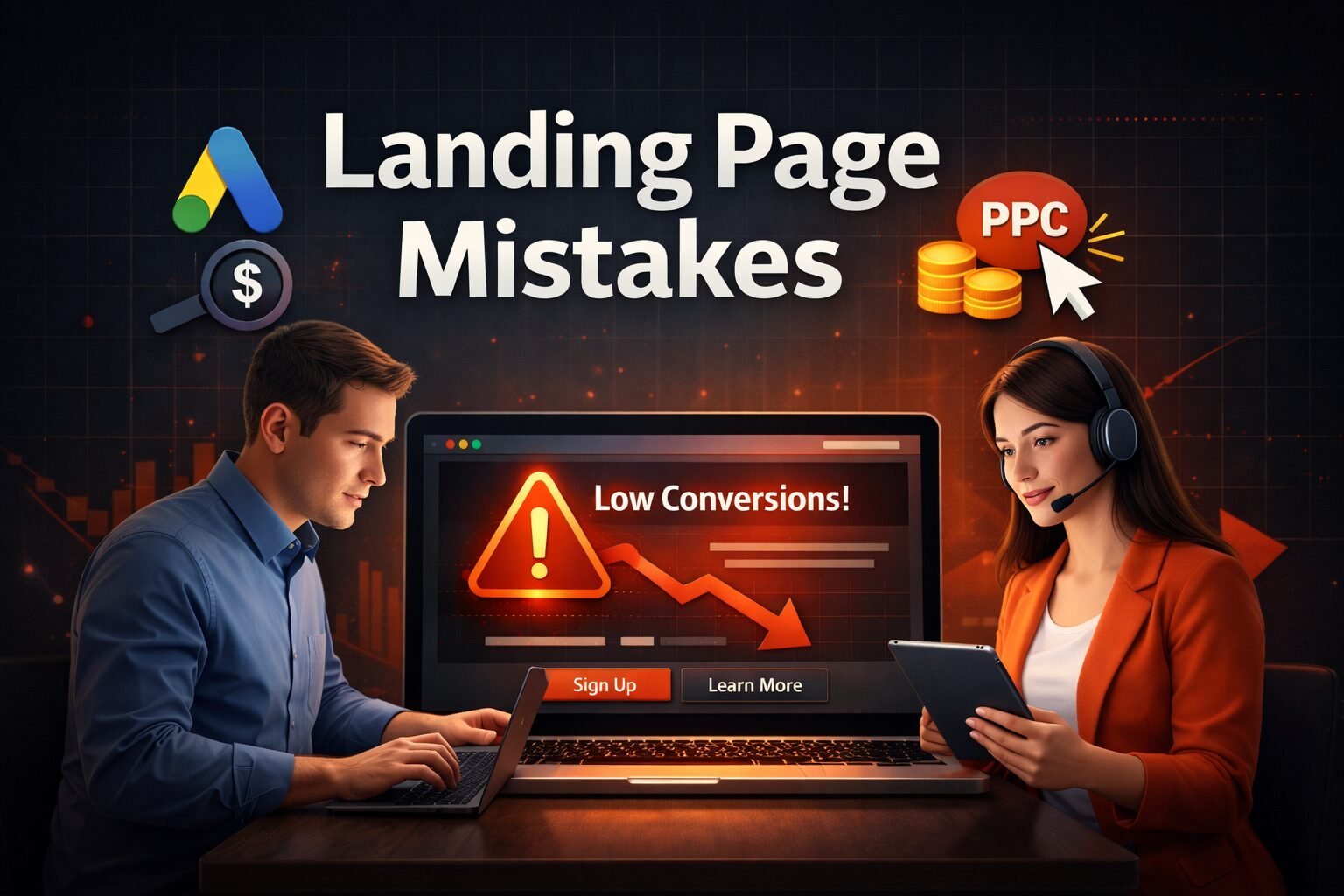
The most common landing page mistakes for lead generation are costing businesses thousands of rupees every month. You set up your Google Ads or Meta Ads campaign. The ads are running. Clicks are coming. But the leads are not. Sound familiar? This is one of the most frustrating problems in digital marketing. You are paying for traffic but that traffic is not converting. In most cases, the problem is not your ad.
The problem is what happens after someone clicks your landing page. In this blog, we will cover all the major landing page mistakes for lead generation that directly reduce your PPC conversions. We will explain each mistake in simple language and tell you exactly how to fix it.
Why Your Landing Page Directly Affects PPC Performance
When you run PPC ads on Google or Meta (Facebook and Instagram), you pay for every single click. Google also assigns a Quality Score to your ads — from 1 to 10. One of the biggest factors in this score is your landing page experience. A bad landing page lowers your Quality Score, which means you pay more per click and your ad shows less often. It also increases your bounce rate, which means people leave without taking any action.
Research from WordStream shows that around 70% of PPC budgets are wasted not because of bad ads but because of poor landing pages. HubSpot found that businesses using dedicated landing pages for each campaign get up to 55% more leads. And Google’s own research with Deloitte shows that even a one second delay in page loading can reduce conversions by 7%. These numbers make it clear that fixing your landing page is more important than increasing your ad budget.
Landing Page Mistakes for Lead Generation — All 9 Explained
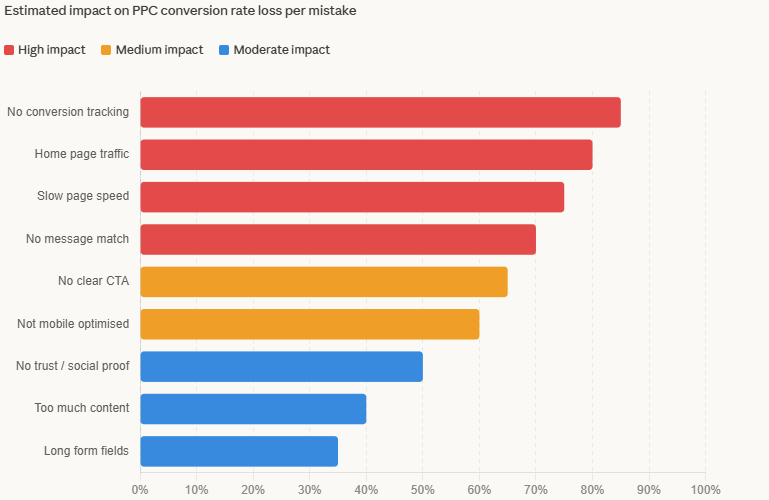
Mistake 1. Sending PPC Traffic to Your Home Page
This is the number one landing page mistake for lead generation in Google Ads and Meta Ads campaigns. Your home page has too many menus, too many links, and too many messages. It is built for everyone, which means it is built for no one. When a person clicks your ad and lands on a page that has nothing specific to do with what they searched for, they get confused and leave immediately. And you already paid for that click.
The fix is simple. Create a dedicated landing page for every campaign or ad group. If your ad says ‘Get a Free SEO Audit’, the landing page headline must say the same thing. This is called message match and it is one of the fastest ways to improve your Google Ads and Meta Ads conversion rate.
Mistake 2. Slow Page Loading Speed
Speed is everything in PPC. When someone clicks your Google Ad, they expect the page to open instantly. If it takes more than 3 seconds to load, most people close it and click on a competitor’s result instead. You paid for that click and got nothing in return. Use Google Page Speed Insights to check your page score and aim for 85 or above. Compress all images, remove unnecessary plugins and scripts, and use a fast hosting provider. Shared hosting is often too slow for PPC landing pages.
Mistake 3. No Clear Call to Action
Your landing page has one job to get the visitor to take one specific action. Call you. Fill a form. Download something. Book a demo. But many pages have no clear button, or they have too many options, or the button is hidden at the bottom. Every PPC landing page should have one primary call to action placed above the fold meaning the visitor should see it without scrolling. Use action words like ‘Get Free Quote’, ‘Book a Free Call’, or ‘Claim Your Offer’. Make the button large, bright, and easy to find.
Mistake 4. No Message Match Between Ad and Landing Page
Message match is one of the most overlooked landing page mistakes for lead generation in PPC. If your Google Ad says ‘Affordable Web Design Starting at Rs. 5,000’ and the landing page headline says ‘We Build Websites for All Budgets’, the visitor feels confused. They are not sure they are on the right page. That confusion alone kills conversions. Whatever promise you make in your ad, your landing page must repeat it immediately in the headline and the first paragraph. The visitor should feel they are exactly in the right place the moment they land.
Mistake 5. Too Much Text and Too Many Distractions
A landing page is not a blog post or a brochure. It is a focused conversion tool. Many businesses put their entire company story, all their services, long paragraphs, and unnecessary navigation links on a single landing page. By the time the visitor reaches the form or button, they have already lost interest. A good PPC landing page should have a strong headline, two to three short benefit points, one form or button, and a single trust element like a client review or a number such as ‘500+ businesses served’. Remove everything else. On a landing page, less is always more.
Mistake 6. Not Optimised for Mobile
In India, over 75% of Google searches happen on mobile phones. If your landing page does not open properly on a mobile screen, the form fields are too small to type in, or the CTA button is hard to tap you are losing the majority of your PPC traffic. This is one of the most expensive landing page mistakes for lead generation because it silently kills conversions from your biggest audience. Always test your page on multiple mobile screen sizes. Make sure buttons are at least 44px tall, form fields are easy to fill, and the phone number is a clickable call button on mobile devices.
Mistake 7. No Social Proof or Trust Elements
When a visitor arrives on your landing page from a paid ad, they do not know you. They have never heard of your brand before. Why would they give you their phone number without any reason to trust you? Yet most landing pages have no reviews, no client names, no certifications, and no numbers. Adding even one trust element a Google review rating, a client testimonial with a real name, or a number like ‘1,200 leads generated’ can increase form fills by 30 to 40%. Trust elements are not optional on a PPC landing page. They are essential.
Mistake 8. Form Asking for Too Much Information
Reducing your form length is one of the quickest fixes for landing page mistakes for lead generation. The longer your form, the fewer people will complete it. Asking for name, email, phone, company name, city, budget, and project details on a single form is too much. Visitors feel tired or worried about their privacy and leave without filling anything. For most lead generation landing pages, three fields are enough Name, Phone Number, and one relevant question like ‘What service are you looking for?’. That is all you need to follow up with a qualified lead.
Mistake 9. Not Tracking Conversions Properly
This is the most dangerous of all landing page mistakes for lead generation because every other mistake becomes invisible without proper tracking. If you do not have conversion tracking set up, you are running your PPC campaign completely blind. You do not know which keywords brought leads, which ad copy worked, or which device converted best. Set up Google Ads conversion tracking and Meta Pixel on your Thank You page, install Google Analytics 4 with a form submission goal, and use call tracking if your main CTA is a phone call. Check your data every week and make every decision based on real numbers, not guesswork.
Conclusion
Every rupee you spend on PPC deserves a landing page that converts. The landing page mistakes for lead generation we covered in this blog are all fixable and fixing even two or three of them can dramatically improve your results without increasing your ad budget.
Start with the basics. Make sure your page loads fast, your message matches your ad, you have one clear call to action, and your form is short. These four changes alone can double your leads from the same ad spend. Remember, your ad brings the visitor to the door. Your landing page is what gets them inside. If the page is broken, no amount of money spent on ads will fix it. Fix your landing page first and then scale your PPC campaigns with confidence.
How Dizispark Can Help You
If your landing page is not converting your PPC clicks into leads, the problem is fixable. At DiziSpark, we specialise in building and optimising landing pages that are designed to convert — whether you are running Google Ads, Meta Ads, or any other paid campaign. We have helped businesses across India get more leads from the same ad budget simply by fixing their landing pages. Our team handles everything from design and copywriting to speed optimisation and A/B testing. You do not need to spend more on ads. You just need a page that actually works. Visit us today at Dizispark and get a free landing page audit for your business.
FAQs
Q1. How fast should a PPC landing page load?
Under 3 seconds on desktop and under 2.5 seconds on mobile. Use Google PageSpeed Insights to check your score. Anything below 70 needs improvement. Compress images, use fast hosting, and remove unnecessary scripts to speed things up.
Q2. Why does a bad landing page waste my Google Ads and Meta Ads budget?
In Google Ads and Meta Ads, you pay for every click whether or not the visitor converts. If your page is slow, confusing, or not relevant to the ad, the visitor leaves without taking action. A bad landing page can waste 60 to 70% of your total ad budget silently.
Q3. Do I need a separate landing page for every ad?
Ideally yes at least one landing page per ad group or campaign. Businesses that use dedicated landing pages for each campaign get up to 55% more leads than those who send all traffic to one generic page.
Q4. How does a landing page affect Google Ads Quality Score?
Google gives every ad a Quality Score from 1 to 10. One of the three main factors is Landing Page Experience. If your page is slow, irrelevant, or has a high bounce rate, your Quality Score drops. A lower score means you pay more per click and your ad shows less often.
Q5. Does a landing page affect Meta Ads performance too?
Yes, absolutely. Just like Google Ads, Meta Ads (Facebook and Instagram) also send paid traffic to your landing page. If your page is slow, unclear, or not mobile friendly, visitors will leave without converting. Meta also tracks user behaviour after the click if people consistently bounce from your page, Meta’s algorithm will show your ad to fewer people and your cost per lead will increase over time.