Remember when SEO meant getting your website to appear on the first page of Google results? Those days feel almost nostalgic now. In 2026, search looks completely different. Users don’t just browse blue links anymore. They expect instant answers. They want summaries, comparisons, and quick solutions delivered directly to them. This is why Google AI Overviews and ChatGPT have become powerful discovery channels for businesses. But here’s the challenge I keep hearing from business owners and marketers: “We’re doing SEO, so we should appear in both, right?”
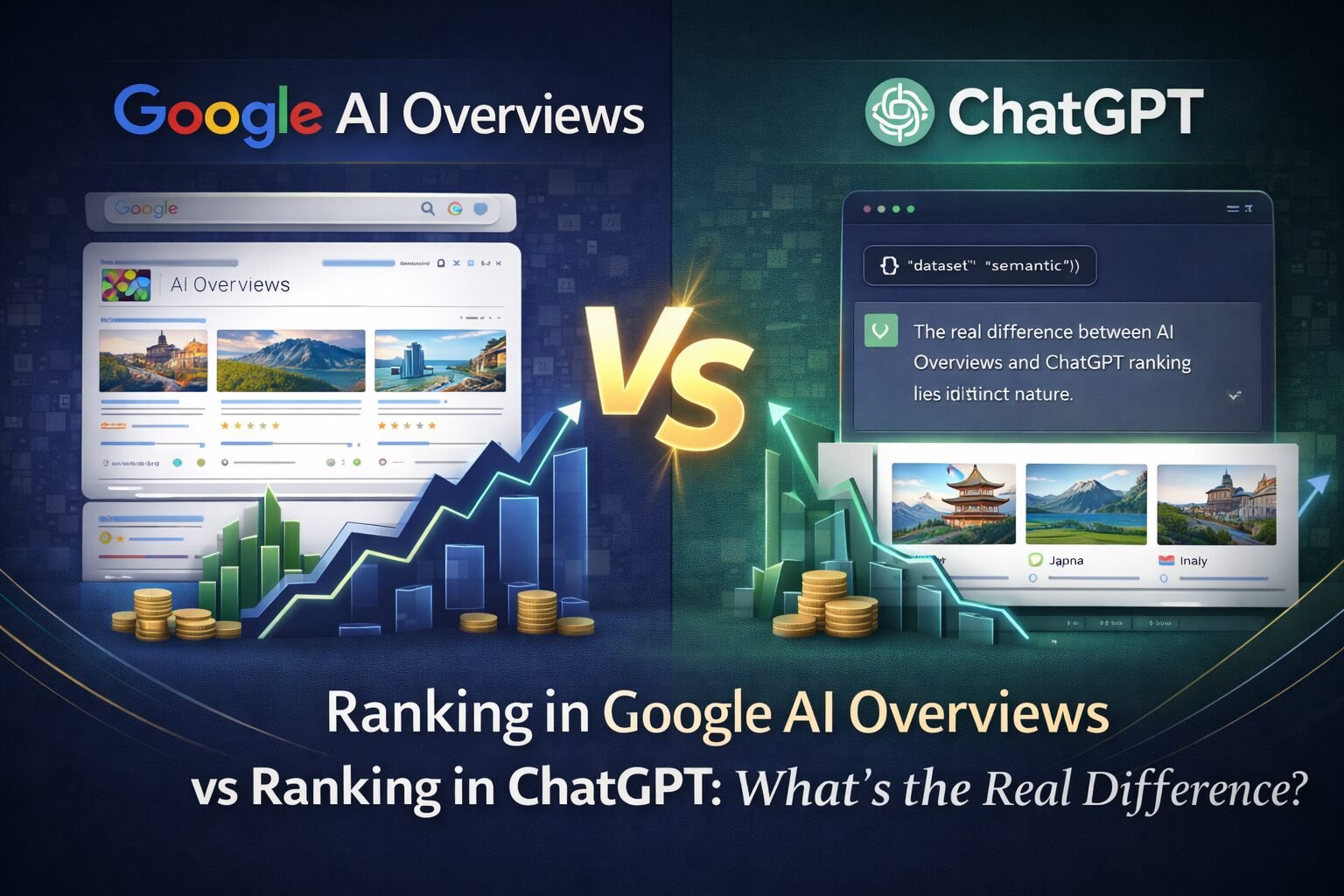
Ranking in Google AI Overviews vs ranking in ChatGPT are fundamentally different goals. Both use AI. Both generate answers. Both influence buying decisions. But the way they select information? Completely different.
Let me break this down clearly, with real data you can trust.
Why Understanding the Difference Between Ranking in Google AI Overviews vs Ranking in ChatGPT Matters in 2026
The Shift from Blue Links to AI Answers
Consider these numbers. They tell a powerful story about where search is heading:
- 58.5% of U.S. searches and 59.7% of European searches now end without a click.
- Google AI Overviews appear on 21% of all keywords searched.
- ChatGPT processes over 1.7 billion monthly visits.
Users are getting answers directly in search results and AI platforms. They don’t always need to visit your website to get what they need.
How Buyers Use Both Platforms Differently
Here’s what confuses many marketers: Google still dominates raw search volume. It receives 373 times more searches than ChatGPT. But that’s not the whole picture. 35% of Gen Z now use AI tools as their first research stop when considering purchases. Think about what that means. A generation of buyers is forming opinions about your brand before ever typing a query into Google. The impact is already visible. Stack Overflow traffic dropped 35% after ChatGPT launched. People went straight to AI for answers instead of traditional forums.
The Cost of Missing Out
Here’s the harsh reality:
When Google AI Overviews appear, users click traditional results in only 8% of visits, and AI Overviews cause click-through rate drops between 34.5% and 61% depending on the query type. If your brand doesn’t appear in the AI summary, you’re invisible. If ChatGPT doesn’t mention you for relevant questions, you lose the conversation entirely. This is why understanding ranking in Google AI Overviews vs ranking in ChatGPT isn’t optional anymore. It’s essential.
What Does “Ranking in Google AI Overviews” Actually Mean?
Google AI Overviews Are Search-Based
Google AI Overviews are AI-generated summaries that appear at the top of search results, above organic listings. They provide direct answers by combining content from multiple websites. Most importantly, they cite sources. If your website gets cited, you gain instant trust and potentially higher click-through rates. Unlike ChatGPT, AI Overviews are search-based. They select content from indexed web pages, driven by search intent and Google’s live algorithm.
How Google Selects Content for AI Overviews
Google scans content from pages that meet specific criteria:
- Properly indexed and accessible
- Highly relevant to the search query
- Trustworthy and authoritative
- Written in clean, structured format
- Supported by strong SEO signals
Google also has clear preferences. It loves content that answers questions directly. It favors short paragraphs, direct answers, and structured headings. This is where Answer Engine Optimization (AEO) becomes crucial. AEO helps your content become easier for AI to extract and summarize. When your page looks like a clean answer sheet, it becomes AI-friendly.
Key Factors for Ranking in Google AI Overviews
Based on the research, these factors matter most:
- On-page SEO and content structure: Your pages must be technically sound and well-organized.
- Clarity of answers: Write in direct answer formats. Don’t bury your key points in fluff.
- Schema markup: FAQ, How To, and Article schema help Google understand your content.
- EEAT signals: Experience, Expertise, Authoritativeness, and Trustworthiness matter enormously. Google uses EEAT to avoid surfacing misinformation.
- Topical authority: One blog isn’t enough. Google prefers websites that cover topics deeply with multiple connected pages.
What the Data Shows About AI Overviews
Let me share some revealing statistics from Ahrefs’ comprehensive analysis:
- 57.9% of question queries trigger AI Overviews. If someone asks “why,” “what,” or “how,” there’s a good chance an AI summary will appear.
- 46.4% of queries with 7+ words trigger AI Overviews. Longer, more specific questions get summarized.
- 76% of AI Overview citations also rank in Google’s top 10 organic results. You generally need to rank well to get cited.
- 99.9% of AI Overview keywords are informational. People are learning, not necessarily buying yet.
One more fascinating finding: pages ranking for fan-out queries are 161% more likely to be cited in AI Overviews. Fan-out queries are the sub-questions Google’s AI generates about a topic. Cover those comprehensively, and you increase your chances dramatically.
What Does “Ranking in ChatGPT” Actually Mean?
ChatGPT Is Model-Based, Not Search-Based
Here’s the fundamental difference.
ChatGPT generates answers based on trained knowledge plus live web browsing when enabled. It doesn’t maintain its own search index. When someone asks ChatGPT a question, it doesn’t show ten blue links. It synthesizes information and provides a conversational answer.
Ranking in ChatGPT means your brand appears as a recommended solution when users ask relevant questions. For example, if someone asks “What is the best digital marketing agency for small businesses?” and ChatGPT names your company, you’ve won visibility even without a direct click.
How ChatGPT Finds Information
This is critical to understand:
ChatGPT relies on Bing’s search index for current information. According to Semrush research, 87% of ChatGPT’s cited sources match top Bing rankings.
When you ask ChatGPT a question requiring fresh data, here’s what happens behind the scenes:
- It performs a Bing search and gathers 20-30 top web results
- It scans for store websites, review aggregators, niche blogs, local guides, and directories
- It analyzes 5-8 “most promising” sources
- It selects 3-5 sources to cite, preferring those with star ratings, no paywalls, and verifiable content
What ChatGPT Cannot Access
Equally important is understanding ChatGPT’s limitations:
- It cannot directly access Bing Places for Business data. Local business information from Bing’s business directory isn’t visible to ChatGPT.
- It cannot access Google Search or Google Maps directly.
- It only sees what appears in Bing’s web index.
This means if your business isn’t well-represented in Bing’s index and across the broader web, ChatGPT won’t find you.
How Source Preferences Have Changed
The platforms ChatGPT trusts have shifted significantly over the past year:
| Time Period | Reddit Citations | Wikipedia Citations |
| August 2025 | ~60% | ~55% |
| Current | ~10% | <20% |
Rising sources now include Medium, Forbes, LinkedIn, and PR Newswire. ChatGPT is becoming more selective, favoring established publications over community forums.
Key Factors for Ranking in ChatGPT
Based on all sources, these factors determine whether ChatGPT mentions your brand:
- Brand authority across the web: Are you mentioned consistently on trusted sites?
- Citations from trusted platforms: Tech publications, SaaS directories, industry blogs
- PR publications and backlinks: Media coverage builds credibility
- Wikipedia-style mentions: Not necessarily Wikipedia itself, but authoritative encyclopedia-style references
- High-authority business directories: Industry-specific listings matter
- Consistent NAP across platforms: Name, address, phone consistency builds trust
One local business owner I spoke with put it perfectly: “Make your business easy for Bing to understand and easy for ChatGPT to cite.”
The Core Difference: Search-Based vs Model-Based
Let me summarize the fundamental differences in a simple comparison:
| Factor | Google AI Overviews | ChatGPT |
| Foundation | Search-based (Google index) | Model-based + Bing index |
| Content Source | Indexed web pages | Trained knowledge + live Bing results |
| Selection Driver | Search intent + algorithm | Brand authority + citations |
| Key Optimization | On-page SEO, structure, AEO | Brand mentions, backlinks, PR |
| Citation Pattern | 76% from top 10 Google results | 87% match top Bing results |
| Content Format | Direct answers, short paragraphs | Thought leadership, comparisons |
| Update Frequency | Live algorithm updates | Model training + Bing refresh |
This table tells you everything you need to know about why ranking in Google AI Overviews vs ranking in ChatGPT requires different approaches.
How to Optimize for Google AI Overviews (Step by Step)
1. Write Content in Answer Format (AEO Style)
The most important step is writing content that answers questions directly. Every section should deliver value immediately. Avoid vague openings that feel like filler. Instead of slowly building up to your point, start with the answer.
Example of what works:
- Google AI Overviews are AI-generated summaries that appear at the top of search results.
- This format improves clarity and makes it easier for Google to extract information.
2. Use Question-Based Subheadings
Google AI Overviews often appear when users type conversational questions. Your headings should match that intent.
Effective headings include:
- “What is Google AI Overviews?”
- “How does AI Overviews work?”
- “How to rank in AI Overviews in 2026?”
These question-based headings signal relevance to Google’s AI and improve your chances of being selected.
3. Keep Sentences Short and Active
AI Overviews prefer simple, clear writing. Long sentences confuse both readers and AI extraction
Write in short, active-voice sentences Instead of: “AI Overviews are being used by Google to provide summaries to users searching for information.”
Write: “Google uses AI Overviews to provide summaries.”
This improves clarity instantly and helps your content perform better in AI-based search results.
4. Add Supporting Entities and Context
Google AI Overviews don’t rely only on keywords. They need context and topic relevance
Naturally include related concepts like:
- AEO optimization
- EEAT signals
- Topical authority
- Structured data
- Schema markup
- Content clusters
- Generative engine optimization
This deepens your content and makes it more credible. It helps Google trust your page as a reliable source.
5. Target Informational, Question-Based Keywords
The data is clear: AI Overviews appear on 57.9% of question queries.
Focus on “why,” “what,” “how,” and “definition” queries. Use tools to find 7+ word questions that your audience actually asks.
6. Build Topical Authority Through Content Clusters
One blog post isn’t enough. Google prefers websites that cover topics deeply.
If your main topic is AI Overviews, support it with related content like:
- What is AEO in SEO?
- How to write content for AI search engines
- How schema helps in AI Overviews
- GEO vs SEO: what’s the difference?
When your website has multiple connected pages, Google understands your expertise better. This increases your chances of ranking in AI Overviews.
7. Use Schema Markup Strategically
Schema isn’t optional anymore. Google AI Overviews rely on structured data to interpret pages quickly.
Most valuable schema types:
- FAQ Schema
- Article Schema
- HowTo Schema
- Organization Schema
- Breadcrumb Schema
FAQ schema is especially powerful because it creates clear question-answer patterns. Google’s AI loves this.
8. Strengthen EEAT Signals
Google uses EEAT (Experience, Expertise, Authoritativeness, Trustworthiness) to avoid misinformation. Your content must show credibility.
You can demonstrate EEAT by:
- Mentioning industry examples
- Quoting known platforms like Google, Adobe, or Microsoft
- Adding author bio and company details
- Linking to relevant internal and external sources
- Using real-world business scenarios
Write with confidence and specificity. Avoid vague claims.
9. Optimize for Fan-Out Queries
Here’s a powerful insight: pages ranking for fan-out queries are 161% more likely to be cited in AI Overviews. Fan-out queries are the sub-questions Google’s AI generates about a topic. If your main topic is “content marketing,” fan-out queries might include “how often should I blog?” or “what content formats work best?” Cover these related questions comprehensively, and you’ll increase your visibility.
10. Don’t Obsess Over Word Count
Here’s something surprising: there’s near-zero correlation between word count and AI citations. Answer the query directly and early. Density beats length. Be the most relevant source, not necessarily the longest one.
How to Optimize for ChatGPT Visibility (Step by Step)
1. Build Brand Mentions Across Authoritative Websites
ChatGPT recognizes brands that consistently appear in high-quality sources.
Focus on:
- Tech publications
- SaaS directories
- Industry blogs
- Guest posting on respected sites
- Review platforms like G2, Capterra, TrustPilot
These mentions serve as credibility signals for AI systems. They validate that your business is real and trusted.
2. Ensure Bing Indexing (This Is Critical)
I cannot emphasize this enough: ChatGPT relies on Bing’s index for current information. If your site isn’t in Bing, your chances of appearing in ChatGPT answers are extremely low.
Take these actions immediately:
- Create an account on Bing Webmaster Tools
- Submit your XML sitemap
- Use IndexNow for faster crawling when you publish or update content
Remember: 87% of ChatGPT citations match top Bing results.
3. Publish Thought Leadership Content AI Can Quote
ChatGPT prefers content that feels expert-driven and easy to reference.
Create content like:
- Detailed guides
- Comparison articles
- Industry frameworks
- Real-world case studies
- Best practices compilations
- Trend-focused insights
Write content that sounds authoritative and includes clear takeaways. When your content is well-structured and quotable, AI systems can easily extract key points.
4. Create Content That Answers Buying Questions
Many ChatGPT users are in decision-making mode. They ask direct purchase-intent questions.
Common patterns:
- “Which company is best for [service]?”
- “Who provides [specific solution]?”
- “What’s the best [product category] for [use case]?”
Your website should include content that clearly answers these buyer-intent queries. Explain what you offer, how your workflow works, what makes you different, and what results clients can expect.
5. Get Featured in Relevant Listicles and Comparisons
AI Overviews and ChatGPT frequently pull from curated lists when recommending tools. If you want to appear for queries like “Best SEO tools for small business” or “Top marketing agencies in 2026,” your brand needs to be on trusted third-party listicles.
Action steps:
- Identify industry blogs that publish “best of” lists in your category
- Reach out with updated product information and competitive differentiators
- Aim for mentions that include both your brand name and category keyword together
- Example: “Dizispark – AI SEO Agency”
6. Build Presence on Platforms AI Trusts
Your brand shouldn’t live only on your website. You need presence on platforms that AI models trust.
These include:
- Medium articles
- LinkedIn content (especially thought leadership)
- Industry guest posts
- SaaS directories
- Review websites
- PR platforms
- Forums and Q&A sites (Reddit, Quora) – but quality matters
These platforms act as validation signals for AI systems. They confirm your business is real and credible.
7. Optimize for Conversational Search
People use ChatGPT like a conversation, not like typing keywords into a search box.
They ask full questions with context:
- “I’m a marketing director at a SaaS company with a $50K budget. Who are the best SEO agencies that specialize in AI content?”
Your content should sound natural. It should feel like it’s answering a person, not feeding a search engine.
8. Target Industry-Specific Use Cases
General content won’t help you stand out. AI favors specificity.
Create dedicated pages for each vertical you serve:
- “SEO for SaaS Companies”
- “Digital Marketing for Healthcare Providers”
- “Content Strategy for E-commerce Brands”
On each page, include:
- Features that matter most to that industry
- Case studies and testimonials from similar clients
- Industry-specific language and common pain points
9. Publish Original Research and Statistics
AI models love citing fresh, reliable data. If you publish original research, you gain a significant edge.
Examples that work:
- Annual industry reports
- Benchmark studies from your user base
- Surveys with quotable statistics
- Trend analysis with proprietary data
Pro tip: highlight unique and surprising findings. For example, “Companies using AI in content marketing see 40% higher engagement” gets cited more often than generic statements.
Update these reports regularly. Freshness helps with both Google and ChatGPT visibility
10. Monitor What Ranks on Bing
Since ChatGPT relies on Bing’s index, you need to know what Bing ranks for your key terms. Check the first 20-30 Bing organic results for queries relevant to your business. Look for opportunities to optimize your presence in the results that ChatGPT actually references.
GEO vs SEO: Why You Need Both Strategies
What Is Generative Engine Optimization (GEO)?
Generative Engine Optimization (GEO) – also called AI Engine Optimization (AEO) or LLM search optimization – means making your brand visible inside AI-driven results. Unlike traditional SEO, GEO doesn’t focus primarily on driving clicks to your website. Instead, it focuses on your brand being named or cited when someone uses ChatGPT, Gemini, or other AI assistants to find solutions. GEO works alongside SEO, not instead of it. Google still dominates traffic, but AI engines are growing fast and shaping early decisions.
GEO vs SEO: Key Differences
| Traditional SEO | Generative Engine Optimization (GEO) |
| Rank in search results to earn clicks | Be cited in AI responses for visibility |
| Optimize for keywords and backlinks | Optimize for brand authority and citations |
| Traffic measured in clicks and visits | Success measured in citations and mentions |
| Focus primarily on your website | Focus on presence across multiple platforms |
| Keyword research centered on search volume | Prompt research centered on user questions |
| Content optimized for ranking | Content optimized for quotation |
Why Both Matter in 2026
Here’s the truth: you can’t choose one. Google still sends the vast majority of traffic. You need SEO to capture that demand. But AI platforms shape decisions earlier in the buyer journey. When someone asks ChatGPT for recommendations, they’re forming opinions before ever searching on Google. GEO builds authority that feeds both platforms. A smart AI SEO strategy supports both goals simultaneously. The brands that win will be the ones that build credibility AND publish AI-ready content.
Tracking Success: How to Measure Visibility in Both Platforms
Track these metrics:
- Which keywords trigger AI Overviews in your industry?
- Which of your pages get cited in AI summaries?
- How do your rankings correlate with AI Overview appearance?
- Are you losing click-through rate to AI answers?
Use tools like Ahrefs, Semrush, and Google Search Console to monitor these trends.
For ChatGPT Visibility
Measuring ChatGPT visibility requires a different approach since there’s no dashboard:
- Manual testing: Regularly test prompts related to your business. Does ChatGPT mention your brand?
- Bing rankings correlation: Since 87% of citations match top Bing results, track your Bing positions.
- Citation volume: Monitor how often your brand appears on third-party sites that AI trusts.
- Share of voice in AI responses: Compare your mentions against competitors.
Tools like Semrush, Bing Webmaster Tools, and SparkToro can help with different aspects of this tracking.
Key Metrics to Watch
- Share of search in AI responses for your category
- Prompt visibility for key buying questions
- Brand performance inside generative systems
- Zero-click visibility trends and their impact on your traffic
Conclusion
Ranking in Google AI Overviews vs Ranking in ChatGPT requires a balanced strategy if you want long-term visibility in the evolving search landscape. Google AI Overviews rely heavily on traditional SEO signals such as structured content, search intent alignment, and strong EEAT authority from indexed websites. In contrast, ChatGPT responses often depend on brand credibility, trusted citations, and information sourced through Microsoft Bing along with widely referenced platforms.
As AI continues shaping how users research and make decisions, businesses must optimize both their website and their broader digital presence. By publishing structured, helpful content for Google while also building brand mentions and authority across the web, you increase the chances of appearing in AI-driven answers and staying competitive in modern search.
How Dizispark Can Help
Achieving a strong Ranking in Google AI Overviews vs Ranking in ChatGPT requires more than traditional SEO—it demands a strategy built for AI-driven search. At Dizispark, we help businesses improve visibility across both ecosystems by combining advanced SEO, Answer Engine Optimization (AEO), and AI-ready content strategies. Our team optimizes websites for Google AI Overviews through structured content, schema implementation, and strong EEAT signals, while also strengthening brand presence for AI tools like ChatGPT by improving indexing on Microsoft Bing, building authoritative mentions, and developing thought-leadership content. With technical SEO, AI-optimized content creation, and continuous performance tracking, Dizispark ensures your brand stays visible where modern search decisions begin.
FAQs
1. How do I rank in Google AI Overviews?
Create structured content with clear answers, short paragraphs, strong EEAT signals, and FAQ-style formatting. Add schema markup, especially FAQ schema. Target informational, question-based keywords.
2. How do I rank in ChatGPT?
Build strong brand mentions through guest posts, PR, backlinks, and authoritative listings. Ensure your site is indexed in Bing – this is essential. Publish thought leadership content and get featured in relevant listicles and comparison articles.
3. Does Bing SEO really matter for ChatGPT visibility?
Absolutely. ChatGPT relies on Bing’s index for current information. Research shows 87% of ChatGPT citations match top Bing results. Set up Bing Webmaster Tools and use IndexNow for faster crawling.
4. Is GEO replacing SEO?
No. SEO drives traffic; GEO builds authority. You need both strategies working together. Google still sends most traffic, but AI platforms shape early decisions and influence buyer preferences.
5. How long does it take to see results?
Timelines vary based on your website’s existing authority and content quality. Some businesses see results within weeks; others need months. Strong topical authority, proper indexing, and consistent quality work speed up the process
6. What type of content works best for AI visibility?
For Google AI Overviews: content that answers questions directly with clear structure, use H2 question headings, short sentences, comparison sections, and step-by-step guides. For ChatGPT: thought leadership, original research, and content that demonstrates deep expertise in your field.
7. Does schema markup help with AI Overviews?
Yes. FAQ schema creates clear question-answer patterns that Google’s AI easily understands and extracts. It significantly increases your chances of being featured in AI Overviews
8. How are AI tools deciding which sources to cite?
AI tools look for authoritative, clear, and well-structured data. For Google: indexed pages with strong EEAT signals. For ChatGPT: Bing-indexed content with strong brand mentions, citations from trusted sources, and consistent presence across authoritative platforms