
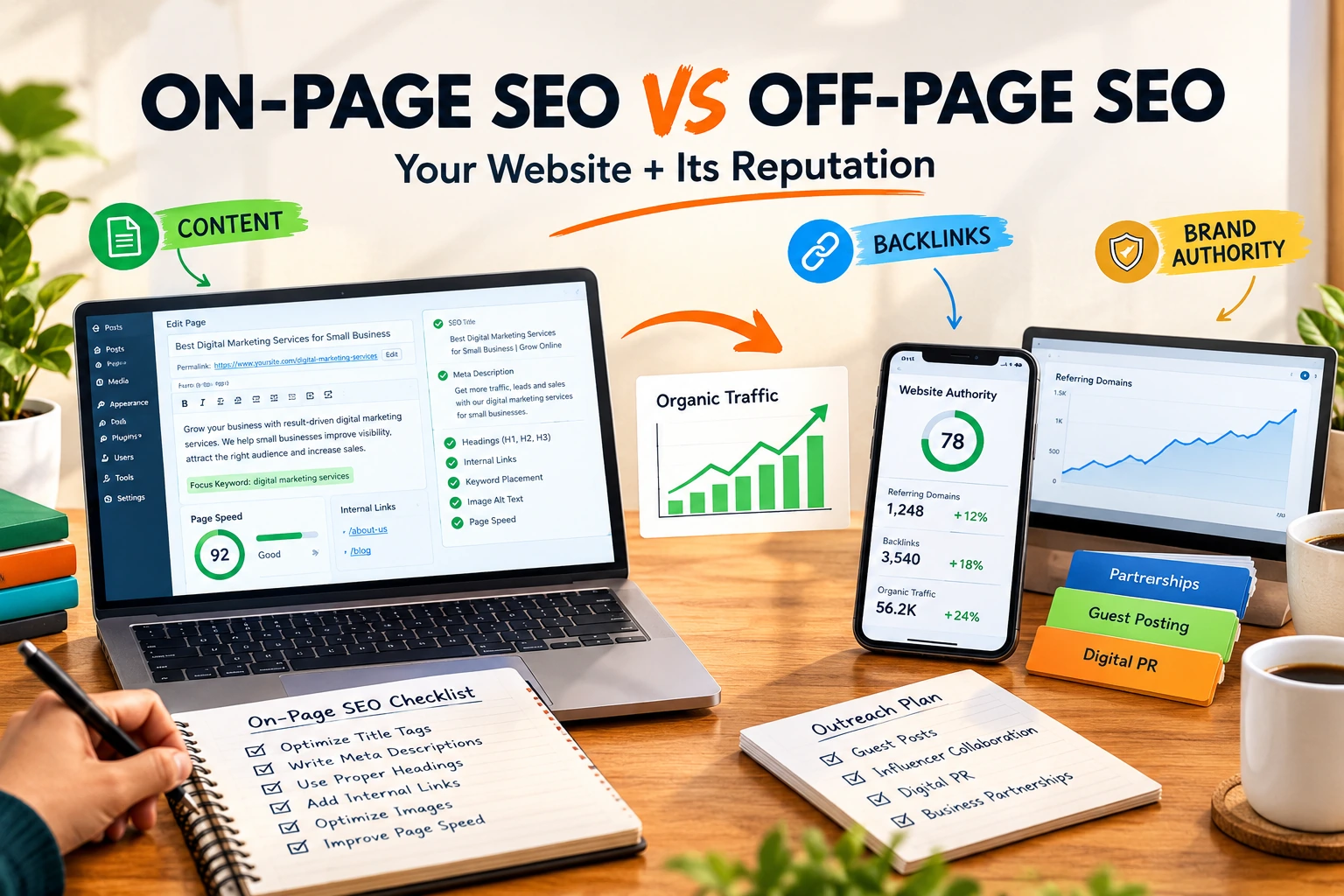
On page SEO vs off page SEO is one of the first questions every website owner meets when planning organic growth. Both approaches aim to raise visibility in search results, but they work on very different parts of the problem. One improves the pages you control, and the other builds the reputation you earn elsewhere on the web. Semrush explains that Google weighs both on-page and off-page factors when ranking results. GeeksforGeeks and Brillica Services reach the same conclusion, which is that a complete strategy needs both sides working together. This guide breaks down on page SEO vs off page SEO with definitions, factors, a comparison table, tools, and seven best practices you can apply in 2026.
Table of Contents
ToggleWhat Is the Difference Between On Page SEO vs Off Page SEO ?
Semrush gives the simplest answer to the on page SEO vs off page SEO question. On-page SEO covers what you do on a webpage, while off-page SEO covers what you do outside your website, and both aim to improve search rankings. On-page work makes content better for users and search engines through unique titles, links between pages, and optimized images. Off-page work is mainly about improving your reputation through links from other websites, social promotion, and review management.
Brillica Services offers a helpful analogy for on page SEO vs off page SEO. On-page SEO is like setting up and organizing a shop, while off-page SEO is like earning positive word of mouth and recommendations from other businesses.
What Is On-Page SEO ?
Brillica Services describes on-page SEO, also called on-site SEO, as the practice of optimizing individual pages to improve rankings and attract organic traffic. It is entirely under your control, which makes it the foundation of a well-optimized website. GeeksforGeeks lists seven key elements, namely content quality, keyword optimization, meta tags, URL structure, internal linking, user experience, and technical SEO. Each element helps search engines crawl, understand, and rank a page.
When it is done well, search engines understand the content and visitors enjoy a smooth experience. That dual benefit is why most experts treat on-page work as the starting point.
What Is Off-Page SEO ?
Off-page SEO covers all actions taken outside your website to build credibility, trust, and authority. Brillica Services notes that these factors are not entirely under your control, yet they have a strong effect on rankings. GeeksforGeeks stresses that many people equate off-page SEO with link building, but it also includes promotion methods such as blogging and social bookmarking. Its list of elements covers backlinks, social media marketing, reputation management, influencer marketing, brand mentions, and guest blogging.
Semrush adds that backlinks may be treated like endorsements. The more high quality links a page earns, the more authoritative it can appear to search engines.
On Page SEO vs Off Page SEO Comparison Table
The table below summarizes the main differences drawn from all three sources. It shows how each approach differs in control, focus, tactics, and speed of results.
| Aspect | On-Page SEO | Off-Page SEO |
|---|---|---|
| Definition | Optimization done on the website itself | Activities done outside the website |
| Control | Fully under your control | Partly dependent on other people |
| Focus | Content, HTML, and page structure | Reputation, authority, and relationships |
| Main tactics | Titles, headings, URLs, images, internal links | Backlinks, reviews, social promotion, mentions |
| Links | Internal links within your own site | External links from other websites |
| User experience | Direct focus through speed and mobile design | Indirect effect through trust and traffic |
| Best starting point | First, as the foundation | Second, once pages are ready |
On Page SEO vs Off Page SEO Examples
Examples make the on page SEO vs off page SEO split easier to see. Rewriting a title tag to include the main keyword is on-page work, while earning a guest post that links to that page is off-page work. Adding alt text to a product photo is on-page, and collecting a new customer review on a third party platform is off-page. Linking one blog post to another on your own site is on-page, and winning a mention from a respected blogger is off-page. In every case, the on-page action improves the page itself and the off-page action proves that others value it.
Control and Speed of Results
Control is a major practical difference in on page SEO vs off page SEO. Brillica Services points out that on-page work is entirely yours to change, while off-page signals depend partly on other publishers, reviewers, and audiences. That is why teams usually see quick, controllable wins from on-page fixes first and slower gains from off-page work later.
On-Page SEO Factors That Matter Most
Semrush highlights several on-page factors that deserve attention on every page. In any on page SEO vs off page SEO plan, these are the changes you can make today, and together they shape how Google reads and ranks your content.
1. Title Tags and Meta Descriptions
A title tag tells search engines what a page is about. SEMrush advises keeping it between 50 and 60 characters, placing the primary keyword near the front, and avoiding keyword stuffing. Meta descriptions do not directly influence rankings, but they affect how many people click. The sources differ on length, since SEMrush suggests around 105 characters to avoid truncation while Brillica Services recommends 150 to 160 characters with a call to action.
2. URL Slugs and Heading Tags
Semrush recommends descriptive yet concise slugs that separate words with hyphens and often use the primary keyword. Brillica Services agrees and shows a short readable address as the model. Every page should carry one H1 that matches the title tag closely, followed by H2 and H3 headings in a clear hierarchy. Those headings help both users and search engines scan the structure.
3. Content Quality and Search Intent
Semrush says strong content is original, accurate, and helpful, and that it must match search intent. It names four intent types, which are informational, navigational, commercial, and transactional. To raise quality, it recommends showing expertise, citing credible sources, offering something unique, using proper grammar, and including keywords naturally. Brillica Services warns that stuffing keywords can harm rankings.
4. Images, Internal Links, and Page Experience
Alt text lets search engines and screen reader users understand an image, and Semrush asks for short, informative descriptions with natural keywords. Brillica Services adds compressing images and renaming files with relevant words. Internal links help search engines discover all your content and understand how it fits together. Page experience, meaning speed, security, and easy navigation, is often treated as technical SEO, but Semrush still encourages checking each page individually.
Off-Page SEO Factors That Matter Most
In the on page SEO vs off page SEO balance, off-page factors take longer to influence, yet they can decide who wins when two pages are otherwise equal. Semrush notes that Google will likely favor the site with the better reputation, all else being equal.
1. Backlinks and Link Building
Brillica Services calls backlinks among the most powerful ranking factors, provided they come from authoritative sites. It warns that spammy backlinks can lead to penalties. Semrush describes link building as finding publishers who may want to link to you and sending a persuasive pitch. Brillica Services lists guest blogging, broken link building, and content outreach as practical strategies.
2. Local Listings, NAP Citations, and Reviews
Semrush recommends claiming and verifying your Google business listing, entering complete information, and responding to reviews. It also explains that name, address, and phone citations let search engines verify your business details and support local SEO. Reviews matter most in local SEO because they affect local rankings. Google can even use the wording of customer reviews to match a profile with relevant searches.
3. Social Media, Influencers, and Brand Mentions
Brillica Services says social signals do not directly affect rankings, yet they drive traffic. Semrush agrees that social activity can indirectly help by raising authority and awareness over time. GeeksforGeeks adds that unlinked brand mentions on reputable sites add credibility, and that influencer collaboration can expand reach. These activities work best when they point people back to strong, optimized pages.
Which Comes First in On Page SEO vs Off Page SEO
Semrush says you should generally focus on on-page SEO before off-page SEO. Optimized pages help Google understand your content and give users a good experience, so the foundation must come first. On-page work is also direct, because you make changes on your own site. Off-page work is less straightforward, since you often rely on other people to endorse you.
Brillica Services also frames on-page work as the base that off-page work builds on. Links pointing to weak, unclear pages deliver less value than links pointing to well-optimized ones. Off-page work becomes essential once the foundation is solid. It is often what builds and protects a competitive edge.
How On Page SEO vs Off Page SEO Work Together
Brillica Services recommends starting with on-page work and then enhancing it with off-page activity. Its example is a blog post about healthy eating tips that is first optimized on the page and then shared on social media to boost visibility. GeeksforGeeks describes the same relationship. On-page optimization provides a high quality, user friendly experience, while off-page activity builds reputation and authority across the web.
A balanced plan therefore treats on page SEO vs off page SEO as two halves of one system. Strong pages earn better links, and strong links lift strong pages higher.
Tools for On Page SEO vs Off Page SEO
GeeksforGeeks lists tools that support both sides of on page SEO vs off page SEO. Google Keyword Planner helps find keywords and volumes, Google Search Console monitors indexing, performance, and external links, and Google Analytics tracks traffic, behavior, and conversions. It also names SEMrush for audits and competitor analysis, Ahrefs for keyword and backlink research, and Moz for domain authority and link quality. Brillica Services adds Google PageSpeed Insights for speed checks and the Mobile-Friendly Test for responsive design.
Using several tools together gives a fuller picture of on page SEO vs off page SEO performance than any single report can.
7 Best Practices for Balancing On Page SEO vs Off Page SEO
The sources point to seven practical habits that keep on page SEO vs off page SEO in balance. Apply them in order for the strongest results.
1. Fix the foundation first. Optimize titles, headings, URLs, and content before chasing links, as Semrush advises.
2. Match every page to search intent. Decide whether the searcher wants information, a comparison, or a purchase, and write for that need.
3. Keep titles and descriptions natural. Place the main keyword near the front of the title and avoid stuffing, as both Semrush and Brillica Services warn.
4. Build internal links deliberately. Connect related pages so search engines and visitors can follow your content.
5. Earn links through value. Use guest posts, broken link outreach, and useful content instead of spammy links.
6. Manage your reputation. Encourage and answer reviews, keep citations consistent, and monitor brand mentions.
7. Measure both sides together. Use Search Console and Analytics to track indexing, traffic, and referral sources, as GeeksforGeeks suggests.
Common Mistakes in On Page SEO vs Off Page SEO
The most common error in on page SEO vs off page SEO is stuffing keywords into pages, which Semrush and Brillica Services both say can hurt rankings. The second is chasing low-quality backlinks that risk penalties. Another mistake is ignoring the foundation. Promoting a page with weak content or slow loading wastes the effort of every link and share.
Conclusion
On page SEO vs off page SEO is not a contest with one winner. On-page work gives search engines and users a clear, fast, helpful page, and off-page work proves that other people trust it. The three sources agree on the order of operations. Build the foundation first, then add links, reviews, and brand signals that raise authority. Review both sides regularly, because search engines and competitors keep changing and results depend on steady improvement.
How Dizispark Can Help
Dizispark is a Delhi-based digital marketing agency that delivers both on-page and off-page SEO, from title and content optimization and internal linking to link building, citations, and review growth. We audit your pages first so link building always points to pages ready to rank.
We also manage a fully optimized Google My Business Profile that strengthens local search visibility alongside your organic work, and we connect it with your SEO strategy and paid campaigns for one consistent growth plan.
Reach out to Dizispark today and let us build a balanced SEO plan matched to your pages, your budget, and your timeline.
Frequently Asked Questions
What is the main difference between on-page SEO and off-page SEO?
The main difference between on page SEO vs off page SEO is where the optimization takes place. On-page SEO improves elements within your website, including content, title tags, headings, URLs, images, and internal links. Off-page SEO focuses on activities outside your website, such as earning quality backlinks, managing online reviews, and building brand credibility. Both approaches help improve organic visibility, but they work differently. A successful SEO strategy combines relevant website improvements with activities that strengthen your website’s reputation.
Is on-page SEO more important than off-page SEO?
When comparing on page SEO vs off page SEO, both are important for long-term organic growth. However, on-page SEO is generally a sensible starting point because it helps ensure that your website contains useful content, relevant keywords, and a clear structure. Once your pages are optimized, off-page SEO can help build authority through quality backlinks and brand mentions. For example, a business should improve its service pages before promoting them through external websites. The right balance depends on your website’s current condition, competition, and business goals.
What are the most important on-page SEO factors?
Understanding on page SEO vs off page SEO begins with knowing which elements you can control directly. Important on-page SEO factors include helpful content, relevant keyword placement, descriptive title tags, meta descriptions, clear headings, internal links, image alt text, and readable URLs. Website speed, mobile usability, and crawlability also deserve attention, although some are more closely associated with technical SEO. Regularly reviewing these elements can help identify outdated content, missing information, and usability issues. Prioritize changes that make your pages more useful to visitors and easier for search engines to understand.
What are the most effective off-page SEO techniques?
In the comparison of on page SEO vs off page SEO, off-page techniques focus on improving your website’s reputation beyond its own pages. Effective methods include earning relevant backlinks, contributing useful guest articles, building industry relationships, encouraging genuine customer reviews, and increasing brand visibility. Local businesses can also maintain accurate business listings and consistent contact information. The goal is to develop credibility rather than collect links indiscriminately. Avoid spammy link-building practices and focus on relevant websites, genuine relationships, and useful content that can attract attention from your target audience.
Can a website rank without backlinks?
Yes, a website can rank for some searches without having many backlinks. Relevant content, clear page structure, good internal linking, and strong alignment with search intent can help pages become discoverable and useful. However, backlinks may be an important competitive advantage for difficult keywords, especially when competing websites have established authority. Results depend on the search query, competition, website quality, and other ranking systems. Instead of treating backlinks as a requirement for every page, assess the search results for your target keywords and build a strategy that addresses the actual competitive gap.
How long does on-page and off-page SEO take to show results?
The time required to see results from on page SEO vs off page SEO varies according to competition, website history, content quality, technical issues, and the work completed. Some on-page improvements may produce noticeable changes sooner, while meaningful organic growth can take several months. Off-page SEO may require additional time because earning relevant backlinks and building brand recognition depend partly on other websites and audiences. Track impressions, clicks, keyword visibility, organic traffic, and conversions regularly. Evaluating performance over time provides a more useful picture than judging an SEO campaign by a single ranking change.
Which tools can help measure on-page and off-page SEO performance?
When evaluating on page SEO vs off page SEO, using the right tools helps you measure different aspects of performance. Google Search Console provides information about search impressions, clicks, indexing, and queries. Google Analytics helps measure website traffic, engagement, and conversions. Tools such as Semrush, Ahrefs, and Moz can support keyword research, competitor analysis, site audits, and backlink assessment. Google PageSpeed Insights can help identify website performance issues. Combining these tools provides a broader view of your SEO progress and helps you identify practical improvements based on data rather than assumptions.
Should small businesses invest in both on-page and off-page SEO?
Small businesses should consider both on page SEO vs off page SEO when planning long-term organic growth. Start by optimizing important service pages, improving content, fixing major website issues, and adding relevant internal links. Once the website provides a strong foundation, focus on earning quality backlinks, developing relevant business relationships, managing genuine customer reviews, and improving local visibility where appropriate. Businesses targeting specific locations may also benefit from maintaining an accurate Google Business Profile. Review results regularly and prioritize activities that increase relevant website traffic, qualified enquiries, and conversions within your available budget.