

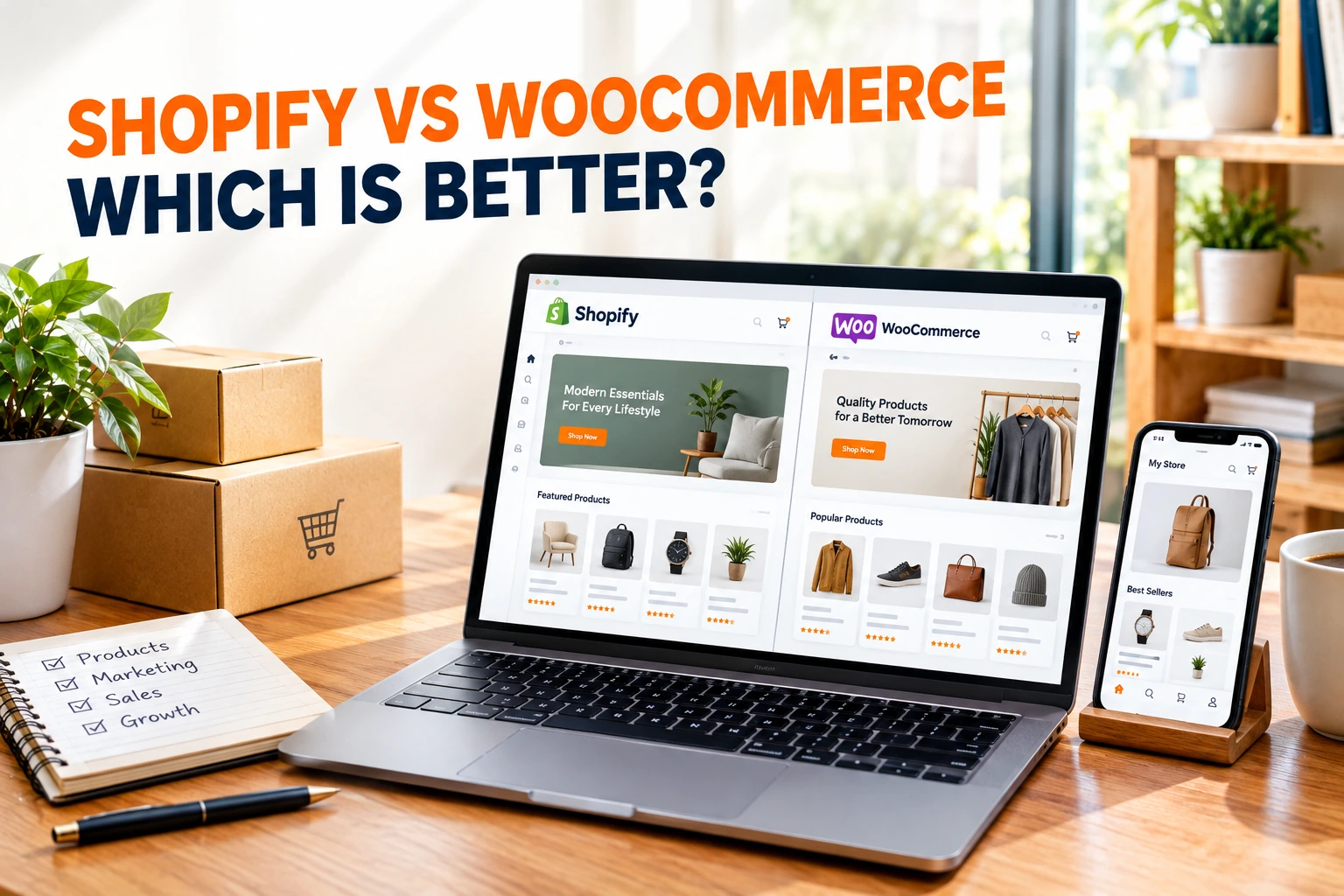
Shopify vs WooCommerce is one of the first and most important decisions any online seller makes. Both platforms power successful stores, but they are built on very different ideas, and the wrong choice can cost money, time, and search rankings later. Green Cube Solutions says it has built more than 65 stores on the two platforms and concludes that the best choice depends on your business type, technical comfort, and long term goals. Dynamic Dreamz adds an India view, covering rupee pricing, payment gateways, and local market share. This guide compares Shopify vs WooCommerce on ease of use, cost, payments, customization, SEO, security, and scale, then explains how to choose for your own store in 2026.
Table of Contents
ToggleWhat Is the Difference Between Shopify vs WooCommerce
Shopify is a fully hosted platform. You pay a monthly subscription, and Shopify handles hosting, security, updates, and core infrastructure, so you can focus on selling. WooCommerce is a free, open-source plugin for WordPress that turns a website into a store. Green Cube Solutions notes that you manage your own hosting, updates, and technical setup, and in return you get far more flexibility. In short, Shopify vs WooCommerce is a choice between convenience and control.
Shopify vs WooCommerce at a Glance
The table below combines the comparisons from both sources, with India specific points from Dynamic Dreamz.
| Feature | Shopify | WooCommerce |
|---|---|---|
| Type | Hosted platform | Self-hosted WordPress plugin |
| Starting cost | About INR 2,400 per month | Free plugin, hosting extra |
| Ease of use | Beginner friendly | Needs some technical comfort |
| Customization | Strong within its ecosystem | Almost unlimited |
| Payments in India | Third party gateways only | Free plugins for major gateways |
| Transaction fees | Extra fee on lower plans | No platform fee |
| SEO control | Good but partly locked | Advanced through WordPress |
| Maintenance | Handled by Shopify | Handled by you or a developer |
What Is Shopify
Green Cube Solutions describes Shopify as a fully hosted platform used by everyone from solo sellers of handmade goods to enterprise brands with millions in monthly revenue. You build inside Shopify’s interface, choose a theme, and add apps for extra features. The main benefit is speed. Dynamic Dreamz calls it beginner friendly, with a clean dashboard, guided setup, and an app store that adds features without coding.
What Is WooCommerce
WooCommerce runs on WordPress, which Green Cube Solutions says powers over 43 percent of websites worldwide. That foundation lets it be extended, customized, and integrated in almost limitless ways. Dynamic Dreamz stresses that you own and manage everything, from hosting to security to updates. That responsibility is the price of control.
Ease of Use in Shopify vs WooCommerce
In Shopify vs WooCommerce ease of use, both sources agree that Shopify wins. Green Cube Solutions says a basic store can be set up, with products, payments, and launch, without technical knowledge. WooCommerce has a steeper learning curve. You need to understand hosting, WordPress, plugin management, and basic site administration, which can feel heavy without professional help. Dynamic Dreamz adds a useful point. If a development partner handles setup and upkeep, the technical gap largely disappears.
How Shopify vs WooCommerce Changes Your Daily Work
The platform you pick shapes your week as much as your budget. On Shopify, daily work centers on products, orders, and marketing, because hosting and security sit with Shopify. On WooCommerce, you or your developer also handle WordPress updates, plugin updates, backups, and hosting performance. Green Cube Solutions warns that neglecting these tasks can create vulnerabilities. Extra features arrive differently as well. Shopify adds them through apps, while WooCommerce adds them through plugins and custom code, which is why the Shopify vs WooCommerce cost picture shifts as a store grows.
Shopify vs WooCommerce Pricing
Pricing is where Shopify vs WooCommerce gets real. Green Cube Solutions puts the Shopify Basic plan at about USD 39 per month, and says add-on apps can push a well equipped store to USD 150 to 300 or more per month. WooCommerce itself is free, but you pay for hosting, a domain, SSL, themes, and plugins. Green Cube Solutions estimates USD 30 to 100 per month for a well hosted store, often less than an equivalent Shopify setup. Dynamic Dreamz gives rupee figures for Shopify plans.
| Shopify Plan | Approximate Price in India | Notes |
|---|---|---|
| Basic | INR 2,400 per month | 2 staff accounts, basic reports |
| Shopify | INR 6,600 per month | Professional reports, 5 staff accounts |
| Advanced | INR 25,000 per month | Advanced reports, 15 staff accounts |
| Plus | INR 1,90,000 plus per month | Enterprise features, custom checkout |
For WooCommerce, Dynamic Dreamz lists the typical costs below. Prices change often, so confirm them on the Shopify pricing page and the WooCommerce pricing guide.
| WooCommerce Cost | Typical Range in India |
|---|---|
| Plugin | Free |
| Shared hosting | INR 300 to 800 per month |
| Managed WordPress hosting | INR 3,000 to 8,000 per month |
| Domain | INR 700 to 1,500 per year |
| Premium theme | INR 5,000 to 15,000 one time |
| Essential plugins | INR 0 to 5,000 per year |
A Simple Cost Example for Shopify vs WooCommerce
A quick calculation shows why fees matter. This is an illustration built from Dynamic Dreamz figures, not a quote. Suppose a store sells INR 5,00,000 a month on the Shopify Basic plan. A 2 percent extra transaction fee adds INR 10,000 on top of the INR 2,400 plan and the gateway’s own charge. The same sales on WooCommerce carry no platform fee, so the main costs are hosting and plugins. That gap is why Shopify vs WooCommerce looks different for a small test store than for a busy one.
Transaction Fees and Payment Gateways in India
Fees are a major part of Shopify vs WooCommerce for high volume stores, and they differ by plan. Green Cube Solutions says Shopify adds a transaction fee of 0.5 to 2 percent when you use a third party gateway instead of Shopify Payments. Dynamic Dreamz says Shopify Payments is not available in India, so every Indian merchant must use a third party gateway such as Razorpay, Cashfree, or Paytm. It reports an extra 2 percent fee on the Basic plan, waived from the INR 6,600 plan upward.
WooCommerce charges no platform fee. Dynamic Dreamz notes that free plugins exist for Razorpay, Paytm, PhonePe, Cashfree, and CCAvenue, with full UPI support, so you pay only the gateway’s own fee. Check current availability with Shopify, since its payment coverage can change.
Customization and Flexibility in Shopify vs WooCommerce
In the Shopify vs WooCommerce customization contest, both sources say WooCommerce dominates. Green Cube Solutions explains that a skilled developer can build custom pricing rules, complex product options, B2B wholesale portals, multi-vendor marketplaces, and subscription models. Shopify is capable but works inside the limits of its platform. Green Cube Solutions says some deep customization needs workarounds or a move to Shopify Plus, and Dynamic Dreamz adds that it may require Liquid knowledge or custom apps.
SEO in Shopify vs WooCommerce
In Shopify vs WooCommerce SEO, both platforms support solid optimization, but both sources give WooCommerce a slight edge. Because it runs on WordPress, you control URL structure, meta tags, headings, schema markup, and content strategy. Dynamic Dreamz points to free tools such as Yoast SEO and Rank Math and to stronger blogging. It lists Shopify’s forced URL prefixes for collections and products, plus a more basic blog, as limitations.
Experienced developers can work around many Shopify limits. Still, content heavy stores that depend on organic search usually find WooCommerce easier to optimize.
Security and Maintenance
On security in Shopify vs WooCommerce, Shopify handles updates, SSL, PCI compliance, and server security for you. Green Cube Solutions says you never need to think about it. WooCommerce puts these tasks on you or your developer, including plugin updates, hosting security, backups, and WordPress maintenance. If neglected, they can create vulnerabilities.
Scalability and Performance
For Shopify vs WooCommerce scale, Dynamic Dreamz says Shopify handles traffic spikes reliably without server management, and Shopify Plus is designed for high volume brands. WooCommerce scales too, but it needs the right hosting, such as a VPS or managed WordPress hosting. So Shopify scales with less effort, while WooCommerce scales with more control.
Shopify vs WooCommerce Market Share in India
Dynamic Dreamz reports 135,274 active WooCommerce stores in India against 78,411 on Shopify. It reads this as a sign of the Indian market’s preference for flexible, cost effective solutions. The same article cites a projection that India’s ecommerce market will reach about USD 325 billion by 2030. Treat these figures as the source’s estimates and verify them before quoting.
Which Should You Choose in Shopify vs WooCommerce
There is no universal winner. Both sources say the right answer depends on your situation, and the table gives a quick guide.
| Your Situation | Better Fit |
|---|---|
| You want a fast, hassle free launch | Shopify |
| You are non-technical and want managed hosting | Shopify |
| You want to scale fast without managing servers | Shopify |
| Budget is tight and you want lower long term costs | WooCommerce |
| You want full SEO control and a content heavy store | WooCommerce |
| You need deep customization or B2B features | WooCommerce |
| You already use WordPress | WooCommerce |
| You need maximum Indian payment flexibility | WooCommerce |
Green Cube Solutions also recommends Shopify when uptime matters most and you sell internationally. It recommends WooCommerce when you want ownership of your data and have a developer available.
Shopify vs WooCommerce for Different Business Types
Green Cube Solutions gives clear profiles. Shopify fits a first store with a relatively straightforward catalog, an owner without a developer, and a seller who needs strong multi-currency support for international sales. WooCommerce fits businesses with complex pricing rules, B2B wholesale needs, or subscription models. It also suits owners who want full control of their data, already run WordPress, or process enough volume to avoid transaction fees. Dynamic Dreamz frames the same split for India. Founders who want a managed, fast launch lean toward Shopify, while cost conscious and content driven brands lean toward WooCommerce in the Shopify vs WooCommerce debate.
Migrating Between Shopify and WooCommerce
Dynamic Dreamz says migration in either direction is possible. It involves moving products, customers, orders, and SEO redirects, and careful planning avoids data loss and ranking drops. Treat a migration as a project with a checklist, not a weekend task. Test redirects before switching your domain.
Common Mistakes When Comparing Shopify vs WooCommerce
The first mistake in Shopify vs WooCommerce comparisons is looking only at the starting price. Shopify’s app costs and fees, and WooCommerce’s hosting and plugin costs, change the real total. The second is ignoring payment gateways. For Indian stores, UPI and local gateways matter more than almost any other feature. The third is picking a platform without a plan to build it well, which leads to the next point.
The Platform Matters Less Than the Build
Green Cube Solutions says the platform matters far less than most people think. Quality of the build, clear product presentation, smooth checkout, and a relevant buyer experience decide success. It has seen well built and poorly built stores on both platforms. Choose the platform that fits your needs, then invest in building it properly.
Conclusion
Shopify vs WooCommerce does not have one winner. Shopify wins on simplicity, maintenance, and fast launches, while WooCommerce wins on cost control, SEO depth, customization, and payment flexibility. Both sources agree that in Shopify vs WooCommerce your technical comfort, budget, and growth plans should decide the platform. For Indian stores, payment gateways and transaction fees deserve extra attention. Pick the platform that fits today, plan for tomorrow, and put real effort into the build.
How Dizispark Can Help
Dizispark is a Delhi-based digital marketing agency that helps online stores grow with SEO, Google Ads, Meta Ads, and conversion tracking on Shopify and WooCommerce alike. We set up analytics and campaigns first so every Shopify vs WooCommerce decision is backed by data.
We also manage a fully optimized Google My Business Profile that strengthens local search visibility alongside your store marketing, and we connect it with your SEO strategy and paid campaigns for one consistent growth plan.
Reach out to Dizispark today and let us build a marketing plan for your online store.
Frequently Asked Questions
Which is better, Shopify vs WooCommerce?
Neither is better for every store. Green Cube Solutions says the right choice depends on your business type, technical comfort, and goals. Shopify suits beginners, fast launches, and owners who want managed hosting and security. WooCommerce suits stores that need deep customization, strong SEO control, lower long term costs, or ownership of their data. Dynamic Dreamz agrees and adds that India specific factors such as payment gateways and transaction fees can tip the balance. List your priorities first, then compare costs, then pick the platform that matches them. Revisit the choice if your catalog, budget, or team changes.
Which is cheaper, Shopify or WooCommerce?
WooCommerce usually has the lower starting cost because the plugin is free. Green Cube Solutions estimates USD 30 to 100 per month for a well hosted store, against USD 39 for Shopify Basic before apps, which can push totals to USD 150 to 300 or more. Dynamic Dreamz lists Indian hosting from INR 300 per month. Shopify’s pricing is more predictable and includes hosting and security. Compare total monthly cost, including apps, plugins, hosting, and transaction fees, rather than the headline plan price alone. A store with few apps and low volume may find Shopify perfectly affordable.
Which is easier for beginners, Shopify or WooCommerce?
Shopify is easier for beginners. Both sources say its dashboard is clean, setup is guided, and no technical knowledge is needed to launch a basic store. WooCommerce asks you to handle hosting, WordPress, plugins, updates, and backups, which can feel overwhelming without help. Dynamic Dreamz notes that a development partner can remove that gap. If you are launching your first store alone and want to move fast, Shopify is the safer starting point, and you can revisit the decision as your needs grow. Many stores later move to WooCommerce when they need more control.
Which is better for SEO, Shopify or WooCommerce?
WooCommerce has a slight advantage. Green Cube Solutions says WordPress gives full control over technical SEO, URL structure, schema markup, and content strategy. Dynamic Dreamz adds free plugins such as Yoast SEO and Rank Math, stronger blogging, and no forced URL prefixes. Shopify’s SEO is good but partly locked by its architecture. Developers can work around many limits, so a well built Shopify store can still rank. For content heavy stores that depend on organic search, WooCommerce is usually easier to optimize. In Shopify vs WooCommerce SEO, good content and fast pages still matter more than the platform label.
Is Shopify Payments available in India?
According to Dynamic Dreamz, no. It says Shopify Payments is not available in India, so merchants must connect a third party gateway such as Razorpay, Cashfree, or Paytm. It reports that the Basic plan then adds a 2 percent transaction fee on top of the gateway’s own charges, waived on the INR 6,600 plan and above. Green Cube Solutions gives a range of 0.5 to 2 percent for third party gateway fees. Check Shopify’s current India payment options before you decide, because availability can change. Ask your gateway provider to confirm fees in writing.
Does WooCommerce support Razorpay and UPI?
Yes. Dynamic Dreamz says WooCommerce has a free Razorpay plugin that supports UPI, cards, net banking, wallets, and EMI, and that free plugins also exist for Paytm, PhonePe, Cashfree, and CCAvenue. WooCommerce adds no platform transaction fee, so you pay only the gateway’s standard fee. Green Cube Solutions also notes this makes WooCommerce more cost effective for stores using regional gateways like Razorpay. Install the plugin, test a live UPI payment, and confirm your gateway’s current charges before launch. Also check that refunds and failed payment flows work smoothly.
Can I migrate from Shopify to WooCommerce or back?
Yes. Dynamic Dreamz says migration between the two is possible in both directions. The process involves moving products, customers, orders, and SEO redirects, and careful planning prevents data loss and ranking drops. Plan a staging site, map every old URL to a new one, test checkout, and keep a backup of your data. Many stores hire a professional for this, because a mistake can disrupt sales and search visibility. Schedule the switch for a quiet sales period and monitor traffic closely afterward. Treat Shopify vs WooCommerce migration as a planned project.
Which is better for customization, Shopify or WooCommerce?
WooCommerce is better for deep customization. Green Cube Solutions explains that, being open source, it lets a skilled developer build custom pricing rules, B2B wholesale portals, multi-vendor marketplaces, and subscription models. Shopify is capable within its limits, but some changes need workarounds, Liquid knowledge, custom apps, or Shopify Plus. If your store fits standard ecommerce patterns, Shopify’s apps will probably cover your needs. If you need unusual checkout flows, complex product options, or regional language support, WooCommerce gives you more freedom. Budget for a developer if you choose it, since custom work needs ongoing care.