
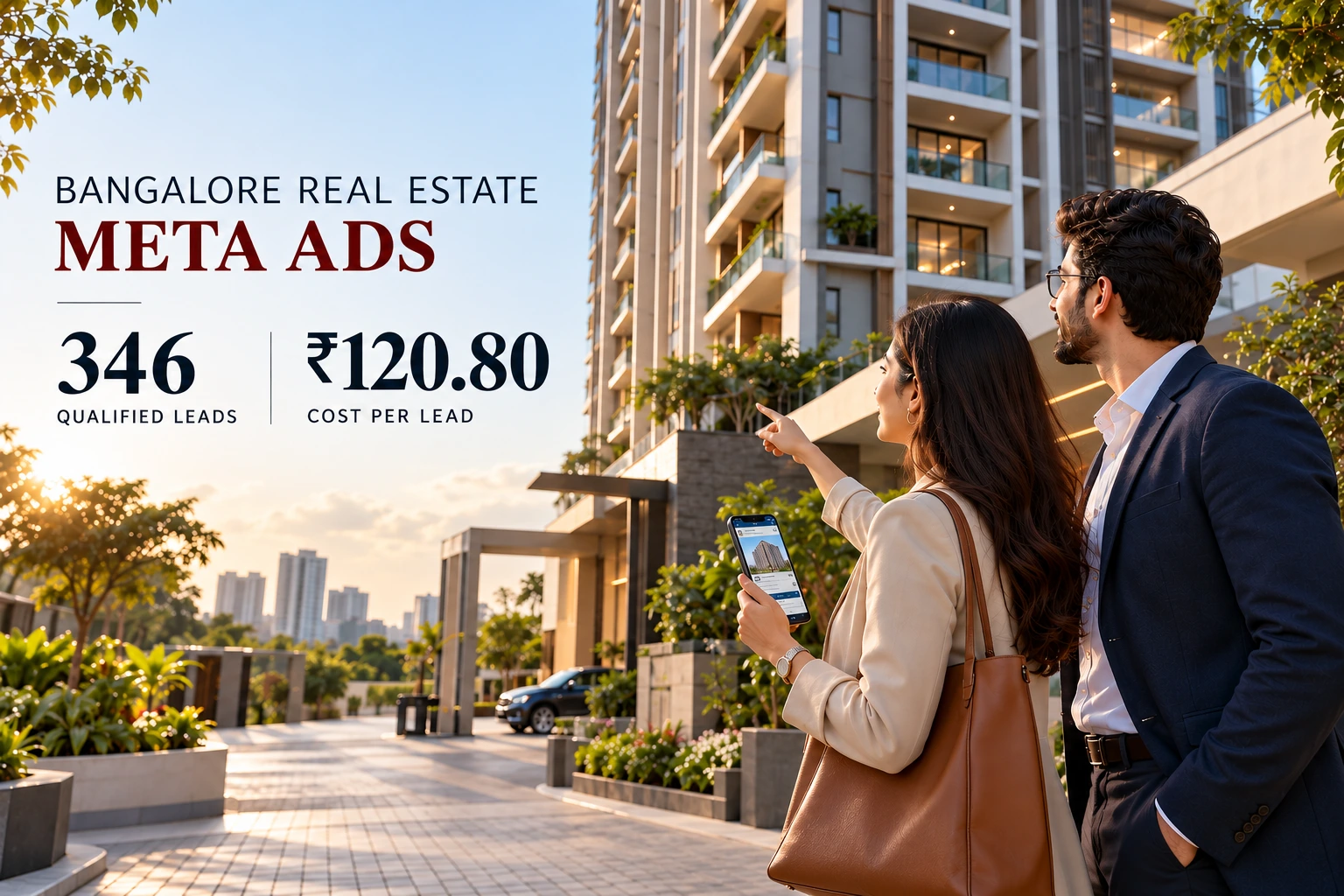
Client: Real Estate Developer — Premium Residential Flats, Bangalore (Client Name Confidential)
Agency: Dizispark
Platform: Meta Ads — Facebook & Instagram Full-Funnel Campaign (Awareness + Lead Generation)
Campaign Goal: Maximise qualified leads for premium Bangalore flats at an efficient, sustainable cost per lead
Campaign Period: 1 Month (Aug 1 – Aug 31, 2026)
Total Spend: ₹7,26,362.64
Industry: Real Estate — Residential Flats, Bangalore
1 About the Client
Our client is a real estate developer building premium residential flats in Bangalore one of India’s most competitive and most closely watched real estate markets. At any given time, hundreds of builders and brokerages are actively advertising across the same city, all chasing a relatively small pool of serious, ready to engage buyers, which makes Bangalore real estate one of the most expensive and crowded categories to run paid ads in.
Buying a flat is also a large, high-consideration purchase that almost nobody decides on after a single ad impression. It typically takes multiple touchpoints seeing the project, understanding the location and pricing, building real trust in the builder before a genuinely interested buyer is ready to share their contact details. The client needed a strategy built around that reality, not a single ad, single click approach that treats a multi lakh property decision like an impulse purchase.
2 The Problem
Real estate lead generation in Bangalore comes with two compounding challenges. The category is expensive to advertise in because of intense builder on builder competition for the same audience, and the purchase decision itself is slow which means a campaign optimized purely for immediate clicks tends to either starve for leads or pay a very high price for low intent ones.
Running only direct lead generation ads, with no supporting awareness layer, risks repeatedly showing the same offer to a small, already aware audience while leaving a much larger pool of genuinely interested Bangalore buyers people who simply haven’t heard of the project yet completely untouched. On the other hand, running only broad awareness ads with no dedicated conversion layer produces visibility and nothing else: no measurable leads, no way to prove ROI.
The brief was to build both layers at once within a single month’s budget: enough reach to keep introducing the project to new, relevant buyers throughout the month, and a dedicated, well targeted lead capture layer to convert that awareness into actual, qualified enquiries the client’s sales team could follow up on.
3 What We Wanted to Do
The plan was to run a genuine full-funnel structure, rather than treating awareness and lead generation as separate, unconnected efforts. Large scale awareness and reach campaigns would put the project in front of a wide, relevant Bangalore audience continuously through the month, while dedicated Meta Lead Form campaigns, built specifically for conversion, would capture interest from the most engaged part of that audience.
Within the lead-generation layer itself, the goal was to test more than one creative angle and location-based targeting approach, so that if one ad’s cost per lead started climbing, budget could shift toward whichever version was converting more efficiently rather than locking the entire month’s lead gen budget into a single, unproven ad.
4 What Dizispark Did
Step 1 Built a Full-Funnel Campaign Structure
Rather than pushing every ad toward the same immediate get a lead goal, we split the account into two connected layers broad awareness and reach campaigns to introduce the project to new Bangalore audiences, and dedicated Lead Form campaigns aimed specifically at the audience most likely to be ready to enquire.
Step 2 Tested Multiple Creative Angles and Locations
Within the lead-generation layer, we ran more than one ad variation, testing different creative angles and location-based targeting, so performance could be compared directly instead of relying on a single assumption about what would resonate with Bangalore flat buyers.
Step 3 Shifted Budget Toward the More Efficient Lead Ad
One lead ad consistently outperformed the other delivering leads at ₹107.81 each versus ₹151.89 on the other variant and budget was weighted toward the stronger performer as this became clear, which is what helped keep the blended cost per lead across the layer at ₹120.80.
Step 4 Used Meta Lead Forms to Minimize Drop-Off
Every lead-generation ad used Meta’s native Lead Form format, letting interested buyers share their details in a few taps without navigating to a separate website or landing page critical in a category where every extra step between an ad and a submitted form costs real, high intent leads.
Step 5 Kept the Awareness Layer Running Throughout the Month
Rather than front-loading all the awareness spend and switching it off early, reach and awareness campaigns continued running alongside the lead-generation ads for the full month consistently reaching over 20 lakh unique accounts and keeping a steady stream of new, relevant buyers entering the funnel.
Step 6 Tracked Reach, Spend, and Cost Per Lead Daily, Account-Wide
Every ad both awareness and lead-generation was monitored daily on spend, reach, impressions, and, where applicable, cost per lead, giving a clear, real-time view of whether the full-funnel investment was translating into efficient, qualified leads rather than just impressions on a screen.
5 The Results
Here is what the campaign delivered across a single month, Aug 1 – Aug 31, 2026:
| 346Total Qualified Leads (Form)From the dedicated lead-generation layer | ₹41,797.57Spend on Lead-Gen AdsOut of ₹7,26,362.64 total account spend |
| ₹120.80Blended Cost Per LeadStrong result for competitive Bangalore real estate | ₹111.20Blended CPM, Full AccountCost per 1,000 impressions, calculated from totals |
| 3.27Average Frequency, Full AccountCalculated from total impressions ÷ reach | ₹7,26,362.64Total Monthly SpendFull funnel — awareness + lead generation |
346 qualified leads at a blended ₹120.80 each is a strong result for a category where cost per lead regularly runs several times higher, especially in a market as saturated with builder competition as Bangalore. That efficiency came directly from running two lead ad variants side by side rather than betting on one: the stronger variant alone delivered leads at ₹107.81, well under the weaker one’s ₹151.89, and shifting budget toward it is what pulled the blended number down.
The Full-Funnel Math
The ₹7,26,362.64 total spend wasn’t only funding the 346 leads directly a large share of it was building the awareness layer underneath them. Across the month, the account reached an estimated 65.33 lakh impressions and over 20 lakh unique Meta accounts, at a blended CPM of just ₹111.20 a genuinely efficient rate for a category where attention is this expensive to win.
That awareness layer is what kept introducing the project to new, relevant Bangalore buyers throughout the month, so the dedicated lead-generation ads weren’t just reaching the same small, already-aware pool over and over — the average account-wide frequency of 3.27 shows the audience was seeing the brand multiple times without the campaign being limited to a tiny, overexposed segment.
One more detail is worth pulling out: the two lead-generation ads had very different costs per 1,000 impressions roughly ₹55.53 for the ₹151.89-per-lead ad versus roughly ₹192.81 for the ₹107.81-per-lead ad. In other words, the ad with the cheaper cost per lead actually cost over 3x more per impression, strong evidence that its targeting and creative were reaching meaningfully higher-intent people, not just cheaper ones.
6 Sample Ad-Level Breakdown
To show how the full-funnel strategy actually looked in the account, here is a representative sample of 8 ads from the month, spanning both the awareness layer and the lead-generation layer (ad names withheld for client confidentiality; the account ran additional ads beyond this sample, with full-month totals shown separately below):
| Ad | Layer | Results | Cost/Result | Spend | Impressions | Reach | Frequency |
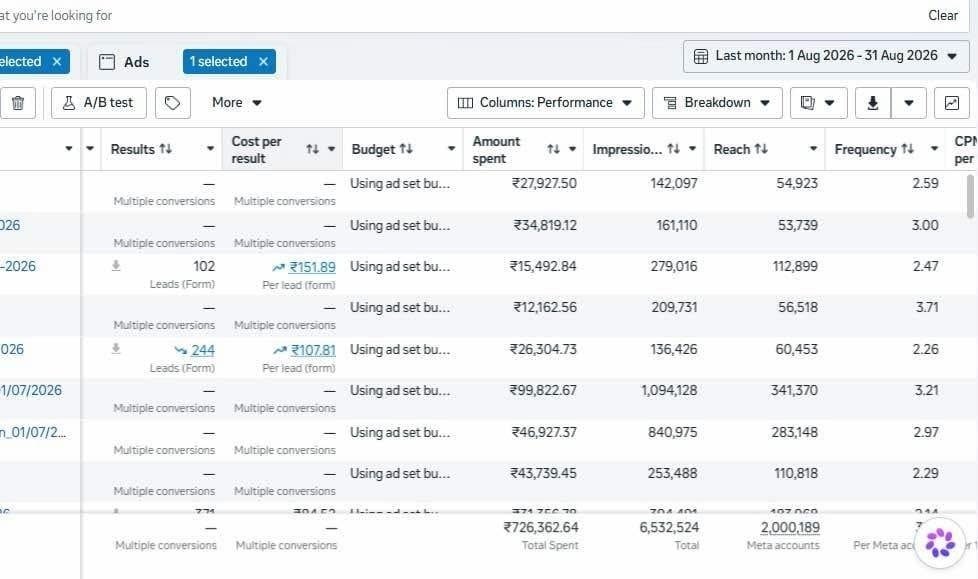
| Ad 1 | Awareness | — | — | ₹27,927.50 | 142,097 | 54,923 | 2.59 |
| Ad 2 | Awareness | — | — | ₹34,819.12 | 161,110 | 53,739 | 3.00 |
| Ad 3 | Lead Gen | 102 Leads | ₹151.89 | ₹15,492.84 | 279,016 | 112,899 | 2.47 |
| Ad 4 | Awareness | — | — | ₹12,162.56 | 209,731 | 56,518 | 3.71 |
| Ad 5 | Lead Gen | 244 Leads | ₹107.81 | ₹26,304.73 | 136,426 | 60,453 | 2.26 |
| Ad 6 | Awareness | — | — | ₹99,822.67 | 1,094,128 | 341,370 | 3.21 |
| Ad 7 | Awareness | — | — | ₹46,927.37 | 840,975 | 283,148 | 2.97 |
| Ad 8 | Awareness | — | — | ₹43,739.45 | 253,488 | 110,818 | 2.29 |
| Full Account | All Ads | 346 Leads | ₹120.80 blended | ₹7,26,362.64 | 65,32,524 | 20,00,189 | 3.27 (calc.) |
Only 2 of the 8 sampled ads carried the direct lead-generation objective the rest were awareness and reach campaigns, deliberately spending the larger share of the budget on building visibility across Bangalore. That’s a normal, healthy shape for a real estate full-funnel account a wide, affordable top layer feeding a narrower, higher-intent conversion layer, rather than every rupee chasing an immediate lead.
7 Real Ad Results Screenshot
Here is the actual screenshot taken directly from Meta Ads Manager, showing the real, unedited performance numbers behind this sample (ad names blurred for client confidentiality).
8 Before & After Dizispark
| Area | Before | After |
| Campaign Structure | No connected awareness-to-lead funnel | Full-funnel structure awareness layer feeding a dedicated lead-gen layer |
| Qualified Leads | No consistent, trackable lead pipeline | 346 qualified leads (Form) in a single month |
| Cost Per Lead | No benchmark cost per lead in this category | ₹120.80 blended; best ad at ₹107.81 |
| Reach | Limited, untracked visibility in the market | 20.00 lakh+ unique accounts reached in a month |
| Creative Testing | A single, unproven creative and message | Multiple lead-ad variants tested side-by-side |
| Budget Allocation | Spend committed without performance data | Budget shifted toward the stronger-performing lead ad |
| Lead Capture | Reliant on website forms and manual follow-up | Native Meta Lead Forms, minimizing drop-off |
| Visibility Into Spend | No layer-by-layer performance data | Full ad-level tracking across awareness and lead gen |
9 Key Numbers
Across a single month, the account generated 346 qualified leads from a dedicated lead-generation spend of ₹41,797.57, at a blended cost of ₹120.80 per lead — a strong, sustainable number in one of India’s most expensive real estate markets. The stronger of the two lead ads delivered 244 leads at ₹107.81 each, while the other delivered 102 leads at ₹151.89 each; shifting budget toward the better performer is what brought the blended figure down.
Supporting that lead-generation layer, the full account spent ₹7,26,362.64 across the month, reaching an estimated 65.33 lakh impressions and over 20.00 lakh unique Meta accounts, at a blended CPM of ₹111.20 and an average frequency of 3.27 — calculated directly from total impressions divided by total reach. Interestingly, the lead ad with the lower cost per lead (₹107.81) also had a noticeably higher cost per impression (roughly ₹192.81 vs. roughly ₹55.53 on the other ad), suggesting its targeting and creative were reaching smaller but meaningfully more convertible audiences rather than simply cheaper ones.
10 Conclusion
Bangalore real estate is one of the most competitive, most closely contested ad categories in the country, with hundreds of builders chasing the same relatively small pool of ready buyers. Going in, there was no guarantee that a single month’s budget could produce a meaningful number of genuinely qualified leads at a sustainable cost — this is a category where it’s easy to spend a great deal and have very little to show for it.
Building a real, connected full-funnel structure — rather than running awareness and lead generation as disconnected efforts — changed that. With a total investment of ₹7,26,362.64, the campaign reached over 20 lakh unique Bangalore-relevant accounts and converted a dedicated slice of that audience into 346 qualified leads at a blended ₹120.80 each, with the strongest ad alone delivering leads at ₹107.81.
Just as valuable as the lead count itself is the clarity the client now has: a proven comparison between two lead-ad approaches, a clear read on what awareness spend costs and delivers in this market, and a full month of ad-level data to guide where the next budget cycle should go.
Dizispark made this happen for a premium flats developer in one of India’s toughest real estate markets, and the same full-funnel, test-and-scale approach can be applied for any developer or brokerage looking to turn ad spend into a genuine, trackable pipeline of qualified buyers.
Ready to Fill Your Pipeline With Qualified Buyers?
Dizispark builds and runs full-funnel Facebook & Instagram campaigns for real estate developers and brokerages across India pairing large-scale awareness with dedicated, well-targeted lead generation, instead of chasing clicks with a single generic ad.
✓ A real, two-layer funnel — broad awareness paired with dedicated lead-generation ads
✓ Multiple creative angles and locations tested, with budget shifted to what actually converts
✓ Native Lead Form ads that minimize drop-off for a high-consideration purchase like real estate
✓ Daily, campaign-level tracking so you always know your real cost per lead
For this Bangalore flats developer, that meant 346 qualified leads in a single month at a blended ₹120.80 each — in one of India’s most competitive, most expensive real estate markets.
Let’s build the same kind of full-funnel system for your project. Reach out for a free consultation — no obligation, just a clear look at what’s possible for your budget.
Website: https://dizispark.com/
WhatsApp / Call: 6287 623 081 | We work with real estate developers & brokerages across India