
Have you ever wondered why the local business two streets away shows up first on Google, even though your products or service are just as good? You are not alone, Local shop owners, service providers, and small business teams run into this constantly, and the reason is almost always the same, their competitor has a real digital marketing strategy in place while they are relying on word of mouth alone. Digital marketing for local businesses is not optional anymore. In 2026, it is one of the clearest ways a small, local brand can compete with bigger players without a bigger budget.
This complete guide covers everything you need to know about digital marketing for local businesses in 2026. You will find a breakdown of local SEO, content marketing, social media, and email strategies, along with practical techniques, measurement tips, and the mistakes that quietly hold local businesses back. Every claim in this article is backed by verified data listed at the end of each section.
Table of Contents
ToggleWhy Digital Marketing for Local Businesses Matters Right Now
Digital marketing for local businesses matters because customer discovery has shifted almost entirely online, even for purchases that happen in person. A large share of local searches lead to a store visit or purchase within a single day, which means a business that is easy to find online has a direct advantage over one that isn’t.
Local businesses also have something larger competitors don’t proximity and community trust. When digital marketing is used well, it doesn’t erase that advantage, it amplifies it. A local bakery, salon, clinic, or repair shop can use online channels to reach exactly the people who are already nearby and already looking, rather than competing for a broad, generic audience.
Digital tools that once felt reserved for large corporations with big budgets are now accessible and affordable for small, local teams. The businesses that pull ahead aren’t necessarily spending the most. They are the ones using the right mix of local SEO, content, social media, and email consistently.
Key Takeaway:
Most local purchase decisions start with an online search, and a majority of those searches lead to a visit or purchase within 24 hours. Digital marketing for local businesses works because it puts your business in front of nearby customers at the exact moment they are ready to choose
What Digital Marketing for Local Businesses Actually Includes
Digital marketing for local businesses covers a mix of online channels working together rather than any single tactic. For most local businesses, the core mix includes search engine optimisation and local search presence, content marketing across written, visual, and video formats, social media for audience building and customer service, email marketing and automation for retention, paid advertising for targeted reach, and partnerships or influencer outreach.
Unlike traditional advertising, digital marketing for local businesses is measurable down to the rupee. A local business owner can track exactly which channel brought in a customer, what that customer cost to acquire, and whether the campaign paid for itself. This is a meaningful advantage for a local business working with a limited budget, since spend can be redirected toward whatever is actually working rather than guessed at.
The businesses that see the strongest results tend to focus on a smaller set of channels done well, rather than spreading thin attempts across every platform available.
Local SEO: The Foundation of Digital Marketing for Local Businesses
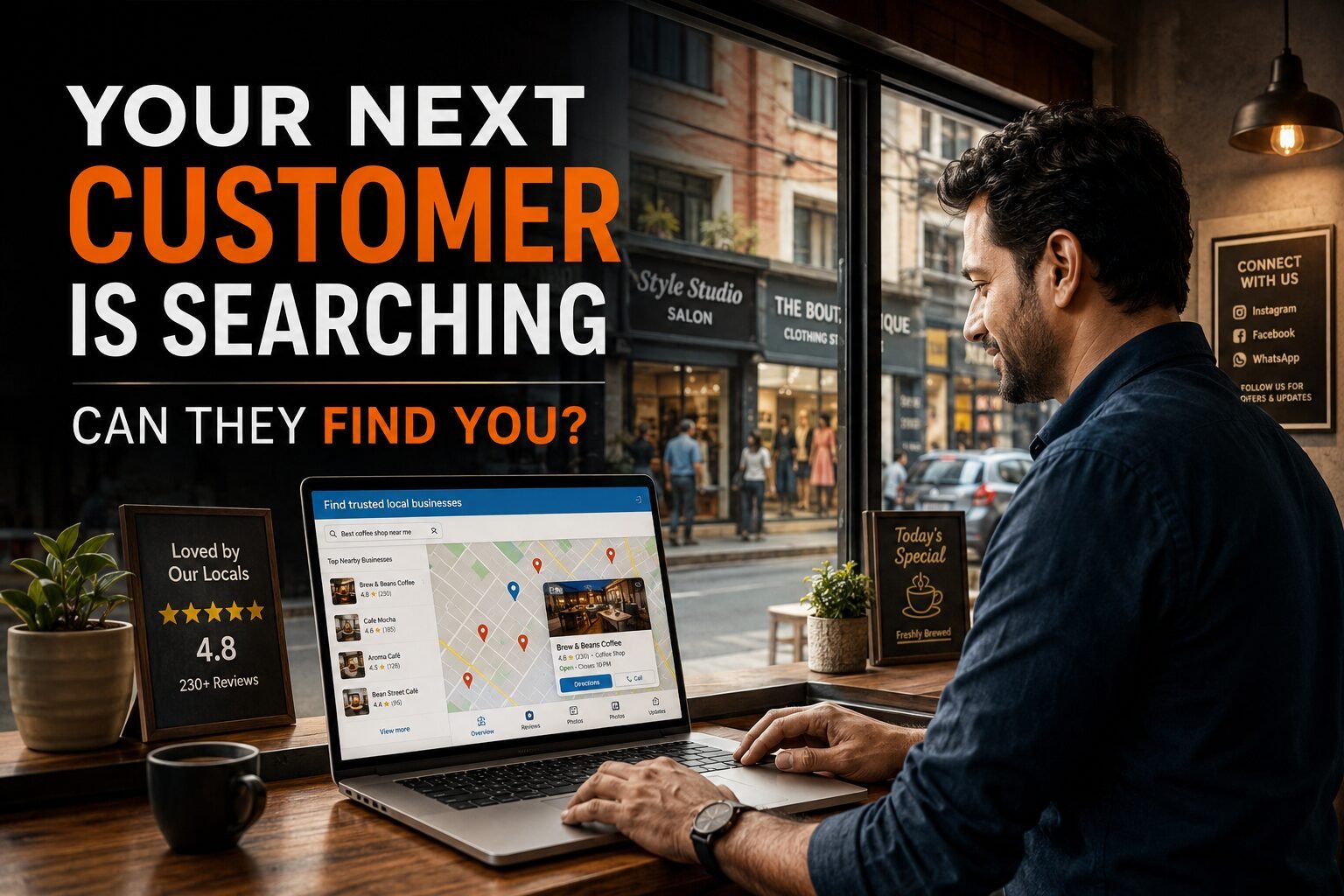
Local SEO is often the single highest-leverage part of digital marketing for local businesses, because it puts you in front of people actively searching for what you offer nearby. Local SEO drives meaningfully more foot traffic than a website with no local optimisation at all, and a large majority of local searches lead to a store visit within a day.
Google Business Profile: Keeping your business hours, photos, and posts current on your Google Business Profile is one of the most impactful steps a local business can take. Businesses with a complete, accurate profile tend to receive significantly more clicks than incomplete listings.
Geo-targeted keywords: Researching and using location-specific keywords, combining a service with a neighbourhood or city name, helps local landing pages appear in relevant local search results. Building dedicated pages around these terms, rather than relying on a single generic homepage, improves visibility for each area you serve.
Localised content: Incorporating city and neighbourhood-specific terms into titles, meta descriptions, and body content, alongside genuinely local content such as “best in Delhi” guides or posts about local events and news, helps a local business show up for the searches that matter most to it.
Review management: Encouraging satisfied customers to leave reviews and responding to them promptly builds the credibility that search engines and customers both weigh heavily. A strong average rating measurably improves click-through rates from local search results.
Content Marketing for Local Businesses
Content marketing is a core part of digital marketing for local businesses, and it doesn’t require a large team or budget to work. It requires content that is genuinely useful, relevant, and specific to the community a business serves.
Local businesses have a real advantage here: authentic storytelling and local knowledge that larger, national competitors simply can’t replicate. Content built around local events, neighbourhood problems, or community stories tends to resonate more strongly than generic industry content, because it signals that the business genuinely understands and belongs to the area it serves.
Practical formats that work well for local businesses include blog posts answering common local customer questions, “best in [city]” or “top [service] in [neighbourhood]” style guides, short videos or reels showing the business and its people, and customer story features. Repurposing one piece of content into multiple formats, turning a blog post into a short video or a set of social posts, helps a small team get more mileage from limited content resources.
Before creating content, it helps to answer three questions: who your audience actually is, what their specific needs and pain points are, and what you want the content to achieve, whether that’s leads, foot traffic, or brand awareness. This keeps content focused rather than scattered.
Social Media Marketing for Local Businesses
Social media plays a significant role in digital marketing for local businesses, with the vast majority of small businesses now using it as part of their marketing approach. The key isn’t being present on every platform, it’s showing up consistently on the one or two platforms where your local customers actually spend their time.
Choose the right platform: A visually driven business, such as a cafe, salon, or boutique, tends to do well on Instagram. A local service business, consultancy, or clinic may see more value from a platform like LinkedIn or Facebook, where trust and word-of-mouth referrals carry more weight.
Post with consistency, not just volume: A content calendar mixing product or service updates, behind-the-scenes glimpses, and customer testimonials keeps a steady stream of content without overwhelming a small team’s resources.
Use short-form video: A large majority of brands now treat video as a core part of their marketing, and for local businesses, short reels or clips showing the business, its people, and real customers tend to build trust faster than polished, generic ads.
Engage and retarget: Responding to comments and messages, encouraging user-generated content, and running retargeting ads to people who’ve already visited your website or profile all compound over time. Retargeted visitors convert at meaningfully higher rates than cold audiences.
Email Marketing and Customer Retention for Local Businesses
Email remains one of the highest-return channels in digital marketing for local businesses, often returning many times its cost when done consistently. For a local business, email and messaging tools are especially valuable because retaining an existing customer costs far less than acquiring a new one, and repeat customers tend to spend more over time.
Build your list with a clear incentive: Offering a discount, useful resource, or loyalty perk in exchange for a sign-up, at checkout, on your website, or through social media, builds a list of people who already want to hear from you.
Automate the basics: Welcome sequences, abandoned-cart reminders, and birthday or anniversary offers can run with minimal ongoing effort once set up, and they consistently improve retention for consumer-facing local businesses.
Use WhatsApp and SMS alongside email: WhatsApp messages see very high response rates within minutes of being sent, making it a strong complement to email for time-sensitive offers or appointment reminders.
Keep it local and personal: Referencing local events, partnerships with nearby businesses, or customer stories from the community makes email content feel relevant rather than generic, which is something a local business is naturally well positioned to do.
How to Measure Digital Marketing for Local Businesses
Knowing whether digital marketing for local businesses is working comes down to tracking a small set of metrics consistently, rather than trying to monitor everything at once.
| Metric | What It Tells You | Where to Track It |
|---|---|---|
| Website Traffic | How many people are finding you, and through which channel | Google Analytics |
| Conversion Rate | The share of visitors who take a desired action, such as booking or buying | Google Analytics, website forms |
| Customer Acquisition Cost | What it actually costs to win one new customer | Ad platform data plus total marketing spend |
| Local Search Rankings | Where you appear for “near me” and location-based searches | Google Business Profile insights, SEO tools |
| Review Volume and Rating | How trustworthy your business appears to new searchers | Google Business Profile, review platforms |
| Email Open and Click Rates | How engaged your existing subscriber base is | Email marketing platform |
| Return on Investment | Whether campaign revenue outweighs campaign cost | Combined spend and revenue tracking |
Set specific, measurable goals before you start, such as a target percentage increase in bookings or a set number of new email subscribers in a month, rather than a vague goal like “get more customers.” Review these numbers on a regular monthly or quarterly cadence and use what you find to shift budget toward what is actually working. Businesses that consistently review and adjust their marketing plans are substantially more likely to report success than those that set a plan once and never revisit it.
Common Mistakes to Avoid in Digital Marketing for Local Businesses
Even with the right channels in place, certain mistakes quietly limit results in digital marketing for local businesses. Here are the ones that hurt the most:
- Ignoring Google Business Profile: An incomplete or outdated profile is one of the most common and easily fixed gaps in local digital marketing, and it directly affects how often you show up in local search.
- Trying to be everywhere at once: Spreading a small team across every social platform usually produces weak, inconsistent content everywhere instead of strong, consistent content in one or two places that matter.
- Using generic, non-local content: Content that could belong to any business in any city misses the trust advantage local content naturally builds.
- Not tracking spend against results: Without basic tracking in place, it’s impossible to know which channel is actually driving customers, which usually means budget keeps going toward whatever feels familiar rather than what performs.
- Neglecting reviews: Not asking for reviews, or not responding to the ones you get, leaves credibility on the table that competitors are actively building.
- Treating email as an afterthought: Given its return relative to cost, under-investing in email and messaging is one of the more expensive gaps in a local business’s marketing mix.
- Setting a strategy once and never revisiting it: Local audiences, competitors, and platforms all change. A plan that isn’t reviewed every few months tends to quietly go stale.
Conclusion
Digital marketing for local businesses is not about having the biggest budget or the flashiest campaigns. It is about consistently putting your business in front of the customers who are already nearby and already searching, using a focused mix of local SEO, content, social media, and email.
The local businesses that pull ahead are the ones that get the fundamentals right: a complete, well-optimized Google Business Profile, genuinely local content, consistent presence on the one or two platforms their customers actually use, and a habit of tracking what’s working and adjusting accordingly. None of this requires a large team or a large budget. It requires focus, consistency, and a willingness to keep refining the approach based on real results. Done well, digital marketing for local businesses turns proximity and community trust, the natural advantages a local business already has, into a steady stream of customers who choose you first.
How Dizispark Can Help
Grow your business with proven local digital marketing strategies that put you in front of customers ready to visit, book, or buy. Dizispark helps local businesses build a complete digital presence through local SEO, content strategy, social media management, and email marketing, all tracked against real results. We handle everything from Google Business Profile optimisation to campaign performance reporting so you get more visibility, more foot traffic, and more repeat customers.
Frequently Asked Questions
What is digital marketing for local businesses?
Digital marketing for local businesses refers to using online channels, including local SEO, content marketing, social media, and email, to reach nearby customers, build trust in a specific community, and drive both online and in-store sales. It differs from general digital marketing mainly in its focus on location-based visibility and community relevance.
Why is digital marketing important for local businesses specifically?
A large share of purchase decisions for local products and services now start with an online search, and a majority of those searches lead to a store visit or purchase within a day. A local business without a digital presence is effectively invisible to a large share of nearby customers who are actively looking to buy.
What is the single most important digital marketing channel for a local business?
Local SEO, particularly a complete and well-maintained Google Business Profile, tends to deliver the strongest return for the effort involved, since it puts a business directly in front of people searching for exactly what it offers nearby. That said, the strongest results usually come from combining local SEO with consistent content and social media rather than relying on one channel alone.
How much should a local business spend on digital marketing?
There’s no universal figure, since it depends on the business’s size, goals, and competitive landscape. A practical starting point is to set specific goals first, such as a target number of new customers or bookings, then allocate a modest, trackable budget across one or two channels and adjust spend based on what the data shows is working.
How can a small, local business compete with bigger competitors online?
By focusing on what larger competitors can’t easily replicate: genuine local content, direct community relationships, fast personal responses to reviews and messages, and a highly specific local SEO presence. A local business doesn’t need to outspend a national brand, it needs to out-localise it.
How long does it take to see results from digital marketing for local businesses?
Local SEO improvements and organic content typically take a few months to build meaningful traction, while paid social and search ads can generate visible results within days to weeks. Consistency matters more than speed. Businesses that maintain a steady, tracked effort over several months tend to see compounding results that one-off campaigns don’t produce.
Do local businesses really need social media, or is it optional?
For most local businesses, social media is close to essential rather than optional, since the vast majority of small businesses now use it and customers increasingly expect to find and interact with local businesses there. The key is choosing the one or two platforms your specific customers use most, rather than trying to maintain a weak presence everywhere.
What is the biggest mistake local businesses make with digital marketing?
The most common and costly mistake is not tracking results against spend, which means budget keeps flowing toward channels that feel familiar rather than ones that are actually driving customers. A close second is neglecting Google Business Profile and reviews, both of which have an outsized impact on local search visibility relative to the effort required to maintain them.