
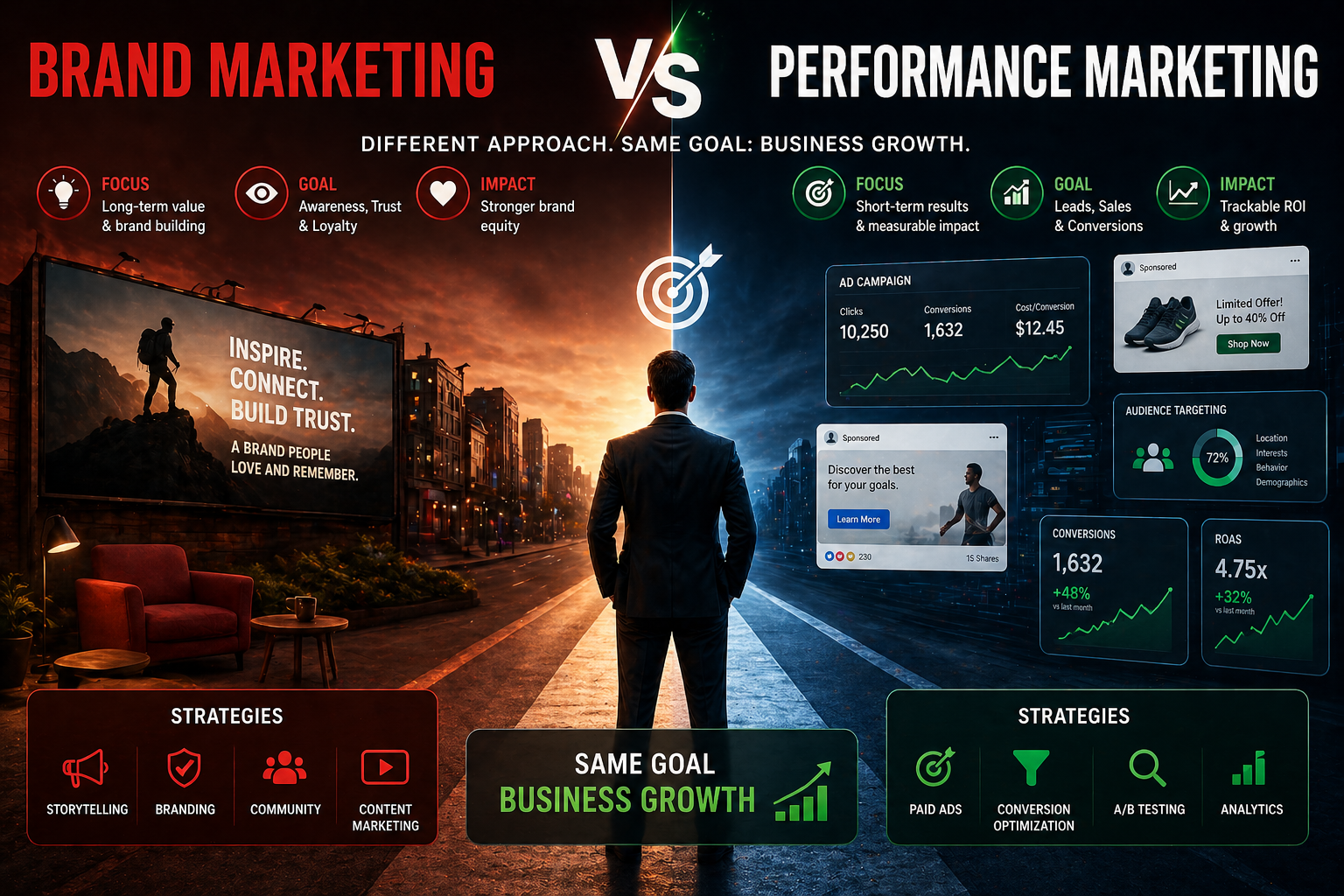
The debate over brand marketing vs performance marketing shapes how businesses allocate their marketing budgets, structure their teams, and measure success. According to Trackier’s 2026 research, 81% of marketers focus on brand marketing for long-term success, while 40% of global ad budgets go to performance marketing for immediate, measurable returns. Both numbers exist simultaneously because both strategies are necessary, not competing alternatives.
This guide covers brand marketing vs performance marketing across 7 key dimensions, explains what each strategy delivers, and shows how Indian businesses in 2026 can integrate both into one coordinated growth system that builds trust and drives measurable revenue at the same time.
Table of Contents
ToggleWhat Is Brand Marketing and What Is Performance Marketing?
Understanding brand marketing vs performance marketing starts with clear definitions of each:
Brand Marketing: What It Is
Brand marketing is a long-term strategy focused on building awareness, trust, and emotional connection between a company and its target audience. It promotes the values, identity, and personality of a brand rather than a specific product or immediate action. Brand marketing channels include content marketing, PR and earned media, social media storytelling, influencer partnerships, sponsorships, and brand-level advertising. Success is measured through brand recall, share of voice, Net Promoter Score, direct traffic, and branded search volume. Results compound over months and years. According to Coupler.io’s 2026 brand marketing research, loyal customers spend 43% more at brands they are loyal to, making brand equity a direct revenue driver despite being harder to attribute in real time.
Performance Marketing
Performance marketing is a results-driven strategy where advertisers pay only when a specific, measurable action is completed: a click, a lead, a sale, or a download. It focuses on immediate, trackable outcomes using data-driven channels including Google Ads, Meta Ads, affiliate marketing, programmatic advertising, and email campaigns. Key metrics are Cost Per Acquisition (CPA), Return on Ad Spend (ROAS), Click-Through Rate (CTR), Cost Per Click (CPC), and conversion rate. According to MNTN’s 2026 performance marketing guide, performance marketing is important because it ties direct results to marketing spend, making it easy to justify budget allocation and prove immediate impact in real time.
Brand Marketing vs Performance Marketing: Key 2026 Data
These data points reveal how the balance between both strategies is shifting in India and globally in 2026:
81% of marketers prioritise brand marketing for long-term success
Yet 40% of global ad budgets still go to performance marketing for immediate ROI, confirming that both strategies coexist as essential parts of a complete marketing system. (Trackier, 2026)
India’s digital advertising market crossed Rs. 35,000 crore in 2025, growing at over 20% annually
Performance marketing is the primary growth driver, with Google Ads, Meta Ads, and retail media advertising capturing the majority of this growth for D2C and e-commerce brands. (Balistro, 2026)
Loyal customers spend 43% more at brands they are loyal to
This is the compound financial return of brand marketing investment: lower acquisition costs, higher average order values, and longer customer lifetime value. (Coupler.io, 2026)
Performance marketing without brand support becomes expensive quickly
When brand equity is absent, every acquisition requires paid media. When brand equity is strong, performance campaigns convert at higher rates with lower cost per acquisition. (IUS Digital Solutions, 2026)
7 Key Differences: Brand Marketing vs Performance Marketing
Here are the 7 dimensions that most clearly separate these two strategies:
1. Goal and Time Horizon
Brand Marketing Goal
Build long-term awareness, trust, emotional connection, and brand equity. Results compound over 6 to 24 months. The primary question is: how many people know and trust us, and what feeling does our brand create? Brand marketing treats every customer interaction as a relationship investment rather than a transaction.
Performance Marketing Goal
Generate immediate, measurable actions: clicks, leads, sales, and downloads. Results are visible within days or weeks. The primary question is: what did we spend and what specific action did it produce? Performance marketing treats every rupee as an accountable investment with a traceable return.
2. Metrics and Measurement
Brand Marketing Metrics
Brand awareness (reach and impressions), brand recall (survey-based), share of voice, Net Promoter Score (NPS), direct traffic volume, branded search volume in Google Search Console, social media sentiment, and customer lifetime value. According to Coupler.io’s 2026 research, modern AI tools now provide more accurate brand measurement than was possible in previous years, including sentiment analysis and predictive brand equity modelling.
Performance Marketing Metrics
Cost Per Acquisition (CPA), Return on Ad Spend (ROAS), Click-Through Rate (CTR), Cost Per Click (CPC), conversion rate, cost per lead, and customer acquisition cost. Every metric is directly tied to a specific campaign action. Google Analytics 4, Meta Ads Manager, and Google Search Console provide real-time dashboards tracking every metric at campaign, ad group, and keyword level.
3. Channels and Formats
Brand Marketing Channels
Content marketing and blogging, PR and earned media, organic social media storytelling, brand-level video production, podcast sponsorships, influencer brand partnerships, out-of-home advertising (OOH), television and CTV brand campaigns, and community building. These channels prioritise reach and emotional resonance over immediate conversion.
Performance Marketing Channels
Google Search Ads, Google Shopping and Performance Max, Meta Ads (Facebook and Instagram), LinkedIn Ads for B2B, affiliate marketing networks, programmatic display advertising, email marketing automation, WhatsApp marketing campaigns, and retargeting campaigns. In India specifically, retail media on Amazon India, Flipkart, and Myntra is one of the fastest-growing performance marketing channels in 2026 according to Balistro’s research.
4. Budget Model and Risk Profile
Brand Marketing Budget
Long-term investment with delayed ROI. Budget goes toward content creation, PR fees, creative production, event sponsorship, and awareness campaigns.
Returns are not immediate but compound: a strong brand reduces future performance marketing costs by increasing organic demand and direct traffic.
Risk: investment is difficult to justify without robust attribution modelling.
Performance Marketing Budget
Pay-for-outcome model. Budget is directly tied to measurable results. Every rupee is traceable to a click, lead, or sale. Risk: without brand support, performance marketing becomes increasingly expensive over time as audiences experience ad fatigue and cost-per-click rises. According to IUS Digital Solutions’ 2026 strategy research, performance marketing alone without brand backing eventually becomes unsustainably expensive.
How Brand and Performance Marketing Converge in 2026
5. Speed of Results
Brand Marketing Timeline
3 to 24 months for meaningful impact. Brand awareness builds incrementally through repeated exposure. You cannot run a brand campaign for 30 days and expect measurable equity. The Balistro 2026 research confirms that brand marketing efforts compound over time: early brand investments from 12 months ago produce lower acquisition costs today.
Performance Marketing Timeline
3 to 7 days for initial results with Google Search Ads, 1 to 14 days for Meta Ads at scale. Performance marketing results are visible in real time and adjustable within hours. This immediacy is its defining advantage for product launches, seasonal campaigns, and businesses that need revenue before organic channels mature.
6. Audience Targeting Approach
Brand Marketing Targeting
Broad reach across all potential customers in the target demographic. Brand marketing is not primarily concerned with purchase intent. It builds awareness among people who are not yet ready to buy so that when they are ready, your brand is top of mind. Targeting is based on demographic, psychographic, and interest profiles rather than purchase-intent signals.
Performance Marketing Targeting
Precise intent-based targeting. Performance marketing reaches people who are actively searching for your product or who have previously engaged with your brand. AI-powered bidding on Google and Meta in 2026 automatically finds the users most likely to complete the target action. India’s DPDP Act 2023 is reshaping targeting by accelerating the shift to first-party data, making CRM-based audience building an essential performance marketing capability according to Balistro’s 2026 research.
7. The Hybrid Advantage: When Both Work Together
The most important 2026 insight on brand marketing vs performance marketing is that the most effective marketing strategies integrate both rather than choosing one. According to Digital ByteTeck’s 2026 research, performance marketing converts better when brand equity already exists. Brand marketing compounds faster when performance data reveals what messaging resonates. The feedback loop works as follows: brand-driven content at the top of the funnel builds awareness and trust. As users engage, they enter performance-driven funnels where retargeting and conversion-focused campaigns convert that trust into revenue. Performance campaign data then informs which brand messages to amplify.
Key Takeaway:
In 2026, the question for every Indian business is not brand marketing vs performance marketing as a binary choice. It is how to build a system where brand marketing reduces the cost of performance marketing over time, and performance marketing data makes brand marketing more precise. Businesses that invest in both simultaneously are building a compounding competitive advantage that neither strategy can deliver alone.
Complete Comparison: Brand and Performance Marketing Side by Side
Use this table for a side-by-side comparison of all 7 key dimensions:
| Dimension | Brand Marketing | Performance Marketing |
|---|---|---|
| Goal | Long-term awareness, trust, brand equity | Immediate, measurable actions and ROI |
| Metrics | Brand recall, NPS, share of voice, direct traffic | CPA, ROAS, CTR, CPC, conversion rate |
| Channels | Content, PR, organic social, TV, influencers | Google Ads, Meta Ads, email, affiliate, retargeting |
| Timeline | 3 to 24 months for measurable impact | 3 to 14 days for initial results |
| Budget model | Long-term investment with delayed ROI | Pay-per-outcome, immediately traceable |
| Targeting | Broad demographic and interest-based | Precise intent-based and behavioural |
| Risk | Delayed attribution, hard to justify short-term | Ad fatigue, rising costs without brand support |
| Best for | Startups building awareness, D2C brand growth | Lead generation, sales, product launches |
| India 2026 priority | Vernacular content, creator partnerships, PR | Google Ads, Meta Ads, WhatsApp, retail media |
Conclusion
The brand vs performance marketing debate is, in reality, a false choice. Indian businesses in 2026 do not have the luxury of building brand equity for 24 months before turning on performance campaigns, nor the sustainability of running performance ads indefinitely without the brand trust that reduces acquisition costs over time. The most successful Indian brands are those that run both simultaneously: brand content that builds authority and trust at the top of the funnel, performance campaigns that capture demand and measure ROI at the bottom. Start with performance marketing for immediate results. Build brand marketing in parallel for long-term equity. Let each strategy strengthen the other.
How Dizispark Can Help
Dizispark builds integrated brand marketing and performance marketing systems for Indian businesses that deliver both immediate measurable results and compounding long-term brand equity: SEO and content strategy for organic brand authority, Google Ads and Meta Ads managed for target CPA and ROAS, Instagram and LinkedIn social media for brand storytelling and community, WhatsApp and email automation for owned audience retention, and your Google My Business Profile fully optimised to rank in local search results and capture high-intent nearby customers every single day.
Frequently Asked Questions
What is the main difference between brand and performance marketing?
Brand marketing focuses on building long-term awareness, trust, and emotional connection between a brand and its audience. It uses channels like content, PR, organic social, and influencers, and measures success through brand recall, NPS, and share of voice. Performance marketing focuses on immediate, measurable actions: clicks, leads, and sales. It uses Google Ads, Meta Ads, affiliate marketing, and email campaigns, measuring success through CPA, ROAS, and CTR. The fundamental difference is time horizon: brand marketing builds equity over 12 to 24 months while performance marketing delivers results within days. Both are essential for sustainable growth in 2026.
Which is better for Indian businesses: brand or performance marketing?
Neither is universally better for Indian businesses in 2026. The right approach depends on your stage of growth. Early-stage businesses and new product launches typically prioritise performance marketing first for immediate lead generation and revenue, then build brand marketing in parallel as cash flow permits. Established brands with significant competition need brand marketing to differentiate on trust and values rather than just price or promotions. According to Digital ByteTeck’s 2026 research, the winning strategy is integrating both: brand marketing at the top of the funnel builds the trust that makes performance campaigns convert at lower cost per acquisition at the bottom.
What percentage of budget should go to brand vs performance marketing?
The widely cited benchmark from marketing research is the 60:40 rule: 60% of budget to brand marketing for long-term equity building and 40% to performance marketing for immediate results. However, this ratio varies significantly by business stage. New businesses or startups typically start with 80% performance and 20% brand to generate immediate revenue. Growing businesses shift toward 60:40 as brand equity builds and performance campaigns become more efficient. Established category leaders often invest 50:50 or even more in brand. According to Hall and Partners’ research cited by Trackier, winning brands that think beyond the 60:40 split and invest proportionally in both outperform single-strategy competitors significantly over time.
What metrics should I use for brand marketing?
The most useful brand marketing metrics in 2026 are: brand awareness (measured through surveys and reach/impression data from social platforms), brand recall (percentage of target audience that remembers your brand without prompting), Net Promoter Score (likelihood of customers recommending you), share of voice (your brand’s mentions relative to competitors), branded search volume (tracked in Google Search Console as the number of people searching your brand name directly), direct website traffic (users typing your URL directly, indicating strong brand recognition), and customer lifetime value (how much a loyal brand customer spends over their relationship with you). Modern AI analytics tools now provide more accurate brand measurement than was possible before 2025.
Can you run brand and performance marketing simultaneously?
Yes, and doing both simultaneously is precisely what the most successful businesses in India do in 2026. Running brand and performance marketing concurrently creates a feedback loop: brand content builds trust, which improves performance campaign conversion rates and reduces CPA. Performance campaign data reveals which messages resonate, which informs better brand content. According to IUS Digital Solutions’ 2026 strategy research, the most effective marketing systems treat brand and performance as two complementary layers of the same strategy rather than competing budget allocations. Start with performance marketing for immediate leads and revenue, then reinvest a portion of that revenue into brand building to lower future acquisition costs.
What is performance branding and why is it important in 2026?
Performance branding is an emerging approach that combines the long-term awareness benefits of brand marketing with the measurability and optimisation of performance marketing. It refers to brand-level campaigns that include performance tracking, conversion objectives, and data-driven optimisation rather than just reach and impressions. According to Balistro’s 2026 performance marketing trends research, performance branding campaigns are growing rapidly because they satisfy both the CFO’s need for measurable ROI and the CMO’s need for sustainable brand equity building. In India, this approach is particularly effective on Connected TV (CTV), YouTube brand campaigns with conversion tracking, and Instagram brand content with shopping integration.
How has AI changed brand marketing and performance marketing in 2026?
AI has transformed both strategies significantly in 2026. In performance marketing, AI-powered bidding on Google Performance Max and Meta Advantage+ automatically optimises ad spend, targeting, and creative selection in real time, achieving better ROAS than manual campaign management for most businesses. AI also enables personalisation at scale: the same ad appears completely different to a college student in Delhi versus a business owner in Mumbai based on real-time behavioural signals. In brand marketing, AI tools now provide more accurate measurement of brand equity, sentiment analysis at scale, and predictive modelling of how brand investments will affect future acquisition costs. According to Creative Nexus’s 2026 research, AI-powered tools also enable first-party data personalisation for brand campaigns, aligning brand messaging with individual user journey stages.
What is the role of content marketing in brand marketing vs performance marketing?
Content marketing plays a dual role that bridges brand and performance marketing. As a brand marketing tool, long-form content including blogs, videos, podcasts, and case studies builds topical authority, brand trust, and organic visibility over time. As a performance marketing tool, content is used in paid promotion, retargeting campaigns, lead magnets for email capture, and landing page copy that drives conversions. According to Orbit Media’s brand vs performance marketing research, all content exists in the intersection of brand and performance: it is either building awareness and trust (brand) or triggering a specific action (performance). The most effective content marketing for Indian businesses in 2026 does both simultaneously: SEO-optimised blog posts that build organic authority while including clear calls to action that drive measurable conversions.