
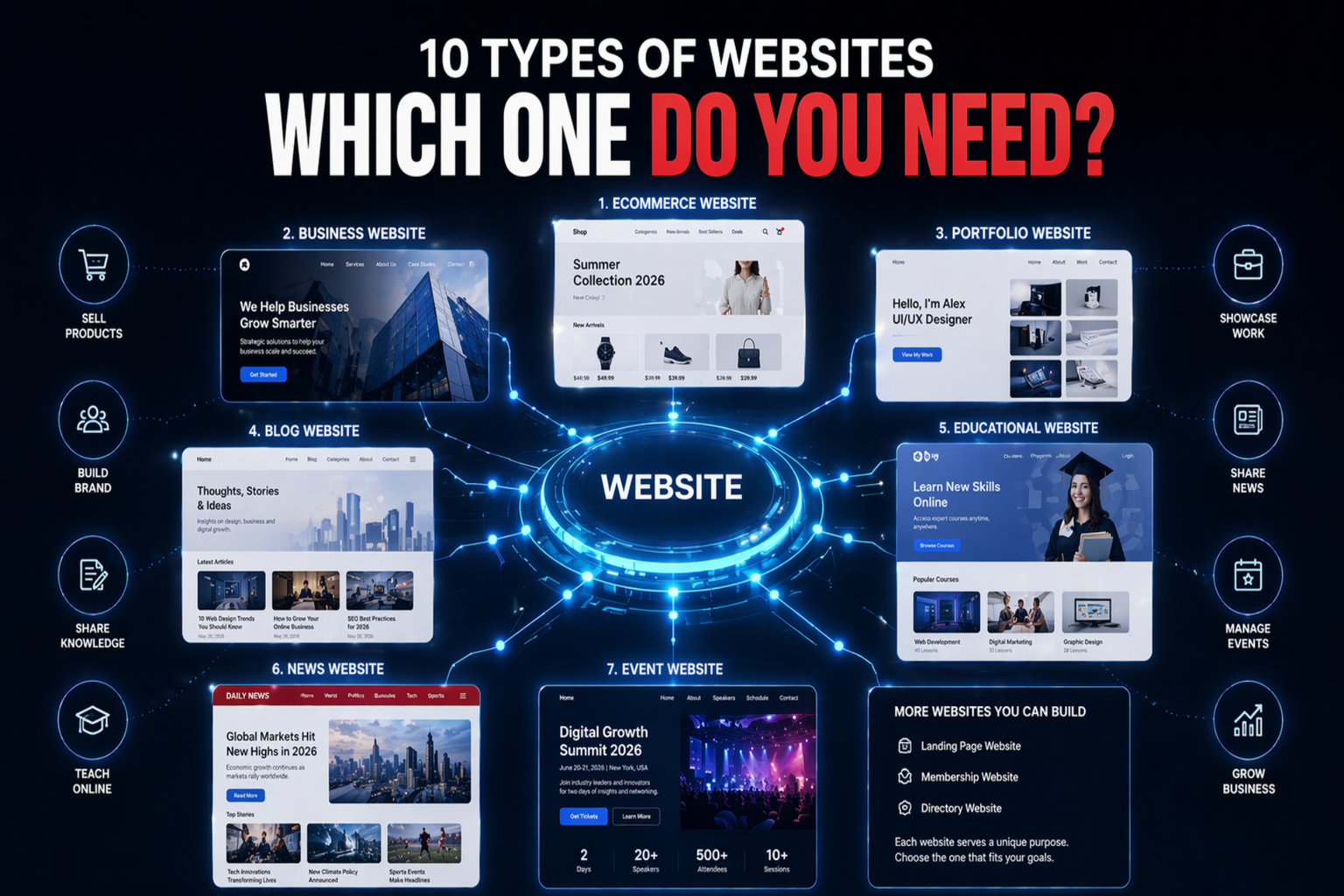
Understanding what are the types of website is a critical first step for any business owner, digital marketer, or entrepreneur planning an online presence in 2026. With more than 1.3 billion websites currently online, according to Tubikstudio’s web design analysis, attention is not guaranteed and can only be earned through relevance, meaning the type of website a business builds must directly match its audience’s intent and purpose.
Webflow’s types of websites guide confirms that every website serves a unique purpose: some convert visitors into customers, some inform and educate, others entertain or build community. Without understanding which type of website serves a specific goal, businesses risk building a visually polished interface that solves none of the right problems.
Tubikstudio’s analysis frames this precisely: understanding the types of website is the first moment where design becomes strategy rather than decoration, because once a business knows what kind of system it is building, everything else falls into place including navigation depth, content density, interaction patterns, and conversion architecture. This guide covers the 10 most important types of website in 2026, with the purpose, design priorities, and business use case for each, drawn from three expert sources.
Table of Contents
ToggleStatic vs Dynamic Websites: The Foundation
Before answering what are the types of website by purpose, it is essential to understand the two foundational technical categories that determine how any website functions.
Tubikstudio’s analysis defines the key distinction: a static website shows fixed content where every visitor sees the same pages and updates happen manually, while a dynamic website changes its content based on user behaviour, data, or context. Static websites work well for landing pages, simple company sites, event pages, and portfolio sites because they have faster load times and fewer moving parts.
Dynamic websites power everything that responds to the user: eCommerce platforms that show personalised recommendations, social networks that display user-generated content, and news platforms that update in real time. Tubikstudio confirms that most modern platforms lean toward the dynamic side because users now expect the web to respond, evolve, and personalise the experience around their specific context and behaviour.
EEAT Note Expertise:
Key distinction: Static websites communicate information. Dynamic websites facilitate interaction.
Tubikstudio identifies three lenses designers use to categorise websites: content behaviour (static vs dynamic), purpose and functionality (the 10 types), and responsiveness across devices. All three must be considered before building any type of website.
What Are the 10 Types of Website? Expert-Ranked 2026 List
Based on Tubikstudio’s purpose-based classification and Webflow’s 12-type design guide, here are the 10 most important types of website for businesses and individuals in 2026, covering what each type is, who needs it, and what design priorities drive its success.
01. eCommerce Website
An eCommerce website is a platform built specifically to sell products or services directly to consumers online. Webflow’s types of websites guide identifies eCommerce as the most conversion-focused of all website types: every interface decision connects to the sequence of discover, compare, select, purchase, and review. Tubikstudio confirms that commerce design punishes ambiguity, meaning a misplaced button, a confusing form field, or a slow checkout flow can instantly cause cart abandonment.
The most important eCommerce design priorities are intuitive navigation, logical category structure, smart search functionality, mobile-first responsive layouts for the majority of mobile shoppers, multiple payment options, and trust-building elements like product reviews, security badges, and clear return policies. Webflow notes that educational overlays, community-inspired Q&A sections, and standout CTA buttons help build the user confidence that converts browsing into purchasing.
Best for: any business selling physical goods, digital products, or services online.
02. Business or Corporate Website
A business website introduces what a company does, who it serves, and why it matters to its target audience. Webflow describes it as often the first touchpoint for potential customers, partners, and press, making first impressions in the first few seconds of every visit. Tubikstudio’s analysis identifies that corporate websites must balance two simultaneous audiences potential clients and potential employees requiring the interface to support both conversion flows and cultural storytelling in parallel.
The design priorities for a business website include a direct headline that communicates the value proposition immediately, intuitive navigation with CTAs visible at all times, social proof elements such as testimonials and recognisable client logos, and supporting visuals that show the product, team, and results. Webflow recommends keeping all navigation and CTAs within a few clicks of key conversion pages including services, pricing, and contact.
Best for: companies of any size wanting to establish credibility and generate leads online.
03. Portfolio Website
A portfolio website showcases creative work, whether design, photography, writing, development, illustration, or any other discipline with a strong visual or storytelling component. Tubikstudio identifies the portfolio site as essentially a digital handshake, where visitors decide whether they trust the creator within seconds, meaning grid discipline, typography, and image hierarchy signal professionalism long before anyone reads a case study.
Webflow’s portfolio design guidance recommends curating work carefully, choosing a handful of projects that reflect expertise and personal style rather than overwhelming the page, walking visitors through the problem, the role, the decisions made, and the impact of the work in each case study, and using whitespace generously so each element breathes. If the portfolio spans multiple disciplines, filters or category navigation ensure the work is organised and discoverable.
Best for: designers, photographers, developers, writers, and creative professionals building a client-ready digital presence.
04. Blog Website
A blog website publishes content regularly including articles, how-to guides, thought leadership pieces, or personal reflections, with the goal of building an audience, driving organic search traffic, and establishing the publisher as a trusted authority. Webflow confirms that with consistent publishing, a blog positions a brand as a reliable thought leader while delivering long-term value through a growing body of indexed, searchable content.
Tubikstudio notes that blogs often exist embedded inside larger platforms corporate sites, eCommerce stores, and educational platforms rather than as standalone sites, where they function as living knowledge engines that improve SEO performance and keep content fresh. Design priorities include clean layouts that prioritise readability, strong tagging and internal linking to connect related content, keyword-researched titles and articles for search discoverability, and social share buttons to encourage content distribution.
Best for: businesses, journalists, creators, and thought leaders building long-term organic search authority.
05. Educational Website
Educational websites are platforms for learning, ranging from simple online libraries to complex systems hosting courses, lectures, and certification programmes. Tubikstudio’s analysis identifies that education design succeeds when cognitive load stays consistently low, meaning information must unfold in digestible layers rather than overwhelming walls of text, as if pacing knowledge rather than dumping it. Webflow’s educational website guidance confirms that these sites are content-rich by nature, making intuitive navigation especially critical, alongside accessible design features like high-contrast colours, responsive layouts for all devices, clear information about course length, start dates, instructors, and certifications available. Design priorities include structured learning paths, clear progress indicators, and content readability. Best for: schools, universities, online course creators, training providers, and ed-tech platforms.
06. News and Magazine Website
News websites deliver timely, relevant content from breaking headlines and in-depth reporting to niche commentary, and are built for speed, volume, and credibility. Tubikstudio identifies that news design must handle two competing needs simultaneously: speed of publishing and clarity of reading, noting that readers often arrive through search engines or social links meaning headlines, typography, and visual hierarchy must communicate context instantly. Webflow confirms that a well-structured news website uses logical content hierarchy with breaking news at the top, featured stories below, and categorised sections for ongoing topics, while articles must load quickly, be easily shareable, and work across all devices.
Accessibility features like adjustable text size and dark mode matter especially for audiences spending significant reading time on news sites. Best for: media organisations, niche publishers, community news outlets, and content-driven brands building editorial authority.
07. Personal Website
A personal website is a hub for an individual’s personal brand, acting as the space to introduce who they are, tell their story, and shape how people perceive them professionally. Webflow distinguishes personal websites from portfolio sites by noting that while a portfolio focuses on specific creative work, a personal website focuses on online presence and personal identity in a broader sense. Design priorities include a strong hero section with a short introduction, professional photo, and mission statement, a clear contact section that is approachable and easy to find, supporting pages for background and experience, and links to social profiles or external work.
Tubikstudio confirms that a careless personal website destroys credibility immediately. Best for: freelancers, speakers, coaches, content creators, job seekers, and professionals wanting to control their digital identity.
08. Directory or Listing Website
Directory websites function as digital catalogues, organising large amounts of structured data around a specific theme or location. Tubikstudio identifies examples including local business listings, service marketplaces, event aggregators, and real estate directories, noting that users always arrive with specific search intent, making filtering precision, search accuracy, and result sorting the most critical interface components. Webflow confirms that if discovery fails in a directory website, the platform fails entirely. Design priorities include powerful filtering and sorting tools, fast-loading search results, clean categorisation, and clear listing cards that give users the key information they need to click through to the right result. Best for: local business directories, job boards, event listings, property platforms, and any platform that aggregates third-party listings.
09. Non-Profit or Charity Website
Non-profit websites are mission-driven platforms that raise awareness, share impact stories, attract volunteers and partners, and encourage donations from the general public. Webflow’s guide identifies that unlike commercial sites, non-profit websites do not sell products but instead communicate purpose and ask for trust, making a well-designed non-profit site one that legitimises the work and emotionally connects with supporters while making it easy to donate, volunteer, or engage with the cause. Design priorities include visual storytelling through campaign imagery and impact statistics, a prominent mission statement on the homepage, action buttons for donating and volunteering that are always visible, and content that highlights current campaigns, success stories, and community impact. Best for: charities, NGOs, social enterprises, foundations, and community organisations.
10. Event Website
An event website promotes a specific occasion such as a conference, concert, festival, product launch, or webinar, with the primary goal of building awareness and driving sign-ups or ticket sales. Webflow’s event website guidance identifies two questions every event site must answer at first glance: is this event relevant to this visitor, and why should they attend? The design must capture the event’s energy immediately and answer those questions through strong visuals, a catchy tagline, and essential details including the date, location, and ticket pricing in the hero section.
Supporting sections should include speaker or performer profiles, highlights from previous editions, testimonials from past attendees, an FAQ section, and persistent CTAs throughout the page as reminders to convert. Best for: conference organisers, entertainment promoters, product launch teams, webinar hosts, and festival organisers.
Quick Reference: All 10 Website Types at a Glance
Use this table to quickly identify what are the types of website that match your specific business goals, audience, and content strategy in 2026.
| Website Type | Primary Goal | Key Design Elements | Best For |
|---|---|---|---|
| eCommerce | Sell products or services online | Product pages, checkout, filters, payment integration, mobile-first | Retail, D2C brands, online stores, digital product sellers |
| Business / Corporate | Build credibility, generate leads | Value proposition headline, CTAs, testimonials, services pages | Companies of all sizes, service providers, B2B brands |
| Portfolio | Showcase creative work to attract clients | Case studies, curated projects, whitespace, contact section | Designers, photographers, writers, developers, creative professionals |
| Blog | Build authority and organic search traffic | Readable layouts, tagging, internal links, keyword-researched content | Businesses, publishers, thought leaders, content creators |
| Educational | Teach through structured content or courses | Learning paths, progress indicators, accessible design | Schools, online course creators, training providers, ed-tech |
| News / Magazine | Deliver timely, credible information | Content hierarchy, fast load, shareable articles, search/filters | Media outlets, niche publishers, editorial brands |
| Personal | Build individual online identity and brand | Hero intro, mission statement, social links, contact section | Freelancers, coaches, speakers, job seekers, content creators |
| Directory / Listing | Organise searchable structured data | Filtering, search precision, result sorting, clean listing cards | Local directories, job boards, real estate, event aggregators |
| Non-Profit / Charity | Raise awareness and donations | Mission statement, visual storytelling, donation CTAs | NGOs, charities, foundations, social enterprises |
| Event | Promote an event and drive sign-ups | Bold hero, date/venue/pricing, speaker profiles, FAQ, persistent CTAs | Conference hosts, music promoters, webinar organisers |
Conclusion
Understanding what are the types of website is not a theoretical exercise: it is the strategic foundation of every successful online presence built in April 2026. The type of website a business chooses determines its navigation architecture, content density, interaction patterns, conversion design, and ultimately its ability to turn visitors into customers or supporters.
As Tubikstudio confirms, without knowing what kind of system you are building, teams end up creating beautiful interfaces that solve nothing, and the internet already has more than enough of those. Whether you need an eCommerce platform built around conversion, a corporate site built around credibility, a portfolio built around trust, or a blog built around long-term SEO authority, the answer to what are the types of website points directly to which design strategy and technical approach will actually serve your audience and achieve your goals.
How Dizispark Can Help
Dizispark is a Delhi-based website design and digital marketing agency that helps businesses build the right type of website for their specific goals from eCommerce stores and corporate sites to portfolio pages, blog platforms, and educational websites paired with a fully optimized Google My Business Profile that drives local search visibility and verified trust signals alongside every website we build, ensuring your digital presence works across both organic search and map discovery from day one.
Whether you are starting from scratch and need guidance on which type of website fits your business, or you already know what you need and want a team that builds it with SEO, speed, mobile responsiveness, and conversion architecture built in, Dizispark delivers it with transparent reporting and measurable outcomes.
Frequently Asked Questions
What are the main types of website?
The 10 main types of website in 2026 are: eCommerce websites for selling products and services online, business or corporate websites for establishing credibility and generating leads, portfolio websites for showcasing creative work, blog websites for publishing content and building SEO authority, educational websites for delivering courses and learning programmers, news or magazine websites for delivering timely information, personal websites for building individual online identity, directory or listing websites for organising searchable structured data, non-profit or charity websites for raising awareness and donations, and event websites for promoting specific occasions and driving ticket sales or sign-ups.
What is the most popular type of website?
eCommerce websites and blog websites are consistently among the most popular types of website globally. Webflow confirms that eCommerce is one of the most widely built website types because of the ongoing growth of online shopping across all industries. Blog websites are also extremely common because businesses in every sector use content publishing to build organic search authority and drive long-term traffic. Tubikstudio notes that more than 1.3 billion websites are online, and the most common purpose-built types remain commercial, informational, and portfolio-based sites.
What is the difference between a website and a webpage?
A website is the complete system of interconnected pages available at a specific domain on the internet, while a webpage is a single document within that system. When you visit a business website and click through from the homepage to the services page to the contact page, each page you land on is a webpage, while the entire collection of pages together forms the website. Tubikstudio defines a website as a structured system of web pages designed to deliver content or functionality through a domain, where the design determines how users navigate and interact with the information across all its pages.
What are the types of website for small businesses?
The main types of website for small businesses include business websites, eCommerce websites, portfolio websites, blog websites, landing page websites, and local business websites. If you are asking what are the types of website that work best for small businesses, the right choice depends on whether your goal is lead generation, online sales, local visibility, or SEO growth.
What are the types of website by purpose?
The types of website classified by purpose are: informational (corporate and personal sites that provide information without selling), transactional (eCommerce sites built for purchasing), educational (platforms that teach through structured content or courses), community (social networks and forums where users connect and interact), entertainment (streaming and gaming platforms), media (news and magazine sites), fundraising (non-profit and crowdfunding platforms), and lead generation (landing pages and service sites focused on capturing contact information). Tubikstudio confirms that the purpose of a website determines its navigation depth, content density, and conversion architecture.
What is a static website vs a dynamic website?
A static website displays fixed content that is the same for every visitor and must be updated manually, making it well-suited for landing pages, portfolios, and simple informational sites where content changes infrequently. A dynamic website generates content in response to user behaviour, account data, location, and other variables, making it essential for eCommerce stores, social platforms, news sites, and any system that must personalise the experience for each user. Tubikstudio explains that static websites communicate information while dynamic websites facilitate interaction, and that modern web users expect the dynamic experience because they have come to expect the web to respond to them rather than presenting fixed information.
How do I choose the right type of website for my business?
To choose the right type of website for your business, start by defining the primary goal: are you selling products, generating leads, publishing content, showcasing work, educating an audience, or building a community? Once the goal is clear, match it to the appropriate website type. If you are selling products, build an eCommerce website. If you are a service business wanting credibility and enquiries, build a corporate website. If you create content for search and audience growth, build a blog. Webflow recommends designing with purpose, meaning the website type should drive every decision from navigation structure to CTA placement, and the entire experience should be oriented around the specific action you want visitors to take.
Can a website be more than one type at the same time?
Yes, many websites combine multiple types in a single platform. Tubikstudio notes that blogs are frequently embedded within corporate websites, eCommerce stores, and educational platforms where they function as knowledge engines that support SEO while the primary website type handles conversion or education. A business website might include a blog for content marketing, an eCommerce section for selling products, and a portfolio section for showcasing work. Webflow confirms that the website type framework is primarily useful for planning the primary purpose and architecture of a site, while additional functionality can be layered on top as long as the core user journey remains clear and the navigation does not become confusing or contradictory.