
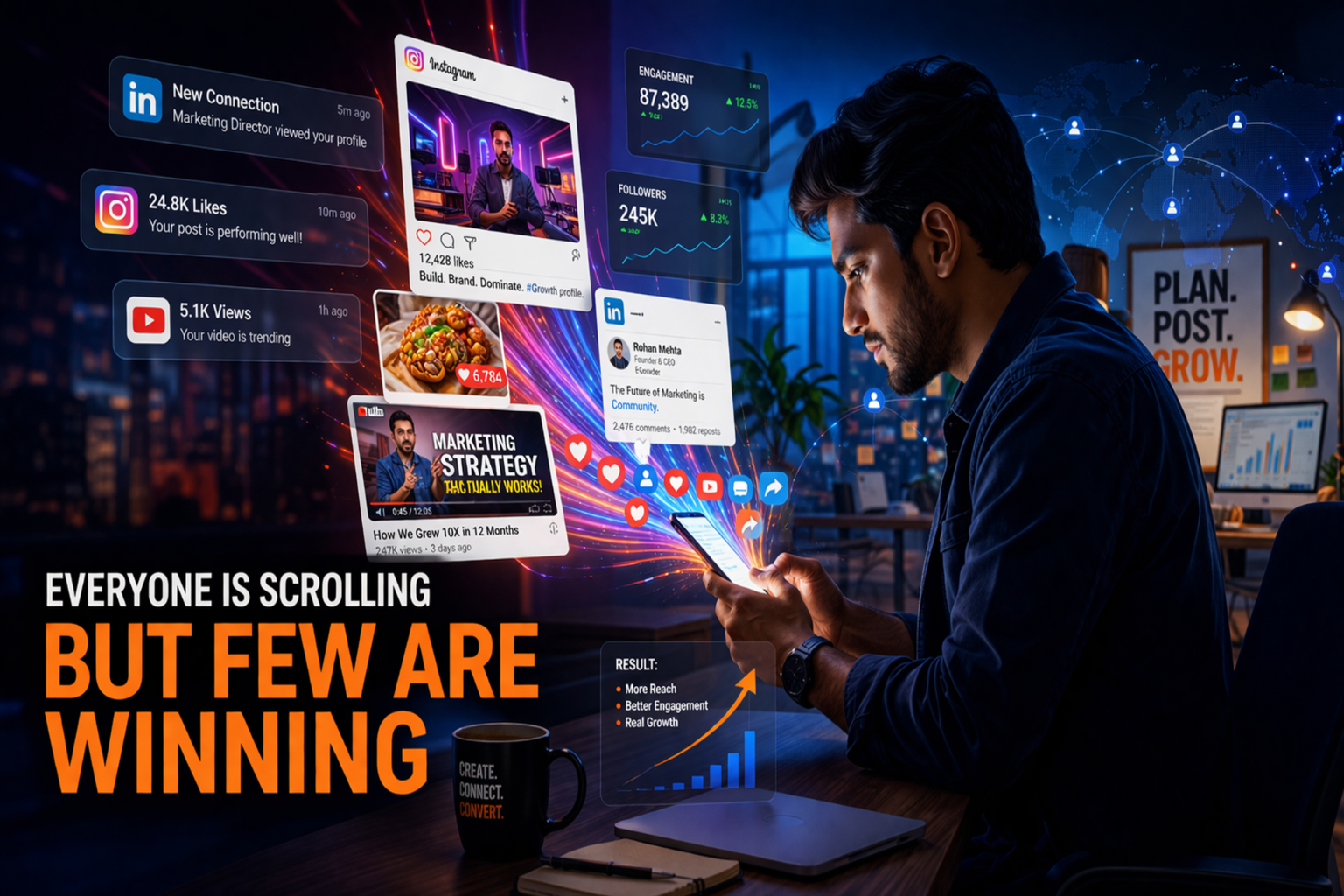
The impact of social media on marketing is now so fundamental that it is difficult to separate what marketing was before social media existed from what it has become. According to Skillfloor’s impact of social media on marketing report, over 5.17 billion people are active on social media globally, representing more than 64 percent of the world’s population. Every one of those users is a potential customer, a potential brand ambassador, and a potential reviewer whose opinion is visible to millions of others.
For businesses in April 2026, social media is not a marketing channel to consider: it is the primary environment where brand relationships are built, audiences are acquired, and purchasing decisions are influenced.
The impact of social media on marketing extends far beyond simply posting content. It has restructured the entire discipline: from how budgets are allocated and how campaigns are measured, to how brands respond to crises and how they compete for consumer attention. This guide covers every major dimension of that impact, with the data, real-world examples, and strategic insights that marketers and business owners need to build an effective social media marketing strategy in 2026.
Table of Contents
ToggleHow Social Media Fundamentally Changed Marketing?
University Canada West’s analysis of the impact of social media on marketing strategies describes a transformation that has accelerated dramatically over the past decade. Social media started as a way for businesses to share updates, but as platforms grew in scale and sophistication, so did the marketing opportunities. Advanced audience targeting, influencer partnerships, user-generated content, and real-time analytics are all now standard components of a marketing strategy that barely existed fifteen years ago.
The most significant structural change in the impact of social media on marketing is the shift of power from brands to consumers.
Zamstars’ analysis captures this precisely: where once the consumer’s voice was small and largely unheard, now even an individual customer can make their presence felt through social media, voicing complaints or recommendations on a platform accessible to millions of users. This shift has forced brands to be more responsive, more transparent, and more customer-centric than traditional marketing ever required. A single viral post, whether positive or negative, can meaningfully affect brand perception across millions of accounts within hours.
Key Stat:
5.17 billion people are active on social media globally in 2026 — more than 64% of the world’s population. Sprinklr reports that social media is now a complete end-to-end shopping ecosystem where the entire customer journey from discovery to purchase can happen inside a single app. This is not social media as a marketing support channel: it is social media as the primary commercial environment.
6 Core Impacts of Social Media on Marketing in 2026
The impact of social media on marketing operates across six distinct dimensions, each of which has transformed how brands attract, engage, and retain customers. Understanding each one is essential for building a strategy that delivers measurable commercial results.
1. Precision Targeted Advertising
One of the most commercially powerful impacts of social media on marketing is the ability to target advertisements with a level of precision that was never possible through television, print, or radio. University Canada West notes that social media algorithms allow businesses to target specific demographics based on user interests, behaviors, location, age, and past interactions with their content, ensuring ads are served to people who are most likely to be interested in the product or service. Skill floor cites HubSpot data showing that targeted social media ads can boost conversions by up to 202 percent compared to non-targeted advertising.
For businesses with limited budgets, this is the most efficient advertising mechanism available: no money is spent reaching audiences who will never convert.
2. Brand Building and Community Development
The impact of social media on marketing in terms of brand building is without precedent. Social platforms give brands a consistent daily presence in their audience’s life, which traditional media could never achieve at comparable cost. Skill floor’s research cites Sprout Social data showing that 64 percent of customers want companies to interact with them on social media, highlighting how fundamental a brand’s online presence has become to customer expectations. Zam stars identifies improving brand awareness as one of social media’s core marketing benefits, noting that interacting with people and sharing creative content on social platforms helps create brand awareness and attract more followers consistently over time.
Sprinklr’s analysis adds a nuanced and important dimension to the brand building impact: organisations with mature social media strategies experience a 26 percent higher customer retention rate and a 21 percent increase in revenue per customer interaction. This data directly links consistent social media brand building to bottom-line commercial outcomes, not just awareness metrics. Brands that build genuine communities, like Glossier’s approach of encouraging customers to share their own content and experiences, convert social media engagement into measurable customer loyalty and repeat revenue.
3. Influencer Marketing and User-Generated Content
The impact of social media on marketing through influencer partnerships and user-generated content is one of the most commercially proven developments of the past decade. Skill floor reports that influencer marketing is used by 93 percent of marketers, and brands earn an average of INR 43 (USD 5.20) for every INR 8 (USD 1) invested, according to Influencer Marketing Hub data. Sprinklr confirms that the average engagement rate for influencer campaigns stands at 4.2 percent, higher than most traditional paid media. More than half of consumers trust product recommendations from influencers they follow, especially when making purchasing decisions.
University Canada West identifies the rise of influencers and user-generated content as having changed the game of marketing fundamentally: brands partner with social media personalities to reach a broader audience with authentic, persuasive content that resonates with followers in ways that polished brand advertising cannot.
The impact of social media on marketing through UGC extends beyond influencers to include everyday customers: 55.7 percent of TikTok content is user-generated, reflecting a deep shift toward authenticity over professionally produced ads.
4. Social Commerce and Direct Revenue Generation
The impact of social media on marketing has extended into direct revenue generation through social commerce in a way that transforms platforms into complete shopping ecosystems. Sprinklr’s analysis describes TikTok Shop, Instagram Checkout, and YouTube Shopping as features that let consumers discover, evaluate, and purchase products without ever leaving the app, collapsing the traditional sales funnel into a single, immersive social experience. TikTok Shop drove a 26 percent surge in US social commerce sales in 2024, and the category continues to grow globally. In India, conversational commerce through WhatsApp Business on platforms like Sprinklr helped boAt generate over USD 236,000 in direct-to-consumer revenue within six months.
This commercial dimension of the impact of social media on marketing means that brands no longer need to route social media audiences through a website before generating revenue: the purchase can happen entirely within the platform where the customer is already engaged. For businesses selling consumer products, this dramatically shortens the path to purchase and reduces the friction that causes drop-off between discovery and conversion.
5. Real-Time Analytics and Data-Driven Decisions
One of the most transformative impacts of social media on marketing is the availability of real-time performance data that allows marketers to measure, learn, and optimise campaigns continuously rather than waiting for post-campaign reports. University Canada West identifies social media analytics as key to getting more marketing return on investment, explaining that metrics like likes, shares, comments, and click-through rates show businesses what content is working and where to target customers. Skillfloor notes that this data-driven approach means businesses can allocate their marketing budget more effectively and get more out of every campaign investment.
Sprinklr’s analysis of this dimension adds enterprise-grade depth: brands can now build custom ROI dashboards, track customer journeys across multiple platforms, and use AI-powered suggestions to optimise campaigns based on real engagement and conversion data. The ability to monitor likes, shares, clicks, and conversions in real time and make immediate strategy adjustments is a capability that traditional marketing simply did not have, and its impact on marketing efficiency and ROI is substantial.
6. Enhanced SEO and Organic Search Visibility
The impact of social media on marketing increasingly includes its influence on search engine visibility.
Zam stars identifies improved SEO ranking as one of social media’s direct marketing benefits: a diverse online presence across social channels contributes to better search engine optimization.
Sprinklr’s data adds a striking specific dimension: Reddit threads now appear in Google search queries more than 97 percent of the time, and discussions and forums appear in 77 percent of search results overall. Brands that invest in authentic, community-driven content on Reddit, Quora, and LinkedIn have a meaningfully higher chance of achieving organic search visibility than those that do not.
Key Statistics: Impact of Social Media on Marketing in 2026
The following statistics from verified 2026 sources illustrate the scale and commercial significance of the impact of social media on marketing.
| Stat | What It Measures | What It Means for Marketing | Source |
|---|---|---|---|
| 5.17 billion | Active social media users globally | 64% of the world’s population; largest potential marketing audience in history | Skillfloor |
| 202% | Increase in conversions from targeted social ads | Compared to non-targeted advertising across digital channels | Skillfloor / HubSpot |
| $5.20 | Average brand return per $1 spent on influencer marketing | Influencer marketing delivers the highest ROI of any social content format | Skillfloor / Influencer Marketing Hub |
| 64% | Consumers who want brands to interact with them on social media | Direct engagement expectation; brands that do not respond lose credibility | Skillfloor / Sprout Social |
| 60% | Cost saving vs traditional marketing from social media use | Brands save significantly by shifting budget from print, TV and radio to social | Skillfloor / WebFX |
| 26% | Higher customer retention for brands with mature social strategies | Retention improvement directly linked to consistent social engagement | Sprinklr / Deloitte |
| 4.2% | Average influencer campaign engagement rate | Higher than most traditional paid media formats | Sprinklr |
| 97% | Google search queries that show Reddit results | Social forum content now dominates organic search visibility | Sprinklr |
Marketing Strategies That Harness the Impact of Social Media
Understanding the impact of social media on marketing is only valuable if it informs practical strategy. The following approaches, drawn from University Canada West, Skill floor, Sprinklr, and Zam stars, represent the most effective ways businesses translate social media’s potential into measurable results in April 2026.
1. Platform-Specific Content Strategy
The impact of social media on marketing is maximized when businesses develop content strategies specific to each platform rather than repurposing the same content everywhere. Skill floor recommends creating engaging stories, videos, polls, and posts that draw viewers in based on the format each platform rewards. Instagram and TikTok reward short-form video and authentic behind-the-scenes content. LinkedIn rewards thought leadership articles and professional case studies. YouTube rewards educational long-form video. Reddit rewards genuine, helpful community participation. Zam stars emphasizes that knowing your business goals and clearly articulating concepts on each platform goes a long way in establishing your brand in the minds of consumers across different audience segments.
2. Emotional and Authentic Content
The impact of social media on marketing is strongest when content creates genuine emotional connection rather than simply promoting products.
Sprinklr’s analysis of this dynamic is compelling: a meta-analysis of 800 Facebook video ads found that high-arousal videos are shared twice as often as low-arousal ones. Brands like Dove’s Real Beauty campaign and Duolingo’s meme-led TikTok strategy demonstrate that emotional resonance consistently outperforms feature-led promotional content in reach and engagement. University Canada West identifies the ability to create shareable content such as memes, quizzes, or viral challenges as a core engagement strategy, because these formats extend organic reach beyond existing followers through peer sharing.
3. Cross-Platform Presence and Consistent Measurement
Sprinklr’s enterprise-level analysis of the impact of social media on marketing identifies cross-platform presence as a force multiplier: brands that coordinate storytelling, targeting, and creative content across all channels create a compounding effect that improves brand recall, increases conversion rates, and maximizes the value of every piece of content created. University Canada West’s data-driven marketing section confirms that tracking engagement, reach, and conversion rates across platforms gives businesses the evidence they need to refine their strategy, focus on what works, and eliminate what does not. Skill floor recommends monitoring analytics consistently and making strategy adjustments based on real campaign data, not assumptions.
Pros and Cons: The Balanced Impact of Social Media on Marketing
No assessment of the impact of social media on marketing is complete without acknowledging both its advantages and its challenges. The following table, drawn from Skillfloor’s research, provides the most practically useful overview for marketers.
| Dimension | Advantage | Challenge |
|---|---|---|
| Wider reach at lower cost | Cost-effective campaigns replace expensive TV, print, and radio with measurable digital reach | Content saturation makes it increasingly difficult to stand out without consistent quality investment |
| Precision targeting | Demographic, interest, and behaviour targeting ensures marketing budget reaches the most relevant audience | Algorithm dependency means organic reach is unpredictable and can be reduced without warning by platform changes |
| Real-time engagement | Instant two-way communication builds trust and allows brands to capitalise on trending moments | Negative feedback and customer complaints are highly visible and can spread rapidly if not managed promptly |
| Brand building and loyalty | Consistent content builds long-term brand recognition and community among followers | Requires significant time investment to manage accounts, create content, and engage consistently |
| Measurable ROI | Every campaign can be tracked, measured, and optimised based on real performance data | Privacy regulations and platform restrictions increasingly limit tracking and data collection capabilities |
Conclusion
The impact of social media on marketing in April 2026 is total. It has changed how brands reach audiences, how customers discover products, how trust is built, how advertising is targeted, how campaigns are measured, and how purchasing decisions are made. The 5.17 billion people active on social media represent the largest addressable marketing audience in commercial history, and the tools available to reach, engage, and convert that audience have never been more sophisticated or more accessible.
The brands that win in this environment are not simply those with the largest budgets: they are the brands that understand the impact of social media on marketing deeply enough to use each platform strategically, create genuinely engaging content, build real communities, measure performance honestly, and adapt continuously based on what the data shows. Social media marketing in 2026 is not optional and it is not simple, but done well, its commercial return, measured in brand equity, customer retention, direct revenue, and measurable ROI, is greater than any other marketing channel available.
How Dizispark Can Help
Dizispark is a digital marketing agency that helps businesses in India harness the full impact of social media on marketing through integrated, performance-driven strategies built around your specific audience, goals, and budget. We manage your complete social media presence including content strategy, creative production, platform-specific posting, paid social advertising, community engagement, and monthly performance reporting, ensuring every channel works together as a coordinated growth system rather than a collection of disconnected activities.
Whether your business needs to build brand awareness from scratch, generate consistent leads through Meta Ads, or convert social media engagement into direct revenue through social commerce, Dizispark brings the strategy, creative talent, and analytical discipline to deliver results you can measure. We stay current with every platform algorithm change, new content format, and emerging social commerce feature so your brand is always ahead of competitors still relying on outdated approaches.
Frequently Asked Questions
What is the impact of social media on marketing?
The impact of social media on marketing is transformational and multi-dimensional. Social media has changed how brands reach audiences (through precision targeting and organic content), how trust is built (through influencer partnerships and authentic community engagement), how campaigns are measured (through real-time analytics), and how purchasing decisions happen (through social commerce). With over 5.17 billion active social media users globally, the impact of social media on marketing in 2026 is greater than any other single development in the history of the discipline.
How has social media changed marketing strategies?
University Canada West identifies three primary ways social media has changed marketing strategies. First, it has enabled advanced audience targeting based on demographics, interests, and behaviors that was impossible through traditional media. Second, it has shifted power from brands to consumers, making real-time engagement and reputation management essential rather than optional. Third, it has enabled data-driven campaign management where every piece of content can be tested, measured, and optimized based on real performance metrics. The result is that marketing strategies in 2026 are more precise, more responsive, and more accountable than they have ever been.
What is the impact of social media on marketing ROI?
The impact of social media on marketing ROI is substantial when measured correctly. Targeted social media ads boost conversions by up to 202 percent compared to non-targeted advertising. Influencer marketing delivers an average return of USD 5.20 per USD 1 invested. Organizations with mature social media strategies experience 26 percent higher customer retention and 21 percent more revenue per customer interaction. Businesses using social media for marketing save up to 60 percent compared to traditional channels. These figures represent the commercial impact of social media on marketing when strategy, content quality, targeting, and measurement are all working together.
Why is social media important for marketing in 2026?
Social media is important for marketing in April 2026 because it is where customers discover brands, evaluate products, share recommendations, and make purchasing decisions. Over 5.17 billion people use social media globally, and 64 percent of customers expect brands to interact with them on social platforms. The impact of social media on marketing also includes its growing role in search engine visibility, direct e-commerce through social shopping features, and crisis management. Businesses that are absent from or weak on social media are invisible to a majority of their potential customers before those customers ever visit a website.
What are the advantages of social media marketing for businesses?
The major advantages that demonstrate the positive impact of social media on marketing include: wider reach at lower cost than traditional advertising, precision targeting based on detailed audience data, real-time two-way engagement that builds customer relationships, measurable campaign performance with detailed analytics, brand building and community development that generates long-term loyalty, influencer and UGC partnerships that create authentic trust signals, and social commerce that enables direct revenue generation within social platforms without routing customers through a separate website.
What are the negative impacts of social media on marketing?
The negative impacts of social media on marketing include: content saturation making it increasingly difficult to stand out without consistent quality investment, algorithm dependency that can reduce organic reach unpredictably, public visibility of negative feedback and customer complaints, the significant time and resource investment required to manage multiple platforms consistently, growing compliance and regulatory complexity around advertising and data privacy, and the risk of reputational damage from viral negative content that can spread faster than brands can respond. A strong social media strategy acknowledges and plans for these challenges rather than ignoring them.
How does influencer marketing demonstrate the impact of social media on marketing?
Influencer marketing is one of the clearest demonstrations of the impact of social media on marketing because its results are both large in scale and directly measurable. With 93 percent of marketers using influencer marketing and an average return of USD 5.20 per USD 1 invested, influencer partnerships are consistently among the highest-ROI marketing tactics available.
The impact comes from the trust that influencers have built with their audiences: followers treat influencer recommendations as peer advice rather than advertising, making them far more persuasive than traditional branded content.
How can small businesses use the impact of social media on marketing to compete?
The impact of social media on marketing is particularly powerful for small businesses because it dramatically reduces the cost barrier to reaching large audiences. Zam stars notes that social media has opened the doors to a completely free and global means of advertising, allowing small businesses to promote themselves on platforms like Instagram, Facebook, and LinkedIn at no direct cost through organic content. Paid social advertising allows small businesses to compete with much larger competitors by targeting the exact local or demographic audience they serve with precision, rather than paying for broad-reach advertising that wastes budget on irrelevant audiences. The key for small businesses is consistency, quality, and choosing two or three platforms where their target audience is most active rather than spreading effort thinly across all channels.