
Every business investing in digital marketing needs a clear picture of where it stands before deciding where to go next. The swot analysis of digital marketing gives you exactly that: a structured view of your internal capabilities and the external forces shaping your results. A swot analysis of digital marketing is not just an academic exercise. It is a practical decision-making tool that helps businesses in India allocate budgets correctly, fix underperforming channels, capitalize on fast-moving opportunities, and defend against real competitive and regulatory threats.
This complete guide walks through all four quadrants with specific examples for Indian businesses in 2026, a visual SWOT matrix, and a step-by-step method for turning your findings into an actionable strategy.
Table of Contents
ToggleWhat Is a SWOT Analysis of Digital Marketing?
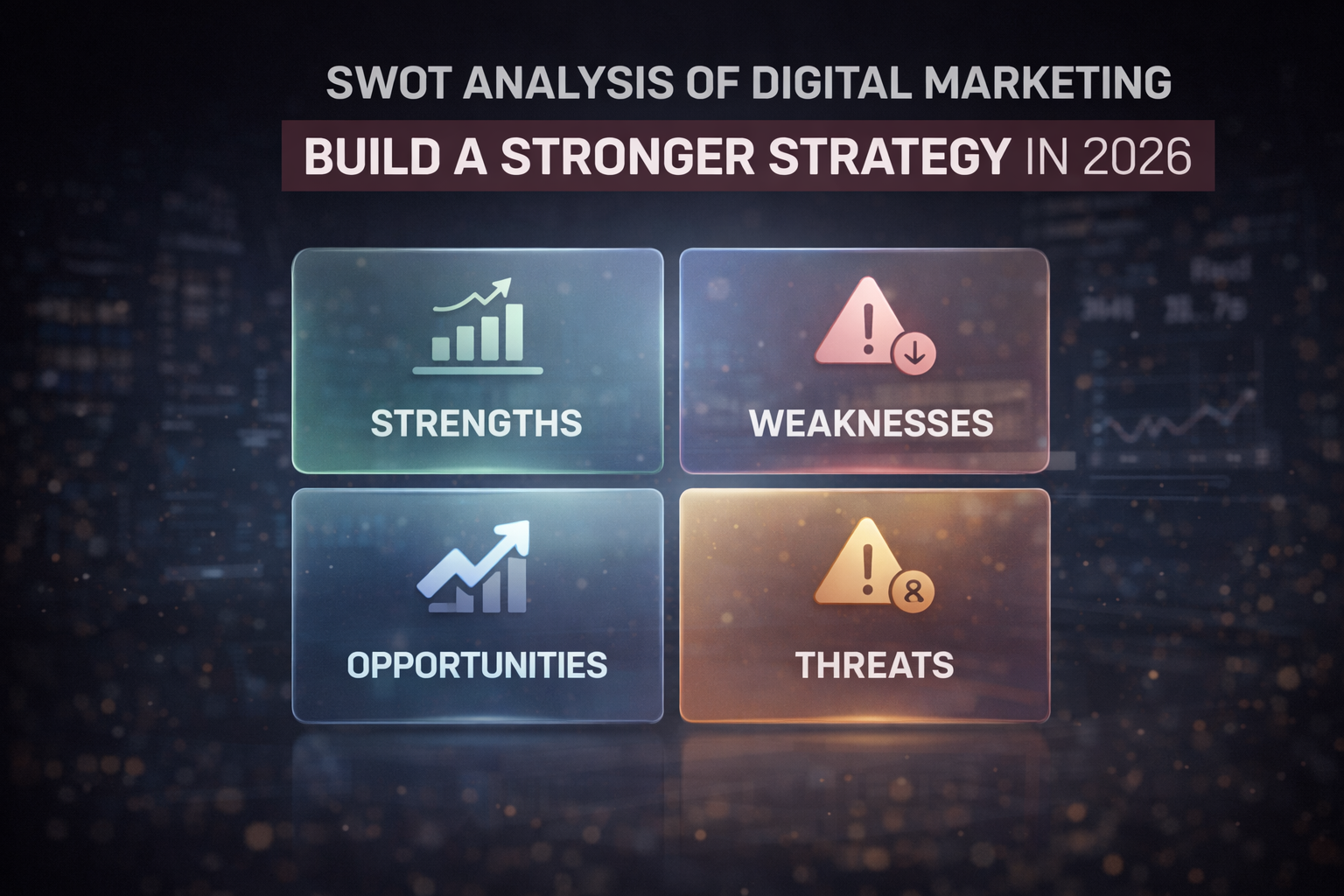
A swot analysis of digital marketing is a strategic planning framework that evaluates four factors affecting your online marketing performance. SWOT stands for Strengths (internal advantages), Weaknesses (internal disadvantages), Opportunities (external favorable conditions), and Threats (external risks). Strengths and Weaknesses are factors your business controls. Opportunities and Threats are external factors you cannot control but must respond to.
This framework is used to audit a business’s entire digital presence or to evaluate a specific campaign, channel, or product launch. According to the EU Business School’s guide for digital marketers, a SWOT analysis allows businesses to identify internal strengths and exploit external opportunities while addressing weaknesses and mitigating threats. Harvard Business Review describes SWOT as a powerful tool for brainstorming and strategic planning.
Simple Definition:
SWOT Analysis of Digital Marketing a structured audit of your Strengths (what your digital marketing does well), Weaknesses (where it falls short), Opportunities (external trends you can capitalize on), and Threats (external risks that could harm your results). Run it once per quarter or before any major campaign.
The 4 Quadrants of SWOT Analysis of Digital Marketing
Here is a complete breakdown of each quadrant in the swot analysis of digital marketing with real examples for Indian businesses in 2026:
S Strengths: Internal Advantages of Your Digital Marketing
Strengths in the swot analysis of digital marketing are the internal assets and capabilities your digital marketing currently has that give you an advantage over competitors. These are factors within your direct control. Identifying them helps you double down on what is working rather than spreading effort equally across all channels.
Strengths: Examples for Indian Businesses
- Well-optimized website with strong local SEO rankings for city and service keywords
- Active social media presence with consistent posting and growing engagement on Instagram or LinkedIn
- Strong Google Business Profile with 100-plus reviews averaging 4.5 stars or above
- Established email or WhatsApp marketing list of opted-in customers generating repeat business
- Quality content library of blogs, videos, or case studies that rank organically and build authority
- Precise audience targeting through Meta Ads and Google Ads with low cost per lead
- Data-driven culture: regular use of Google Analytics and Search Console to guide decisions
- Dedicated in-house or agency team with SEO, content, and paid ads expertise
The Strategy Story’s framework for this analysis highlights data-driven insights and cost efficiency as two of the most significant strengths. Digital marketing’s ability to collect real-time consumer behavior data and reach large audiences at a fraction of traditional advertising cost is a structural advantage that compounds over time.
W Weaknesses: Internal Limitations of Your Digital Marketing
Weaknesses are internal factors within your control that are currently holding back your digital marketing performance. According to the DMI’s SWOT analysis framework, identifying weaknesses is the starting point for improvement.
The most common weakness identified in Indian businesses’ digital marketing is inconsistency: inconsistent posting, outdated website content, incomplete Google Business Profiles, and no lead nurturing after initial contact.
Weaknesses: Examples for Indian Businesses
- Website is slow on mobile or not optimised for local search keywords
- No consistent content publishing schedule: blogs updated rarely or never
- No email or WhatsApp marketing list: every new campaign starts from zero
- Paid ads running without conversion tracking or clear cost-per-lead targets
- No system for collecting and responding to Google and platform reviews
- Digital marketing team lacks skills in analytics, SEO, or content creation
- Budget is insufficient to compete in high-competition keywords or industries
- No lead nurturing after initial inquiry: follow-up is manual, slow, or absent
Weaknesses are not permanent. Each weakness in the SWOT analysis of digital marketing is an improvement opportunity with a clear fix. A slow website gets a Page Speed optimization. A missing email list gets a lead magnet. No review system gets a WhatsApp automation. The value of the analysis is converting each weakness into a prioritized action.
O Opportunities: External Trends Favoring Digital Marketing
Opportunities are external conditions your business can capitalise on. They are not created by you but you can respond to them faster than competitors.
For Indian businesses in 2026, the digital opportunity landscape is exceptionally rich: growing internet users, tier-2 city expansion, AI-driven marketing tools, social commerce growth, and government digital initiatives all create openings that did not exist 3 years ago.
Opportunities: Examples for Indian Businesses in 2026
- India has 590 million social media users in 2026 massive audience growth for social campaigns
- Tier-2 and tier-3 city consumers are rapidly adopting online shopping and digital services
- AI tools now automate content creation, ad targeting, and campaign optimisation at low cost
- Social commerce (Instagram Shopping, WhatsApp Catalogues) enables direct in-platform sales
- India’s influencer marketing industry is projected to reach Rs. 28 billion in 2026
- Voice search and vernacular content in Hindi, Tamil, Bengali expanding organic reach
- India’s e-commerce market projected to reach USD 200 billion by 2027 growing buyer base
- Google’s AI-powered search features creating new opportunities for structured content ranking
The multi-education journal research on this topic specifically highlights growing online platform audiences, influencer relationships, and positive customer reviews as the primary opportunities available to Indian businesses. The shift from traditional to digital media, accelerated by mobile penetration, represents the single largest opportunity available to any Indian brand with a well-executed digital presence.
T Threats: External Risks to Your Digital Marketing
Threats are external forces that could harm your digital marketing performance even if your internal strategy is sound. They are largely outside your direct control but must be monitored and responded to proactively. According to Percoco’s SWOT framework for digital marketing, the most significant threats include high online competition, ad blockers, algorithm changes, and negative reviews from unsatisfied customers.
Threats: Examples for Indian Businesses in 2026
- Algorithm updates: Google’s March 2026 Core Update caused ranking drops for thin content sites
- Rising ad costs: Google and Meta CPCs increasing as more Indian businesses adopt digital ads
- Ad blockers: growing percentage of users blocking display and pre-roll ads
- High competition: more businesses investing in digital marketing makes organic ranking harder
- Data privacy regulations: India’s DPDP Act 2023 restricting data collection and usage for ads
- Negative reviews on Google, Zomato, or Amazon can undermine trust faster than ads build it
- Platform dependency risk: over-reliance on one platform creates vulnerability to policy changes
- AI-generated content flooding search results, making genuine expertise harder to stand out
No business can eliminate these threats, but every business can prepare for them. Diversifying across multiple digital channels reduces platform dependency risk. Consistently building reviews and responding to them reduces the damage of occasional negative ones. Publishing genuinely expert, E-E-A-T compliant content reduces exposure to Google algorithm updates.
SWOT Analysis of Digital Marketing: Visual Matrix
Use this matrix to organize your own findings. Internal factors (Strengths and Weaknesses) are on the left. External factors (Opportunities and Threats) are on the right:
| S | STRENGTHS (Internal, Positive) What your digital marketing does well | O | OPPORTUNITIES (External, Positive) External trends you can capitalize on |
| Strong SEO rankings in your city Active social media with real engagement High-rated Google Business Profile Owned email or WhatsApp contact list Quality original content that ranks | 590 million Indian social media users Tier-2 city digital adoption boom AI tools reducing content creation cost Social commerce on Instagram and WhatsApp India influencer market: Rs. 28 billion |
| W | WEAKNESSES (Internal, Negative) Internal gaps holding your marketing back | T | THREATS (External, Negative) External risks that could harm your results |
| Slow or non-mobile-friendly website No email or WhatsApp list built No consistent content publishing Ads running without conversion tracking No review collection system in place | Google and Meta algorithm changes Rising cost-per-click on paid platforms India DPDP Act 2023 data restrictions Increasing competition in every niche Negative reviews spreading faster online |
How to Use Your SWOT Analysis of Digital Marketing Findings
Completing the analysis is only half the task. The other half is converting findings into strategy. The DMI and Target Internet both recommend a TOWS approach: matching your SWOT quadrants to generate specific strategic actions:
| Combination | Strategic Question | India Example Action |
| S + O | How can you use your strengths to capture opportunities? | Use your strong SEO rankings to capture growing tier-2 city search traffic with city-specific landing pages |
| W + O | Which weaknesses must you fix to exploit opportunities? | Build your WhatsApp list now to activate social commerce on WhatsApp Catalogues before competitors do |
| S + T | How can your strengths reduce the impact of threats? | Use your content authority and E-E-A-T signals to weather Google algorithm updates that hurt thin-content sites |
| W + T | Which weakness and threat combination is most dangerous? | No review system plus negative competitor reviews is the highest risk: fix by automating review requests immediately |
Pro Tip:
Review your SWOT every quarter, not just annually. The digital marketing landscape changes too quickly for an annual review to remain relevant. Set a calendar reminder every 90 days. Bring in at least one person outside the marketing team to challenge assumptions. The most valuable insights in a SWOT often come from people who interact with customers daily.
Conclusion
A SWOT analysis is the most practical starting point for any business that wants to improve its digital marketing results in 2026. It cuts through guesswork by showing you exactly where your digital marketing is strong, where it is underperforming, what external opportunities you are currently missing, and what risks require a proactive response.
Run your SWOT audit today. Use the matrix in this guide. Fill each quadrant honestly. Then convert your findings into the 4 strategic combinations shown above. The businesses in India that grow fastest are not necessarily the ones with the biggest budgets. They are the ones that understand their position and allocate effort where it delivers the most.
How Dizispark Can Help
A SWOT analysis of digital marketing tells you where you are. Dizispark helps you act on what it reveals. We conduct comprehensive digital marketing audits for Indian businesses that identify every strength to leverage, every weakness to fix, every opportunity to capture, and every threat to defend against. Our audit covers your website technical SEO, Google Business Profile, paid ads performance, social media content strategy, email and WhatsApp marketing setup, content quality, competitor analysis, and review management. You receive a clear, prioritised action plan with realistic timelines and measurable milestones. Whether you are starting your digital marketing journey or optimising an existing strategy, we build the system that produces consistent, growing results. Get your free Digital Marketing SWOT Audit today.
Frequently Asked Questions
What is a SWOT analysis of digital marketing?
A SWOT analysis of digital marketing is a strategic planning framework that evaluates four factors affecting your online marketing performance: Strengths (internal advantages), Weaknesses (internal limitations), Opportunities (external favorable conditions), and Threats (external risks). It provides a structured audit of where your digital marketing currently stands and what strategic actions will most improve your results.
How often should you run a SWOT analysis for digital marketing?
Digital marketing changes quickly enough that an annual SWOT analysis is insufficient. The DMI recommends reviewing your SWOT quarterly or at a minimum when your market changes, your company targets a new audience, or you make significant changes to your website or campaigns. For Indian businesses, running a fresh SWOT before each major campaign or at the start of each financial quarter ensures the analysis reflects current market conditions.
What are the main strengths in a SWOT analysis of digital marketing?
The main strengths typically identified in a SWOT analysis of digital marketing include: strong organic SEO rankings, an active and growing social media presence, a high-rated and verified Google Business Profile, an owned email or WhatsApp marketing list, a library of quality original content that ranks and educates, effective paid ads with measurable cost per lead, and a team with genuine digital marketing expertise. These strengths compound over time and create compounding competitive advantages.
What are the biggest threats in digital marketing in India in 2026?
The biggest threats in digital marketing in India in 2026 include: Google algorithm updates (the March 2026 Core Update caused significant ranking drops for thin and AI-generated content), rising cost-per-click on Google and Meta advertising platforms as more Indian businesses adopt digital ads, India’s DPDP Act 2023 restricting data collection and retargeting, increasing competition in every niche making organic differentiation harder, and ad blockers reducing display advertising reach.
What opportunities exist in digital marketing in India in 2026?
The biggest opportunities in digital marketing in India in 2026 include: the expansion of social media users to 590 million (with tier-2 and tier-3 cities driving the majority of new growth), social commerce through Instagram Shopping and WhatsApp Business Catalogues, India’s influencer marketing industry projected at Rs. 28 billion, AI tools reducing content creation and ad management costs, growing adoption of voice search in Hindi and regional languages, and India’s e-commerce market projected to reach USD 200 billion by 2027.
What is the difference between SWOT and TOWS in digital marketing?
SWOT analysis identifies your current Strengths, Weaknesses, Opportunities, and Threats. TOWS analysis takes those SWOT findings and generates strategic actions by combining them: Strengths plus Opportunities (build on strengths to capture opportunities), Weaknesses plus Opportunities (fix weaknesses to exploit opportunities), Strengths plus Threats (use strengths to counter threats), Weaknesses plus Threats (address the most dangerous weakness-threat combinations first). Target Internet recommends using SWOT to identify your current position and TOWS to determine your strategy from those findings.
How do you conduct a SWOT analysis of digital marketing for a small business?
To conduct a SWOT analysis of digital marketing for a small business: start by pulling data from Google Analytics, Search Console, and your social media platform insights to inform the internal quadrants (Strengths and Weaknesses). Research competitor digital presence to identify relative strengths and weaknesses. For external quadrants (Opportunities and Threats), review industry reports, check algorithm update news, and assess regulatory changes. Fill each quadrant with 5 to 8 honest, specific points. Then apply the TOWS combinations to generate 4 strategic priorities.
Why is SWOT analysis of digital marketing important for Indian businesses?
This analysis is particularly important for Indian businesses because the digital landscape is changing faster here than almost anywhere else. 590 million social media users, tier-2 city digital adoption, AI-driven consumer behaviour shifts, and a rapidly evolving regulatory environment mean that a strategy built 12 months ago may no longer reflect current market realities. A quarterly SWOT analysis keeps Indian businesses aligned with their actual position and the actual opportunities available to them, rather than investing in assumptions that may be outdated.