

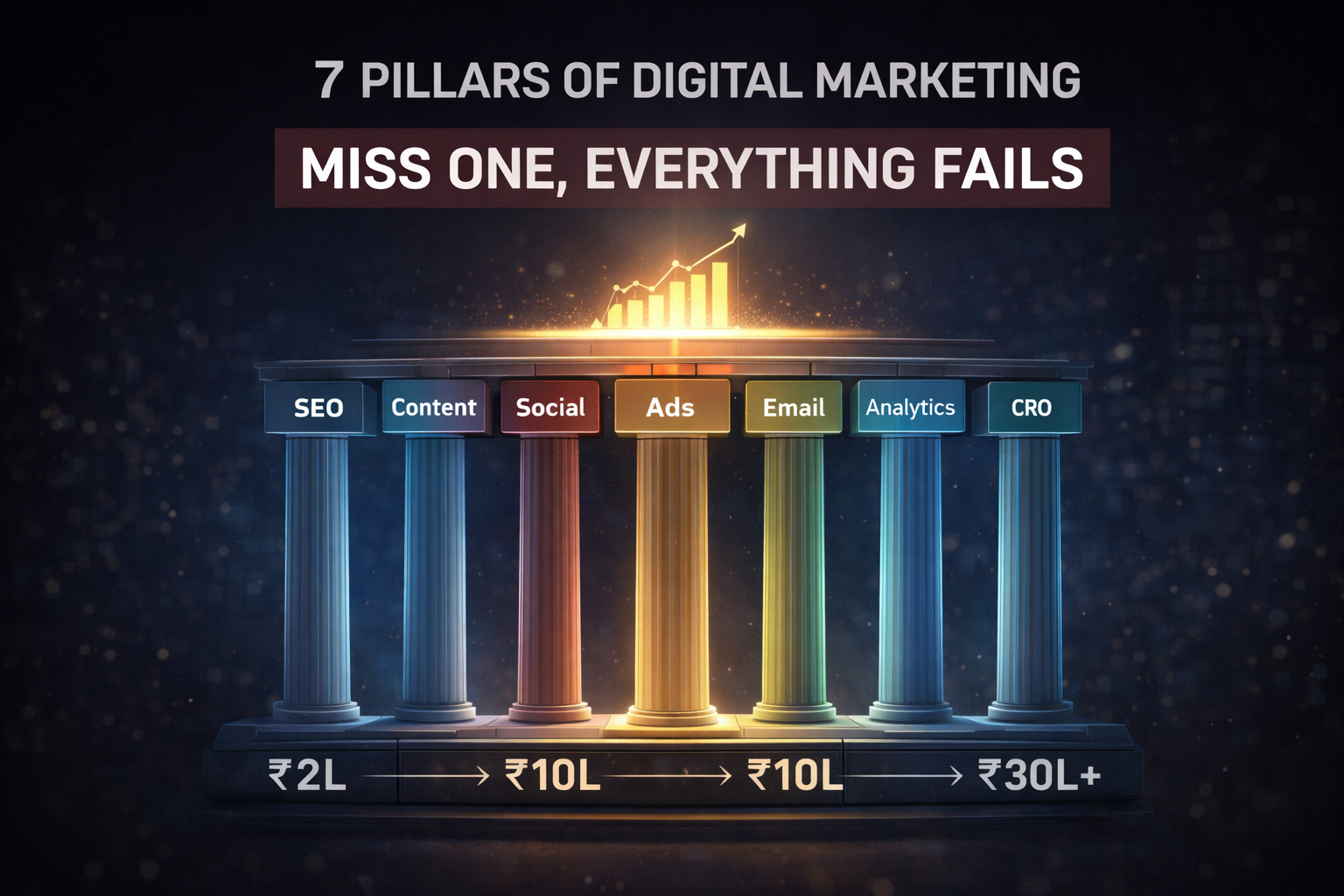
How many main pillars of digital marketing are there? It is one of the most fundamental questions anyone entering the world of online marketing asks, and the answer matters because these pillars are not just a list of channels, they are the structural framework that holds every successful digital strategy together. According to Tech Sprint Innovations’ complete 2026 digital marketing guide, the main pillars of digital marketing are the core components that work together to attract, engage, convert, and retain customers.
Think of digital marketing like a building: if one pillar is weak or missing, the entire structure becomes unstable.
Different sources count the pillars differently. Some identify four, others seven, and others more.
In this guide, we answer how many main pillars of digital marketing exist with the most comprehensive and practically useful framework for 2026: seven core pillars that together form a complete, integrated, and future-ready digital marketing strategy for any business.
Table of Contents
ToggleWhat Are the Pillars of Digital Marketing?
Before answering how many main pillars of digital marketing exist, it is important to understand what the term actually means. The pillars of digital marketing are the fundamental channels and strategies that a complete online marketing plan must include. Each pillar serves a specific function, but none works in isolation.
They are interdependent: the content you create for SEO gets shared on social media and distributed through email. The paid ads you run support the same keywords your SEO targets. The analytics you track inform how you optimize every other pillar.
WhyySoSerious Agency’s 2026 digital marketing guide puts it well: digital marketing is not just about content and running ads, but an absolute approach to reach your audience where they spend most of their time online. The pillars act as the framework for designing, executing, and optimising those efforts in a coordinated and effective way.
How Many Main Pillars of Digital Marketing Exist in 2026?
The question of how many main pillars of digital marketing exist has different answers depending on the source.
Some frameworks count four: SEO, SEM, Content Marketing, and Social Media Marketing. Others extend this to six or seven by adding Email Marketing, Analytics, and Conversion Rate Optimization. In 2026, the most complete and practical answer is seven, because all seven are distinct disciplines with unique roles, tools, and career paths, and a business that ignores any one of them leaves a significant gap in its customer acquisition and retention system.
| Framework | Pillars Included | Best for |
|---|---|---|
| 4-Pillar Model | SEO, SEM/PPC, Content Marketing, Social Media Marketing | Good starting point for beginners and small budgets |
| 6-Pillar Model | Above 4 + Email Marketing + Analytics | Better for growth-stage businesses with data needs |
| 7-Pillar Model (2026) | Above 6 + Conversion Rate Optimisation (CRO) | Complete model for businesses focused on measurable ROI |
Key Takeaway:
There is no single universally agreed number for how many main pillars of digital marketing exist.
The 7-pillar model is the most complete framework in 2026 because it covers every stage of the customer journey from discovery to conversion to retention.
The 7 Core Pillars of Digital Marketing Explained
Here is a clear, practical explanation of each of the seven main pillars of digital marketing in 2026, what they do, why they matter, and how they connect to the others.
Pillar 1: Search Engine Optimization (SEO)
SEO is consistently named as the first and most foundational of the main pillars of digital marketing. Its purpose is to improve a website’s visibility in organic search engine results on Google and Bing so that when potential customers search for relevant products, services, or information, your business appears.
Tech Sprint Innovations identifies three layers of SEO that must all work together: On-Page SEO, which covers content, keywords, headings, and meta tags, Off-Page SEO, which focuses on backlinks, brand mentions, and external authority signals, and Technical SEO, which ensures the website is fast, mobile-friendly, properly indexed, and structurally sound.
What makes SEO such a high-value pillar is its compounding nature. Unlike paid advertising that stops the moment the budget runs out, SEO rankings built through consistent effort generate free, high-quality organic traffic month after month. WhyySoSerious Agency notes that by optimising your website for search engines, you boost organic traffic, which is one of the most cost-effective ways to attract high-quality leads over the long term. SEO also directly supports the Content Marketing pillar because high-quality content is what earns rankings.
Pillar 2: Content Marketing
Content marketing is described by Tech Sprint Innovations as the backbone of digital marketing, and that description is accurate because every other pillar depends on content to function. SEO needs optimised content to rank. Social media needs content to post and engage with. Email marketing needs content to fill its newsletters and sequences. Paid advertising needs compelling ad copy. Without content, none of the other pillars have fuel to run on.
As one of the main pillars of digital marketing, content marketing focuses on creating and distributing valuable, relevant, and engaging material that attracts and retains a clearly defined target audience. Rather than directly promoting products or services, the goal is to provide useful information that builds trust and authority. Content formats include blog posts and articles, videos and short-form Reels, infographics, e-books and guides, podcasts, and case studies. WhyySoSerious Agency notes that when content feels relatable to your audience, it not only builds authority but also encourages customers to engage more and convert, making it a long-term investment in brand credibility rather than just a traffic tactic.
Pillar 3: Social Media Marketing (SMM)
Social media marketing is the community-building and engagement pillar among the main pillars of digital marketing. It involves promoting brands through platforms including Instagram, Facebook, LinkedIn, YouTube, and X, reaching audiences where they spend hours every day.
Tech Sprint Innovations makes an important distinction: social media marketing goes far beyond posting content on a schedule. It is about building a community, engaging with followers, sharing valuable content, and nurturing long-term relationships that build brand trust and loyalty.
Social media marketing operates on two tracks simultaneously. Organic social media, which includes posts, stories, Reels, and direct engagement, builds brand presence and community at no direct cost. Paid social media advertising, which includes targeted campaigns on Meta, LinkedIn, and YouTube, expands reach to new audiences with precision targeting based on demographics, interests, and behaviours. Together these tracks make social media one of the most versatile main pillars of digital marketing, contributing to brand awareness, lead generation, customer retention, and direct sales.
Pillar 4: Paid Advertising (PPC / SEM)
Paid advertising is the instant-visibility pillar among the main pillars of digital marketing. While SEO takes months to deliver results and content marketing compounds over time, paid advertising places your brand in front of your exact target audience within hours of launching a campaign. Search Engine Marketing (SEM) using Google Ads targets users who are actively searching for what you offer. Display advertising builds brand awareness across millions of websites in the Google Display Network. Social media advertising on Meta and LinkedIn allows targeting based on detailed user profile data.
Tech Sprint Innovations notes that paid advertising is ideal for promotions, product launches, and competitive markets where organic visibility is difficult to achieve quickly.
The key advantage of paid advertising as one of the main pillars of digital marketing is its precision and measurability: you can define exactly who sees your ads, how much you pay per click, and what return you generate from each campaign. WhyySoSerious Agency identifies remarketing campaigns, which show ads to users who have previously visited your website, as a particularly high-ROI form of paid advertising because these audiences are already warm and familiar with your brand.
Pillar 5: Email Marketing
Email marketing consistently delivers the highest return on investment of all the main pillars of digital marketing, making it one of the most commercially critical and most frequently underestimated. It involves sending targeted, personalized emails to subscribers with the goal of nurturing leads, building trust, maintaining customer relationships, and driving repeat purchases. Unlike social media platforms where algorithm changes can reduce your reach overnight, email gives you direct, unmediated access to your audience’s inbox, an asset your business owns and controls completely.
Tech Sprint Innovations identifies the key strengths of email marketing as a core pillar: personalized communication that speaks directly to individual subscribers, high conversion potential because email reaches people who have already expressed interest in your brand, cost-effectiveness relative to paid advertising, and automation capability that allows businesses to send the right message to the right person at the right time without ongoing manual effort. Email campaigns span the full customer lifecycle, from welcome sequences for new subscribers to promotional offers, product updates, re-engagement campaigns for inactive subscribers, and post-purchase follow-ups that drive loyalty and referrals.
Pillar 6: Analytics and Data Tracking
Analytics is the intelligence layer that connects all the other main pillars of digital marketing. Without analytics, marketing is guesswork with it, every decision about where to invest budget, which content to create more of, which ad campaigns to scale, and which email sequences to optimize is informed by real evidence. Tech Sprint Innovations identifies analytics as the foundation that measures the success of all digital marketing efforts, providing insights into how campaigns are performing, how users interact with content, and which strategies deliver the best results.
Key metrics tracked through analytics include website traffic and traffic source breakdown, conversion rates across landing pages and campaign types, click-through rates for ads and email, bounce rate and session duration as engagement indicators, and return on investment per channel and campaign. Tools like Google Analytics, Google Search Console, Meta Business Suite, and Looker Studio provide these insights across all digital channels. In 2026, analytics has grown beyond simply reporting what happened to enabling predictive decision-making, where historical data and AI-powered forecasting help marketers anticipate what will happen next and allocate resources accordingly.
Pillar 7: Conversion Rate Optimization (CRO)
Conversion Rate Optimization is the efficiency pillar that ensures all the traffic and leads generated by the first six main pillars of digital marketing are actually converted into customers, subscribers, or enquiries rather than leaving without taking action. CRO focuses on increasing the percentage of website visitors who complete a desired action, whether that is filling out a contact form, making a purchase, booking a consultation, or subscribing to a newsletter.
Tech Sprint Innovations identifies the core CRO techniques as A/B testing different versions of landing pages and call-to-action buttons, improving landing page design and user experience, simplifying navigation and form fields to reduce friction, and using heatmaps and session recordings to understand exactly where visitors are dropping off. CRO is what separates businesses that generate traffic from those that generate revenue. A business spending INR 50,000 per month on Google Ads but converting only one percent of visitors is losing 99 percent of its investment. Improving that conversion rate to three percent through CRO triples revenue without spending an additional rupee on ads, making it arguably the highest-leverage pillar in the entire framework.
How All 7 Pillars Work Together
Understanding how many main pillars of digital marketing exist is important. Understanding how they interact is what allows a business to build a strategy that is genuinely powerful rather than a collection of disconnected activities. The seven pillars are designed to work as a system where each reinforces the others.
| Pillar | Primary Role | How It Connects to Others |
|---|---|---|
| SEO | Creates organic visibility | Needs content to rank, drives traffic that analytics measures |
| Content Marketing | Builds authority and trust | Feeds SEO, social media, and email with material |
| Social Media | Engages and builds community | Amplifies content, drives traffic, supports paid ads |
| Paid Advertising | Delivers immediate visibility | Sends traffic to CRO-optimized landing pages, data informs analytics |
| Email Marketing | Nurtures and retains customers | Uses content to engage, data improves CRO, highest direct ROI |
| Analytics | Measures and informs everything | Tells you which pillars are working and where to invest more |
| CRO | Converts traffic into results | Turns the visitors produced by all other pillars into real revenue |
Tech Sprint Innovations summarizes the combined power of all the main pillars of digital marketing precisely: when all pillars are aligned, businesses achieve a strong online presence, consistent lead generation, higher sales and revenue, and long-term brand growth. The real strength of a 7-pillar approach is not what any single pillar does individually, but what they produce together as a coordinated, reinforcing system.
Which Pillar Should You Focus on First?
Once you understand how many main pillars of digital marketing exist, the practical question becomes: where should you start? The honest answer is that it depends on your business type, budget, timeline, and goals. However, there are sensible starting sequences that most businesses benefit from following.
For most businesses beginning digital marketing, the recommended starting sequence is:
first build a fast, mobile-optimized website with clear calls to action (this is the foundation all pillars sit on), second set up Google Analytics and tracking so every subsequent action is measured from day one, third implement foundational SEO including keyword research, on-page optimization, and a Google Business Profile for local visibility, fourth begin content marketing with at least two keyword-optimized blog posts per month, fifth build a social media presence on the one or two platforms where your audience is most active, sixth add email marketing to capture and nurture leads, seventh introduce paid advertising to accelerate results, and eighth, begin CRO work once you have enough traffic to test meaningfully.
Businesses with an urgent need for immediate results should start with paid advertising alongside foundational SEO, since paid ads generate traffic quickly while SEO builds long-term organic presence. Businesses with tighter budgets should prioritise SEO and content marketing first, as these deliver compounding returns without requiring ongoing ad spend once rankings are established.
Common Mistakes When Building on These Pillars
Understanding how many main pillars of digital marketing exist is only useful if you also understand the mistakes that cause these pillars to underperform. The most common and costly mistake is treating the pillars as silos rather than as an integrated system. Businesses run Google Ads without optimised landing pages (missing CRO), publish blog content without SEO strategy (missing search visibility), or manage social media without connecting it to email list building (missing the highest-ROI retention channel).
A second major mistake is skipping analytics entirely, which means there is no data to tell you which pillars are working, which are wasting budget, and where to invest for better returns. Without measurement, even a well-funded digital marketing operation is running on guesswork.
A third mistake is investing heavily in paid advertising before the CRO pillar is functional, which is equivalent to pouring water into a leaking bucket: you can keep increasing ad spend, but if your landing pages are not converting the traffic they receive, your cost per acquisition will remain unacceptably high regardless of how much you spend. The businesses that achieve the strongest results from their digital marketing are those that treat all seven main pillars of digital marketing with consistent attention, measurement, and optimisation.
Conclusion
How many main pillars of digital marketing are there?
The most complete and practical answer for 2026 is seven: SEO, Content Marketing, Social Media Marketing, Paid Advertising, Email Marketing, Analytics and Data Tracking, and Conversion Rate Optimization. Together, these seven pillars cover every stage of the customer journey from first discovery to final conversion and long-term loyalty.
No single pillar is sufficient on its own, and ignoring any one of them creates gaps that limit growth. The businesses that build the strongest digital marketing foundations are those that understand how many main pillars of digital marketing exist, implement each one consistently, and manage them as an integrated system that improves continuously based on real performance data. Whether you are starting from scratch or strengthening an existing strategy, the seven-pillar framework gives you the most complete roadmap available for digital marketing success in 2026.
How Dizispark Can Help
Dizispark builds and manages every one of the seven main pillars of digital marketing for businesses across India. We do not pick one channel and hope for the best. We create integrated strategies where your SEO, content, social media, paid ads, email, analytics, and CRO all work together as one coordinated system. The result is a digital presence that attracts the right audience, converts them into customers, and keeps them coming back. Whether you are building your first digital strategy or fixing a fragmented one, Dizispark gives you the complete framework your competitors are already using. Get your free digital marketing audit today.
Find out which pillars your business is missing and exactly how much growth they are costing you.
Frequently Asked Questions
How many main pillars of digital marketing are there in 2026?
The most complete answer to how many main pillars of digital marketing exist in 2026 is seven: Search Engine Optimization (SEO), Content Marketing, Social Media Marketing, Paid Advertising (PPC/SEM), Email Marketing, Analytics and Data Tracking, and Conversion Rate Optimization (CRO). Some frameworks identify four pillars by combining certain channels, but the seven-pillar model provides the most comprehensive and actionable framework for building a complete digital marketing strategy.
What is the most important pillar of digital marketing?
SEO and Content Marketing are consistently identified as the foundational pillars because they work together to build long-term organic visibility and audience trust. However, the most important pillar for any specific business depends on its goals and timeline. Analytics is arguably the most overlooked but most critical support pillar because without it, every other pillar operates without feedback or direction.
Can a small business use all 7 pillars of digital marketing?
Yes, but small businesses should priorities and sequence the pillars rather than trying to implement all seven simultaneously with limited resources.
A practical starting sequence is: website optimization, Google Analytics setup, foundational SEO, content marketing, one or two social media platforms, email list building, and then paid advertising and CRO once the foundational pillars are in place. Consistency on fewer pillars delivers better results than superficial activity across all seven.
What is the difference between SEO and SEM in the pillars of digital marketing?
SEO (Search Engine Optimization) focuses on improving your website’s organic ranking in search results without paying for each click. It is a long-term strategy that builds compounding visibility over time. SEM (Search Engine Marketing), often used interchangeably with PPC (Pay Per Click), uses paid search advertising to appear at the top of search results immediately.
Both target search engines like Google but through different mechanisms: organic vs paid. Most complete strategies use both.
Why is CRO considered one of the main pillars of digital marketing?
Conversion Rate Optimization is a core pillar because it determines how efficiently all the other pillars produce actual business results. Without CRO, a business can drive large amounts of traffic through SEO, social media, and paid ads and still fail to generate sufficient leads, sales, or revenue because the website is not converting visitors into customers effectively. CRO ensures that every rupee invested in all the other pillars generates the maximum possible return.
How does content marketing support the other pillars of digital marketing?
Content marketing is the backbone pillar that feeds material into every other channel. Blog content provides pages for SEO to rank. Social media posts are built from content ideas and articles. Email newsletters use content as their primary value proposition. Paid ad copy is developed from key content themes. A/B tests in CRO are built around content variations. Without consistent content creation, all other pillars lose the fuel they need to function effectively.
What role does analytics play as a pillar of digital marketing?
Analytics is the intelligence and feedback layer of digital marketing. It measures the performance of every other pillar in real time, tracks key metrics like traffic, conversion rate, click-through rate, and ROI, and provides the data needed to make informed decisions about where to invest more and where to cut. Without analytics, digital marketing decisions are based on assumption rather than evidence. With it, every pillar continuously improves based on what the data actually shows is working.
Is email marketing still relevant as a pillar of digital marketing in 2026?
Yes, absolutely. Email marketing consistently delivers the highest ROI of all the main pillars of digital marketing. It gives businesses direct, algorithm-independent access to their audience’s inbox, enables deeply personalized communication at scale through automation, and supports the full customer lifecycle from lead nurturing to repeat purchase to loyalty programs. In an era where social media reach is increasingly dependent on paid promotion, email remains the most reliable owned channel for consistent audience engagement.