
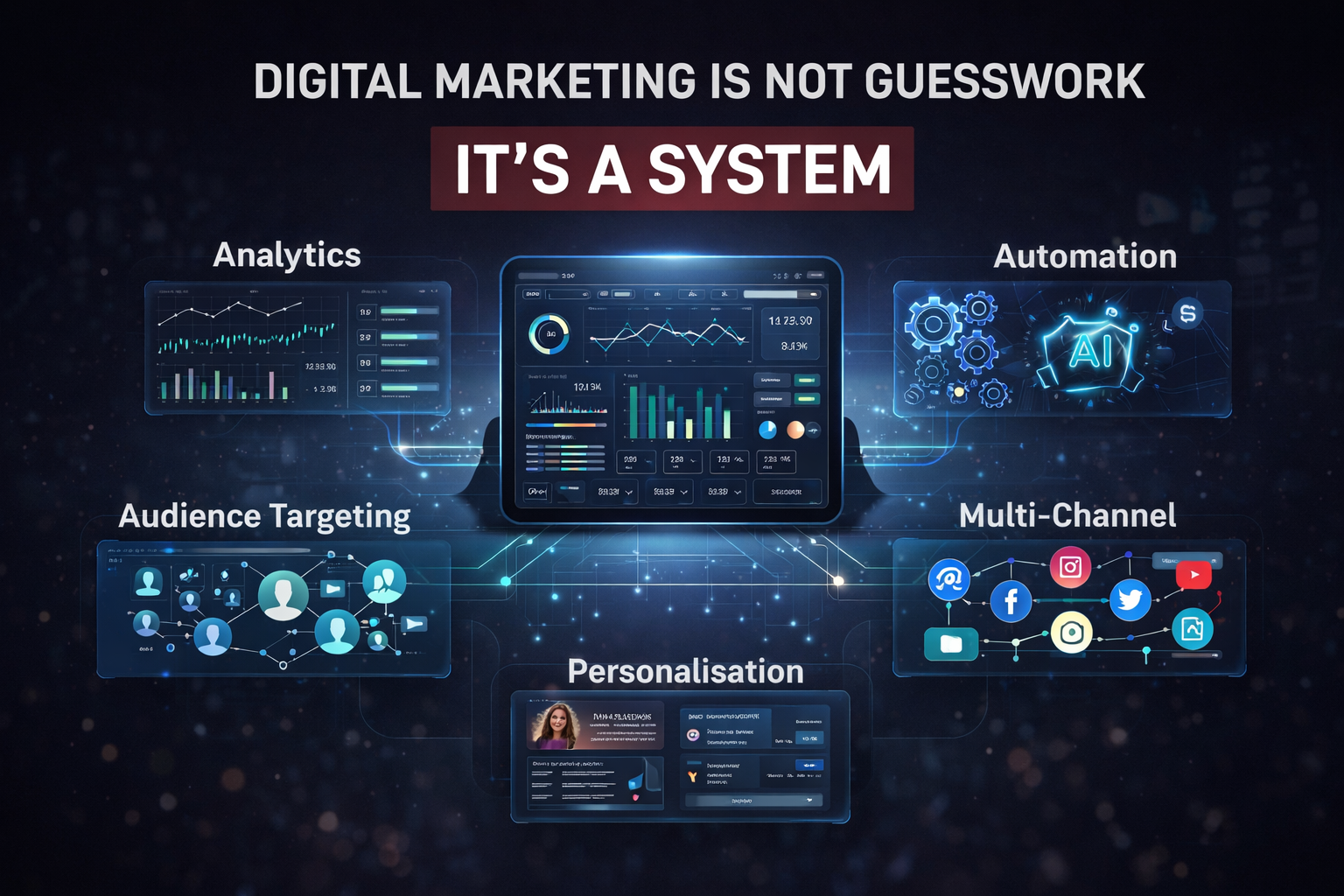
The features of digital marketing are what separate it from every other form of promotion a business has ever used. Traditional advertising broadcasts a message and hopes someone notices. Digital marketing targets, measures, personalizes, and adapts in real time, turning every campaign into a learning system that improves with every click. According to Interns Hala’s comprehensive digital marketing guide, about 89 percent of internet users go online at least once a day, meaning the audience digital marketing can reach is not just large, it is consistently active and engaged.
This guide covers every core feature of digital marketing that businesses and marketers need to understand in 2026, from the foundational characteristics that make it measurable and targeted to the modern capabilities like automation and 24/7 availability that make it genuinely transformative for businesses of any size.
Table of Contents
ToggleWhat Is Digital Marketing?
Digital marketing is the use of digital channels including websites, search engines, social media platforms, email, and mobile applications to promote products and services, engage with customers, and generate leads and sales. As FITA Academy notes, it grew alongside the internet in the 1990s and has since evolved into the primary marketing channel for businesses globally, with the digital advertising industry already valued at around $200 billion and continuing to grow.
What makes understanding the features of digital marketing essential is that digital marketing is not a single tactic but an ecosystem of interconnected tools and strategies. Each feature works in combination with the others, allowing marketers to build campaigns that are simultaneously broad in reach, precise in targeting, and rich in performance data.
Core Features of Digital Marketing Every Business Should Know
The following are the ten most important features of digital marketing, each explained with practical context so businesses can understand not just what each feature is but why it matters for growth.
1. Measurability and Analytics
Measurability is arguably the most defining of all features of digital marketing. Every action a user takes, from clicking an ad to spending 47 seconds on a product page, generates data that can be tracked, analyzed, and used to improve future campaigns. FITA Academy identifies measurability as one of the most important features of digital marketing, noting that it allows marketers to understand at what percentile a product has reached its audience and which strategies delivered results versus which did not.
Tools like Google Analytics track website traffic, user behavior, and conversion rates. Key performance indicators such as click-through rate (CTR), cost per acquisition (CPA), return on investment (ROI), and conversion rate give businesses a clear, evidence-based view of exactly what their marketing investment is producing. Bud India’s analysis of core digital marketing features confirms that A/B testing further allows businesses to experiment and find the most effective marketing strategies, creating a continuous cycle of measurement and optimization that traditional advertising channels cannot replicate.
2. Precise Audience Targeting
Targeted marketing is one of the strongest features of digital marketing. Rather than broadcasting a message to a broad audience and hoping the right people notice, digital marketing allows businesses to define their audience with extraordinary precision using demographic data, geographic location, browsing behavior, interests, purchase history, and intent signals.
Web quick India’s guide on features of digital marketing illustrates this with a practical example: a fitness equipment brand can specifically target people who have liked gym pages, followed fitness influencers, or recently searched for home workout equipment, ensuring marketing budget is spent only on genuinely potential customers.
3. Remarketing
Remarketing is one of the features of digital marketing that directly addresses one of the most common commercial problems: most website visitors leave without converting on their first visit. Remarketing uses tracking pixels and audience lists to show targeted ads to users who have already visited a website or interacted with a brand’s content, keeping the brand visible during the period between a user’s initial interest and their eventual decision to buy.
Bud India’s feature analysis describes dynamic remarketing as taking this a step further by displaying ads featuring the specific products or services a user has previously viewed, which significantly increases conversion chances compared to generic retargeting. FITA Academy notes that cross-platform remarketing ensures a consistent brand message across different devices, improving the overall user experience and reducing the likelihood that an interested prospect is lost to a competitor.
4. Personalization
Personalization is among the features of digital marketing that creates the strongest connection between a brand and its audience. By using data on customer behavior, purchase history, browsing patterns, and preferences, businesses can deliver content, product recommendations, and marketing messages that feel individually relevant rather than generic. Bud India notes that in the digital era, consumers actively want personalized experiences, and the delivery of tailored content using behavioral data is now a core expectation rather than a bonus.
Web quick India’s analysis points to Amazon as the clearest example: its recommendation engine suggests products based on a customer’s previous searches and purchases, creating a shopping experience that feels specifically designed for that individual. The same principle applies to personalized email campaigns that address the recipient by name and offer content aligned with their demonstrated interests, which consistently outperform generic broadcast emails in open rate, click rate, and conversion.
5. Multi-Channel Reach
One of the most commercially significant features of digital marketing is its ability to reach audiences across multiple channels simultaneously. Not every member of a target audience uses the same platforms or consumes content in the same way. Some respond to Instagram ads, others to Google search results, others to email newsletters, and others to YouTube videos. A multi-channel digital marketing strategy ensures that a brand’s message reaches its audience wherever they spend their time online, increasing both the frequency of exposure and the likelihood of conversion.
FITA Academy identifies multi-channel marketing as a core feature because it dramatically reduces the risk of over-relying on a single platform. Webquick India notes that the goal of multi-channel digital marketing is to ensure consistent messaging across channels while tailoring the format and tone to suit each platform’s specific environment and user expectations.
6. Interactivity and Two-Way Communication
Interactivity distinguishes the features of digital marketing from every traditional marketing channel. A television advertisement, a newspaper feature, or a billboard delivers a one-directional message with no mechanism for the audience to respond. Digital marketing enables direct, real-time two-way communication between a brand and its customers through comments, direct messages, reviews, polls, live streams, and chatbots.
Internshala’s digital marketing guide identifies interactivity as a key feature because it allows businesses to receive reviews, comments, and feedback directly from customers, which builds trust, increases transparency, and provides invaluable product and service insights. Webquick India highlights interactive formats such as Instagram story polls and Q&A sessions as accessible, low-cost ways for any brand to generate genuine audience engagement and gather real-time market intelligence.
7. Cost-Effectiveness
Cost-effectiveness is one of the features of digital marketing that makes it accessible to businesses at every scale. Organic social media content, SEO, and content marketing can all be executed at minimal cost. Paid campaigns on Google and Meta can be run with any budget, from a few hundred rupees per day to lakhs per month, with the ability to pause, adjust, and scale in real time based on performance. FITA Academy notes that a well-planned digital marketing strategy can reach and engage customers at a substantially lower cost than traditional marketing methods of comparable reach.
Interns Hala reinforces this with the observation that digital marketing is much more affordable than other forms of marketing and spends less on advertisements and sponsorships while often achieving higher ROI. This is particularly significant for small and medium businesses that cannot compete with large brands on broadcast advertising budgets but can build substantial, engaged online audiences at accessible cost.
8. Flexibility and Adaptability
Flexibility is among the most practically valuable features of digital marketing. Unlike a newspaper ad that cannot be changed once printed or a billboard campaign locked in for three months, digital marketing campaigns can be modified at any time. Ad copy can be updated, audience targeting can be refined, budgets can be shifted between campaigns that are performing well and those that are not, and entire strategies can be pivoted within hours based on real-time performance data.
Bud India identifies adaptability as a critical feature because the digital landscape is constantly evolving: technology changes, customer preferences shift, and competitor activity fluctuates. Businesses that treat their digital marketing as a living strategy that is regularly reviewed and adjusted consistently outperform those that set campaigns in motion and leave them to run unchanged.
9. 24/7 Availability
Unlike a physical store, a sales team, or a traditional advertising placement that is limited by time of day and geography, digital marketing operates continuously. Your website, ads, content, and social media presence work around the clock, generating brand awareness, answering customer questions, and driving conversions even while your team is offline.
Web quick India lists 24/7 availability as a distinct feature of digital marketing because it fundamentally changes the relationship between a business and its potential customers: the business is always accessible, always discoverable, and always capable of generating leads regardless of the time of day or the location of the prospect.
10. Automation
Automation transforms digital marketing from a manually intensive set of tasks into a scalable, efficient system. Email sequences can be triggered by user behavior, social media posts can be scheduled weeks in advance, leads can be automatically segmented and routed to appropriate nurture campaigns, and bidding strategies on Google Ads can be managed by AI algorithms that optimize for conversion in real time. Web quick India highlights automation tools like HubSpot, Mailchimp, and Hootsuite as examples of platforms that allow businesses to save time and increase efficiency while performing repetitive tasks that would otherwise require constant manual attention.
Key Features of Digital Marketing vs Traditional Marketing
Understanding the features of digital marketing becomes clearer when compared directly with traditional marketing. The contrast illustrates why businesses that have moved their marketing online consistently achieve more with less investment.
| Parameter | Traditional Marketing | Digital Marketing |
|---|---|---|
| Cost | Expensive, fixed budget | Flexible, scalable to any budget |
| Reach | Local or regional | Global, targeted to any location |
| Measurability | Difficult, indirect | Real-time, precise data |
| Flexibility | Ads cannot be changed once live | Can be edited or paused instantly |
| Targeting | Broad, demographic assumptions | Precise: age, location, behaviour, intent |
| Communication | One-way broadcast | Two-way, interactive in real time |
| Personalisation | Impossible at scale | Automated, fully individual |
| Availability | Time and space limited | 24/7, always active |
The 5 D’s of Digital Marketing
No discussion of the features of digital marketing is complete without the 5 D’s framework, which Interns Hala identifies as the structural foundation of how digital marketing operates. Understanding these five dimensions helps businesses visualize where digital marketing happens and what infrastructure supports it.
| D | What It Means for Digital Marketing |
|---|---|
| Digital Devices | The hardware through which users access digital content: smartphones, laptops, tablets, smart TVs, and wearables. The proliferation of affordable smartphones has been the single biggest driver of digital marketing’s reach expansion globally. |
| Digital Platforms | Social media applications and online marketplaces such as Instagram, Facebook, LinkedIn, YouTube, and Amazon that connect brands with audiences and host marketing content, both organic and paid. |
| Digital Media | The channels through which content is distributed: paid ads, email, SEO, social media, content marketing, and more. Each media type has different cost structures, targeting capabilities, and engagement characteristics. |
| Digital Data | The information generated by user interactions with digital platforms and content. Data is what enables the targeting, personalisation, and measurability features of digital marketing that make it so commercially powerful. |
| Digital Technology | The tools, platforms, and software that enable digital marketing to be planned, executed, measured, and optimised, from CRM systems and analytics dashboards to AI-powered bidding tools and marketing automation platforms. |
Types of Digital Marketing Channels
The features of digital marketing are expressed differently across different channels. Interns Hala identifies the following as the primary types of digital marketing, each leveraging the core features in distinct ways suited to different business goals and audience behaviors.
| Channel | How It Leverages Digital Marketing Features |
|---|---|
| SEO (Search Engine Optimisation) | Optimises web content to rank in search engine results, driving consistent organic traffic. Leverages measurability, targeting, and long-term reach without per-click cost. |
| Social Media Marketing | Uses platforms like Instagram, Facebook, and LinkedIn to build brand awareness, community, and direct audience engagement. Maximises the interactivity and two-way communication features. |
| Pay-Per-Click (PPC) Advertising | Delivers paid ads on search engines and social platforms. Only charges when someone clicks, making it highly cost-effective. Best for immediate visibility and lead generation. |
| Content Marketing | Creates and distributes valuable content including blogs, videos, and infographics. Builds authority, supports SEO, and nurtures leads through the purchase journey. |
| Email Marketing | Sends targeted messages directly to subscribers’ inboxes. One of the highest-ROI channels, leveraging personalisation and automation features to convert and retain customers. |
| Influencer Marketing | Partners with content creators to reach their established, trusting audiences. Leverages social proof and multi-channel reach features. |
| Marketing Automation | Uses software to automate repetitive tasks including lead nurturing, email sequences, and ad optimisation. Maximises the efficiency and scalability of all other channels. |
| Mobile Marketing | Reaches users on smartphones via app notifications, SMS, and mobile-optimised ads. Critical given that over 70 percent of digital searches now happen on mobile. |
Common Mistakes That Weaken Your Digital Marketing Features
Knowing the features of digital marketing is only valuable if businesses actually implement them correctly. Several common mistakes consistently prevent businesses from capturing the full power of each feature.
The most widespread mistake is failing to set up proper tracking and analytics before launching campaigns. Without conversion tracking, the measurability feature becomes useless because there is no data to review and learn from. A second common error is targeting audiences too broadly, which wastes budget on users who will never convert and dilutes the precision targeting that makes digital marketing so efficient. A third mistake is ignoring personalization entirely, sending the same generic message to all audience segments regardless of where they are in the purchase journey.
Bud India identifies lack of data-driven decision-making as one of the core causes of underperforming digital campaigns, noting that businesses which track KPIs and adjust based on real performance data consistently outperform those that rely on intuition. Finally, treating digital marketing as a set and forget exercise rather than an adaptive ongoing strategy undermines the flexibility and adaptability features that are among its greatest strengths.
Conclusion
The features of digital marketing, from measurability and precision targeting to personalization, multi-channel reach, and automation, collectively make it the most powerful marketing system available to businesses in 2026. No other approach gives a business the ability to know exactly who saw their message, what action that person took, and how to improve the next interaction. No other approach can operate 24 hours a day, adapt in real time to performance data, and personalize the experience for millions of individual users simultaneously.
Understanding the features of digital marketing is the first step. The second, and more commercially critical step, is implementing them consistently, measuring what they produce, and refining strategy based on what the data shows. Businesses that approach digital marketing as an ongoing, data-led investment rather than a one-time campaign are the ones that consistently grow their visibility, lead generation, and revenue year on year.
How Dizispark Can Help
Every feature of digital marketing described in this guide is something Dizispark deploys for your business, every single day.
We handle it all: SEO that puts you on page one, Google Ads that fill your pipeline, social media content that builds genuine audiences, and email automation that turns leads into loyal customers. Every campaign is tracked, measured, and optimised so your budget works harder every month.
Whether you are starting from zero or scaling what you already have, Dizispark builds the digital presence your competitors wish they had.
Frequently Asked Questions
What are the main features of digital marketing?
The core features of digital marketing include measurability and analytics, precise audience targeting, remarketing, personalization, multi-channel reach, interactivity and two-way communication, cost-effectiveness, flexibility and adaptability, 24/7 availability, and automation. Together these features make digital marketing the most data-driven, efficient, and scalable form of marketing available to businesses today.
Why is measurability one of the most important features of digital marketing?
Measurability is critical because it transforms marketing from a cost centre into an investment with trackable returns. Tools like Google Analytics and platform-native dashboards allow businesses to see exactly which campaigns, keywords, and content pieces are generating traffic, leads, and conversions. This data enables continuous optimization that is simply impossible with traditional advertising channels.
How does targeting make digital marketing more effective than traditional marketing?
Digital marketing allows businesses to target audiences based on demographics, geographic location, browsing behaviour, interests, and purchase intent with extraordinary precision. This means marketing budgets are spent reaching people who are genuinely likely to be interested in the product or service, reducing wasted spend and improving conversion rates compared to broad traditional advertising.
What is remarketing in digital marketing?
Remarketing (also called retargeting) is a feature of digital marketing that shows ads specifically to users who have already visited a website or interacted with a brand’s content but did not convert. By keeping the brand visible during the period between a user’s initial interest and their purchase decision, remarketing significantly increases conversion rates and is one of the most cost-efficient paid digital marketing strategies available.
What are the 5 D’s of digital marketing?
The 5 D’s of digital marketing are Digital Devices (the hardware users access content on), Digital Platforms (social networks and marketplaces), Digital Media (the channels through which content is distributed), Digital Data (the information generated by user interactions), and Digital Technology (the tools that enable marketing to be planned, executed, measured, and optimized).
Is digital marketing cost-effective for small businesses?
Yes. Digital marketing is one of the most cost-effective promotional options available to small businesses. Organic SEO, content marketing, and social media are all achievable at low cost. Paid campaigns on Google and Meta can be scaled to any budget with the ability to pause or adjust spending instantly based on performance. Small businesses can build substantial brand awareness and generate consistent leads with budgets that would not purchase a single week of traditional print or broadcast advertising.
What is the difference between features and types of digital marketing?
Features of digital marketing describe the inherent characteristics that make digital marketing powerful: measurability, targeting, personalisation, interactivity, and so on.
Types of digital marketing refer to the specific channels and methodologies through which marketing is executed: SEO, PPC, social media marketing, email marketing, content marketing, influencer marketing, and others. The features are the ‘why it works’ and the types are the ‘how it is done’.
How does automation improve digital marketing results?
Automation allows businesses to execute repetitive but essential marketing tasks at scale without constant manual effort. Email nurture sequences, social media scheduling, lead segmentation, and AI-powered ad bidding all become more consistent and more efficient with automation. This frees marketing teams to focus on strategy and creative work while ensuring that technical execution, follow-ups, and optimization happen continuously without human error or delay.