
India’s ecommerce market is on track to reach USD 163 billion by 2026 at a 27% CAGR, making, it one of the fastest-growing online markets in the world. Yet most Indian businesses still struggle to how to increase sales online in India consistently.
The reason is almost always the same: they attract traffic but lose buyers at checkout, or they rely on discounts that destroy margins instead of strategies that build lasting revenue. India now has over 270 million online shoppers, the second-largest shopper base globally, and this number is growing rapidly in tier-2 and tier-3 cities.
This complete guide covers 12 proven strategies for how to increase sales online in India in 2026. Every tactic is backed by verified data from India-specific sources listed at the end of each section.
Table of Contents
ToggleWhy Learning How to Increase Sales Online in India Is Urgent in 2026
The opportunity to how to increase sales online in India has never been larger. But the competition has never been fiercer either.
Here are the numbers that define the Indian online sales landscape in 2026:
- India’s ecommerce market is projected to reach USD 163 billion by 2026 growing at a 27% CAGR, according to IBEF.
- Global retail ecommerce sales hit USD 6.88 trillion in 2026, capturing 21.1% of all retail commerce worldwide.
- Mobile commerce drives 59% of all online purchases globally and the share is even higher in India where most buyers shop on smartphones.
- Average ecommerce conversion rate across all platforms is approximately 2%, meaning 98 out of every 100 visitors leave without buying.
- Customer acquisition costs have tripled over the past decade, making retention and conversion optimisation more important than traffic volume.
- Over 70% of new Amazon Prime sign-ups in India during Prime Day 2025 came from tier-2 and tier-3 cities, showing massive untapped demand beyond metros.
- Offering EMI on UPI has proven to increase checkout conversions by 30% for top Indian brands, according to Snapmint data.
Key Takeaway
The businesses that successfully increase sales online in India in 2026 are not the ones spending the most on ads. They are the ones converting existing traffic better, reducing checkout friction, building genuine trust, and reaching the rapidly growing tier-2 and tier-3 buyer base.
12 Proven Strategies to Increase Sales Online in India in 2026
Here are the 12 most effective, data-verified strategies for how to increase sales online in India, each with a specific action step:
1. Optimise Your Website for Mobile-First Indian Buyers
Mobile commerce dominates India. Most Indian shoppers browse and buy on smartphones with varying network speeds. A 1-second delay in load time reduces conversions measurably. Every product page must load in under 3 seconds on 4G mobile, display clearly without zooming, and have buttons large enough to tap without error. Mobile-first design is not optional for any Indian business wanting to increase sales online in India consistently.
Action
Run Google PageSpeed Insights on your key product pages. Target a mobile score above 70. Compress images using WebP format. Remove unused scripts. Switch to a mobile-first theme if your current one is desktop-optimised. A WhatsApp click-to-chat button on every product page significantly improves conversion rates in the Indian market.
2. Reduce Checkout Friction and Offer Multiple Payment Options
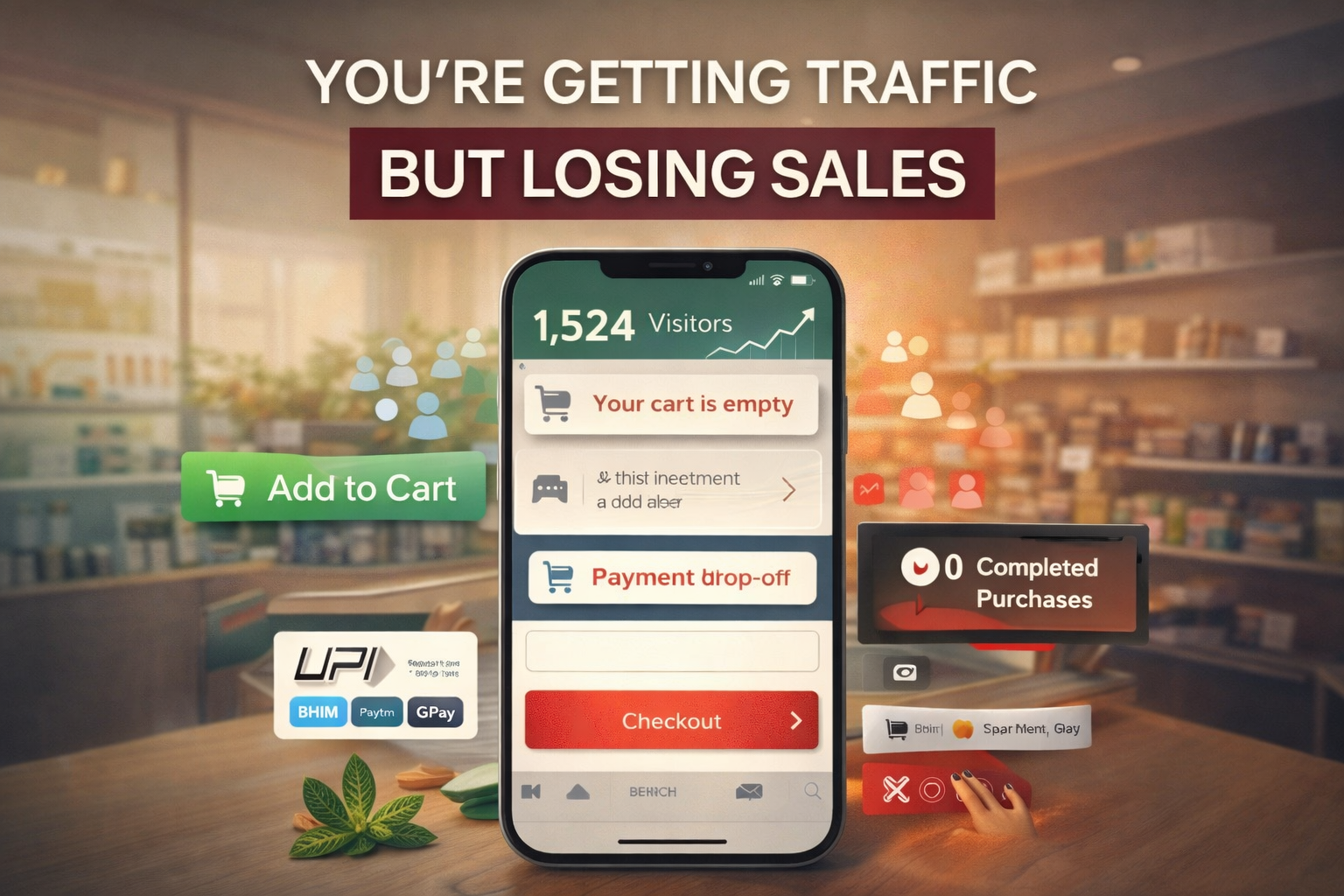
Cart abandonment averages 69.8% globally and is even higher in India where payment preferences vary significantly. UPI dominates Indian digital payments with over 60% market share, while wallets, EMI, net banking, and cash on delivery remain important. Shoppers in the Asia-Pacific region prefer mobile wallets and EMI over credit cards. Offering pay-in-parts and EMI on UPI at checkout removes the affordability barrier that prevents purchases, and this alone has been shown to increase conversions by 30% for Indian brands.
Action
Ensure your checkout accepts UPI, Paytm, PhonePe, Razorpay, net banking, and credit or debit card. Add an EMI option at checkout using Snapmint, Razorpay Affordability Suite, or similar. Enable guest checkout so users do not need to register. Reduce your checkout to 3 steps or fewer. Display all payment logos prominently on product and checkout pages.
3. Use SEO to Generate Consistent Organic Traffic
SEO is the most cost-effective long-term strategy to increase sales online in India. One Indian electronics store that invested in product page SEO and content marketing grew monthly revenue from USD 8,000 to USD 30,000 without increasing its ad spend. Organic traffic reduces dependence on paid advertising, lowers customer acquisition cost, and compounds over time. Optimising product pages for high-intent keywords like ‘buy [product] online India’, ‘best [product] under Rs. 5,000’, and ‘cheap [product] free delivery’ captures buyers who are ready to purchase.
Action
Identify 10 to 15 high-intent, product-specific keywords using Google Keyword Planner or Uber suggest. Optimize each product page title, meta description, H1, and image alt text with these keywords. Write a 600-to-800-word product description that answers real buyer questions. Build a blog with content around how-to guides and comparison articles relevant to your product category.
4. Run Google Shopping and Search Ads for High-Intent Buyers
Google Ads targets buyers who are actively searching for your product right now. For Indian ecommerce, Google Shopping Ads showing your product image, price, and store name directly in search results consistently outperform text ads for conversion rate. Google Ads delivers an average ROAS of 200% to 400% for well-configured Indian ecommerce campaigns. The key is targeting specific, transactional keywords and sending traffic to dedicated, fast-loading product landing pages.
Action
Set up a Google Shopping campaign by connecting your product feed via Google Merchant Centre. For search ads, target keywords with clear purchase intent: ‘buy [product] online’, ‘[product] price India’, ‘[product] free delivery’. Use location targeting for city-specific campaigns. Set a minimum daily budget of Rs. 500 per campaign and use Maximise Conversion Value bidding once you have sufficient data.
5. Leverage Instagram and Facebook Social Commerce
Social commerce is one of the fastest-growing ways to increase sales online in India. Instagram Shopping, Facebook Shops, and shoppable Reels allow buyers to discover and purchase products without leaving the app. India’s large base of young, value-conscious social media users makes these platforms especially powerful for fashion, beauty, electronics, and lifestyle products. Personalised product recommendations in social ads drove 35% of ecommerce sales in India in 2025 and are expected to drive 50% by the end of 2026.
Action
Set up Instagram Shopping and tag products in every relevant post and reel. Create Facebook Shop connected to your product catalogue. Run Facebook and Instagram catalogue ads that dynamically show users products they viewed on your website. Post 4 to 5 times per week using Reels for organic reach. Work with micro-influencers (10,000 to 100,000 followers) in your product category for cost-effective social proof.
6. Build Trust with Reviews and Social Proof
Indian online buyers are highly research-oriented. They read multiple reviews before purchasing, especially for products above Rs. 500. Displaying genuine customer reviews, star ratings, user-generated photos, and real testimonials directly on product pages is the most powerful conversion optimisation tool for any Indian ecommerce business. Brands with strong review profiles consistently achieve 20% to 30% higher conversion rates than equivalent products with no reviews.
Action
After every purchase, send a WhatsApp or SMS message asking for a product review with a direct link. Display reviews prominently on product pages above the fold. Add a photo review option so buyers can upload images of the product in use. Show total review count and average star rating in your product listings. Respond to every negative review professionally and offer to resolve the issue.
7. Use WhatsApp Marketing for Abandoned Carts and Re-engagement
WhatsApp has over 500 million active users in India and delivers an open rate of approximately 98% compared to 20% for email. Sending an abandoned cart reminder via WhatsApp within 30 minutes of abandonment consistently recovers 15% to 25% of lost sales. WhatsApp broadcasts for new product launches, flash sales, and restock alerts also generate significantly higher engagement than equivalent email campaigns in the Indian market.
Action
Set up WhatsApp Business API through Interakt, Wati, or Gupshup. Create an automated abandoned cart message sequence: first message within 30 minutes, second within 3 hours, third the next day. Always include the product image, name, price, and a direct checkout link. Obtain explicit opt-in consent before sending any broadcast messages in compliance with India’s DPDP Act 2023.
8. Implement Personalised Product Recommendations
Personalised product recommendations drove 35% of ecommerce sales in India in 2025, with AI-powered personalisation expected to account for 50% of sales by the end of 2026. Showing customers products related to what they browsed or bought increases average order value and repeat purchase rates. Amazon’s ‘Frequently bought together’ and ‘Customers also viewed’ sections are the most recognised implementations of this strategy and have been shown to increase revenue by 10% to 30% for stores that implement them correctly.
Action
Install a product recommendation plugin on your store (Shopify: ReConvert or LimeSpot; WooCommerce: Frequently Bought Together or WooCommerce Product Recommendations). Configure recommendations on product pages, cart pages, and post-purchase confirmation pages. Segment email and WhatsApp campaigns by past purchase category to deliver relevant product suggestions rather than generic broadcast messages.
9. Offer Loyalty Programmes and Repeat Purchase Incentives
Repeat customers spend more and convert faster. After a customer makes their first purchase, 58% will make a repeat purchase according to Statista data. A loyalty programme that rewards points on every purchase, redeemable on future orders, builds habit-forming buying behaviour without the margin damage of constant discounting. Tier-based loyalty programmes where customers unlock better benefits at higher spend levels are particularly effective for Indian buyers who respond strongly to status and exclusive access.
Action
Set up a loyalty programme using Smile.io (Shopify) or WooCommerce Points and Rewards. Offer points on purchases, reviews, referrals, and social shares. Add a referral programme that gives both the referrer and the new buyer a discount on their next order. Communicate loyalty balances via WhatsApp after every purchase to encourage redemption and repeat visits.
10. Create Urgency with Limited-Time Offers and Stock Indicators
Urgency is one of the most reliable conversion drivers in ecommerce. Displaying real-time low stock indicators (‘Only 3 left’), countdown timers on flash sales, and limited batch offers creates genuine purchase urgency without relying on permanent discounts. Indian buyers, especially in tier-2 cities, respond strongly to festive season sales, flash offers aligned with national events, and early-bird pricing on new product launches.
Action
Add a real-time stock counter to product pages showing remaining units for fast-moving items. Use countdown timers on sale landing pages for events like Holi, Diwali, Independence Day, and Republic Day. Send WhatsApp flash sale alerts to your opted-in list with a 6-to-12-hour validity window. Avoid making urgency indicators fake or permanent Indian buyers are perceptive and lose trust when they see the same ‘Only 2 lefts’ for weeks.
11. Expand to Tier-2 and Tier-3 Cities
Over 70% of new Amazon Prime sign-ups during India’s 2025 festive season came from tier-2 and tier-3 cities. Rural online shoppers in India are expected to grow at a 22% CAGR through 2026. Tier-2 city shoppers show comparable spending power to metro buyers in categories like electronics, appliances, and general merchandise. Brands targeting only metro cities are ignoring the fastest-growing segment of Indian online buyers.
Action
Run geo-targeted Google Ads and Meta Ads campaigns specifically for tier-2 cities relevant to your product category. Create regional language versions of your top product pages in Hindi, Tamil, Telugu, Bengali, or Marathi depending on your target geography. Partner with last-mile delivery services with strong tier-2 coverage such as Delhivery, Shadowfax, or Ecom Express. Display delivery timelines for non-metro pin codes prominently at checkout.
12. Retarget High-Intent Visitors with Personalised Ads
Most visitors do not buy on their first visit. Retargeting users who viewed a product or abandoned a cart with personalised ads across Google, Instagram, Facebook, and YouTube is one of the highest-ROI activities for any business wanting to increase sales online in India. Retargeted ads convert at 3 to 5 times the rate of standard prospecting ads because they reach people who have already demonstrated interest in your specific product.
Action
Install Meta Pixel and Google Ads conversion tag on your store. Create product-specific retargeting audiences: product page viewers (last 30 days), cart abandoners (last 7 days), and past purchasers (for upsell campaigns). Set retargeting ad frequency caps at 3 to 5 impressions per user per week to avoid ad fatigue. Show the exact product the user viewed with a specific offer or free shipping incentive to trigger the purchase decision.
Quick Checklist: How to Increase Sales Online in India
Use this checklist to audit your current approach to increase sales online in India:
- Mobile load speed under 3 seconds on 4G (test with Google PageSpeed Insights)
- UPI, wallets, EMI, and cash on delivery all available at checkout
- Guest checkout enabled no forced registration
- At least 10 verified customer reviews per top product page
- Google Shopping campaign active with product feed in Merchant Centre
- Instagram Shopping set up with products tagged in posts and Reels
- WhatsApp abandoned cart automation active with 3-message sequence
- Product recommendation widgets on product, cart, and thank-you pages
- Retargeting campaigns active on Meta and Google for cart abandoners
- Geo-targeted campaigns running for tier-2 and tier-3 cities
Conclusion
The 12 strategies in this guide cover every major lever available to how to increase sales online in India in 2026. India’s ecommerce market is growing faster than almost any other in the world, but the gap between businesses that convert traffic into revenue and those that do not is widening. Mobile speed, frictionless checkout, trust signals, WhatsApp automation, and personalisation are no longer differentiators. In 2026, they are the baseline.
Start with the strategies that fix your biggest current leak: if you have traffic but low conversion, prioritise checkout optimisation and trust signals. If you have low traffic, prioritise SEO and Google Ads. Every business looking to increase sales online in India in 2026 has a specific bottleneck. Find yours, fix it, then layer on the remaining strategies systematically.
How Dizispark Can Help
Grow your online business with proven strategies to increase sales online in India that are built around your specific products, audience, and goals. Dizispark builds complete ecommerce growth systems for Indian businesses covering Google Ads, Meta Ads, SEO, WhatsApp automation, conversion rate optimization, and social commerce. Whether you sell on your own website, Shopify, WooCommerce, or marketplaces, we build the digital system that turns traffic into revenue consistently every month. Get your free Ecommerce Growth Audit today.
Frequently Asked Questions
What is the fastest way to increase sales online in India in 2026?
The fastest way to increase sales online in India is to fix your checkout conversion rate first. Most Indian ecommerce stores lose 70% to 80% of potential buyers at checkout due to limited payment options, slow mobile loading, or forced registration. Adding UPI, enabling guest checkout, and reducing checkout to 3 steps or fewer can show results within days. Combine this with WhatsApp abandoned cart automation for immediate revenue recovery from visitors who left without buying.
How do I increase online sales in India without spending more on ads?
To increase sales online in India without increasing ad spend, focus on conversion rate optimization and retention. Improving product page content, adding customer reviews, reducing checkout friction, and setting up WhatsApp abandoned cart recovery all increase revenue from your existing traffic. SEO-optimized product pages and blog content generate compounding organic traffic at zero per-click cost. A loyalty program me that converts one-time buyers into repeat customers is consistently the highest-ROI investment for Indian ecommerce businesses.
Why are tier-2 cities important for increasing online sales in India?
Tier-2 and tier-3 cities are the fastest-growing segment of Indian online buyers. Over 70% of new Amazon Prime sign-ups during India’s 2025 festive season came from these cities. Rural online shoppers are growing at a 22% CAGR. Tier-2 shoppers show comparable spending power to metro buyers in electronics and general merchandise categories. Brands that expand their targeting and delivery coverage to these cities consistently find lower customer acquisition costs and less competition than in metro markets.
Does offering EMI really help increase online sales in India?
Yes, significantly. Offering EMI on UPI has proven to increase checkout conversions by 30% for top Indian brands according to Snapmint data. Credit card penetration in India remains low compared to UPI penetration, which means many buyers cannot afford high-ticket items in a single payment without an EMI option. For products above Rs. 2,000, offering a pay-in-3 or pay-in-6 option removes the single biggest barrier to purchase for a large segment of Indian buyers.
How important is WhatsApp for increasing online sales in India?
WhatsApp is one of the highest-impact channels to increase sales online in India. It has over 500 million active users in India, a 98% message open rate, and outperforms email by a significant margin for abandoned cart recovery, flash sale announcements, and order follow-ups. Setting up WhatsApp Business with automated abandoned cart sequences consistently recovers 15% to 25% of lost sales. Always use opt-in consent and comply with India’s DPDP Act 2023 when sending WhatsApp broadcasts.
What payment options should my Indian ecommerce store offer?
To maximize conversions, your Indian ecommerce store should offer: UPI (Phone Pe, Google Pay, Paytm), credit and debit cards, net banking, popular digital wallets, cash on delivery for tier-2 and tier-3 markets, and EMI or pay-later options for products above Rs. 1,000. UPI is currently the dominant payment method in India with over 60% market share in digital payments. Displaying all payment logos at checkout and on product pages builds trust and reduces payment-related abandonment.
How does SEO help increase online sales in India?
SEO helps increase sales online in India by generating consistent, high-intent organic traffic without paying for every click. Optimizing product pages for transactional keywords like ‘buy [product] online India’ or ‘[product] under Rs. 1,000’ captures buyers who are ready to purchase. One documented case saw an Indian online store grow from USD 8,000 to USD 30,000 per month after switching from paid-only to an SEO-led strategy. SEO results compound over time and reduce long-term customer acquisition cost below any paid channel.
What is the average ecommerce conversion rate in India and how do I improve it?
The average ecommerce conversion rate across all platforms is approximately 2%, meaning 98% of visitors leave without buying. To improve your conversion rate and increase sales online in India, focus on mobile page speed under 3 seconds, displaying genuine customer reviews prominently, offering UPI and EMI at checkout, enabling guest checkout, adding a WhatsApp support button on product pages, and using exit-intent popups with a specific offer for first-time buyers. Each improvement compounds and moving from 1% to 2% conversion effectively doubles your revenue without changing your ad spend.