
Two SaaS companies launched in the same month. Same type of product. Same target market. Same starting budget. Twelve months later, one had 2,000 paying customers, USD 400,000 in ARR, and a growing waitlist. The other had 180 customers, was burning through its runway, and had just laid off half its team.
The difference was not the product. Both products worked well. The difference was marketing. One company understood how digital marketing for SaaS companies works. The other treated it like marketing for a regular business. And in SaaS, that mistake is fatal.
SaaS marketing is fundamentally different from marketing a physical product or a one-time service. It is about convincing someone to try something they cannot touch, to pay for it every month, and to keep paying as their needs change. Understanding how digital marketing for SaaS companies actually drives growth and revenue is the single most important thing a SaaS founder or marketer can do in 2026.
Table of Contents
ToggleThe SaaS Market in 2026 — The Opportunity and The Competition
Before we get into strategy, understand the size of the opportunity. And the size of the challenge.
$300 Bn
Global SaaS spending in 2026 (Gartner)
30,000+
SaaS companies competing for market share
85%
Business apps powered by SaaS by 2026 (BetterCloud)
18.4%
SaaS market CAGR through 2032 (Fortune Business Insights)
400%
More leads for SaaS companies that prioritize content marketing
5%
Customer retention increase can lead to 25%+ revenue growth
The SaaS market is enormous and growing fast. By 2032, it is projected to reach USD 1,228 billion according to Fortune Business Insights. But with over 30,000 SaaS companies competing globally, the battle for customer attention has never been harder. According to Gartner’s 2025 data, the average company now uses 106 SaaS applications down from 112 in 2023 meaning customers are consolidating, evaluating more carefully, and choosing fewer, better products. In this environment, the SaaS companies with the strongest marketing will win, regardless of whether they have the best product.
Why Digital Marketing for SaaS Companies is Completely Different
Most businesses sell something once. A customer buys a shirt, a meal, or a piece of furniture. The transaction is complete. SaaS is different. You sell a subscription. Your customer pays you every month. Which means digital marketing for SaaS companies is not just about getting someone to sign up. It is about getting them to stay, expand, and refer others. According to Disruptive Advertising’s 2026 SaaS marketing report, SaaS buyers now spend less than 20% of their time speaking with vendors before making a purchase decision. Marketing does the entire job of education, trust-building, and differentiation before a salesperson ever gets involved.
This means your content, your SEO, your free tools, your case studies, your email sequences, and your LinkedIn presence are not just marketing assets. They are your sales team. Every piece of content you publish is working to move a potential customer closer to a signup while you sleep. The best SaaS companies in 2026 have built marketing machines that do this at scale, automatically, across multiple channels.
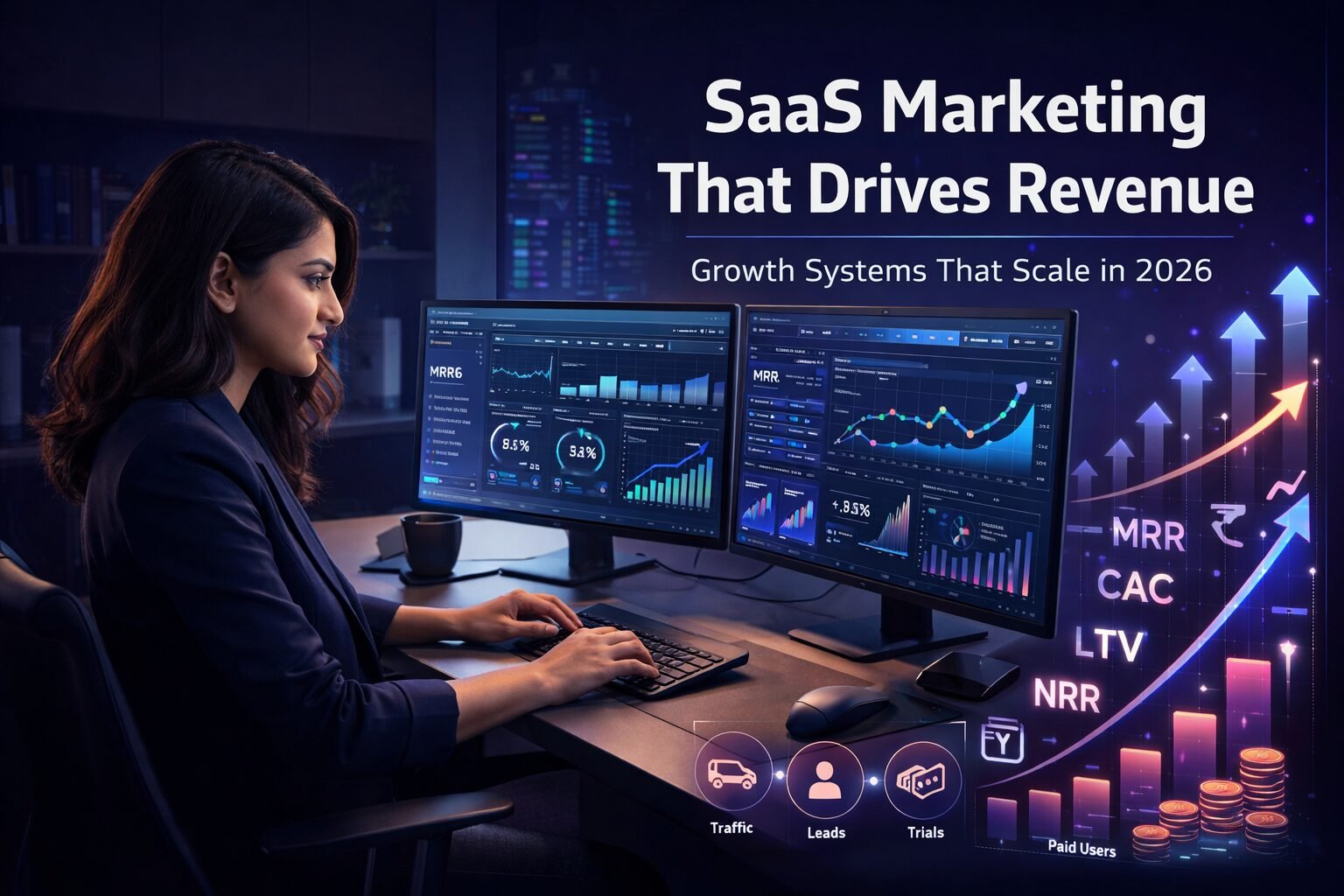
There are also three unique SaaS metrics that every digital marketing strategy must be built around. CAC is Customer Acquisition Cost how much you spend to get one paying customer. LTV is Lifetime Value how much revenue that customer generates over their entire relationship with you. NRR is Net Revenue Retention whether your existing customers are spending more or less over time. According to data from Almcorp’s 2026 SaaS marketing guide, companies with properly aligned marketing strategies achieve LTV to CAC ratios of 3 to 1 or better and NRR of 120% or more, meaning existing customers alone drive significant revenue growth.
Digital Marketing Strategies for SaaS Companies — Complete Overview
Here is a complete comparison of all the major digital marketing strategies for SaaS companies, what they are best for, how long they take to show results, and how much impact they deliver.
| Strategy | Best For | Time to Results | Cost Level | Impact |
|---|---|---|---|---|
| SEO and Content | Long-term signups and organic traffic | 6 to 12 months | Low | Very High |
| Google Ads (PPC) | Immediate trial signups | 24 to 48 hours | Medium to High | High |
| LinkedIn Ads | B2B enterprise leads and decision makers | 1 to 2 weeks | High | Very High |
| Product-Led Growth | Free trial to paid conversion | Ongoing | Low | Very High |
| Email Marketing | Nurturing trials into paid users | Immediate | Very Low | Very High |
| Free Tools and Templates | Top of funnel traffic and signups | 3 to 6 months | Low | High |
| Case Studies | Converting serious evaluators | Ongoing | Low | Very High |
| Community Building | Retention and organic referrals | 6 to 12 months | Low | High |
| Account-Based Marketing | Enterprise accounts, high-value deals | 2 to 4 weeks | High | Very High |
| Affiliate and Partner Marketing | Scalable low-cost acquisition | 1 to 3 months | Low | High |
The Strategies That Drive the Most Growth for SaaS Companies in 2026
1. SEO and Content Marketing — The Compounding Growth Engine
SEO is the single most powerful long-term channel in digital marketing for SaaS companies. According to data from Oliver Munro’s 2026 SaaS marketing statistics report, SEO sourced leads convert at a 51% MQL-to-SQL rate compared to just 26% for PPC traffic. That means organic search leads are nearly twice as likely to become paying customers as paid ad leads.
SaaS SEO works by covering the full buyer journey with content. At the top of the funnel, you target problem aware searches like ‘how to manage remote teams’ or ‘why is my team missing deadlines’. In the middle, you target solution-aware searches like ‘best project management software’. At the bottom, you target buyer ready searches like ‘Asana vs Monday comparison’ or ‘Slack pricing plans’. This systematic coverage of the buyer journey is what turns your website into a 24-hour signup machine. According to Sixth City Marketing, content marketing can lead to 434% more indexed pages and 97% more indexed links. SaaS companies that prioritize content marketing report lead generation growth of up to 400%.
The most successful SaaS blogs in 2026 average 3,000 words per post according to Sixth City Marketing’s research. Free tools and templates are also exceptionally powerful for SaaS companies. Shopify’s free tools generate millions of visits monthly from business owners who discover Shopify while using a free profit calculator or business name generator. This is top-of-funnel magic give something valuable for free, capture the audience, and convert them to customers over time.
2. Product-Led Growth — Let the Product Do the Marketing
Product-led growth means your product itself is your primary acquisition channel. Users sign up for a free trial or freemium version, experience the value directly, and then convert to a paid plan when they are ready. According to data from Position Digital’s 2026 SaaS statistics research, opt-out trials where a credit card is required achieve 49 to 60% conversion rates. Opt in trials with no credit card convert at 18 to 25%. And trial length matters significantly 7-day trials convert at 40.4% while trials longer than 61 days drop to 30.6%.
Slack and Notion are the most cited examples of PLG done right. Both use a free tier that creates genuine value, then let usage naturally drive teams toward paid plans. But according to Disruptive Advertising’s 2026 SaaS trends report, pure PLG is no longer enough in 2026. Every SaaS company offers trials now. The winning companies pair PLG with sales-assisted intelligence using usage data to identify high-intent accounts and having sales step in at precisely the right moment with personalized outreach based on real behavior.
3. Email Marketing — The Highest-Converting Channel in SaaS
Email marketing is the most underrated channel in SaaS. According to Position Digital’s 2026 statistics research, email marketing converts better than Facebook, Bing, and Google Ads for B2B SaaS companies. The most powerful email marketing in SaaS is behavioral. When a user signs up for a trial, they should immediately enter an onboarding email sequence that teaches them the most valuable features, shows them what success looks like, and removes any friction standing between them and their first aha moment.
According to Taboola’s 2026 SaaS marketing trends research, SaaS companies can significantly reduce churn by using personalized re-engagement campaigns, in product messaging, and retargeting based on churn signals. AI-powered tools can detect at-risk users early and help reduce churn through tailored experiences. A user who has not logged in for 10 days should receive a different email than one who logged in yesterday. This level of segmentation and personalization is what separates SaaS companies with NRR above 120% from those losing customers faster than they acquire them.
4. LinkedIn Ads — The Best Paid Channel for B2B SaaS
For B2B SaaS companies, LinkedIn Ads are the most effective paid channel. According to SeoProfy’s 2026 SaaS marketing statistics, 80% of B2B leads come from LinkedIn. According to Position Digital, LinkedIn Ads convert better than Facebook, Google Ads, and Bing for B2B SaaS. And according to Sixth City Marketing, 75% of B2B content marketers use LinkedIn as their paid social media channel of choice, with 79% saying it produced the best results.
The reason LinkedIn works so well for B2B digital marketing for SaaS companies is targeting precision. You can target by job title, company size, industry, seniority level, and even specific companies. A SaaS company selling HR software can target specifically HR Directors at companies with 200 to 1,000 employees in specific industries. That kind of precision means your ad budget goes almost entirely to people who actually have the authority to make a purchase decision.
5. Case Studies — The Most Trusted Content in SaaS
According to Sixth City Marketing, 70% of SaaS businesses consider case studies as their most effective content format for converting leads into customers. And 62% of SaaS companies post case studies specifically to improve traffic and build trust. The reason case studies work so well is that B2B SaaS buyers are risk-averse. They are choosing software that their team will use every day. They want to see proof that it worked for someone like them.
A great SaaS case study tells a specific story. Before the product, the company faced this problem. After implementing the product, here is exactly what changed. With specific numbers ‘40% reduction in time spent on reporting’ or ‘3x increase in qualified leads per month’. According to Position Digital, B2B decision makers trust peer recommendations more than vendor websites, search engines, or AI chatbots. Case studies are peer recommendations in written form. They are your most powerful conversion tool.
The SaaS Marketing Metrics That Actually Matter
Most SaaS companies track vanity metrics. Page views. Social media followers. Email open rates. These feel good but they do not tell you if your digital marketing for SaaS companies is actually growing revenue. Here are the metrics that matter.
CAC or Customer Acquisition Cost tells you how much you spend to get one paying customer. According to Oliver Munro’s 2026 SaaS statistics, median CAC has hit USD 2.00 to acquire USD 1.00 of new ARR — a 14% increase from 2023. If your CAC is rising, your marketing is getting less efficient. LTV or Lifetime Value tells you how much revenue a customer generates before they cancel.
The LTV to CAC ratio should be 3 to 1 or better. NRR or Net Revenue Retention above 100% means your existing customers are spending more than they were. Companies with NRR above 106% grow 2.5 times faster than those with low NRR. MRR or Monthly Recurring Revenue is your most important revenue metric. Churn rate tells you what percentage of customers cancel each month. Even a 5% improvement in customer retention can lead to over 25% revenue growth according to SeoProfy.
The Biggest SaaS Marketing Trends in 2026 You Cannot Ignore
The SaaS marketing landscape is shifting fast in 2026. According to Disruptive Advertising and upGrowth’s 2026 SaaS marketing research, five major shifts are reshaping how SaaS companies grow. AI has moved from assistant to automation, with leading teams using AI to manage entire marketing workflows from onboarding campaigns to pipeline scoring. Ecosystem-led growth through partnerships and integrations is delivering leads at 40 to 60% lower CAC than paid acquisition.
Generative Engine Optimization (GEO) is emerging as SaaS companies realize that 89% of B2B buyers now use AI tools to research products. If your SaaS product is not being recommended by ChatGPT or Google’s AI Overviews, you are invisible to a fast-growing segment of your market. And according to Position Digital, 32% of software buyers now use Reddit to research products before making a decision. Building a genuine presence on Reddit and other peer communities is becoming a serious SaaS marketing channel in 2026.
Conclusion
The global SaaS market is growing towards USD 1.2 trillion by 2032. The companies that will capture the most of that growth are not the ones with the best product features. They are the ones with the best digital marketing for SaaS companies the ones that create organic signups through SEO, convert trials efficiently through behavioral email, build trust through case studies and communities, and retain customers through consistent value delivery.
In 2026, SaaS marketing is not about running ads and hoping for signups. It is about building a complete growth system where SEO drives organic discovery, content builds trust before the sale, PLG lets customers experience value before paying, email nurtures them through the funnel, LinkedIn reaches the right decision makers directly, and community keeps them loyal after they sign up. Every channel reinforces every other. That is how SaaS companies grow from zero to USD 10M ARR and beyond.
The gap between SaaS companies that scale and those that plateau has never been wider. Marketing is the difference. Build the right system and your product will sell itself.
Is Your SaaS Company Growing as Fast as It Should Be?
Most SaaS companies have a great product but a leaky marketing funnel. They spend money on ads, get signups, but struggle to convert trials into paying customers or keep them long enough to grow MRR. At DiziSpark, we build complete digital marketing systems for SaaS companies from SEO and content that drives organic signups to paid campaigns, email nurture sequences, LinkedIn Ads, and retention strategies that reduce churn. We understand SaaS metrics — CAC, LTV, MRR, NRR — and we build marketing that moves all of them in the right direction. Visit us today at Dizispark and Grow your Company.
Frequently Asked Questions
What is the best digital marketing strategy for a SaaS company?
The best strategy combines SEO and content marketing for long-term organic growth, email marketing for trial-to-paid conversion, product-led growth for low-friction signups, LinkedIn Ads for B2B decision maker reach, and case studies for trust and conversion. The companies that grow fastest use all of these channels together as one connected system rather than running them separately.
How long does digital marketing take to show results for SaaS?
Paid channels like Google Ads and LinkedIn Ads show results within 24 to 48 hours. Email marketing produces results immediately for existing users. SEO and content marketing take 6 to 12 months to build significant organic traffic but then deliver the lowest CAC of any channel. Product-led growth and community building take 3 to 6 months to show meaningful impact on conversion and retention.
Which metrics should a SaaS company track in digital marketing?
The most important metrics are Customer Acquisition Cost (CAC), Lifetime Value (LTV), LTV to CAC ratio (should be 3 to 1 or better), Net Revenue Retention (NRR, should be above 100%), Monthly Recurring Revenue (MRR), monthly churn rate, trial to paid conversion rate, and channel-specific conversion rates. These metrics tell you whether your marketing is actually growing revenue, not just generating traffic.
Is SEO effective for SaaS companies?
Yes, it is one of the most effective long-term channels. According to 2026 research, SEO sourced leads convert at a 51% MQL-to-SQL rate compared to just 26% for PPC leads nearly twice as effective. SaaS companies that prioritize content marketing report up to 400% lead generation growth. SEO takes 6 to 12 months to build but then generates the lowest customer acquisition cost of any channel.
Should a SaaS company use LinkedIn Ads?
Yes, especially for B2B SaaS. 80% of B2B leads come from LinkedIn. LinkedIn Ads allow precise targeting by job title, company size, industry, and seniority, meaning your budget goes almost entirely to people with actual purchase authority. LinkedIn Ads convert better than Facebook, Google Ads, and Bing for B2B SaaS according to 2026 research. They are more expensive per click but deliver higher-quality leads.