
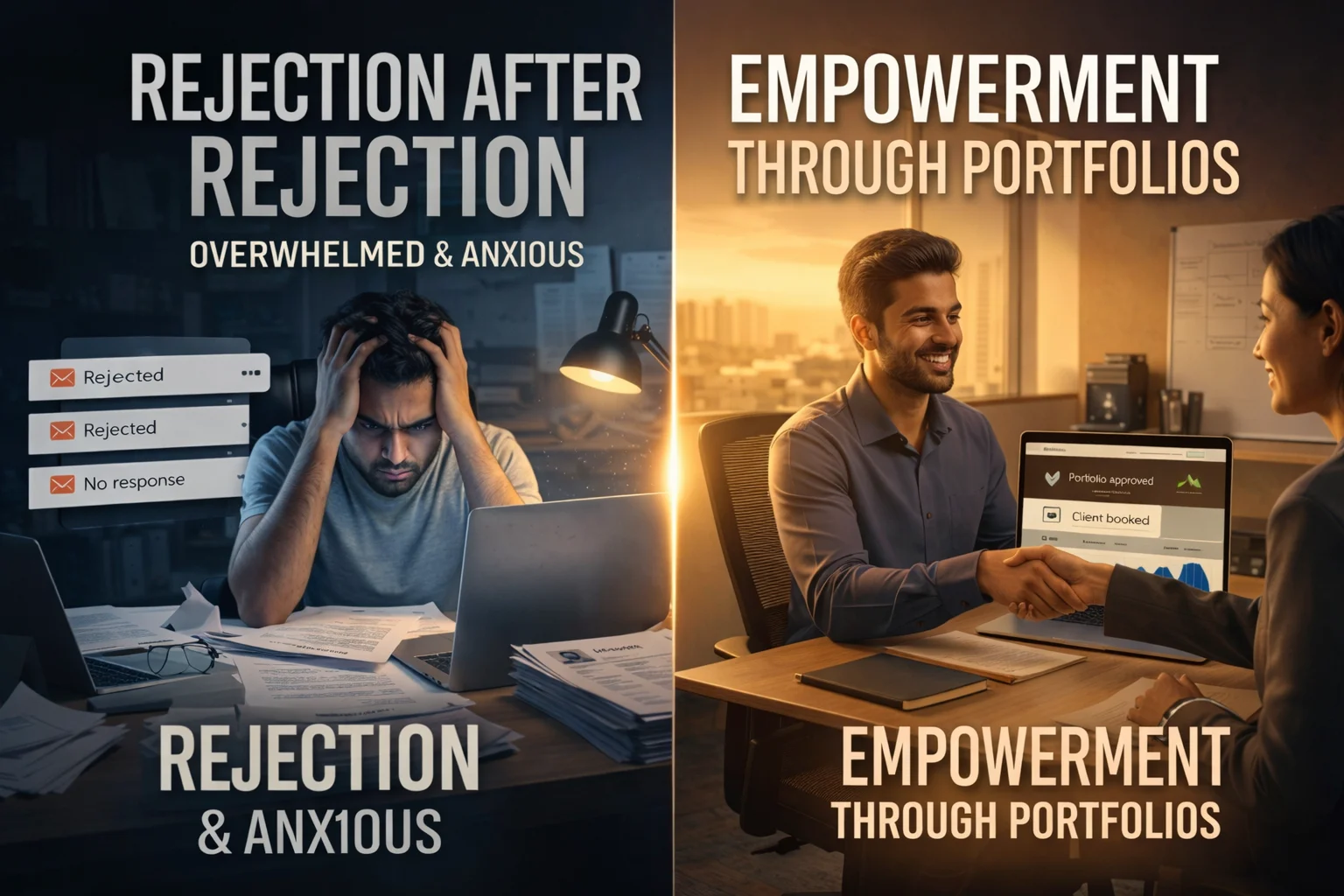
Ravi had applied to 40 digital marketing jobs. He had a Google certification. He had an MBA. He had completed 3 online courses. He got zero callbacks. Then he spent two weeks building a proper portfolio for digital marketing a personal website with 5 case studies showing real campaign results, screenshots of Google Ads dashboards, and an SEO audit he had done for a local business for free. He applied to 10 more jobs. He got 6 interview calls.
Nothing about Ravi changed except his portfolio. And that is the point.
According to AADME’s 2026 digital marketing career research, hiring managers now skim portfolios before reading resumes. Freelance clients evaluate case studies more than proposals. Agencies use portfolios to filter the top 10% from the rest. In 2026, a great portfolio for digital marketing is not optional. It is the single most important career document you will ever build. This guide will show you exactly what to put in it, how to get projects even with zero experience, and how to make it stand out from everyone else applying for the same job.
Table of Contents
ToggleWhat is a Portfolio for Digital Marketing?
A portfolio for digital marketing is a structured collection of your best work, results, and skills presented in one place usually on a personal website. It shows potential employers or clients what you have actually done, not just what you claim you can do. Think of it as evidence. Your resume says you know Google Ads. Your portfolio shows a screenshot of a campaign you ran with the results it achieved. Your resume says you understand SEO. Your portfolio shows a keyword ranking improvement you delivered for a website.
Unlike a resume, which is a list of experience and qualifications, a portfolio is a proof document. It shows thinking, execution, and results all in one place. According to BrainStation’s 2026 portfolio guide, the portfolio website itself becomes an example of your work. A digital marketer whose own website is slow, hard to navigate, or looks unprofessional is telling employers something very important about how they would manage a client’s digital presence. Your portfolio is your biggest marketing campaign. Treat it accordingly.
Why Every Digital Marketer Needs a Portfolio in 2026
The digital marketing job market in India is competitive. According to Frontlines Media’s 2026 fresher career research, thousands of freshers apply for every entry-level position. Collecting certificates — Google, HubSpot, Meta Blueprint is no longer enough to stand out. Everyone has certificates. What most people do not have is a portfolio that shows real results from real campaigns.
Here is the honest truth. A fresher with a strong portfolio for digital marketing showing 3 self-initiated projects with real metrics will get more interviews than someone with 5 certifications and no proof of actual work. According to Coursera’s 2026 digital marketing career roadmap, employers look for hands-on experience using real tools, clear evidence of campaign impact, and the ability to communicate results clearly. A portfolio delivers all three of these things in a way that a resume simply cannot.
For freelancers, a portfolio is even more critical. Clients are not hiring you based on your qualifications. They are hiring you based on whether they trust you with their money. A portfolio that shows you took a business from Rs. 50 per click to Rs. 18 per click on Google Ads, or grew an Instagram account from 800 to 12,000 followers in 4 months, answers every question a client has before they even ask it.
What to Include in a Portfolio for Digital Marketing — Section by Section
1. Your Personal Introduction and Specialization
The first thing anyone sees on your portfolio should tell them exactly who you are and what you specialize in. Not ‘digital marketer’. That is too broad. Instead, something like ‘Performance Marketer specializing in Google Ads and Meta Ads for e-commerce brands’ or ‘SEO Specialist helping local businesses rank on Google’s first page’. According to BrainStation, within 3 seconds of landing on your portfolio, a recruiter should know who you are and what you do. A photo, your name, your specialization, and one sentence about what you bring that is your opening section. Keep it tight. Keep it clear.
2. Your 4 to 6 Best Projects
This is the heart of your portfolio for digital marketing. Not 10 projects. Not 2 projects. According to AADME’s research, 4 to 6 well-documented projects is the right number. Each project should tell a story using the STAR format Situation (what was the problem), Task (what was your job), Action (what did you do), Result (what happened as a result of what you did). Every single project must have real numbers. Not ‘improved traffic. Instead, ‘increased organic traffic from 1,200 to 4,800 monthly visits in 5 months’. Not ‘reduced ad costs’.
Instead, ‘reduced cost per lead from Rs. 320 to Rs. 95 in 6 weeks’. Numbers are the language of trust in marketing. Without them, your case studies are just stories.
3. Screenshots and Visuals
A portfolio without visuals is just a document. Screenshots of Google Ads dashboards showing campaign performance, Google Analytics graphs showing traffic growth, Instagram Insights showing reach and engagement, SEO ranking tracking screenshots these visuals make your results real and believable. According to Wix’s 2026 portfolio guide, portfolios should include case studies with measurable outcomes, clear visuals, and concise descriptions. If your project is content-based, include before and after screenshots of the content you created. If it is SEO-based, show keyword ranking improvements. If it is social media-based, show engagement growth over time. Visual proof is 10 times more persuasive than written claims.
4. Certifications and Tools You Know
Certifications matter but they should support your work, not replace it. Include your Google Digital Marketing Certificate, HubSpot Marketing Certificate, Meta Blueprint, and any other relevant certifications. More importantly, list the specific tools you know how to use. Semrush, Ahrefs, Google Analytics 4, Google Ads, Meta Ads Manager, Canva, Mailchimp, Hubspot, WordPress name the tools and ideally show them in use in your case study screenshots. According to Frontlines Media’s 2026 career research, free certifications from Google and HubSpot are fully sufficient for entry-level roles. What matters more is showing the tools in action through your project work.
5. Testimonials and Social Proof
According to Wix’s 2026 portfolio guide, social proof is one of the strongest assets on a portfolio site. A testimonial like ‘They helped us grow our Instagram following from 1,000 to 18,000 in 3 months and our leads doubled’ is far more powerful than any certification. Even for freshers, social proof is achievable. If you did free work for a local business, ask for a written or video testimonial. If you helped a friend with their social media, get a quote from them. If a professor or mentor has praised your work, ask for a short LinkedIn recommendation. Any external validation builds trust faster than self-promotion.
Portfolio for Digital Marketing — Complete Checklist
Here is your complete checklist. Use this to build and review your portfolio before sending it to any employer or client. Green means must have before you share it with anyone.
| Portfolio Element | Priority |
| Section 1 — Personal Branding | |
| Professional photo or headshot | Must Have |
| Clear bio — who you are and what you specialise in | Must Have |
| Your specialisation mentioned upfront (e.g. SEO, Paid Ads, Social Media) | Must Have |
| Contact details — email, LinkedIn, WhatsApp | Must Have |
| Personal domain name (yourname.com) | Highly Recommended |
| Section 2 — Work Samples and Case Studies | |
| 4 to 6 strong projects (not more, not less) | Must Have |
| Each project has: Problem, Your Role, Action Taken, Results | Must Have |
| Real numbers in every case study (CTR, leads, conversions, traffic) | Must Have |
| Screenshots of dashboards, ads, or analytics | Must Have |
| At least one SEO project | Highly Recommended |
| At least one paid ads (Google or Meta) project | Highly Recommended |
| At least one social media or content project | Highly Recommended |
| Section 3 — Certifications and Tools | |
| Google Digital Marketing and E-commerce Certificate | Must Have |
| HubSpot Marketing Certification (free) | Must Have |
| Meta Blueprint Certificate | Highly Recommended |
| Google Ads certification | Highly Recommended |
| List of tools you know — Semrush, Ahrefs, Canva, Google Analytics, etc. | Must Have |
| Section 4 — Social Proof | |
| At least 1 client or manager testimonial | Must Have |
| LinkedIn profile link with activity and recommendations | Must Have |
| Any brand names you have worked with (even small ones) | Highly Recommended |
| Awards, features, or press mentions if any | Nice to Have |
| Section 5 — Technical Quality | |
| Portfolio loads in under 3 seconds | Must Have |
| Fully mobile responsive | Must Have |
| Clean design — not too many colours or fonts | Must Have |
| Easy navigation — visitor finds what they need in 2 clicks | Must Have |
| Regular updates — at least every 3 months Highly Recommended | Highly Recommended |
How to Get Projects for Your Portfolio With Zero Experience
This is the most common problem freshers face. You need a portfolio for digital marketing to get a job, but you need a job to have portfolio projects. Here is how to break that cycle.
1. Do Free Work for Local Businesses
Go to a local restaurant, a boutique, a coaching centre, or any small business that has no social media presence or a weak one. Offer to manage their Instagram for one month for free in exchange for a testimonial and permission to show the results in your portfolio. Most small business owners will say yes. One month of real work with real results is worth more than 10 course certificates.
2. Create Your Own Projects
Start a blog on a topic you care about and practice SEO on it. Run a Rs. 200 Google Ads or Meta Ads campaign for something even a personal service you offer. Create a mock campaign for a brand you love design the ads, write the copy, explain the strategy, show the expected results. According to AADME’s 2026 research, in 2026 AI tools make it easier than ever to create sample campaigns without a real budget. A well-documented mock campaign with clear reasoning shows more intelligence than a poorly documented real one.
3. Volunteer for NGOs and Startups
Non-profit organizations, local startups, and student-run businesses almost always need digital marketing help and rarely have the budget to pay for it. Volunteer for 4 to 6 weeks, do real work, get real results, document them properly, and add them to your portfolio. This gives you a genuine case study with a real business name attached to it, which is far more credible than a mock project.
4. Do an Internship — Even Unpaid
According to Acadium’s portfolio guide, digital marketing apprenticeships and internships are one of the fastest ways to build portfolio content. Even a 2-month unpaid internship at a small agency gives you real campaign experience, real data to document, and a real company name for your portfolio and resume. The right internship at the right time is worth more than months of self-study.
Best Platforms to Build Your Digital Marketing Portfolio
Your portfolio for digital marketing should ideally live on your own personal website. According to BrainStation, a personal website is the best choice for most digital marketers because it is a 24 hour hub for your personal brand and proves you understand how the web works. Here are the best platform options.
WordPress is the most professional option and shows you understand the world’s most popular CMS. It gives you full control over design, SEO, and page speed. Wix is faster to set up and still looks professional. It is a great option if you want to get your portfolio online quickly without spending weeks on design. Notion is increasingly popular for digital marketing portfolios because it allows clean, structured case study presentation. Squarespace offers beautiful design templates and is easy to use.
LinkedIn can also serve as a basic portfolio use the Featured section to showcase PDFs, screenshots, and links to your work. Whatever platform you choose, make sure your portfolio loads fast, looks clean on mobile, is easy to navigate, and has a clear contact method on every page.
Common Portfolio Mistakes That Cost Freshers Jobs
Building a portfolio is important. Building a bad one can actually hurt you more than having none. Here are the mistakes most freshers make and how to avoid them.
The most common mistake is showing too many projects. Ten mediocre projects are worse than four great ones. Be selective. Only show your best work. The second mistake is having no numbers. Every project needs metrics. Without numbers, your case studies are just descriptions. The third mistake is showing certificates without showing work. Certificates tell employers you completed a course. They do not tell employers you can produce results. Always pair certifications with actual project work.
The fourth mistake is a slow or mobile-unfriendly portfolio website. A digital marketer with a slow website is the equivalent of a chef whose own kitchen is dirty. It immediately creates doubt. Test your website on Google PageSpeed and on a mobile phone before sharing it with anyone. The fifth mistake is not updating the portfolio.
According to Coursera’s 2026 career guide, updating your portfolio at least once a week with new skills, campaigns, or insights is a recommended habit. An outdated portfolio signals that you have stopped growing.
Conclusion
In 2026, your portfolio for digital marketing is your most powerful career tool. It is more important than your resume, more convincing than your certifications, and more trustworthy than anything you can say about yourself in an interview. It is proof. And proof always beats claims.
Whether you are a fresher just starting out, a professional looking to switch roles, or a freelancer trying to win bigger clients, the principles are the same. Show real work. Show real numbers. Show real thinking. Keep it clean, fast, and mobile-friendly. Update it regularly. And never stop adding new projects.
The good news is that you do not need a single day of paid experience to build a portfolio that gets you hired. You need one month of focused effort, a few free tools, and the willingness to do real work before you get paid for it. Start today. Your next job or client is waiting for you to give them a reason to say yes.
Want to Work With a Team That Lives and Breathes Digital Marketing?
Building a great portfolio for digital marketing is the first step. The next step is putting those skills to work on real campaigns that deliver real results for real businesses. At DiziSpark, we are a full-service digital marketing agency where talented marketers work on Google Ads, SEO, social media, content, and more for clients across India. Whether you are a fresher looking for your first role, a professional wanting to grow, or a business that needs expert digital marketing support, DiziSpark is the place for you. Visit us at Dizispark and let us know how we can work together.
Frequently Asked Questions
What should a portfolio for digital marketing include?
A strong portfolio for digital marketing should include a clear personal introduction with your specialization, 4 to 6 case studies with real numbers and screenshots, your certifications and tools, at least one client testimonial, and a clear contact section. Every project should follow the STAR format Situation, Task, Action, Result and show specific metrics like traffic growth, cost per lead, or conversion rate improvements.
How do I build a digital marketing portfolio with no experience?
Do free work for a local business in exchange for a testimonial and permission to show results. Create your own blog or social media page and practice SEO and content marketing on it. Run a small Rs. 200 to Rs. 500 sample ad campaign on Google or Meta. Build mock campaigns for brands you admire with full strategy documentation. Volunteer for an NGO or startup. Any real work, even unpaid, gives you real results to document.
Which platform is best for a digital marketing portfolio?
A personal website built on WordPress or Wix is the best option because it shows you understand web basics and gives you full control. Your own domain name (yourname.com) costs very little and signals professionalism. If you want a quick start, Notion or Squarespace also work well. LinkedIn’s Featured section can serve as a basic portfolio while you build a full website.
Do certifications matter for a digital marketing portfolio?
Certifications support your portfolio but should not replace actual work. A Google Digital Marketing Certificate and HubSpot Marketing Certificate are the most valued for freshers and are both free. What matters more to employers is evidence that you can apply what you learned. Always pair certifications with real or practice project work that demonstrates the skills those certifications cover.
How important are numbers in a digital marketing portfolio?
Numbers are everything. Without specific metrics, your case studies are just descriptions. Employers and clients need to see proof of results. Always include specific numbers percentage increase in traffic, cost per lead before and after, conversion rate improvement, follower growth numbers, or engagement rate changes. If you do not have exact numbers, estimate conservatively and note that the figures are approximate. Some numbers are better than none.