
The Snapchat vs Instagram debate has been running for years, and in 2026 it is more relevant than ever. Both platforms have evolved dramatically. Instagram now has 3 billion monthly active users and has become the backbone of social commerce and influencer marketing. Snapchat has quietly grown to 943 million monthly active users and remains the number one platform for Gen Z in key markets. Choosing between them, or deciding how to split your time and budget across both, is a strategic decision that can significantly impact your business results.
This complete guide breaks down Snapchat vs Instagram across every dimension that matters: users, features, engagement, advertising costs, business tools, and which platform wins for each specific goal. Every figure in this article is sourced and verified, listed at the end of each section.
Snapchat vs Instagram: Key Stats at a Glance (2026)
Before diving into the details, here is a side-by-side overview of the most important numbers:
| Metric | Snapchat | |
|---|---|---|
| Monthly Active Users | 3 billion | 943 million |
| Daily Active Users | Over 500 million | 477 million |
| Founded | 2010 | 2011 |
| Primary Audience | 18 to 34 year olds | 13 to 24 year olds |
| Daily Time Spent | 30 to 35 minutes per day | 30 to 32 minutes per day |
| App Opens Per Day | 5 to 7 times | 30 to 40 times |
| Ad Cost (CPC) | $0.70 to $1.50 per click | $0.30 to $1.00 per click |
| Ad Cost (CPM) | $5 to $6 per 1,000 impressions | $4 to $10 per 1,000 impressions |
| Best For | Brands, influencers, commerce, growth | Gen Z, private messaging, AR |
| Global Ad Revenue Share | Largest with Facebook: 55% combined | Smaller but growing |
| Key Takeaway |
|---|
| Instagram is larger, more business-friendly, and better for discoverability and commerce. Snapchat is more intimate, more frequently opened, and unrivalled for reaching 13 to 24 year olds. The right choice depends entirely on who your audience is and what you are trying to achieve. |
What Is Instagram? Core Features Explained
Instagram launched in 2010 as a photo-sharing app and has since grown into one of the world’s most powerful social media and commerce platforms. With 3 billion monthly active users as of 2026, it is the third largest social network globally after Facebook and YouTube. Instagram is owned by Meta, which gives it access to the world’s most advanced advertising infrastructure.
In the Snapchat vs Instagram comparison, Instagram’s key advantage is its breadth. It supports multiple content formats, robust business tools, and an open, discoverable ecosystem that allows brands and creators to reach audiences they have never met before.
1. Stories
Instagram Stories, launched in 2016, allows users to share photos and videos that disappear after 24 hours. Stories include interactive features like polls, quizzes, question boxes, countdown timers, product stickers, and location tags. Over 500 million accounts use Instagram Stories every day. Businesses watch Stories to keep up with brands they follow and to view relevant products. Unlike Snapchat, Instagram does not notify users when someone screenshots their story.
2. Reels
Reels are Instagram’s short-form video format, available up to 90 seconds long. They are Instagram’s fastest growing content format and the primary driver of organic reach for new audiences. Reels can appear on the Reels explore page, reaching users who do not follow your account at all. This makes Reels one of the most powerful tools for business discovery on any social platform in 2026.
3. Shopping and Commerce
Instagram Shopping allows businesses to tag products directly in posts, Stories, and Reels, enabling users to browse and buy without leaving the app. Instagram has one of the most advanced social commerce ecosystems of any platform. 85% of Instagram users spend time every week exploring and discovering new products and services. The platform’s integration with Meta’s advertising system makes it exceptionally powerful for product-focused businesses.
4. Analytics and Business Tools
Instagram Insights is a free, built-in analytics tool available to all Creator and Business accounts. It provides detailed data on reach, impressions, follower demographics, engagement rates, and content performance. Additionally, Meta’s Business Suite offers advanced campaign analytics, A/B testing, and audience targeting tools. These are significantly more advanced and accessible than the tools available on Snapchat.
What Is Snapchat? Core Features Explained
Snapchat launched in 2011 with a single radical idea: disappearing photos. That core concept of ephemeral content shaped its identity as the platform for authentic, unfiltered, in-the-moment sharing. In 2026, Snapchat has 943 million monthly active users and 477 million daily active users, representing 8% year-on-year growth.
In the Snapchat vs Instagram debate, Snapchat’s unique strength is depth of engagement. Users open the app 30 to 40 times per day on average, primarily to communicate directly with their closest friends. This creates a level of personal intimacy that Instagram’s more public, performative environment cannot replicate.
1.Snaps and Stories
Snaps are the core of Snapchat: photos and short videos sent directly to specific friends or your Story, visible for up to 24 hours before disappearing. Unlike Instagram Stories, Snapchat notifies you when someone screenshots your content, creating a stronger sense of privacy. Snapchat Stories have a 65% completion rate, meaning nearly two thirds of viewers who start watching a Story watch it all the way through.
2. Spotlight
Spotlight is Snapchat’s answer to Instagram Reels and TikTok. It is a short-form video feed driven by an algorithm that surfaces content from any user, not just people you follow. Spotlight is how Snapchat competes for the viral short-form video space, and the platform pays creators for top-performing content. However, it has not yet achieved the reach or cultural impact of Instagram Reels.
3. AR Lenses and Filters
AR (Augmented Reality) is where Snapchat genuinely leads the industry. Snapchat invented the face filter and has built the world’s most advanced consumer AR platform. Branded Snapchat AR lenses deliver 2.5 times higher engagement than standard mobile ads. Snap AR try-on technology for products boosts purchase intent by 25%. One branded GeoFilter recorded a 33% share rate, the highest ever recorded in Germany. This AR capability is a genuine differentiator that Instagram has not been able to fully replicate.
4. Snap Map and My AI
Snap Map allows users to share their real-time location with friends and see where their connections are on a map. It drives high daily engagement among the platform’s young user base. My AI is Snapchat’s built-in AI chatbot, powered by ChatGPT technology. Over 150 million people have used My AI, and over 20 billion messages have been sent to it. My AI daily active users grew 55% year-on-year, making Snapchat one of the most successful AI chatbot deployments on any social platform.
Snapchat vs Instagram: Feature-by-Feature Comparison
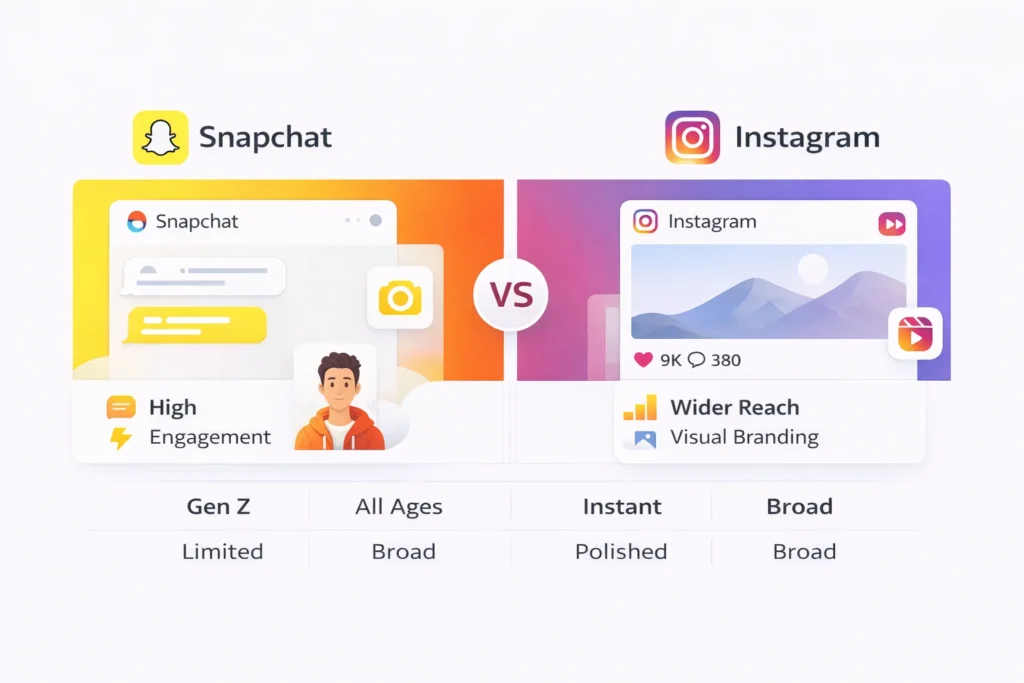
The table below maps every major platform feature in the Snapchat vs Instagram comparison so you can see at a glance which platform wins in each category:
| Feature | Snapchat | |
|---|---|---|
| Monthly Active Users | 3 billion | 943 million |
| Content Formats | Photos, Reels, Stories, Live, Shopping | Snaps, Stories, Spotlight, Live |
| Disappearing Content | Stories (24 hours, no screenshot alert) | Snaps and Stories (with screenshot alert) |
| Short-Form Video | Reels (up to 90 seconds) | Spotlight (competing format) |
| AR Filters | Available but limited variety | Industry leader in consumer AR |
| Shopping Features | Advanced (product tags, shop tab) | Limited (AR try-ons, some integrations) |
| Discoverability | High (public profiles, Explore, Reels) | Low (mostly private, friend-based) |
| Analytics | Free Insights for all accounts | Paid tools only for most accounts |
| AI Integration | Meta AI tools across Meta suite | My AI chatbot (150M+ users) |
| Messaging | DMs and Group chats | Core feature, with streaks and map |
| Ad Formats | Feed, Stories, Reels, Shopping ads | Snap Ads, Lenses, Filters, Spotlight |
| Minimum Ad Budget | $1 per day | $5 per day (effective $20 to $50) |
| Screenshot Notification | No | Yes |
| Location Features | Location tags and stickers | Snap Map (real-time location sharing) |
Snapchat vs Instagram: Users and Demographics
In the Snapchat vs Instagram user comparison, the scale difference is significant. Instagram has 3 billion monthly active users versus Snapchat’s 943 million. But raw numbers do not tell the full story. The demographic breakdown reveals why Snapchat punches above its weight for certain audiences.
1. Instagram Demographics
- 3 billion monthly active users worldwide, 500 million daily active users.
- Largest age group: 18 to 34 year olds, who represent the majority of the user base.
- Gender split: 50.6% male, 49.4% female globally, making it one of the most gender-balanced platforms.
- Over 75% of Instagram users are outside the United States, making it a truly global platform.
- India has the largest Instagram audience of any country with 481 million users, followed by the United States with 169.7 million.
- 29% of social media marketers plan to invest more in Instagram than any other platform in 2026.
2. Snapchat Demographics
- 943 million monthly active users globally, 477 million daily active users.
- The 18 to 24 age group is Snapchat’s largest demographic. 90% of 13 to 24 year olds use Snapchat in key markets, more than Facebook, Instagram, and Messenger combined in this age group.
- 82% of US teens use Snapchat monthly, and 36% say it is their favourite social platform.
- Gen Z accounts for 51.1% of Snapchat’s US monthly active users, the highest proportion of any social media platform in America.
- 48% of US Snapchat users are aged 15 to 25.
- Almost half of Snapchat’s users do not use Instagram, creating a unique audience that cannot be reached through Instagram alone.
3. Snapchat vs Instagram: Engagement and Time Spent
One of the most surprising findings in the Snapchat vs Instagram comparison is Snapchat’s engagement depth. Despite having far fewer users, Snapchat users open the app 30 to 40 times per day on average, far more than any other social platform. This hyper-frequent usage is driven by Snapchat’s core use case: direct, private messaging with close friends.
Instagram users spend an average of 30 to 35 minutes per day on the platform, which is comparable to Snapchat’s 30 to 32 minutes daily. However, the nature of that engagement is fundamentally different. Instagram users browse a public feed, watch Reels, explore shopping, and follow creators. Snapchat users send and receive direct messages, check streaks, and view friends’ stories. Instagram is more passive and discovery-oriented; Snapchat is more active and relationship-driven.
Snapchat Stories have a 65% completion rate, one of the highest of any short-form content format on any platform. Branded creator content on Snapchat gets 6.9 times more engagement than traditional ads. And Snapchat AR lenses deliver 2.5 times higher engagement than standard mobile ads. Instagram Stories achieve a 0.8% average click-through rate on ads, which outperforms feed ads on the platform.
| Simple Definition |
|---|
| Instagram wins on total reach and discoverability. Snapchat wins on frequency of engagement and depth of personal connection. If you want more people to see your brand, choose Instagram. If you want your existing audience to engage with you more intimately and more often, Snapchat deserves serious consideration. |
Snapchat vs Instagram: Advertising and Business Value
For businesses and marketers, the Snapchat vs Instagram advertising comparison is one of the most important dimensions of the debate. Both platforms offer robust ad managers, but they differ significantly in cost, targeting capabilities, formats, and the audiences they reach.
1. Instagram Advertising
Instagram advertising is powered by Meta’s Business Manager, widely considered the most sophisticated ad platform in social media. Instagram and Facebook together capture over 55% of global social media ad revenue in 2026. Advertisers report an average return of $5.20 for every $1 spent on social media advertising across Meta’s platforms. Instagram ad costs are: CPC of $0.70 to $1.50, CPM of $5 to $6. Instagram Story ads achieve a 0.8% average click-through rate, outperforming standard feed ads. The minimum daily budget is just $1, making it accessible to businesses of every size.
2. Snapchat Advertising
Snapchat offers unique ad formats that Instagram cannot replicate: Snap Ads (full-screen vertical video), Branded Lenses (custom AR filters), GeoFilters (location-based overlays), and Spotlight ads. Snapchat’s advertising reach expanded to 340 million users, a 10.6% year-on-year increase. Ad costs on Snapchat are: CPC of $0.30 to $1.00, CPM of $4 to $10. This lower CPC makes Snapchat attractive for early-stage campaigns and brand awareness testing. Snapchat AR try-on ads boost purchase intent by 25%, making them especially valuable for fashion, beauty, and consumer product brands targeting young audiences.
3. Which Platform Gives Better Advertising ROI?
For most businesses, Instagram delivers stronger ROI because of its larger audience, more advanced targeting, lower minimum budgets, and superior analytics. However, for brands specifically targeting 13 to 24 year olds, Snapchat’s lower CPC and uniquely engaged young audience can deliver more cost-effective results in that demographic. The best approach for many brands is to use Instagram as the primary platform and allocate a portion of the budget to Snapchat when targeting a younger audience.
Snapchat vs Instagram: Which Is Better for Your Goal?
The most useful way to answer the Snapchat vs Instagram question is to look at specific goals. Neither platform wins every category. Here is a goal-by-goal breakdown:
1. For Brand Awareness and Discovery
Instagram wins. With 3 billion monthly users, an Explore page, Reels distribution to non-followers, and public profiles that anyone can find, Instagram offers unmatched brand discoverability. A well-timed Reel or viral post on Instagram can reach millions of users who have never heard of your brand. Snapchat’s private, friend-based structure limits organic discovery significantly.
2. For E-Commerce and Product Sales
Instagram wins clearly. Instagram Shopping with product tags, shoppable posts, and the Shop tab creates a seamless path from discovery to purchase. 85% of Instagram users actively explore new products weekly. The platform’s integration with Meta’s ad targeting allows for highly specific retargeting campaigns. Snapchat has some AR try-on capabilities, but its commerce infrastructure is far less developed.
3.For Reaching Gen Z and Teenagers
Snapchat wins. 90% of 13 to 24 year olds in key markets use Snapchat, more than Facebook, Instagram, and Messenger combined in that age group. 82% of US teens use Snapchat monthly. If your product or service specifically targets teenagers and young adults aged 13 to 24, Snapchat gives you access to a uniquely engaged audience that you cannot reach as effectively anywhere else.
4. For Content Creators and Influencers
Instagram wins. Instagram’s public profiles, Reels, Stories, Insights analytics, Branded Content tools, and influencer collaboration features make it the most comprehensive platform for professional content creators. Snapchat’s Spotlight is growing, but its audience is more private and its tools for creators are still less sophisticated than Instagram’s.
5. For Businesses in India
For Indian businesses in the Snapchat vs Instagram debate, Instagram is the clear priority. India has 481 million Instagram users, the largest user base of any country globally. WhatsApp is India’s number one platform, but Instagram is the number one visual discovery and commerce platform for Indian consumers. Snapchat has a much smaller presence in India compared to markets like the United States, the Middle East, and Europe. For most Indian businesses, Instagram should be the primary social media investment.
Pros and Cons of Each Platform
1. Instagram: Pros
- Largest visual social network with 3 billion users and unmatched global reach.
- Best-in-class social commerce with shoppable posts, product tags, and an integrated shop tab.
- Free analytics for all Creator and Business accounts through Instagram Insights.
- Reels provide powerful organic reach to non-followers, ideal for brand discovery.
- Advanced advertising powered by Meta’s Business Manager with precise demographic targeting.
- Dominant platform in India with 481 million users.
2. Instagram: Cons
- Extremely competitive. Standing out organically requires consistent, high-quality content and a clear strategy.
- Algorithm changes can significantly affect organic reach without warning.
- Content on Instagram tends to be polished and curated, which can feel less personal and authentic.
- No screenshot notifications on Stories, which reduces the sense of privacy for some users.
3. Snapchat: Pros
- Unrivalled reach among 13 to 24 year olds. 90% of this age group uses Snapchat in key markets.
- Users open the app 30 to 40 times per day, the highest daily engagement frequency of any major social platform.
- Industry-leading AR technology with branded lenses delivering 2.5 times higher engagement than standard mobile ads.
- Screenshot notifications create a stronger sense of privacy and authenticity.
- My AI chatbot is one of the most widely adopted consumer AI tools, with 150 million users.
4. Snapchat: Cons
- Much smaller global user base (943 million vs 3 billion) limits potential reach for most businesses.
- Low discoverability. The platform is private and friend-based, making it hard to grow audiences organically.
- Analytics tools are limited and mostly paid, making performance measurement difficult.
- Minimal presence in India compared to Instagram, making it less relevant for Indian businesses.
- Less developed social commerce infrastructure compared to Instagram Shopping.
Should You Use Both Snapchat and Instagram?
For many businesses, the Snapchat vs Instagram question does not have to be either or Nearly half of Snapchat users do not use Instagram, which means running both platforms could give you access to an audience segment you would otherwise miss entirely.
The key principle is to treat the platforms differently rather than reposting the same content on both. Instagram content should be polished, discoverable, and commerce-oriented. Snapchat content should be raw, authentic, conversational, and friend-like. Audiences on both platforms will disengage if content feels out of place.
A practical combined strategy for businesses: use Instagram as your primary platform for organic growth, product promotion, influencer collaboration, and paid advertising. If your audience includes a significant segment of 13 to 24 year olds, add Snapchat for brand awareness campaigns using AR lenses and Snap Ads, where the lower CPC can make testing more affordable. Use Snapchat’s My AI integrations for interactive brand experiences that are not possible on Instagram.
Conclusion
The Snapchat vs Instagram debate does not have one universal winner. The right platform depends entirely on who you are trying to reach and what you are trying to achieve.
Instagram wins for total reach, brand discoverability, social commerce, influencer marketing, and business tools. With 3 billion users, free analytics, and the world’s most advanced social ad infrastructure behind it, Instagram is the default choice for most businesses and creators. It is especially dominant in India where 481 million users make it the most important visual platform in the market.
Snapchat wins for Gen Z targeting, personal intimacy, AR engagement, and hyper-frequent daily usage. If your audience skews young, if you want to reach the half of Snapchat’s user base that does not use Instagram, or if you want to explore innovative AR ad formats, Snapchat deserves a serious place in your strategy.
In the end, the Snapchat vs Instagram question is best answered not by choosing a winner, but by choosing the right platform for your audience, your content style, and your business goals. For most Indian businesses in 2026, that answer is Instagram. But for brands targeting young consumers globally, both platforms together offer more reach than either alone.
How Dizispark Can Help
Grow your business with proven social media strategies that put you in front of customers ready to engage and buy. Dizispark helps you build a powerful presence on Instagram and other platforms through expert content strategy, paid social advertising, community management, and performance tracking. We handle everything from account setup and content planning to paid campaigns and analytics, so you get more reach, more followers, and more leads from your social media investment.
Frequently Asked Questions
What is the main difference between Snapchat and Instagram?
In the Snapchat vs Instagram comparison, the core difference is purpose. Instagram is a public, discovery-oriented platform built for content creation, brand building, and commerce. Snapchat is a private, messaging-oriented platform built for real-time communication with close friends. Instagram helps you reach new audiences; Snapchat helps you communicate intimately with existing ones.
Which platform has more users: Snapchat or Instagram?
Instagram has significantly more users with 3 billion monthly active users compared to Snapchat’s 943 million. However, Snapchat’s 477 million daily active users and 30 to 40 daily app opens per user show that its smaller audience is extremely engaged. Instagram has more reach; Snapchat has more depth of engagement.
Is Snapchat or Instagram better for business?
For most businesses, Instagram is better. It has a larger audience, free analytics, advanced shopping features, better discoverability, and more sophisticated advertising tools. However, if your target audience is specifically 13 to 24 year olds, Snapchat’s unique engagement in that demographic makes it a valuable addition to your strategy.
Which is better for advertising: Snapchat or Instagram?
Instagram generally delivers better advertising ROI for most businesses, particularly for reach, conversions, and brand awareness across a broad age range. Snapchat’s lower CPC of $0.30 to $1.00 makes it more cost-effective for early-stage Gen Z targeting, and its AR ad formats deliver uniquely high engagement. Many brands use Instagram as the primary platform and Snapchat tactically for younger audience segments.
Is Snapchat better than Instagram for Gen Z?
Yes, in terms of Gen Z engagement, Snapchat leads. 90% of 13 to 24 year olds in key markets use Snapchat, exceeding Facebook, Instagram, and Messenger combined in that age group. 82% of US teens use Snapchat monthly and 36% say it is their favourite social platform. For brands trying to reach teenagers and young adults, Snapchat provides access to an audience that cannot be reached as effectively anywhere else.
Is Instagram or Snapchat better in India?
Instagram is significantly stronger in India. India is Instagram’s largest market globally with 481 million users. Snapchat has a much smaller presence in India compared to markets like the United States, Saudi Arabia, and Europe. For Indian businesses and creators, Instagram should be the primary social media platform. WhatsApp is the top platform overall in India, with Instagram as the leading visual and commerce platform.
Should I use both Snapchat and Instagram?
If your budget and team capacity allow it, using both platforms is worth considering. Nearly half of Snapchat’s user base does not use Instagram, which means running both gives you a larger potential audience. Treat the platforms differently: use Instagram for polished content, commerce, and broad reach, and use Snapchat for authentic, intimate content targeted at younger audiences. Create platform-native content rather than reposting the same material on both.