
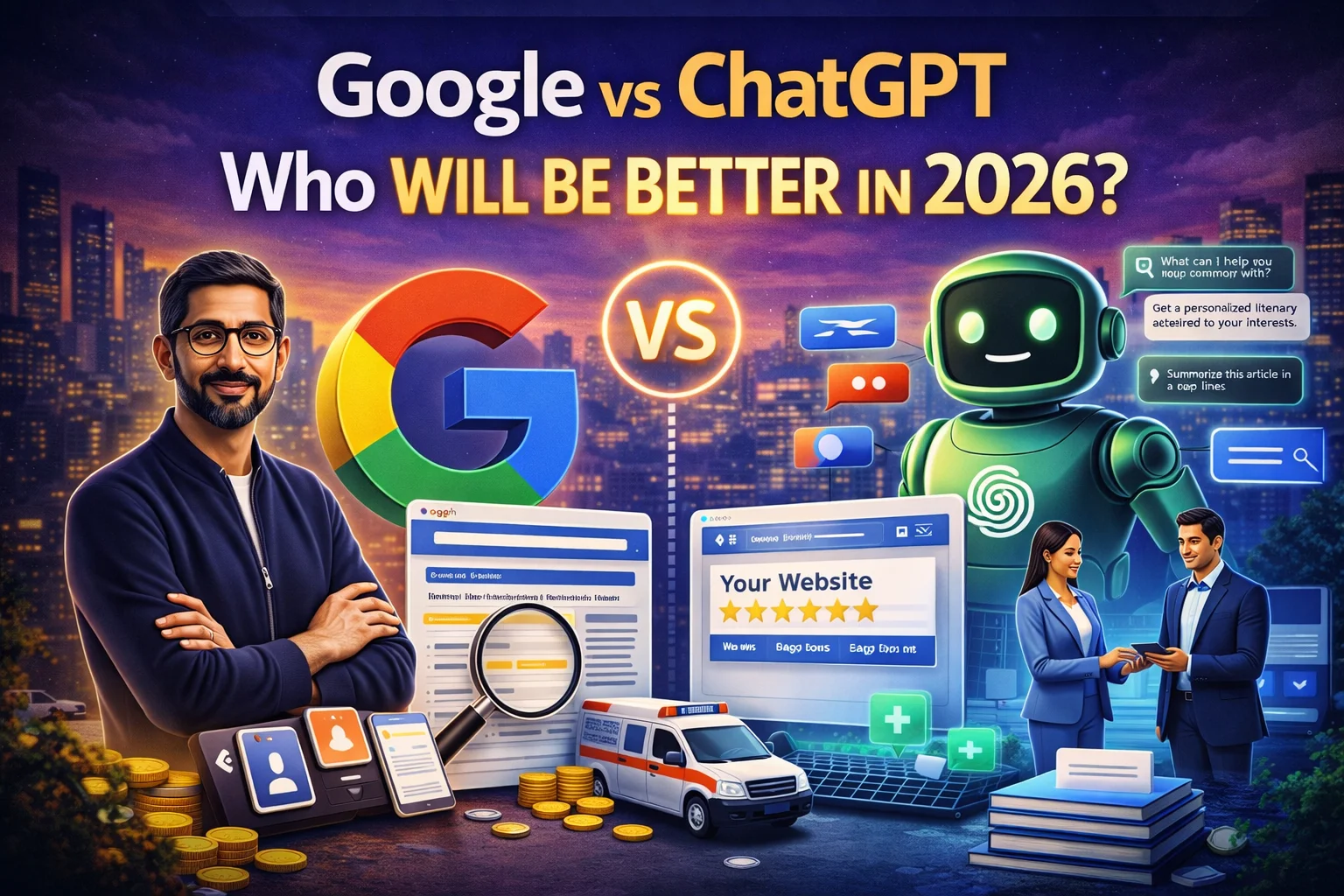
The debate around Google vs ChatGPT is one of the most talked-about topics in the technology world right now. For over two decades, Google has been the undisputed ruler of internet search. Then, in November 2022, OpenAI launched ChatGPT and changed the conversation entirely. For the first time in years, people are genuinely asking: is there a better alternative to Google? And more importantly, which one should you be using?
This complete guide covers everything you need to know about Google vs ChatGPT in 2026. Every fact and statistic in this article is backed by a verified source. The source links are listed at the end of each section so you can check them directly.
Why Google vs ChatGPT Is the Biggest Tech Debate of 2026
When ChatGPT launched in November 2022, it reached 100 million users in just 2 months, the fastest any consumer application had ever achieved that milestone. That speed of adoption immediately raised a question that no one had seriously asked in 20 years: could something actually replace Google Search?
The answer in 2026 is nuanced. Google vs ChatGPT is not a fight with one clear winner. Both tools are powerful, both are growing fast, and both serve different needs. Here are the headline numbers:
- Google processes 13.7 billion searches daily, while ChatGPT handles approximately 2.5 billion daily prompts.
- ChatGPT holds 60.5% of the AI search market share, while Google’s Gemini comes third with just 13.5%.
- Google still drives 190 times more website traffic than ChatGPT, despite ChatGPT handling 12% of Google’s total search volume.
- ChatGPT’s average session duration is 13 minutes 9 seconds, more than double Google’s 6 minutes 12 seconds.
- 72% of ChatGPT subscribers now use it as their primary browser homepage.
| Key Takeaway |
|---|
| Google still dominates with nearly 80% of all digital queries globally. But ChatGPT is growing at a pace the search industry has not seen in over 20 years. Understanding both tools is no longer optional for any business or professional. |
What Is Google Search? How It Works
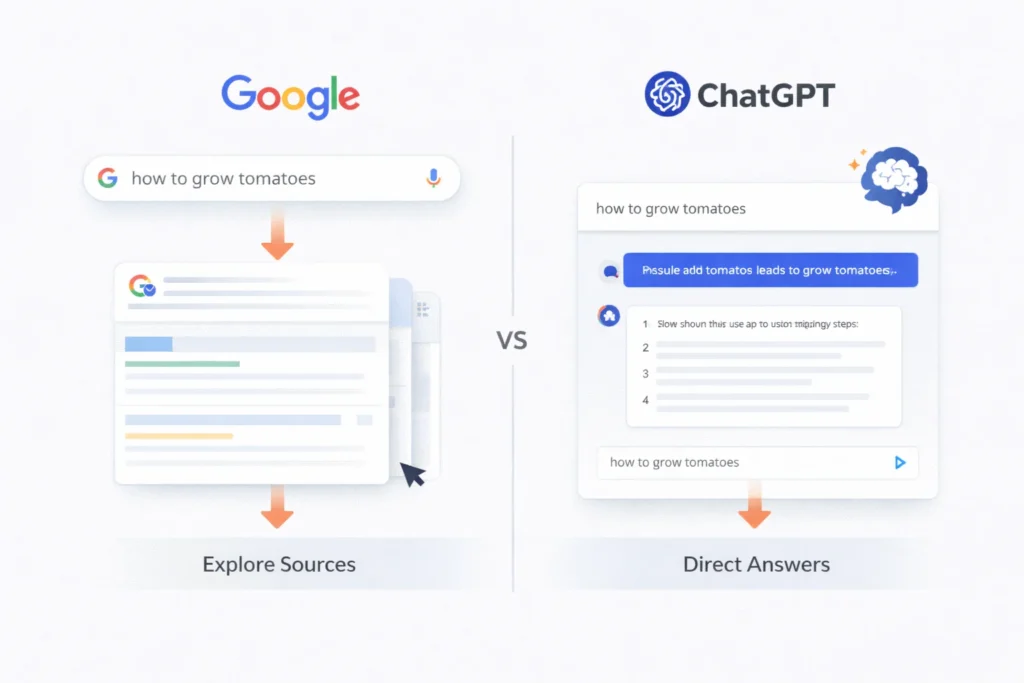
Google Search is the world’s primary tool for finding information online since 1998. When you type a query, Google does not generate an answer. It crawls billions of web pages, indexes their content, and ranks the most relevant pages for you. The results are a list of links to external websites that Google believes best match your query.
In the Google vs ChatGPT comparison, Google’s core strength is the sheer breadth and real-time recency of its index. It searches the entire live internet and provides visual results including text, images, videos, maps, and shopping listings simultaneously.
1. How Google’s Algorithm Finds and Ranks Information
Google uses a machine learning-based algorithm called RankBrain to evaluate the relationship between a user’s query and billions of web pages. It processes queries through crawling (discovering pages), indexing (cataloguing content), and ranking (ordering by relevance). Google ranks websites based on hundreds of signals including content quality, backlinks, page speed, and user behaviour.
2. What Is Google AI Overviews?
Google has responded to ChatGPT by integrating generative AI into search results through Google AI Overviews. This feature generates a written summary at the top of search results for many queries. Google has also launched Google AI Mode, a fully conversational search experience that directly competes with ChatGPT’s interface. Google is no longer just a search engine. It is evolving into an AI platform.
What Is ChatGPT? How It Works
ChatGPT is an AI-powered chatbot developed by OpenAI and trained on large language models starting from GPT-3.5, then GPT-4, GPT-4o, and now GPT-5. GPT stands for Generative Pre-trained Transformer. It uses deep Natural Language Processing (NLP) and machine learning to generate human-like, conversational responses to any text prompt.
In the Google vs ChatGPT debate, what makes ChatGPT fundamentally different is that it does not return a list of links. It generates a direct answer in natural language. You can follow up with more questions and it remembers the context of your entire conversation.
1. How ChatGPT Generates Answers
ChatGPT analyses the intent and context of your prompt using its language model, then generates a clear, structured response directly in the chat. Unlike Google, it does not send you to another website. You can ask follow-up questions, refine your request, or ask for a different explanation, all in one continuous conversation.
2. What Is ChatGPT Search (SearchGPT)?
In October 2024, OpenAI launched ChatGPT Search, also known as SearchGPT. This feature allows ChatGPT to search the live web in real time using third-party providers including Microsoft Bing, plus content from media partners like Reuters, The Associated Press, and the Financial Times. This removed ChatGPT’s previous limitation of being restricted to its training data cutoff.
OpenAI continued building on this with two products in late 2025. ChatGPT Atlas is a macOS browser with AI-powered conversational search built in. ChatGPT Pulse delivers daily, personalised research snapshots tailored to individual users. Together, they signal a shift from passive query answering to active, memory-driven search.
Key Differences between of Google vs ChatGPT
The table below breaks down the core differences in the Google vs ChatGPT comparison so you can see at a glance which tool suits your situation better:
| Factor | Google Search | ChatGPT |
|---|---|---|
| Interface | Search bar, list of links | Conversational chat interface |
| Response Format | Links to external websites | Direct answers and summaries |
| Real-Time Info | Yes, full live web index | Yes, via ChatGPT Search |
| Accuracy | High, real-time verified results | High, but occasional errors possible |
| Personalisation | Based on search history and location | Based on conversation context |
| Ads | Yes, first results often ads | No ads at all |
| Session Duration | 6 minutes 12 seconds average | 13 minutes 9 seconds average |
| Creative Tasks | Returns links to existing content | Generates original content directly |
| Cost | Free | Free (Plus plan at $20 per month) |
| Best For | Shopping, maps, news, quick lookups | Research, writing, coding, learning |
Google vs ChatGPT Market Share in 2026
One of the most important data points in the Google vs ChatGPT debate is market share. Here is the latest data from Q4 2025, published by First Page Sage based on client analytics, third-party usage datasets, and anonymised user behaviour logs:
| Platform | Monthly Active Users | Share of Total Queries | Avg. Session |
|---|---|---|---|
| Google Search | 5 billion | 77.9% | 6m 12s |
| ChatGPT | 858 million | 17.1% | 13m 09s |
| Other (Bing etc.) | 580 million | 5.8% | 4m 33s |
| Key Insight |
|---|
| Google still dominates with nearly 80% of all digital queries globally. But ChatGPT’s session duration of 13 minutes 9 seconds is more than double Google’s 6 minutes 12 seconds, indicating significantly deeper user engagement. |
Google vs ChatGPT: Which Is Better for Each Use Case?
The best way to understand the Google vs ChatGPT difference is to look at real tasks. Each tool is built for different situations.
1. For Quick Facts and Breaking News
Google wins here. Google’s real-time index scans the entire live web instantly. For breaking news, sports scores, stock prices, or weather, Google delivers current, verified results in under a second. ChatGPT Search can also access real-time data, but Google’s established news ecosystem and integration with Google News makes it faster and more comprehensive for time-sensitive queries.
2. For Research and Learning
ChatGPT wins here. When testing 500 search queries, users preferred ChatGPT on 42% of queries versus 40% for Google. ChatGPT was rated more often as “Amazing” for research tasks because it synthesises information from multiple sources into a single, structured response. You do not need to click through five different websites to get your answer.
3. For Shopping and Local Search
Google wins clearly. Google Shopping allows users to compare prices, see product images, read reviews, and make purchases directly from search. For local search, Google Maps is unmatched for finding restaurants, clinics, and services nearby with live opening hours. ChatGPT can recommend products but cannot show live prices or availability.
4. For Writing, Coding, and Creative Tasks
ChatGPT wins decisively. This is where its large language model truly shines. It can write blog posts, debug code, generate marketing copy, translate languages, summaries long documents, and create poetry or screenplays. When tested on coding queries specifically, users strongly preferred ChatGPT. Google can only point you to external resources for these tasks.
5. For Businesses and Digital Marketers
For businesses, the Google vs ChatGPT choice depends on your goal. Google remains essential for driving website traffic and lead generation. Google still drives 190 times more website traffic than ChatGPT, making it critical for any business relying on inbound visitors. ChatGPT excels for content creation, market research, customer support automation, and generating first drafts of marketing materials.
Pros and Cons of Google vs ChatGPT
1. Google: Strengths
- Massive real-time index of the entire web, updated constantly
- Unmatched for local search, maps, shopping, and visual results
- Drives 190 times more website traffic than ChatGPT for businesses
- Free to use with no subscription required
- Trusted ranking system with established source credibility signals
2. Google: Limitations
- First results are often paid ads, not organic content
- Requires clicking through multiple websites to get a complete answer
- No conversational follow-up or context-aware dialogue capability
- Cannot generate original content or complete creative tasks
3.ChatGPT: Strengths
- Conversational interface that feels like talking to a knowledgeable expert
- Synthesises multiple sources into one clear, structured answer
- Excellent for writing, coding, research, summarisation, and creative work
- Zero ads, completely distraction-free experience
- Average session duration of 13 minutes 9 seconds reflects deep engagement
ChatGPT: Limitations
- Can occasionally generate inaccurate or outdated information
- Drives far less website referral traffic than Google for businesses
- No visual search, Google Maps integration, or native shopping
- A single ChatGPT query uses nearly 10 times the electricity of a Google search, raising sustainability concerns
Will ChatGPT Replace Google?
This is the central question in the Google vs ChatGPT debate. The short answer in 2026 is: not yet, and possibly not entirely. Here is why.
Google retains 77.9% of all digital queries globally and still drives the vast majority of web traffic. For transactional searches, where users are looking to buy something or find a local business, Google leads significantly because of its rich e-commerce integration, Google Maps, and established trust in purchase scenarios.
But ChatGPT is gaining ground rapidly, especially among younger, tech savvy users. In the AI search market specifically, ChatGPT already owns 60.5% of market share. Google has responded with AI Overviews, AI Mode, and Google Gemini. The most likely outcome is not a replacement but a bifurcation: Google for transactional and local intent, ChatGPT for conversational and creative intent.
| Simple Definition |
|---|
| ChatGPT is not a Google killer. It is a Google complement. Smart users in 2026 are already using both tools for what each does best: Google for traffic, maps, and shopping; ChatGPT for research, writing, and deep learning. |
Conclusion
The Google vs ChatGPT question does not have a single winner. It has two different tools built for two different purposes. Need to buy something, find a local business, or get breaking news? Use Google. Need to research a complex topic, write content, debug code, or get a detailed explanation? Use ChatGPT. Need the best results overall? Use both strategically. What is certain is that the Google vs ChatGPT landscape is changing fast. For businesses, this means one thing: your digital marketing strategy must now account for both platforms. SEO alone is no longer enough. Visibility on AI-powered search is the next frontier.
How Dizispark Can Help
If you’re still trying to understand how to win in the evolving Google vs ChatGPT landscape, the right strategy can make all the difference. At Dizispark, we help businesses stay visible across both traditional search engines like Google and AI-driven platforms like ChatGPT. From SEO and Google Ads to content strategy and AI visibility (GEO), we build data-driven marketing systems tailored to your goals, audience, and industry. Whether you want to increase website traffic, generate more leads, or appear in AI-powered answers, our team ensures your brand stays ahead in this new search era. Book your free strategy consultation today and start growing smarter in the Google vs ChatGPT world.
Frequently Asked Questions
What is the main difference between Google vs ChatGPT?
In the Google vs ChatGPT comparison, Google is a search engine that returns a ranked list of links to external websites. ChatGPT is a conversational AI that generates a direct, written answer to your question. Google is better for finding websites, shopping, and local information. ChatGPT is better for research, writing, coding, and in-depth explanations.
Is ChatGPT better than Google?
Neither is universally better. ChatGPT wins for research, writing, and creative tasks. Google wins for shopping, local search, and driving website traffic. In a 500-query test, users preferred ChatGPT on 42% of searches and Google on 40%, showing they are best suited to different task types.
What is the market share in the Google vs ChatGPT race in 2026?
According to Q4 2025 data from First Page Sage, Google holds 77.9% of total digital query market share with 5 billion monthly active users. ChatGPT holds 17.1% with 858 million monthly active users. ChatGPT’s session duration of 13 minutes 9 seconds is more than double Google’s 6 minutes 12 seconds.
Will ChatGPT replace Google Search?
Not entirely, and not in the near future. Google retains dominant market share and is especially strong for transactional, local, and visual searches. ChatGPT leads in the AI search market with 60.5% share. The most likely outcome is both tools coexisting, each dominating different search intent categories.
Does ChatGPT have real-time information?
Yes. Since October 2024, ChatGPT Search accesses live web data in real time using Microsoft Bing and media partners like Reuters and the Financial Times. This removed ChatGPT’s previous limitation of being restricted to its training data cutoff.
How does Google vs ChatGPT affect my business SEO strategy?
The Google vs ChatGPT shift means businesses must now optimise for both. Google continues to drive the majority of website traffic. But businesses should also ensure their content is cited by AI tools like ChatGPT. This emerging practice is called Generative Engine Optimisation (GEO), and it is becoming an essential addition to traditional SEO.
Is ChatGPT Search free?
ChatGPT Search is available to both free and paid users. ChatGPT Plus subscribers pay $20 per month for priority access, faster response times, GPT-5, and enhanced web search. Google Search remains completely free with no subscription required.