
If you have ever searched for how to grow your business online, you have come across the term SEO. But SEO is not one single thing. It is made up of two powerful pillars: On Page and Off Page SEO. Understanding both is the foundation of any digital marketing strategy that actually works. Google processes over 8.5 billion searches every single day, and the businesses that rank at the top are not there by accident. They have mastered On Page and Off Page SEO together.
This complete guide explains exactly what On Page and Off Page SEO mean, how they differ, why you need both, and how to use them to rank higher on Google in 2026. Every fact in this article is backed by a verified industry source so you can trust what you read and apply it with confidence.
Why SEO Still Matters in 2026
Before diving into On Page and Off Page SEO individually, it helps to understand the scale of the opportunity.
Here are four facts that show why SEO is non negotiable for any business today:
- 68% of all online experiences begin with a search engine.
- The number one result on Google earns an average click-through rate of 39.8%, while position two earns just 18.7%.
- Google’s organic results received 4.6 billion clicks in a single day compared to just 16.4 million clicks on paid ads.
- The global SEO services market is expected to grow at 20% CAGR and reach $103.24 billion
These numbers make one thing clear: SEO is not optional. And at the heart of every successful SEO strategy is a strong understanding of both On Page and Off Page SEO.
What Is on Page SEO?
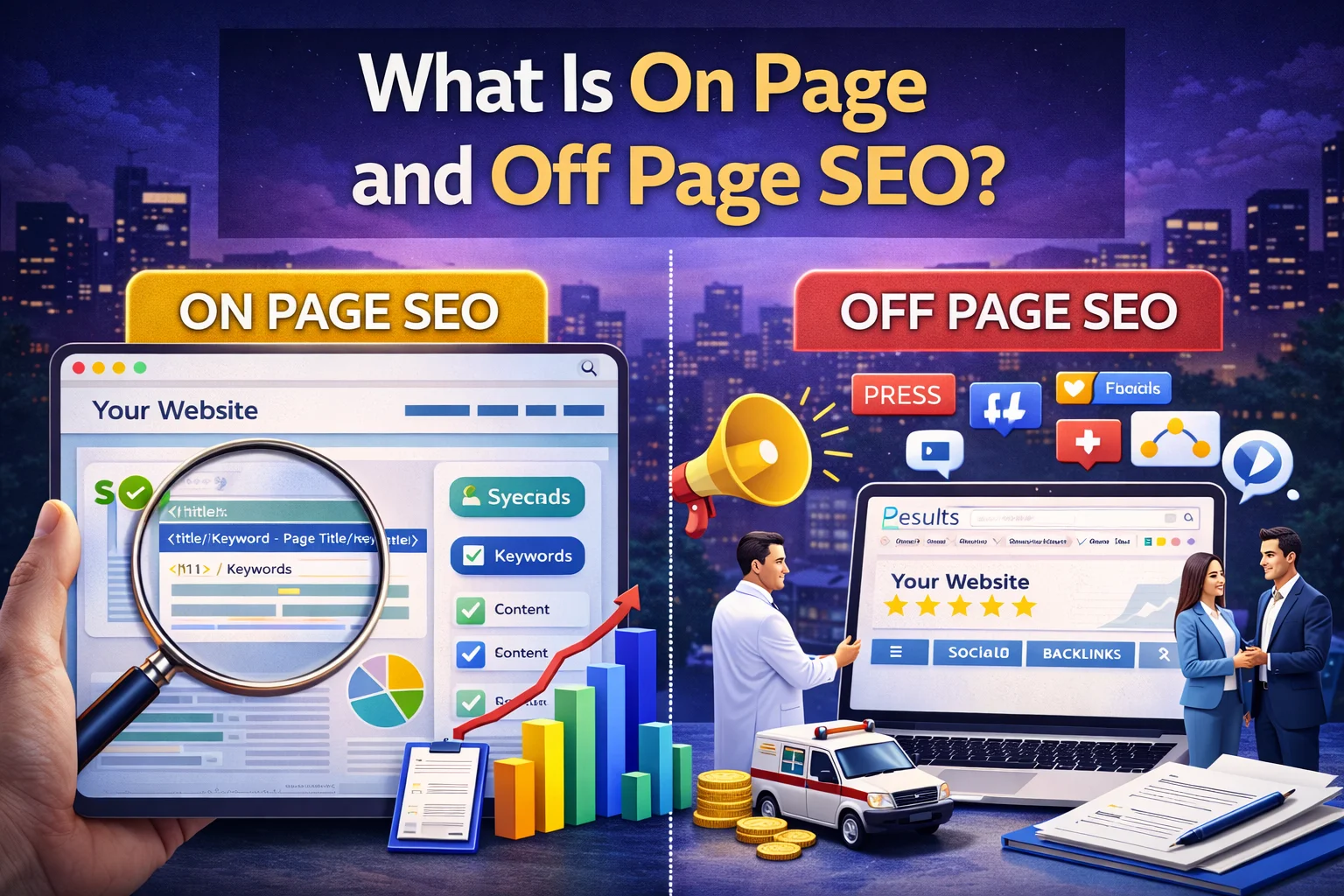
on Page SEO refers to all the optimisation actions you take directly on your own website to help it rank higher in search results. Think of it as the foundation of your digital presence. Every element you control on your pages, from the words you write to the speed at which they load, is part of on Page SEO.
What is on Page SEO in practical terms? It is the process of making each page on your website as useful, readable, and relevant as possible, both for the people visiting it and for Google’s crawlers. According to a 2026 industry report, 53% of SEO experts believe that creating high-quality content is the single most effective way to improve search rankings
| Simple Definition |
|---|
| on Page SEO is every action you take on your own website to help it rank higher: writing great content, using the right keywords, fixing your page titles and meta descriptions, speeding up load times, and building a clear site structure. If you can edit it on your website, it is on Page SEO. |
Key on Page SEO Elements You Must Optimise
Here are the core on Page SEO techniques that every website needs to have in place:
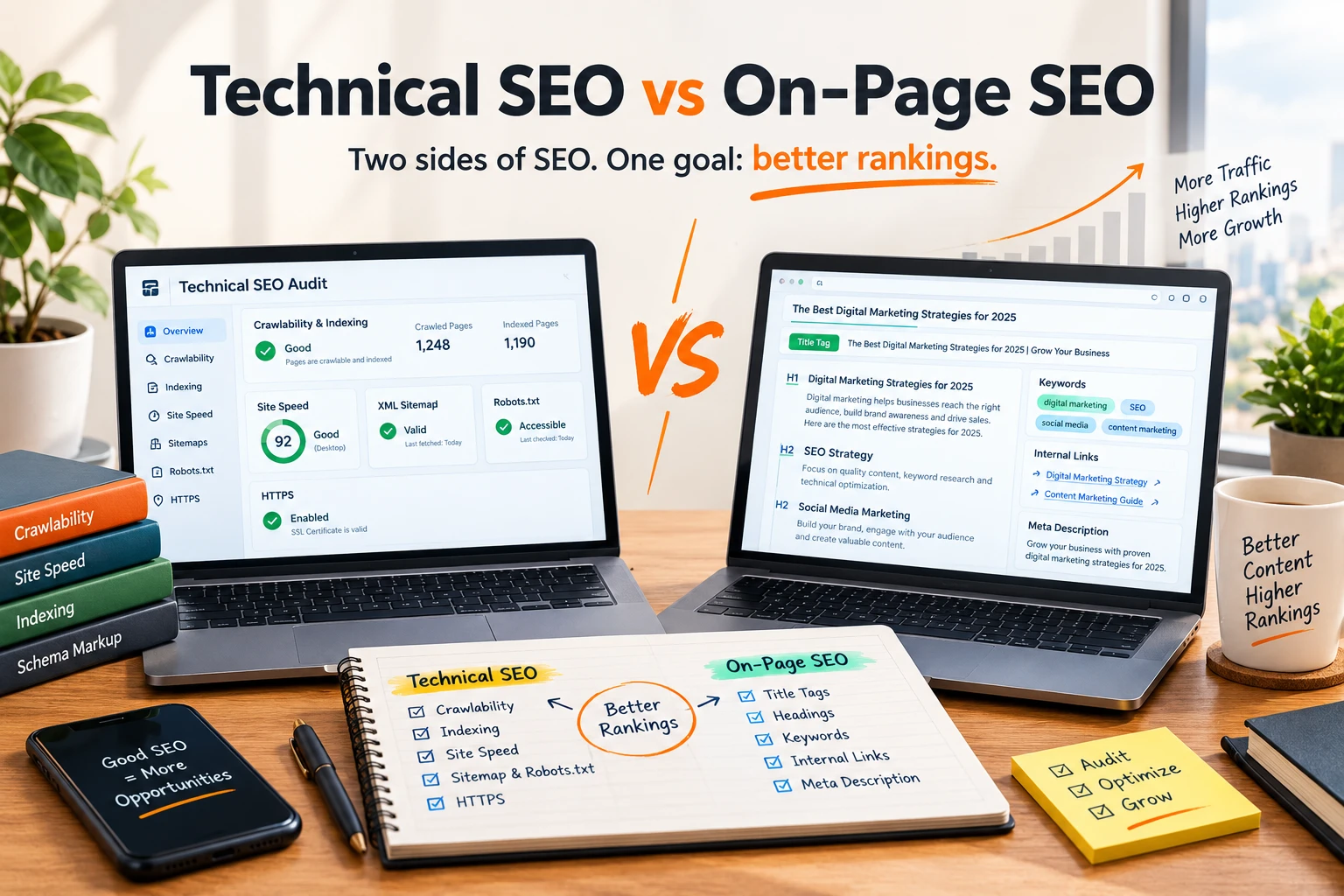
- Title Tags: Each page should have a unique title tag under 60 characters that includes your target keyword. Title tags with 40 to 60 characters have the highest click-through rates.
- Meta Descriptions: A clear, compelling summary of your page under 160 characters. It does not directly affect rankings but strongly influences whether users click your result.
- Headings (H1, H2, H3): Properly structured headings help Google understand your content. Articles using a mix of H2s, H3s, and H4s consistently show the best SEO performance.
- Keyword Optimisation: Your focus keyword should appear naturally in the title, first paragraph, headings, and throughout the body. Never stuff keywords. Write for people first.
- Internal Linking: Links between your own pages help Google crawl your site and distribute authority. Every page should link to at least one other relevant page on your site.
- Image Alt Text: Alt text is missing on 55.5% of home pages. Adding descriptive alt text to every image improves both accessibility and image search rankings.
- URL Structure: Keep URLs short, descriptive, and keyword-friendly. For example, /what-is-on Page -seo is far better than /page?id=4621.
- Content Quality: Relevant, original, engaging content that genuinely answers the user’s question. Long-form content attracts 77.2% more backlinks than shorter pieces.
What Is Technical SEO and How Does It Fit In?
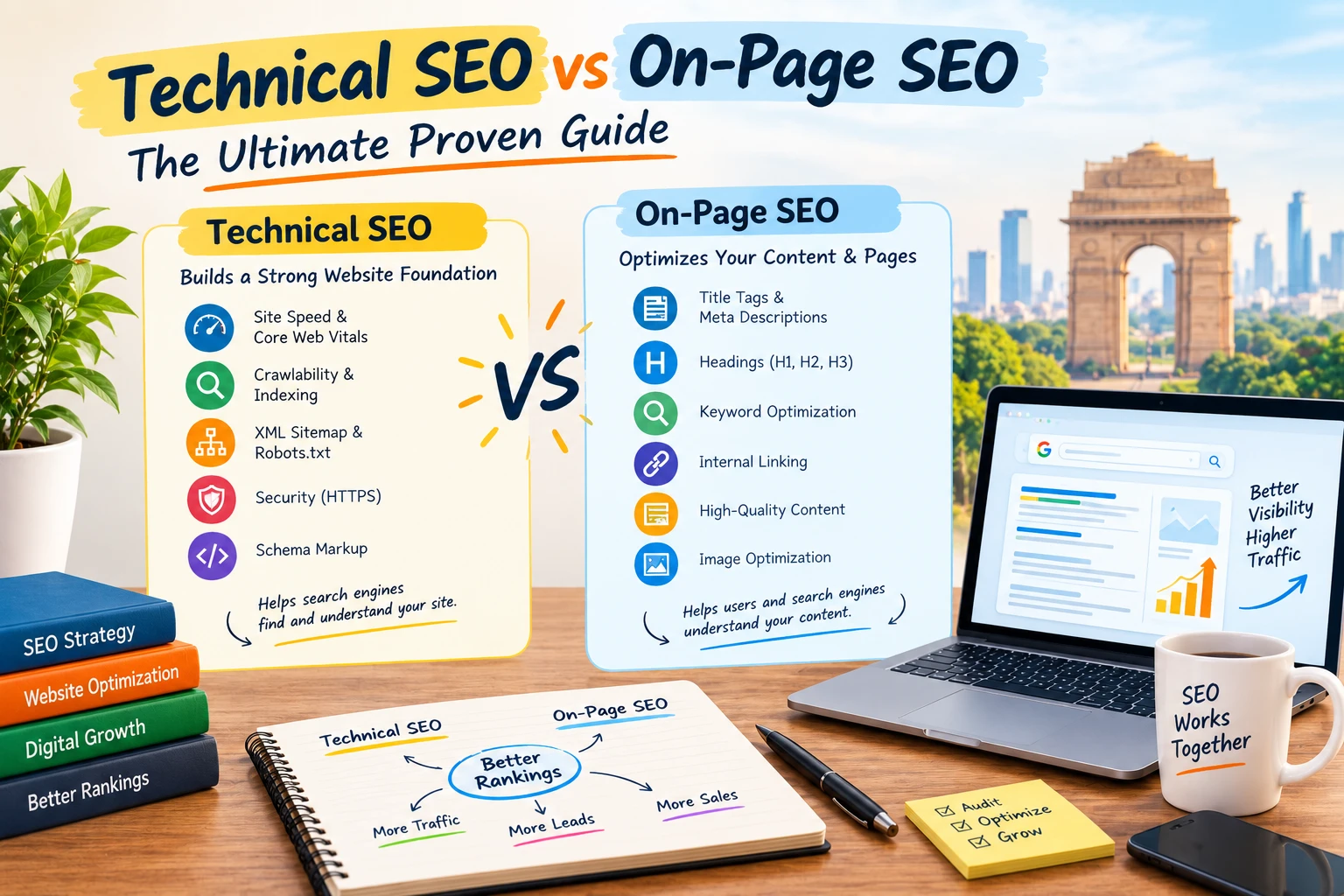
Technical SEO is a subset of on Page SEO. It focuses on the behind-the-scenes structure of your website rather than the visible content. Even if your content is outstanding, technical issues can prevent Google from finding and ranking your pages.
- Page Speed: 47% of users expect a website to load in under two seconds, and 40% will leave if it takes longer than three seconds.
- Mobile-Friendliness: Over 62.73% of global web traffic now comes from smartphones. Google uses mobile-first indexing, meaning it ranks your mobile version first.
- Core Web Vitals: Google’s Core Web Vitals measure loading performance, interactivity, and visual stability. Pages in position one are 10% more likely to pass Core Web Vitals than those in position nine.
- HTTPS and SSL Certificate: Securing your site with SSL is a confirmed Google ranking signal. Every website should use HTTPS.
- XML Sitemap and Robots.txt: A sitemap helps Google find all your pages. The robots.txt file tells it which pages to crawl.
Mastering the on Page side of On Page and Off Page SEO is your first priority. Without a solid on Page foundation, no amount of Off Page work will produce lasting results.
What Is Off Page SEO?
What is off page SEO? Off Page SEO covers everything you do outside your own website to improve your site’s authority, trustworthiness, and relevance in Google’s eyes. While on Page SEO is fully within your control, Off Page SEO depends largely on how other websites and people on the internet engage with your content.
The core principle of Off Page SEO is simple: Google treats external links and mentions as votes of confidence. When authoritative websites link to yours, Google interprets that as a signal that your content is valuable and trustworthy. Backlinks are among Google’s top three ranking factors. Pages ranking at number one have an average of 3.8 times more backlinks than those ranking in positions two through ten.
| Simple Definition |
|---|
| Off Page SEO is everything that happens outside your website that influences your Google rankings: backlinks from other websites, your Google Business Profile, online reviews, brand mentions, and your overall reputation on the internet. If you cannot edit it directly on your website, it is Off Page SEO.. |
Key Off Page SEO Techniques That Actually Work
Here are the most effective Off Page SEO techniques, backed by real data:
- Link Building: Earning backlinks from authoritative, relevant websites is the backbone of Off Page SEO. 92.3% of top-ranking domains have at least one backlink. Quality beats quantity: one link from a high-authority site is worth more than 100 links from low-quality sources.
- Guest Blogging: Writing articles for reputable websites in your industry earns you backlinks and exposes your brand to a new audience. Always write for sites relevant to your niche.
- Google Business Profile: Setting up and optimising your Google Business Profile is one of the most impactful Off Page actions for local businesses. Only 2% of people do not search for local businesses online.
- Online Reviews and Reputation Management: Positive reviews on Google and other platforms build trust with both users and search engines. Respond professionally to all reviews, positive and negative.
- Social Media Signals: While social shares are not a direct ranking factor, they increase content visibility, which leads to more organic backlinks over time.
- Brand Mentions: Even unlinked mentions of your brand across the internet contribute to your online authority and reputation in Google’s knowledge graph.
What Is E-E-A-T and Why Does Google Care?
E-E-A-T stands for Experience, Expertise, Authoritativeness, and Trustworthiness. Google added the extra E for Experience in late 2022. E-E-A-T is the framework Google uses to evaluate whether a website deserves to rank for important queries.
- Experience: Content written from real personal experience is valued more highly by Google.
- Expertise: Depth of knowledge in your subject area, shown through accurate, detailed, and well-researched content.
- Authoritativeness: Your reputation within your industry, built through quality backlinks, mentions, and consistent publishing.
- Trustworthiness: The accuracy, security, and transparency of your website, including HTTPS, clear authorship, and cited sources.
E-E-A-T is built through both sides of On Page and Off Page SEO. Your on Page content demonstrates expertise, while your Off Page backlinks and brand mentions build authority and trust.
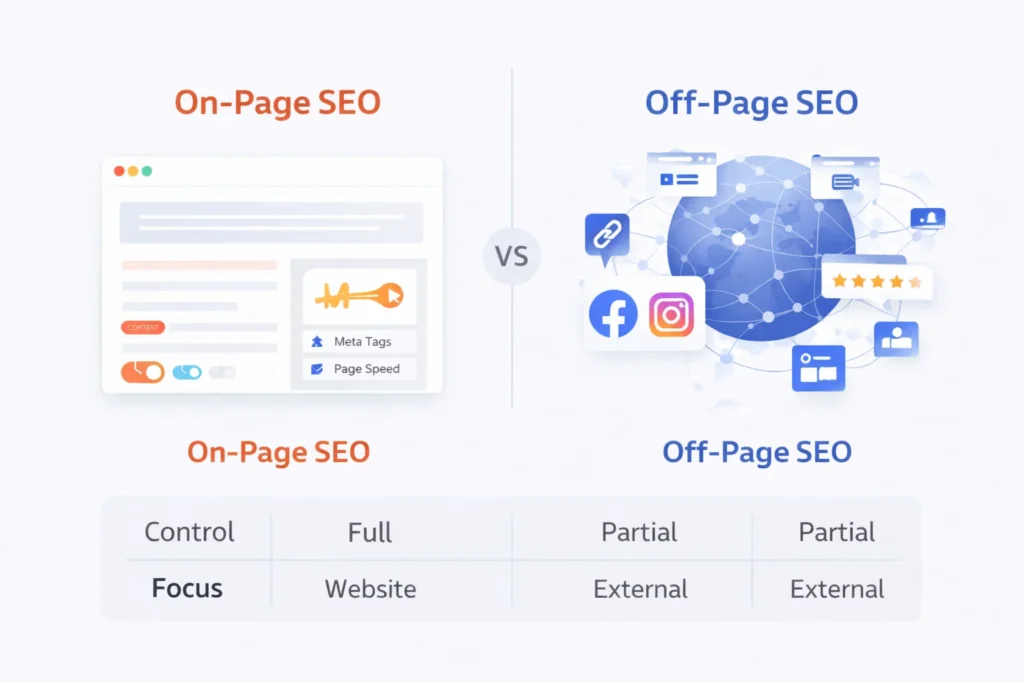
Key Differences Between On Page and Off Page SEO
The table below summarises the core differences between On Page and Off Page SEO so you can see clearly how they complement each other:
| Factor | on Page SEO | Off Page SEO |
|---|---|---|
| Definition | Optimising elements on your website | Actions taken outside your website |
| Control Level | Fully within your control | Partially depends on others |
| Key Focus | Content, keywords, speed, structure | Backlinks, brand mentions, reviews |
| Main Goal | Relevance and user experience | Authority and trustworthiness |
| Time to Impact | Visible in weeks with consistent effort | Takes 3 or more months to show strong results |
| Primary Tools | Google Search Console, Screaming Frog | Ahrefs, Moz, SEMrush |
| Examples | Title tags, meta descriptions, internal links | Guest posts, backlinks, Google Business Profile |
| E-E-A-T Role | Expertise and content quality | Authority and trustworthiness |
Why You Need Both On Page and Off Page SEO Together
One of the most common mistakes businesses make is treating On Page and Off Page SEO as separate choices. They are not. They are two halves of the same strategy. Focusing on only one side is like building a shop with no sign outside, or putting up a sign with no shop behind it.
Here is what happens when you use both together:
- Higher Rankings: on Page SEO signals to Google that your content is relevant. Off Page SEO signals that other authoritative sources agree. Together, they push you up the rankings faster than either alone.
- More Traffic: Keyword optimisation on Page targets specific search terms. Guest blogging and social sharing Off Page funnels additional traffic from external platforms.
- Better User Experience: on Page work ensures your website is fast, clear, and useful. Off Page work ensures users can find you through multiple channels.
- Stronger Brand Authority: Publishing quality content on Page and earning quality backlinks Off Page builds your reputation as a trusted source in your industry.
- Improved Ad Efficiency: If you also run Google Ads, a well-optimised on Page experience improves your Quality Score, which lowers your cost per click.
| Key Takeaway |
|---|
| Research confirms that On Page and Off Page SEO signals from both inside and outside your website are equally important in determining a page’s quality and relevance to a user’s search (Source: 9). The businesses rising to the top of Google in India and globally are those paying close attention to both. |
On Page and Off Page SEO for Local Businesses in India
For small and medium businesses across India, On Page and Off Page SEO work differently depending on whether you are targeting a local or national audience. Here is how to apply both correctly:
1. on Page SEO for Local Businesses
- Include city-specific keywords in your page titles, meta descriptions, and content. A salon in Mumbai should target ‘best hair salon in Delhi’ rather than just ‘best hair salon’.
- Add your full address and phone number in the footer of every page using consistent Name, Address, Phone (NAP) formatting.
- Use LocalBusiness schema markup to help Google understand your business type, location, and hours.
- Create dedicated Contact and About pages with location details to reinforce local relevance.
2. Off Page SEO for Local Businesses
- Google Business Profile: Claim, verify, and fully optimise your listing. Add photos, respond to reviews, and keep your hours updated. This is the single most impactful free step for local Off Page SEO.
- Local Citations: List your business consistently across JustDial, IndiaMART, Sulekha, and other Indian directories. NAP consistency across all platforms is critical.
- Local Backlinks: Earn links from local newspapers, city-specific blogs, and chambers of commerce.
- Customer Reviews: Actively encourage satisfied customers to leave Google reviews. Businesses with more positive reviews rank higher in local search results and on Google Maps.
Applying both sides of On Page and Off Page SEO to your local strategy is the fastest route to appearing in Google’s local pack, the top three map results that appear for searches like ‘restaurant near me’ or ‘CA in Pune’.
Common Mistakes Businesses Make with On Page and Off Page SEO
Knowing what not to do is just as important as knowing what to do. Here are the six most damaging mistakes:
1. Treating On Page and Off Page SEO as Separate Activities
Many businesses focus only on content or only on link building. Both On Page and Off Page SEO must work in parallel. A website with brilliant content but no backlinks will struggle to rank. A website with hundreds of backlinks but thin, poorly structured content will also underperform.
2. Keyword Stuffing
Repeating your target keyword unnaturally throughout your content is a practice Google has penalised for years. Use your focus keyword at a natural density of 1% to 2% of total words, placed in strategic positions: the H1, the first paragraph, at least two H2 headings, and naturally in the body text.
3. Ignoring Mobile Optimisation
Over 62.73% of all global web traffic comes from smartphones. A website that is not mobile-friendly will be penalised in Google rankings because Google uses mobile-first indexing. Test your site on multiple devices before publishing any page.
4. Buying Low-Quality Backlinks
Purchasing backlinks from link farms or unrelated websites is against Google’s guidelines and can result in a manual penalty. 52.3% of digital marketers say link building is the most challenging part of SEO. The correct approach is to earn links through quality content and genuine outreach, not shortcuts.
5. Neglecting Page Speed
Google’s Core Web Vitals are a direct ranking factor. A one-second delay in page load time can increase bounce rates significantly. Use Google PageSpeed Insights to check and fix issues before they cost you rankings.
6. No Tracking or Measurement
You cannot improve what you do not measure. Set up Google Analytics 4 and Google Search Console on every website. Track organic traffic, keyword rankings, backlinks earned, and conversion rate. 87% of marketers admit that data is their most underused asset.
Conclusion
Understanding On Page and Off Page SEO is not optional in 2026. It is the difference between a website that sits unseen on page five and one that attracts real customers every day from page one of Google.
on Page SEO builds your foundation: quality content, fast loading pages, well-structured headings, and optimised metadata. Off Page SEO builds your authority: quality backlinks, a strong Google Business Profile, consistent citations, and a growing online reputation. Together, On Page and Off Page SEO create a signal of relevance, authority, and trust that Google rewards with higher rankings.
The good news for small businesses is that you do not need a massive budget to start. Fixing your on Page basics costs nothing except time. Setting up your Google Business Profile is free. Publishing two to four helpful blog posts per month is achievable for any business. Start with the fundamentals, stay consistent, and the results will follow.
How Dizispark Can Help
Most businesses in India are losing leads every day because their On Page and Off Page SEO is either incomplete or handled incorrectly. At DiziSpark, we specialise in building complete SEO strategies that are tailored to your business, your city, and your budget. We do not sell templates. We build real strategies that bring real results.
Our clients regularly see their organic traffic grow and their ranking positions improve after we complete their SEO audit and implement both on Page and Off Page strategies. If your website is not ranking where it should, let us take a look.
Frequently Asked Questions
What is the difference between On Page and Off Page SEO?
on Page SEO involves optimising your website content and structure, including title tags, headings, content quality, page speed, and internal links. Off Page SEO involves actions taken outside your website to build its authority, primarily through earning backlinks, managing your Google Business Profile, and building your brand’s online reputation. Together, On Page and Off Page SEO create the complete picture Google uses to evaluate your site’s ranking worthiness.
What is on Page SEO and which elements matter most?
on Page SEO is the process of optimising individual pages on your website for both users and search engines. The most impactful elements are: a keyword-optimised title tag under 60 characters, a compelling meta description under 160 characters, an H1 heading containing your focus keyword, high-quality body content, fast page load speed, mobile-friendly design, and descriptive image alt text. Get these right first before investing heavily in Off Page strategies.
What is Off Page SEO and how do I start?
Off Page SEO is every action you take outside your website to improve how Google perceives your site’s authority and relevance. The best place to start is setting up your Google Business Profile (free), ensuring your NAP details are consistent across online directories, and then focusing on earning your first backlinks through guest blogging on industry-relevant websites. Do not buy backlinks. Earn them through quality content and genuine relationships.
Which is more important: on Page or Off Page SEO?
Neither is more important than the other. In the On Page and Off Page SEO balance, on Page builds your foundation and Off Page builds your authority. Without strong on Page work, Off Page efforts produce weak results. Without Off Page authority, even excellent on Page content struggles to rank in competitive niches. Both sets of signals are equally important in Google’s ranking algorithm.
How long does SEO take to show results?
For on Page SEO, you can see improvements in click-through rates within a few weeks of fixing titles and meta descriptions. For overall ranking improvements, most businesses see noticeable changes after 3 to 6 months of consistent effort. For Off Page SEO, the impact of new backlinks typically takes around 3 months to show in rankings. Patience and consistency are the two most important qualities in SEO.
Can I do On Page and Off Page SEO myself?
Yes. on Page SEO is largely manageable in-house with tools like Google Search Console (free), Yoast SEO or RankMath for WordPress, and Google PageSpeed Insights (free). Off Page SEO, particularly link building, is more time-intensive and benefits from professional help. However, setting up your Google Business Profile, listing your business on directories, and asking satisfied customers for Google reviews are all tasks any business owner can do themselves.
What are the best On Page and Off Page SEO techniques for a new website?
For a new website, the most important on Page SEO techniques are: set up Google Search Console, submit your sitemap, write unique title tags and meta descriptions for every page, ensure your site loads in under three seconds, and make it fully mobile-responsive. The most important Off Page SEO techniques to start with are: claim and optimise your Google Business Profile, submit your details to relevant online directories, and publish one high-quality guest post per month on a reputable website in your industry.