In 2019, a mid sized clothing brand in Delhi spent Rs. 8 lakh on a full-page Times of India advertisement. The ad looked great. The brand felt proud. And the results? They got 12 new customers they could trace back to that ad. That works out to Rs. 66,000 per customer. Meanwhile, their competitor spent Rs. 40,000 on Facebook and Instagram Ads that same month, targeted people aged 22 to 35 in Delhi NCR interested in fashion, and got 180 new customers. That is Rs. 222 per customer.
This is not a story against traditional marketing. It is a story about understanding what each type of marketing actually delivers and choosing the right tool for the right job. Because in 2026, the debate is not really about which is better. It is about understanding both well enough to use them wisely.
In this guide, we will cover the complete traditional marketing vs digital marketing comparison what each one is, how they differ, their pros and cons, real data from India, and which approach makes the most sense for your specific business in 2026.
Table of Contents
ToggleWhat is Traditional Marketing?
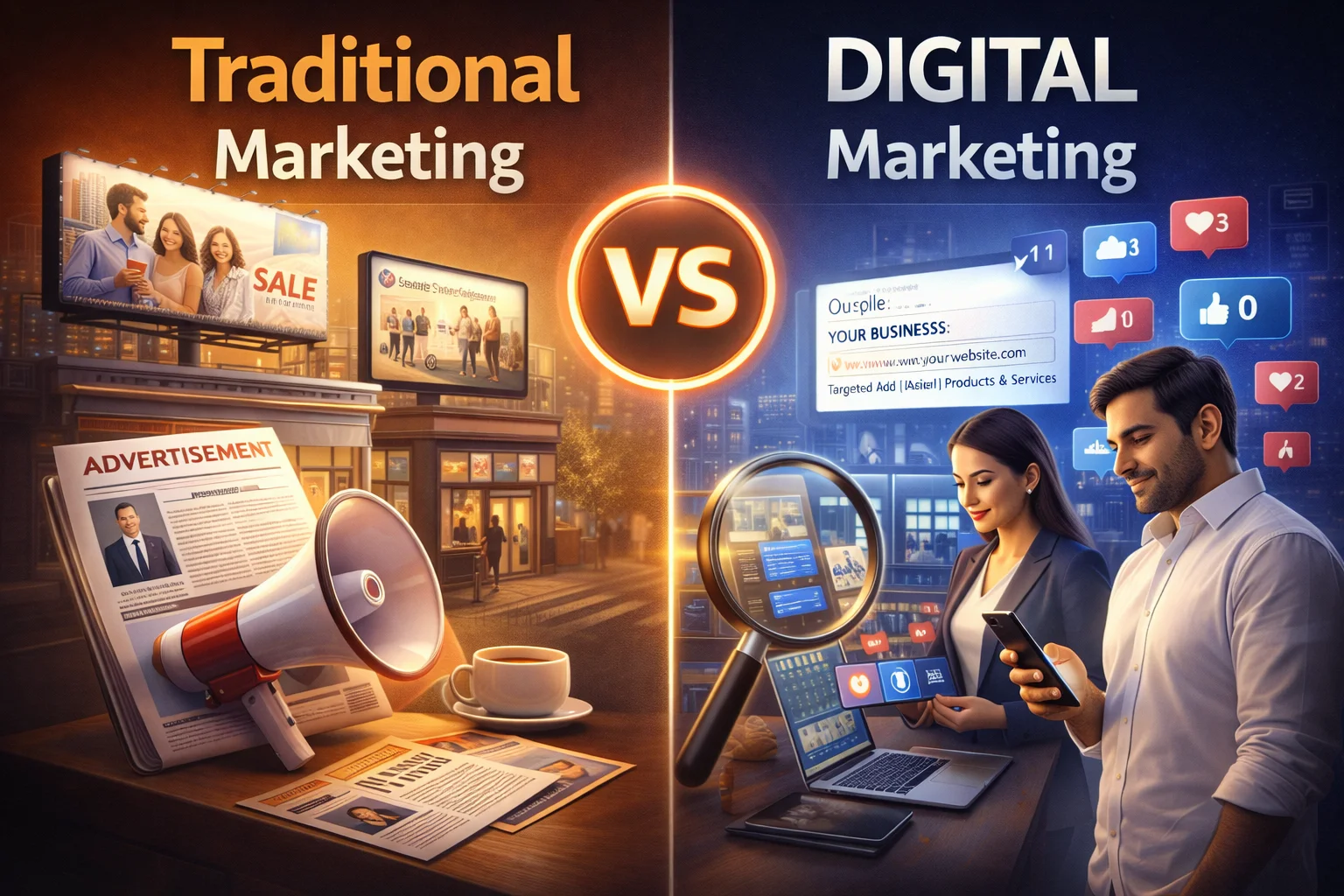
Traditional marketing refers to any marketing that happens offline. It is the kind of marketing that existed long before the internet. Television commercials, newspaper and magazine ads, radio spots, outdoor hoardings and billboards, pamphlets and flyers, direct mail, cinema ads, and event sponsorships all fall under traditional marketing. These channels reach people in their physical environment while they are watching TV, reading a newspaper, driving past a hoarding, or listening to the radio in their car.
Traditional marketing has been the backbone of brand building in India for decades. Companies like Amul, Fevicol, Nirma, and Lifeboy built iconic, lasting brands through consistent traditional marketing long before digital existed. It is a well understood, well established way of reaching large audiences, especially in markets where internet penetration is low or where older demographics are the primary audience.
What is Digital Marketing?
Digital marketing is any marketing that happens online or through digital devices. In the traditional marketing vs digital marketing debate, digital refers to Google Search and Shopping Ads, Meta Ads on Facebook and Instagram, YouTube pre-rolls, SEO, content marketing, email marketing, WhatsApp marketing, influencer marketing on social media, and any other channel that uses the internet or a digital device to reach potential customers.
Digital marketing became a mainstream business tool in India after the Jio revolution of 2016 which made data essentially free for hundreds of millions of Indians. Today, digital marketing accounts for 44% of India’s total advertising spending more than any other single medium including television. According to Ipsos India’s 2025-26 digital marketing state report, India added 56 million new internet users in 2025 alone, taking the total to 806 million. The digital marketing market in India is expected to reach Rs. 620 billion by 2026, growing at 23.49% annually.
The Numbers Tell the Story — India 2026
Rs. 49,000 Cr
Digital ad spend India 2025 now the largest ad medium
Rs. 44,000 Cr
Television ad spend India 2025
Rs. 20,000 Cr
Print ad spend India 2025
74.4%
Global ad spend is now digital (Statista 2025)
61%
Marketers report better ROI from digital vs traditional (IBEF)
3x to 5x
Average ROI of digital vs traditional marketing
These numbers show clearly where the market is going. Digital advertising has overtaken television in India for the first time. According to IBEF’s research on India’s digital marketing rise, 61% of marketers now report better ROI through digital marketing compared to traditional activities. And globally, digital commands 74.4% of total ad spend according to Statista. This is not a prediction. It is the current reality of the market.
Traditional Marketing vs Digital Marketing — Complete Side-by-Side Comparison
Here is a full, honest comparison of every important factor between traditional and digital marketing.
| Factor | Traditional Marketing | Digital Marketing |
|---|---|---|
| Definition | Offline channels TV, radio, newspaper, hoardings, pamphlets | Online channels Google, Instagram, Facebook, Email, YouTube |
| Cost | Very high lakhs to crores for TV, print, outdoor | Low to medium can start from Rs. 100 per day |
| Reach | Local, regional, or national fixed geographic area | Local to global target any city, country, or interest |
| Targeting | Broad everyone who reads the paper or watches TV | Precise target by age, city, gender, interest, income, behaviour |
| Measurability | Very difficult no way to know exact impact | Fully measurable every click, lead, sale tracked in real time |
| Result Speed | Slow weeks or months to see impact | Fast Google Ads shows results in 24 to 48 hours |
| Two-Way Communication | One way brand speaks, customer cannot respond | Two-way customers comment, reply, review, share |
| Flexibility | Cannot change once published or aired | Can edit, pause, or stop any campaign instantly |
| Customer Trust | High print and TV feel credible to older audiences | Growing reviews and social proof build strong trust |
| ROI Tracking | No direct tracking possible | Exact ROI tracked down to every rupee |
| Content Lifespan | Short newspaper is tomorrow’s waste paper | Long blogs and videos generate traffic for years |
| Best For | Mass brand awareness, older audiences, offline heavy markets | Lead generation, D2C sales, startups, ecommerce, all audiences |
| India 2026 Share | Print: Rs. 20,000 crore, TV: Rs. 44,000 crore | Digital: Rs. 49,000 crore now the largest ad medium |
Pros and Cons of Each — Honest Assessment
Here is an honest breakdown of what each type of marketing does well and where it falls short.
| Traditional Marketing | |
|---|---|
| PROS | CONS |
| Builds mass awareness quickly for large audiences | Very expensive — not affordable for small businesses |
| High credibility with older demographics in India | No way to measure exact results or ROI |
| Works well in areas with low internet penetration | Cannot target specific audience segments |
| TV and hoardings have high recall value | Cannot change the message once it goes live |
| Radio reaches commuters and rural areas effectively | Results take weeks or months to appear |
| Digital Marketing | |
|---|---|
| PROS | CONS |
| Very affordable start from Rs. 100 per day | Requires constant management and optimization |
| Fully measurable every rupee tracked | Ad fatigue is real users scroll past ads quickly |
| Target exactly the right audience with precision | Increasing competition raises cost per click over time |
| Can be changed, paused, or stopped any time | Requires skills, tools, and knowledge to do well |
| Works for businesses of every size and budget | Results can take time for organic channels like SEO |
The 5 Most Important Differences Explained Simply
1. Cost and Budget — The Biggest Gap
This is where traditional marketing vs digital marketing shows the starkest difference. A 30-second TV commercial on a national channel in India costs Rs. 2 to 10 lakh per slot. A full page ad in a national newspaper costs Rs. 5 to 15 lakh. A hoarding in a prime Mumbai location costs Rs. 2 to 5 lakh per month. These numbers are completely out of reach for small and medium businesses.
Digital marketing removes this barrier entirely. You can start a Google Ads campaign for Rs. 500 per day. A Facebook or Instagram ad can reach thousands of targeted people for Rs. 200. This democratization of advertising is the single most important thing digital marketing has done for businesses in India.
2. Targeting Broad vs Precise
Traditional marketing targets broadly. A newspaper ad is seen by everyone who reads that paper regardless of age, income, location, or interest in your product. A hoarding is seen by everyone who drives past it. You are paying for enormous reach but most of that reach is completely irrelevant to your product. Digital marketing lets you target with extraordinary precision.
You can show your ad only to women aged 25 to 40 in South Delhi who have shown interest in fitness and have a household income above Rs. 10 lakh per year. You pay only to reach people who actually match your ideal customer profile. According to IBEF, companies using customized targeted digital ads experience a tenfold higher conversion rate compared to traditional broad-audience methods.
3. Measurability The Game Changer
This single difference changes everything about how marketing works. With traditional marketing, you can estimate how many people might have seen your ad. You can run a survey asking new customers how they heard about you. But you can never know exactly how many people saw your billboard, how many called because of your newspaper ad, or what your precise cost per customer was. With digital marketing, every single action is tracked.
You know exactly how many people saw your ad, how many clicked, how many visited your website, how many filled a form, how many bought something, and what the cost per result was down to the rupee. This data lets you improve every campaign over time. Traditional marketing is a guess. Digital marketing is a science.
4. Two-Way Communication Silent vs Conversational
Traditional marketing is a monologue. The brand speaks and the customer listens. A TV commercial cannot respond to what a viewer thinks. A newspaper ad cannot answer a reader’s question. Digital marketing is a dialogue. Customers comment on your Instagram posts. They reply to your emails. They write reviews on Google. They share your content and add their own opinions. This two-way communication builds genuine relationships between brands and customers. It also gives businesses priceless feedback in real time you can see immediately when a campaign message is not working or when customers have questions that your marketing is not answering.
5. Speed and Flexibility — Fixed vs Fluid
Once you print 50,000 pamphlets or book a billboard for a month, you are committed. If the message is wrong, the offer expired, or a competitor just launched something that changes the market you cannot change anything. Traditional marketing is fixed the moment it is published. Digital marketing is completely flexible. You can change your ad headline at 11pm tonight and the new version goes live in minutes. You can pause a campaign if it is not working. You can increase your budget on a campaign that is doing well. You can test two different messages and automatically run more of whichever one performs better. This flexibility means you are never stuck with a marketing mistake for long.
When to Use Traditional Marketing vs Digital Marketing in India
The question is not which is better overall. The question is which is right for your specific business, audience, and goal. Here is a practical framework for deciding in the traditional marketing vs digital marketing context.
1. Use Traditional Marketing When
Your target audience is above 55 years old and is more influenced by TV and print. You are a large brand launching a new product to a mass market and need broad awareness quickly. You are targeting rural or semi urban markets where internet penetration is still low. Your product has a very broad appeal and you benefit from showing it to as many people as possible. You are running a political campaign or a public awareness drive that needs maximum mass reach.
2. Use Digital Marketing When
Your target customers are between 18 and 50 years old and spend significant time online. You are a small or medium business with a limited marketing budget. You need measurable results and want to know exactly what your marketing spend is generating. You want to target specific demographics, locations, or interest groups rather than broad audiences. You are running an ecommerce store, a service business, a startup, or any business where direct leads and sales are the primary goal.
3. Use Both Together for Maximum Impact
The most successful brands in India in 2026 do not choose between traditional and digital. They use both in a coordinated way. A large FMCG brand runs TV commercials for broad awareness, then retargets the same audience digitally on Instagram and YouTube. A real estate developer uses hoardings in the city for physical visibility, while running Google Search Ads to capture everyone who searches flats for sale in Bangalore online. According to Techeasify’s 2026 research, the difference between traditional and digital marketing is best understood as complementary tools rather than competing ones. In 2026, most businesses get the best results by combining both and following the data.
Traditional Marketing vs Digital Marketing in the Indian Context
The traditional marketing vs digital marketing debate looks different in India than anywhere else in the world. India is a country of extraordinary diversity with metros that are as digitally advanced as Singapore and rural areas where TV and radio are still the primary media. This means the right answer depends heavily on where your customers are and how they consume media.
In India’s Tier 1 cities — Mumbai, Delhi, Bangalore, Hyderabad, Pune — digital marketing is clearly the dominant channel for most businesses. The audience is online, highly active on social media, comfortable buying online, and responds well to digital ads and content. In Tier 2 and Tier 3 cities, the picture is changing rapidly.
According to Research 2026 India digital marketing research, India will have 900 million active internet users by 2026, with the majority of new users coming from smaller cities and rural areas. For many product categories, digital marketing is already the most effective channel even in smaller cities. But for some products targeting older rural demographics, traditional channels like local cable TV, FM radio, and wall paintings still deliver results that digital cannot.
The key insight for Indian businesses is this. Do not assume that your traditional marketing from 10 years ago still reaches the same audience in the same way. India’s media consumption has changed dramatically and continues to change fast. If your marketing strategy still looks the same as it did in 2015, you are almost certainly leaving significant money on the table.
Conclusion
The traditional marketing vs digital marketing debate does not have one universal winner. What it has is data and the data is very clear about the direction of travel. Digital advertising now accounts for 74.4% of global ad spend. In India, digital has overtaken television as the largest advertising medium. 61% of marketers report better ROI from digital. The average digital campaign delivers 3 to 5 times higher ROI than traditional.
But traditional marketing is not dead. For specific audiences, specific markets, and specific goals, it remains powerful and relevant. The right question is not which is better but which combination is right for your business, your audience, and your goals in 2026. For most businesses in India especially small and medium ones with limited budgets digital marketing should be the primary channel. For larger brands with mass-market products, a combination of both delivers the best results.
One thing is certain. Businesses that understand both types of marketing and use them intelligently will always outperform those that use only one or the other. Know your audience, track your results, and follow the data. That is the marketing strategy that wins in 2026.
Stop Guessing. Start Growing With a Strategy That Works.
Whether you are wondering how to shift from traditional to digital marketing or want to build a combined strategy that uses the best of both, DiziSpark can help. We have helped businesses across India build digital marketing systems that deliver consistent, measurable growth. We handle your SEO, Google Ads, Meta Ads, social media, content, and email so you can focus on running your business. No guesswork. No wasted budgets. Just clear strategy and real results. Visit us at Dizispark today and book a free marketing consultation.
Frequently Asked Questions
What is the main difference between traditional marketing and digital marketing?
The main difference in traditional marketing vs digital marketing is the medium and measurability. Traditional marketing happens offline — TV, newspapers, hoardings, radio and results cannot be precisely measured. Digital marketing happens online Google, Instagram, email, YouTube and every click, lead, and sale can be tracked in real time. Digital also allows precise audience targeting while traditional reaches broad audiences.
traditional marketing still relevant in India in 2026?
Yes, but its role has changed. Traditional marketing is still relevant for mass brand awareness, reaching older demographics, and markets with lower internet penetration. TV and print ads still command significant budgets in India. But for most small and medium businesses, digital marketing delivers better ROI, more precise targeting, and fully measurable results. The most effective approach for large brands is a combination of both.
Which is more cost-effective — traditional or digital marketing?
Digital marketing is significantly more cost-effective for most businesses. You can start a Google Ads or Meta Ads campaign for Rs. 200 to Rs. 500 per day. Traditional marketing like TV ads, newspaper ads, and hoardings costs lakhs to crores per placement. According to IBEF research, 61% of marketers report better ROI from digital marketing. The average digital campaign delivers 3 to 5 times higher ROI than traditional methods.
Can small businesses use traditional marketing in India?
Traditional marketing at scale national TV, major newspapers is not practical for most small businesses due to very high costs. However, smaller local forms of traditional marketing like local FM radio spots, auto rickshaw ads, local newspaper inserts, and community hoardings are more affordable and can work for hyper local businesses. For most small businesses, digital marketing offers better value, better targeting, and better measurability.
How much of India’s advertising budget is now digital?
According to Ipsos India’s 2025-26 digital marketing report and IBEF data, digital advertising accounts for 44 to 49% of India’s total advertising spending in 2025-26, making it the single largest advertising medium ahead of television for the first time. The digital advertising market in India reached Rs. 49,000 crore in 2025 and is projected to reach Rs. 620 billion by 2026, growing at 23.49% annually.