Social media vs digital marketing is one of the most commonly confused comparisons in modern business strategy, and the confusion is understandable. Both involve online channels, both use content, both generate leads, and both are essential to growing a brand in 2026. However, treating them as the same thing leads to misallocated budgets, incomplete strategies, and missed opportunities. According to Lindenwood University’s guide on this topic, while these terms are often used interchangeably, each approach has distinct roles, channels, and methods that make it unique.
This guide answers the social media vs digital marketing question clearly and completely: what each one is, how they differ, where they overlap, which channels belong to each, and how to decide what your business should be investing in for maximum return in 2026.
Table of Contents
ToggleDefining the Terms: What Each One Actually Means
What Is Digital Marketing?
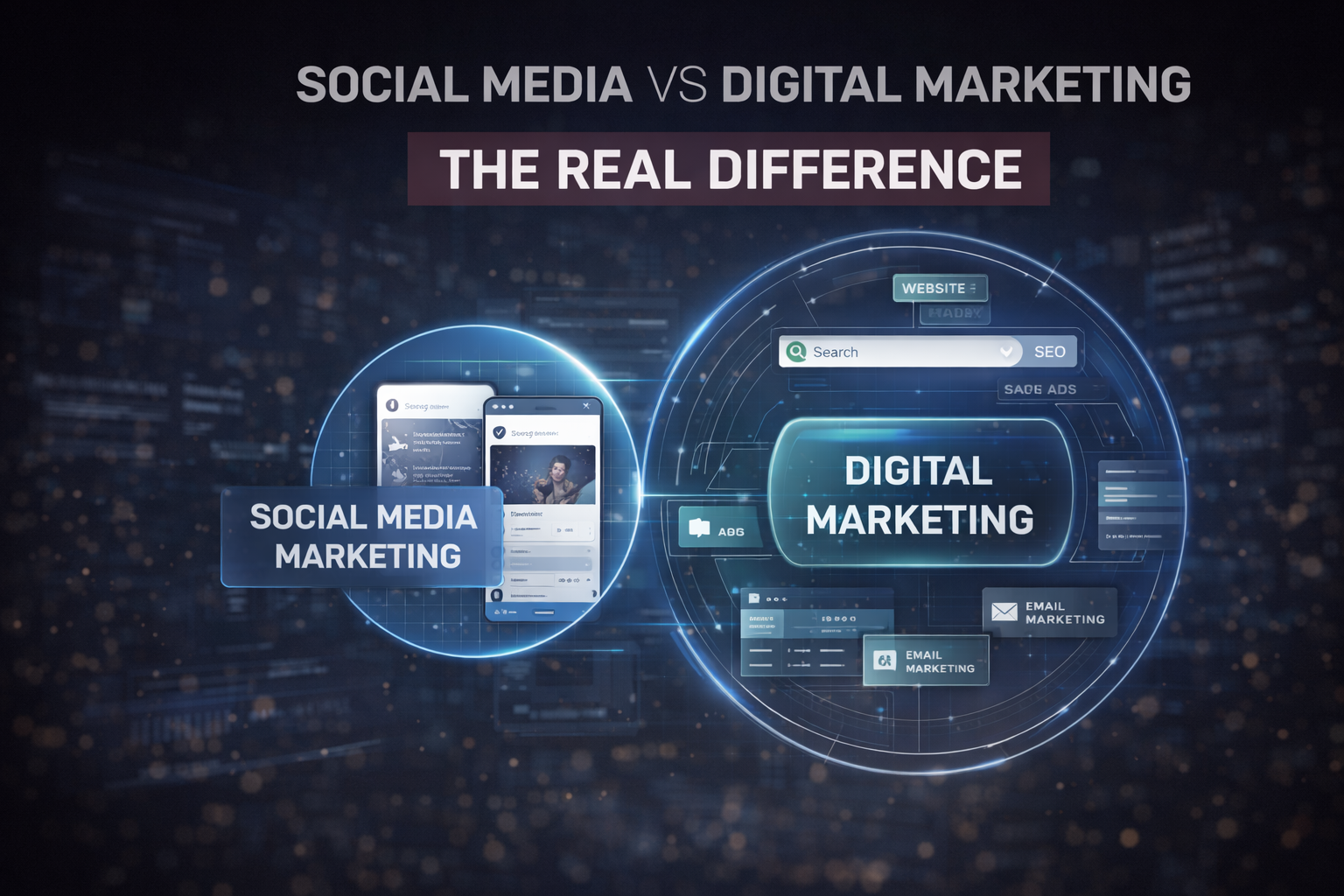
Digital marketing is the broad, umbrella term for all marketing activity that uses digital channels and online technologies to reach, engage, and convert customers. As Lindenwood University explains, it spans online advertising, content marketing, email campaigns, search engines, and more, reaching consumers across multiple platforms and devices. Its primary goal is to create experiences that drive conversions, leads, and sales across the complete customer journey.
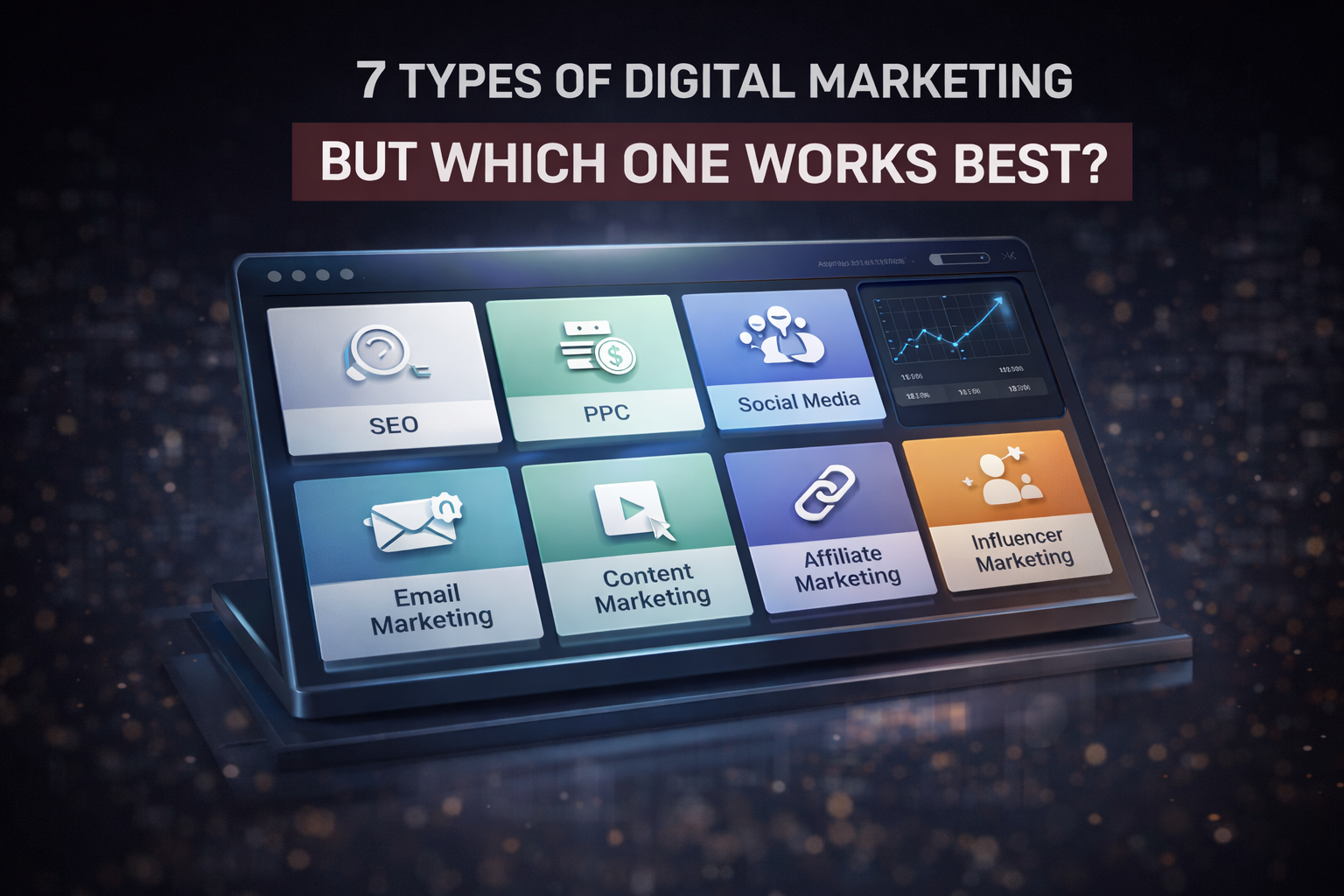
The channels under the digital marketing umbrella include Search Engine Optimisation (SEO), Pay-Per-Click advertising (PPC), content marketing, email marketing, website design and development, affiliate marketing, influencer marketing, marketing automation, and social media marketing. Bastion Agency’s analysis of social media vs digital marketing confirms that digital marketing involves the utilisation of all available channels to reach customers wherever they spend their online time, using both organic and paid strategies across search engines, email inboxes, websites, and social platforms simultaneously.
What Is Social Media Marketing?
Social media marketing is a specific subset that lives within the broader digital marketing umbrella. It focuses exclusively on promoting brands, building relationships, and engaging audiences through social platforms including Instagram, Facebook, LinkedIn, TikTok, YouTube, and X. According to MO burst’s comparison of social media vs digital marketing, social media marketing focuses on posting content, running platform-specific ads, engaging with followers, and leveraging user-generated content with the primary goal of building brand awareness, community, and customer loyalty.
The key distinction in the social media vs digital marketing comparison is scope. Lindenwood University puts it precisely: social media marketing focuses solely on promoting products, services, or brands through social media platforms. Every tactic in social media marketing happens within the walls of a social platform, whereas digital marketing operates across the entire digital ecosystem, from search results to email inboxes to banner ads on news websites.
Simple Definition:
Digital marketing is the entire house. Social media marketing is one important room inside it. You cannot do digital marketing without some form of social media presence, but you can do digital marketing without making social media your primary channel.
Social Media vs Digital Marketing: Key Differences Explained
When comparing social media vs digital marketing directly, several critical differences emerge across scope, intent, communication style, measurement, and cost structure. The table below captures the most important distinctions that businesses and marketers need to understand.
| Dimension | Digital Marketing | Social Media Marketing |
|---|---|---|
| Scope | All digital channels: SEO, PPC, email, content, social, web, automation | Only social platforms: Instagram, Facebook, LinkedIn, TikTok, YouTube, X |
| Primary Goal | Convert leads into paying customers, drive measurable ROI | Build brand awareness, community, engagement, and loyalty |
| User Intent | Captures active demand (user is searching) | Creates passive discovery (user is scrolling) |
| Communication | Largely one-way: website, email, ad deliver a message | Two-way: real-time replies, comments, conversations |
| Measurement | ROI, conversion rates, click-through rates, revenue attribution | Engagement rate, follower growth, reach, impressions |
| Cost Structure | Variable: SEO is free long-term, PPC and email scale with budget | Content creation costs + platform ad spend |
| Speed of Results | PPC is immediate, SEO takes months, email is fast | Organic is slow, paid social is faster |
| Audience Reach | Global reach across all digital touchpoints | Limited to users on each specific platform |
One of the most practically important differences in the social media vs digital marketing comparison is around intent. Indeed’s career guide on this topic notes that digital marketing is generally easier to measure in terms of ROI and data compared to social media, because channels like SEO and PPC have clear, direct conversion tracking from click to purchase. Social media ROI is more diffuse because it operates at the awareness and community-building end of the customer journey, where the value is real but harder to attribute to a single sale.
Where Social Media vs Digital Marketing Overlap
Despite their differences, the social media vs digital marketing comparison also reveals significant common ground. Both disciplines share several foundational characteristics that make them complementary rather than competitive strategies.
Lindenwood University identifies four core similarities.
First, both aim to increase brand awareness, drive traffic, and engage audiences with the ultimate goal of fostering customer loyalty and conversions.
Second, analytics plays a significant role in both: data analysis is how marketers in either discipline gauge campaign performance, identify trends, and optimize strategies for better results.
Third, both leverage targeted advertising and content marketing to reach specific audience segments, tailoring messages to demographics and interests to maximize relevance. Fourth, content creation is central to both, whether that is blog posts and email newsletters in digital marketing or Reels, posts, and Stories in social media marketing.
The most important similarity in the social media vs digital marketing comparison is that the two strategies are designed to work together, not separately.
MO burst’s analysis makes the commercial logic clear: while digital marketing channels like SEO and PPC drive potential customers to a website, social media platforms are necessary to spread brand awareness and build the trust that makes those visitors convert. The most effective online marketing strategies in 2026 use digital marketing to capture demand and social media marketing to build the audience and brand recognition that makes demand generation more efficient.
Channels That Belong to Each Strategy
Understanding which specific channels and tools belong to each side of the social media vs digital marketing comparison helps businesses decide where to invest and what skills to develop.
| Channel | Category | What It Does |
|---|---|---|
| SEO (Search Engine Optimisation) | Digital Marketing | Organic search visibility on Google/Bing, drives free long-term traffic |
| PPC / Google Ads | Digital Marketing | Paid search ads, immediate visibility for high-intent keywords |
| Email Marketing | Digital Marketing | Direct inbox communication, highest ROI channel, owned audience |
| Content Marketing | Digital Marketing | Blogs, guides, videos that build authority and support SEO |
| Website Design and CRO | Digital Marketing | Converting website visitors into leads and customers |
| Marketing Automation | Digital Marketing | Automated workflows for lead nurturing and customer retention |
| Instagram / TikTok / Reels | Social Media Marketing | Visual content, short-form video, brand storytelling, younger audiences |
| Facebook Pages and Ads | Social Media Marketing | Community building, retargeting, local business visibility |
| LinkedIn Marketing | Social Media Marketing | B2B networking, thought leadership, professional lead generation |
| YouTube Marketing | Both | Long-form video supports SEO (digital marketing) and brand building (social) |
| Influencer Marketing | Both | Operates through social platforms but serves broader digital campaign goals |
| Paid Social Ads | Both | Social platform ads serve social media goals but are measured like digital campaigns |
Social Media vs Digital Marketing: Which Is Better for Your Business?
The most common practical question in the social media vs digital marketing debate is which one a business should priorities. The honest answer is that it depends on your goals, budget, industry, and timeline, and in most cases the right answer is both, used strategically for different purposes at different stages of the customer journey.
MO burst’s framework provides the clearest guidance: social media aims to build brand awareness while digital marketing strives to convert leads into paying customers. These are different jobs in the same customer acquisition system, not competing approaches. A business that invests only in social media builds an audience but struggles to convert it into revenue. A business that invests only in digital marketing channels like SEO and PPC may drive traffic and conversions but lacks the community and brand trust that makes customers choose them over a competitor with similar pricing and quality.
| Business Situation | Recommended Approach |
|---|---|
| You need leads quickly | Prioritise digital marketing (PPC/Google Ads) to capture people actively searching for your service |
| You are launching a new brand | Prioritise social media marketing to build awareness and community before demand exists |
| You want sustainable long-term growth | Invest in SEO and content marketing, supported by consistent social media presence |
| You have a B2B product or service | Prioritise LinkedIn marketing + email marketing + content SEO over entertainment-led social platforms |
| You sell visual consumer products | Social media (Instagram, TikTok, Pinterest) is your primary channel with SEO supporting it |
| You want the highest ROI | Email marketing delivers the best returns; support it with SEO and social media for audience building |
| You have a small budget | Start with SEO, content marketing, and organic social; add paid channels as revenue grows |
| You want to outperform competitors | Use all channels in an integrated strategy where each supports and amplifies the others |
How Social Media and Digital Marketing Work Together in 2026
The most important insight from the social media vs digital marketing comparison is not which one to choose, but how to make them work together. Bastion Agency recommends a multi-channel strategy that engages users at all stages of the customer journey, from top-of-funnel awareness all the way through to purchase, with social media functioning as an important tactic within the broader digital marketing strategy rather than as a standalone replacement for it.
In practice, the two strategies feed each other at every stage of the customer journey. A potential customer first discovers a brand through a social media Reel or a sponsored post on Instagram. They visit the website, which has been optimized for SEO and conversion rate. They leave without buying.
A remarketing campaign, which is a digital marketing tactic, brings them back with a targeted ad. They subscribe to the email list. Over the next two weeks, an automated email sequence nurtures them toward a purchase. They buy, leave a review, and become a follower on social media where they continue to see content that reinforces their loyalty and encourages them to refer others. This complete cycle cannot be built on either social media marketing or digital marketing alone. It requires both, coordinated as one integrated system.
Key Takeaway:
The social media vs digital marketing debate is a false choice. Social media generates the initial awareness and builds the audience. Digital marketing converts that audience into revenue and retains customers long-term. The businesses that grow fastest in 2026 are those that use both together.
Career Paths: Social Media vs Digital Marketing
For professionals exploring the social media vs digital marketing question from a career perspective, both fields offer strong and growing opportunities with distinct skill sets and role types. Lindenwood University’s career analysis shows that advertising and marketing manager roles are projected to grow 8 percent from 2023 to 2033, faster than the national average, reflecting the sustained demand for skilled professionals across both disciplines.
Digital marketing careers include SEO Specialist, PPC Manager, Content Marketer, Email Marketing Strategist, Marketing Automation Specialist, Data Analyst, and Digital Marketing Manager. These roles are found across virtually every industry, with particularly strong demand in finance, healthcare, technology, education, retail, and B2B services. Social media marketing careers include Social Media Manager, Content Creator, Community Manager, Influencer Marketing Specialist, and Social Media Strategist. These roles are especially prevalent in e-commerce, fashion, beauty, food and beverage, entertainment, and direct-to-consumer brands where visual storytelling and community building are central to the business model.
Professionals who develop skills in both areas command the strongest position in the job market, since businesses increasingly want marketers who understand how social media activity feeds into broader digital performance metrics and how digital marketing data can improve social media targeting and content strategy. The social media vs digital marketing division is becoming less relevant at the strategic level, where the most valued professionals are those who can orchestrate both as parts of a single coordinated campaign.
Conclusion
Social media vs digital marketing is ultimately not a competition. Digital marketing is the complete framework for all online promotional activity. Social media marketing is one powerful, distinct channel within that framework. Understanding the difference helps businesses allocate budget more intelligently, measure results more accurately, and build marketing strategies that produce both immediate revenue and long-term brand equity.
The businesses that perform best in 2026 are not choosing between social media vs digital marketing. They are using social media to build the audience, trust, and community that makes every other digital marketing channel more effective. They are using digital marketing channels like SEO, email, PPC, and CRO to convert that audience into revenue and retain customers over time. Both are essential. Both are powerful. And both are most powerful when they work together.
How Dizispark Can Help
Dizispark is a digital marketing agency that builds and manages both social media marketing and full-spectrum digital marketing strategies for businesses across India.
We do not make you choose between the two: we design integrated campaigns where your social media presence, SEO, paid ads, content, and email all work together as one coordinated growth engine. Whether your business needs to build brand awareness from scratch through social media, rank on Google through SEO, generate leads through paid campaigns, or retain customers through email automation, Dizispark has the team, the tools, and the track record to deliver results you can measure.
Every strategy we build is rooted in your specific goals, your industry, and the channels where your audience actually spends their time, not a one-size-fits-all template.
Get your free digital marketing audit today and find out exactly where your business is leaving growth on the table.
Frequently Asked Questions
What is the main difference between social media and digital marketing?
The main difference in the social media vs digital marketing comparison is scope. Digital marketing is the broad umbrella term covering all online marketing channels including SEO, PPC, email marketing, content marketing, website optimization, and social media. Social media marketing is a specific subset that operates exclusively through social platforms like Instagram, Facebook, LinkedIn, and TikTok. Digital marketing targets users with active intent (people searching for something), while social media marketing targets users through passive discovery (people scrolling through a feed).
Is social media marketing part of digital marketing?
Yes. Social media marketing is a component of digital marketing, not a separate or competing discipline. Digital marketing is the broader category that includes social media as one of its channels alongside SEO, PPC, email marketing, content marketing, and others. A complete digital marketing strategy typically includes social media marketing as one of its key channels, but social media alone is not sufficient to replace the full range of digital marketing tactics.
Which is better for a small business: social media marketing or digital marketing?
For most small businesses, the most practical starting point is a combination of local SEO, Google Business Profile optimization, and one or two social media platforms relevant to their audience. Social media builds community and brand awareness at low cost, while SEO drives high-intent organic traffic over time. For businesses needing immediate leads, adding Google Ads alongside these foundational channels makes sense. The choice in the social media vs digital marketing debate for small businesses should be guided by budget, audience location, and how customers typically search for the type of product or service offered.
Can social media marketing replace digital marketing?
No. Social media marketing cannot replace digital marketing because it addresses only one part of the customer journey, primarily awareness and engagement, while leaving other critical stages uncovered. Without SEO, a business is invisible to people actively searching on Google Without email marketing, there is no owned channel for customer retention. Without PPC, there is no immediate demand capture. Without CRO, traffic from any source does not convert efficiently. Social media is an important part of a complete digital marketing strategy, not a substitute for one.
What is the ROI difference between social media and digital marketing?
Digital marketing channels like email marketing, SEO, and PPC typically deliver more directly measurable ROI than social media marketing because they have clearer conversion tracking from click to purchase. Indeed, notes that it is generally easier to measure ROI and gather data with digital marketing compared to social media. Social media delivers value that is real but harder to attribute directly to revenue, such as brand awareness, audience trust, community engagement, and repeat purchase behavior driven by consistent visibility.
Which digital marketing channels give the fastest results?
In the social media vs digital marketing comparison on speed, paid advertising (PPC and paid social) delivers the fastest results, typically within days of launching a campaign. Email marketing also generates rapid response. SEO and content marketing are slower, typically showing strong results after 60 to 180 days, but they deliver compounding returns that do not stop when the budget does. Organic social media falls in the middle: faster than SEO to show engagement, but slower than paid channels to drive measurable business outcomes.
What skills do you need for social media marketing vs digital marketing?
Social media marketing requires skills in content creation, copywriting, video production, platform algorithm understanding, community management, influencer relationship management, and paid social advertising. Digital marketing requires a broader skill set including SEO and technical website knowledge, PPC campaign management, email marketing and automation, data analytics, CRO, content strategy, and understanding of the full customer journey. Professionals who develop strong skills in both areas are among the most sought-after in the marketing industry.
Should I hire a social media manager or a digital marketing agency?
A social media manager handles your social platforms specifically: content creation, posting, community management, and platform-specific paid campaigns. A digital marketing agency manages a broader set of channels including SEO, Google Ads, email marketing, content strategy, analytics, and CRO alongside social media. For most growing businesses, a digital marketing agency provides more complete coverage and better integration between channels. For businesses that already have their digital marketing strategy in place and need execution support on social platforms, a dedicated social media manager can be the right fit.