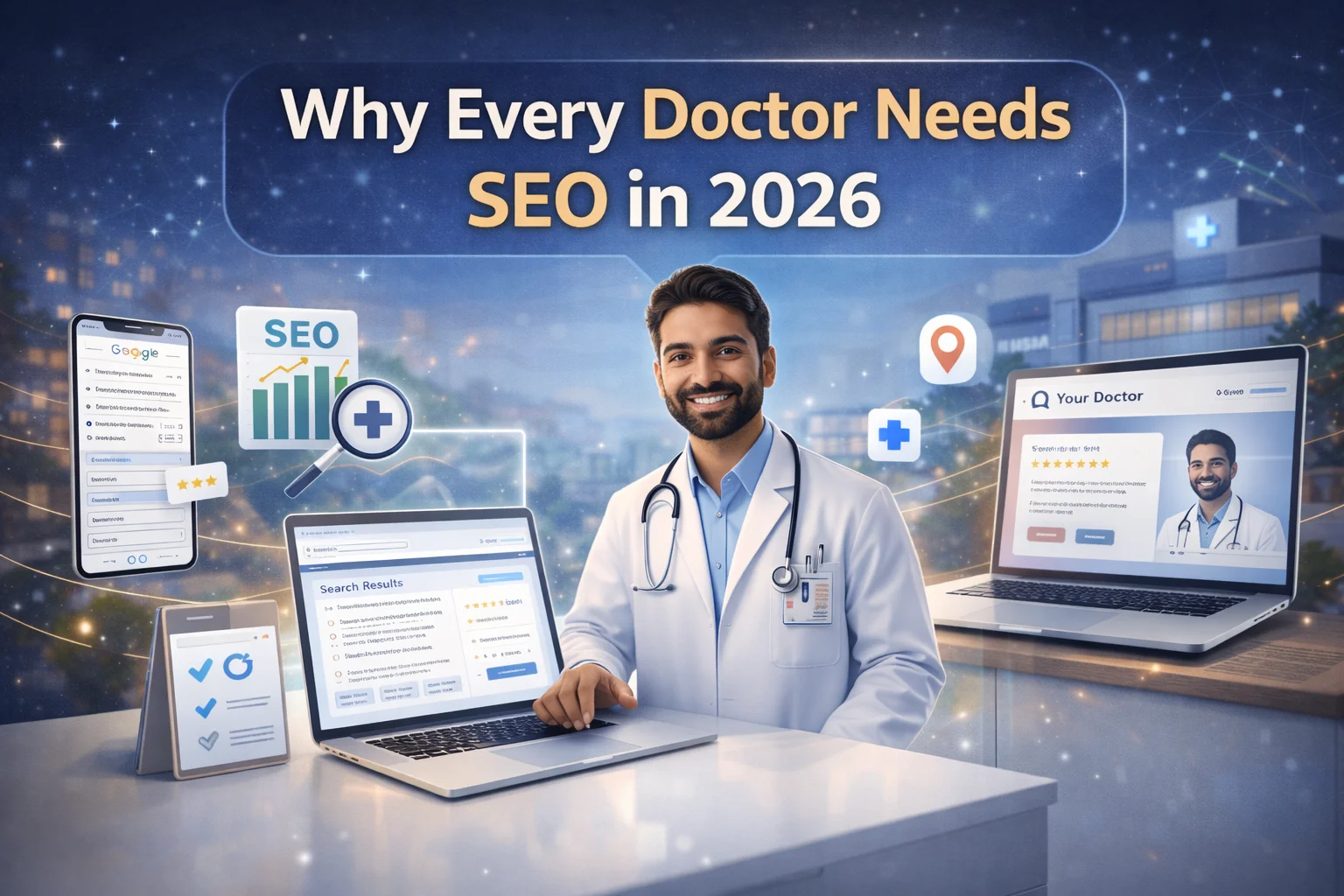
Think about the last time you needed to find a new doctor. What did you do? If you’re like most people, you probably pulled out your phone, opened Google, and started searching. Maybe you looked for “best cardiologist near me” or “dentist in [your city].” You likely checked reviews, compared a few options, and maybe even booked an appointment online. This shift in patient behavior is exactly why SEO for doctors has become one of the most powerful growth tools for clinics, medical practices, and hospitals in 2026.
The way patients discover and choose healthcare providers has fundamentally changed. They no longer depend only on referrals from friends or signboards outside clinics. Instead, they turn to Google, mobile search, voice assistants, and online reviews. In this article, we’ll explore exactly why every doctor needs SEO in 2026, backed by real data, not guesswork.
The Digital Shift in Healthcare Marketing (2026 & Beyond)
>How Patients Find Doctors Online Today
Healthcare marketing has changed dramatically. Patients today behave like informed consumers. They research extensively before making healthcare decisions.
In 2026, most patient journeys start online. Before booking an appointment, patients typically:
- Search symptoms or treatments on Google
- Look for “best doctor near me” queries
- Compare multiple doctors and hospitals
- Read Google reviews and testimonials
- Check clinic locations on Google Maps
- Use voice search on mobile devices
Research confirms this behavior. 77%+ of patients start their healthcare journey on Google or another search engine before scheduling an appointment. Additionally, just under half of individuals seek out a new doctor specifically using Google.
>Why Traditional Marketing Alone No Longer Works
Traditional marketing methods like newspaper ads, hoardings, and pamphlets still exist. But they have significant limitations:
- Lack precise targeting
- No measurable ROI
- Short-term visibility at best
In contrast, SEO for doctors focuses on organic search visibility, ensuring you’re found by patients who are already looking for medical help.
>New Research: How Patient Behavior Has Evolved
Recent studies reveal just how much patient behavior has transformed:
- 84% of patients check online reviews before choosing a provider.
- 73% of patients adopted new behaviors or tools to research providers in the past year – including AI chatbots like ChatGPT, voice search assistants like Siri and Alexa, and social media platforms.
- 31% of patients use generative AI like ChatGPT and Google AI Overviews to research or compare providers.
- 35% of patients have chosen a provider based on social media presence.
- 25% of patients began using voice assistants to research providers in 2025.
These numbers tell a clear story: if your practice isn’t visible where patients are searching, you’re losing opportunities every single day.

Why Doctors Need SEO in 2026 More Than Ever
>Increased Competition in Search Results
The healthcare landscape is more competitive than ever. New clinics, multispecialty hospitals, and telemedicine platforms enter the market every year. When patients search for doctors online, they usually click results on the first page of Google. If your practice does not appear there, you effectively lose potential patients to competitors.
Without SEO for doctors:
- Your competitors rank above you
- Your website gets little or no traffic
- Your clinic remains invisible online
>Building Trust Through Visibility
High rankings aren’t just about traffic – they signal trust. Appearing on top search results improves:
- Credibility
- Authority
- Patient confidence
41% of patients say their trust in a provider increases when they see responses to online reviews.
>The New Reality: AI Is Reshaping Patient Choice
Here’s a statistic that should grab every doctor’s attention:
26% of patients report that AI tools directly influenced their choice of healthcare provider, nearly matching primary care referrals at 28%.
Even more striking:
- 61% of patients trust online reviews more than personal recommendations from friends and family.
- One-third of patients trust AI-generated search results as much as traditional search engines.
This is why understanding and investing in SEO for doctors has never been more critical.
How SEO Helps Doctors Get More Patients Organically
SEO Brings the Right Patients at the Right Time
One of the biggest advantages of SEO is that it attracts high-intent patients without ongoing ad spend.
SEO for doctors targets patients who are actively searching for:
- Specific treatments
- Doctors near their location
- Emergency or urgent care
This is exactly how SEO helps doctors get more patients who are ready to book appointments.
Organic Patient Growth That Lasts
Unlike paid ads that stop delivering results when the budget ends, SEO supports organic patient growth by:
- Reducing cost per lead
- Improving lead quality
- Delivering long-term visibility
- Strengthening brand reputation
Consider this: 70% of visitors who use their smartphone to conduct a local search visit the clinic the same day.
Core SEO Services Doctors, Clinics, and Hospitals Need
>SEO for Medical Practices and Clinics
Healthcare SEO isn’t generic. It requires industry-specific expertise, compliance awareness, and local optimization.
Effective SEO for doctors includes:
- Treatment- and specialty-based keyword targeting
- Optimized doctor profile pages
- Mobile-first website performance
- Secure, fast-loading websites
These elements ensure your clinic ranks for relevant searches and converts visitors into patients.
>Local SEO for Doctors: Capturing Nearby Patients
Most healthcare searches are local in nature. Patients want immediate care close to their location. Consider this: 46% of all Google searches are seeking local information. That’s nearly half of all searches like “dentist near me” or “orthopedic doctor in [city]” show strong local intent. This makes local SEO for doctors one of the highest ROI marketing channels available.
>Key Elements of a Local SEO Strategy
An effective local SEO strategy includes:
- Google Business Profile optimization: Claim and verify your listing
- Accurate NAP consistency: Name, Address, Phone matching everywhere
- Location-based landing pages: Pages for each practice location
- Patient reviews and ratings management: Monitor and respond
- Local content marketing: Address community health concerns
Google Business Profile: Your Digital Storefront
>Why GBP Matters for Doctors
Your Google Business Profile is often the first point of contact between your practice and potential patients. Complete, optimized profiles improve visibility in Google Maps and local search results.
They give patients essential information at a glance: your hours, location, services, and reputation.
>Optimization Checklist
To maximize your profile’s effectiveness:
- Claim and verify your listing for each provider at your practice
- Ensure NAP details match your website exactly
- Add high-quality photos of your office, staff, and services
- Select relevant business categories
- Keep hours updated – including holidays
- Use Google Posts to share updates, health tips, special offers
- Enable direct messaging and appointment booking
- Monitor Q&A section and provide helpful answers
>The Review Factor
Reviews are central to healthcare decisions today:
- 84% of patients check online reviews before choosing a provider.
- 45% of patients value providers who actively respond to reviews.
- 40% of patients have canceled or avoided booking due to negative reviews.
Encourage satisfied patients to leave reviews on Google, Healthgrades, and other platforms. Respond to all reviews professionally both positive and negative. 57% of patients admit they rarely or never leave reviews themselves, but 74% are at least somewhat likely to leave reviews when prompted, and 47% are most likely to leave a review within 24 hours of their appointment. This timing insight is gold. Ask for reviews while your care is fresh in their mind.
Content That Educates and Converts
What Type of Content Works Best
Content marketing plays a vital role in SEO for doctors. The right content educates patients and builds trust.
Effective content includes:
- Educational blogs answering common patient questions
- Treatment and condition pages with clear, accurate information
- Doctor-reviewed FAQs addressing patient concerns
- Symptom guides, treatment explanations, medication information
The Trust Factor
90% of individuals have used the internet for health-related information. Helpful content builds trust and improves rankings. Non-commercial health sources increase patient trust by 4.3 times compared to commercial sources.
When you provide accurate, helpful information, patients see you as a trusted authority not just another service provider.
Local Content That Connects
Create content addressing local health concerns or events:
- “What to Know About Allergy Season in [City]”
- “Flu Shot Clinics in [Area]: What to Expect”
- “Tips for Avoiding Dehydration During [City] Summers”
This builds connection and adds relevance for local SEO. It shows patients you understand their community and their needs.
Technical SEO for Healthcare Websites
>Mobile Optimization Is Non-Negotiable
60%+ of search traffic comes from mobile devices. Most local searches happen on mobile
Your website must be:
- Fast loading
- Easy to navigate on small screens
- Featuring tappable buttons and contact forms
Google prioritizes mobile-friendly websites in rankings. If your site isn’t optimized for mobile, you’re losing patients.
>Key Technical Elements
Effective technical SEO includes:
- Mobile responsiveness: Adapts to any screen size
- Fast page speed: Patients won’t wait for slow sites
- HTTPS security: Builds trust and meets Google requirements
- Medical and FAQ schema markup: Helps Google understand your content
- Clear calls-to-action: “Book Appointment” buttons prominently placed
>Schema Markup for Medical Practices
Schema markup is code that helps Google understand your site’s content. For medical practices,
valuable schema types include:
- MedicalBusiness schema
- LocalBusiness schema
- FAQPage schema
- Review schema
This structured data can improve how your listings appear in search results adding star ratings, hours, and more information directly in search.
Voice Search for Doctors and Mobile-First Patients
>Why Voice Search Matters
Voice-enabled searches are growing rapidly in healthcare. 25% of patients began using voice assistants to research providers in 2025.
Patients use conversational queries like:
- “Best cardiologist near me”
- “Emergency hospital open now”
- “Doctor who takes Blue Cross near me”
>Voice Search Optimization Techniques
To capture voice search traffic:
- Target conversational keywords and long-tail phrases
- Create FAQ-based content that answers natural language questions
- Strengthen local SEO signals
- Optimize for featured snippets – short, clear answers within 40-60 words
When patients ask their phones for healthcare recommendations, make sure your practice is the answer.
Healthcare SEO Trends 2026 Doctors Must Follow
>Key Trends Shaping 2026
Staying ahead of healthcare SEO trends is critical for long-term success.
Key trends include:
- AI-driven search results and AI Overviews: Search is evolving rapidly
- Voice and mobile-first indexing: Mobile dominates
- EEAT-focused medical content: Experience, Expertise, Authority, Trust
- Strong emphasis on local SEO: “Near me” searches continue growing
- Zero-click search optimization: Patients get answers directly in search
- Entity and authority signals for AI answers: Being referenced as an authority
>The Rise of Generative Engine Optimization (GEO)
Healthcare marketing now requires visibility in both traditional search and generative answer platforms. Patient journeys may begin and end inside AI-generated results.
Your brand needs to be referenced, summarized, and recommended accurately by AI tools. This is where strong SEO for doctors combined with authority-building strategies becomes essential.
Common SEO Mistakes Doctors Should Avoid
1. Inconsistent Contact Information Across Platforms
If your name, address, or phone number differs between your website and Google Business Profile, you confuse both patients and search engines.
2. Ignoring Negative Reviews
Negative reviews happen. Ignoring them makes things worse. Respond professionally, address concerns, and show future patients you care.
3. Not Optimizing for Mobile Devices
With 60%+ of searches on mobile, a non-mobile site is invisible to most patients.
4. Using the Same Content Across Multiple Location Pages
If you have multiple clinics, each needs unique, locally-relevant content – not copied pages with city names swapped.
5. Not Claiming or Regularly Updating Google Business Profile
An unclaimed or outdated profile sends the message that your practice isn’t active or attentive.
6. Failing to Update Hours for Holidays
Nothing frustrates patients more than arriving at a closed clinic because your online hours said open.
7. Becoming Inactive on Your Profile
Regular posts, photo updates, and review responses signal engagement to both Google and patients.
Tracking Results and Improving Your Local SEO
>Key Metrics to Monitor
To measure the effectiveness of your SEO for doctor’s efforts, track:
- Organic traffic by location
- Conversion rates on contact forms and appointment bookings
- Google Business Profile engagement (calls, directions, website clicks)
- Rankings for local search terms
- Review volume and sentiment
>Tools to Use
- Google Analytics 4: Track website traffic and conversions
- Google Search Console: See which queries bring visitors
- Google Business Profile Insights: Native analytics for your profile
- SEO tools: Ahrefs, SEMrush for keyword tracking and competitor analysis
>Continuous Improvement
SEO for doctors is not a one-time activity. Monitor, report, and update regularly to stay on top. SEO isn’t static adapt to shifts in patient behavior and search engine algorithms.
Conclusion
The evidence is overwhelming: SEO for doctors is no longer optional in 2026. With 77% of patients starting their healthcare journey online, 84% checking reviews, and 31% using AI tools to research providers, your digital visibility directly impacts your practice’s growth. Unlike traditional marketing, SEO delivers sustainable patient acquisition by putting your practice in front of patients actively searching for your services. From Google Business Profile optimization to educational content that builds trust, every element works together to create consistent patient flow. The practices that invest in SEO today will dominate local search results tomorrow, while those who delay risk becoming invisible to the patients who need them most.
Ready to make your practice visible to patients searching for you? At Dizispark, we specialize in healthcare SEO for doctors that drives real patient appointments. From complete Google Business Profile optimization and review management to local content creation and technical website improvements, we handle everything so you can focus on patient care. Our proven strategies help doctors like you attract more patients, build lasting trust, and grow their practices sustainably. Dizispark for a consultation and discover how our specialized SEO for doctors can transform your practice’s online visibility into real, measurable patient growth.
How Dizispark Can Help
If you want to attract more patients and grow your practice in 2026, partnering with a specialized healthcare SEO agency can make all the difference. A well-optimized online presence not only helps patients find you but also builds trust and credibility before they ever step into your clinic. At Dizispark, we specialize in SEO for doctors that drives real patient appointments. From Google Business Profile optimization and review management to local content creation and technical website improvements, we handle everything so you can focus on patient care.
Dizispark and discover how our specialized SEO for doctors can transform your practice’s online visibility into real, measurable patient growth.
Frequently Asked Questions
What is SEO for doctors and how does it work?
SEO for doctors means optimizing your website so patients find you on Google when searching for medical care. It delivers sustainable, long-term patient growth by putting your practice in front of people actively seeking your services.
How do patients actually find doctors online in 2026?
Patients search symptoms, look for “best doctor near me,” compare providers, and read reviews – with 77% starting their healthcare journey on Google before booking. If you’re not visible where patients search, you’re invisible to potential patients.
How important are online reviews for my medical practice?
Critical 84% of patients check reviews before choosing a provider, and 61% trust them more than personal recommendations. Responding to reviews increases trust for 41% of patients.
Why is local SEO so important for doctors?
Because 46% of all Google searches are local, and 70% of local mobile searchers visit a clinic the same day. Local SEO puts you in front of patients ready to book now.
How long does SEO take to show results for doctors?
Most practices see noticeable improvements within three to six months. Unlike paid ads, SEO delivers compounding returns that continue growing over time.
Are patients really using AI to find doctors in 2026?
31% use ChatGPT or Google AI Overviews to research providers, and 26% say AI directly influenced their choice of doctor. Strong SEO ensures AI tools find and recommend your practice.