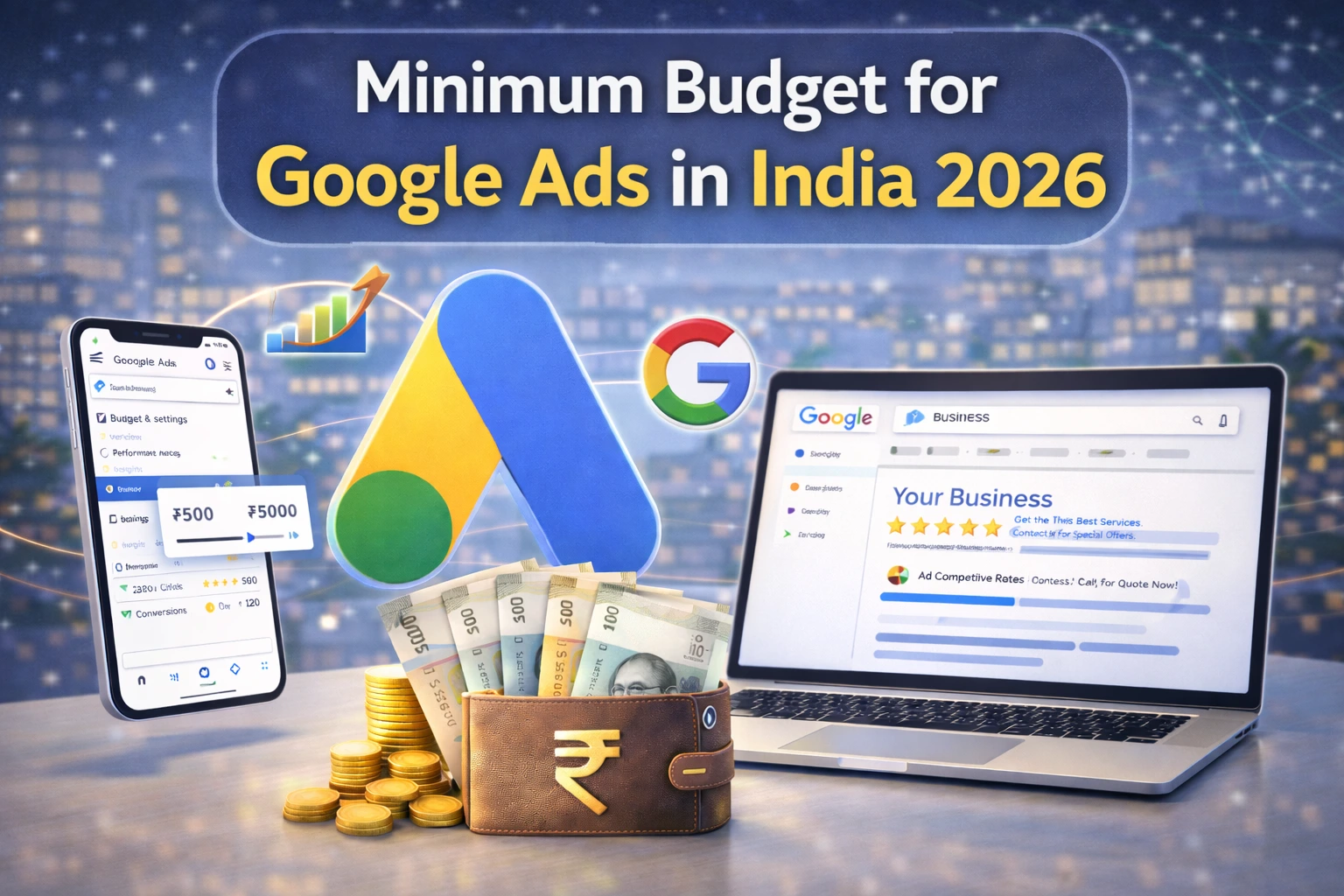
“What’s the minimum budget for google ads in india?” This is hands down the most common question I hear from small business owners, startups, and entrepreneurs across the country. And honestly, it’s the right question to ask. When you’re watching every rupee, you need to know what actually works not just what’s technically possible.
The truth is, there’s no single fixed answer. Your Google Ads budget depends on multiple factors including your industry, competition level, target location, and campaign goals. The platform technically allows any budget, but practical experience shows that spending too little leads to wasted money, not saved money. Understanding the true minimum budget for google ads in india means looking beyond the platform’s flexibility to what actually delivers real results, consistent leads, calls, and sales. In this guide, I’ll break down exactly what you need to budget based on real data, industry benchmarks, and proven campaign strategies.
How Does Google Ads Pricing Work in India?
Before diving into specific numbers, it’s essential to understand how Google Ads pricing actually works. Unlike traditional advertising where you pay a flat fee, Google uses an auction-based system where you bid for ad placement.
1. The Auction System Explained
Every time someone searches on Google, an automated auction takes place in milliseconds. Google evaluates all ads targeting that search term and decides which ones to show and in what order. The formula is simple:
Ad Rank = Maximum Bid × Quality Score
Your ad position depends on this calculation not just how much you’re willing to pay, but how relevant and useful your ad is to searchers.
2. Key Factors That Determine Your Cost
Several factors influence what you’ll actually pay per click:
- Your Bid: This is the maximum amount you’re willing to pay for a click. You can set this manually or let Google’s automated bidding do it for you.
- Quality Score: Google rates your ads on a scale of 1-10 based on expected click-through rate, ad relevance, and landing page experience. Higher Quality Score directly translates to lower costs and better positions.
- Competition: More advertisers bidding on the same keywords drives prices up. In India, metro cities like Delhi, Mumbai, and Bangalore see significantly higher competition than Tier-2 and Tier-3 cities.
- Industry: Some industries naturally cost more because each click carries higher potential value. Finance, real estate, and legal services consistently show higher CPCs than retail or local services.
- Location: Advertising in major metros costs substantially more than targeting smaller cities or specific pin codes. A hyper-local approach within 5-10 km radius can dramatically reduce costs.
3. Understanding Key Pricing Terms
- CPC (Cost Per Click): What you pay each time someone clicks your ad. This is the most common pricing model for Search Ads.
- CPM (Cost Per Mille): Cost per 1,000 impressions, primarily used for Display Network campaigns focused on awareness.
- CPA (Cost Per Acquisition): The total cost divided by the number of conversions – the metric that actually matters for your business.
- Quality Score: Google’s 1-10 rating of your ad relevance, which directly impacts both your costs and ad positions.
Average Google Ads Cost in India (2026 Data)
Based on current market data from multiple sources, here’s what businesses can expect to pay for Google Ads in India in 2026.
1. Cost Per Click (CPC) Benchmarks
- Search Network CPC: ₹5 – ₹30+ on average, varying significantly by industry and competition.
- Display Network CPC: ₹1 – ₹10, considerably cheaper but with different intent signals.
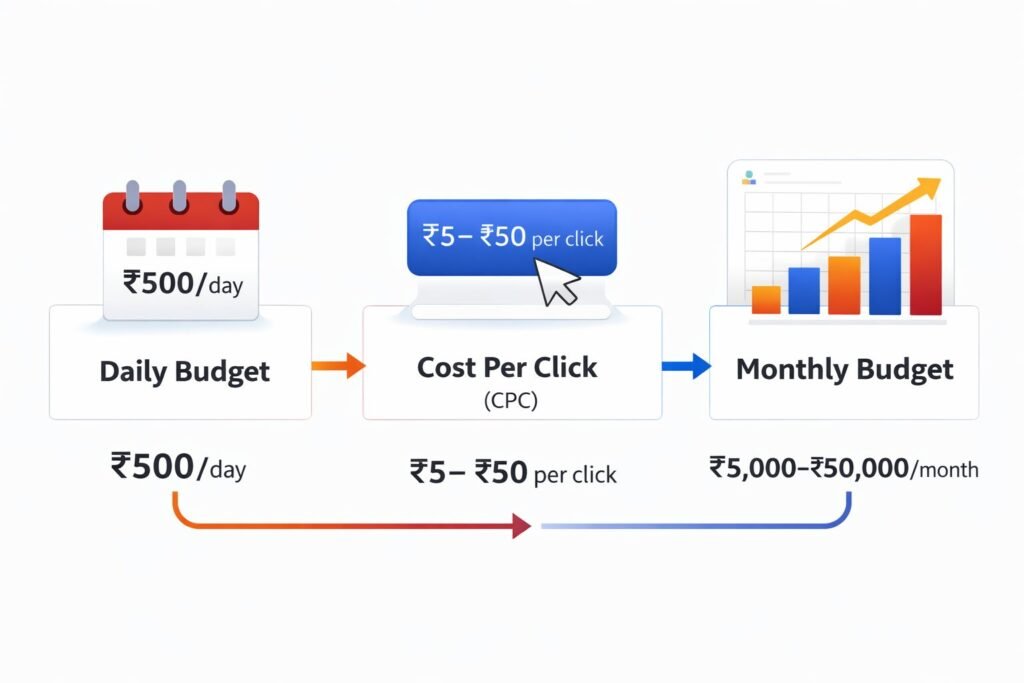
- Overall Average CPC: ₹5 – ₹50 across all industries and campaign types
2. Daily and Monthly Budget Ranges
Different business sizes and goals require different investment levels:
- Small Local Business: ₹300 – ₹800 per day (approximately ₹9,000 – ₹24,000 per month).
- Medium Companies: ₹1,500 – ₹5,000 per day (₹45,000 – ₹1,50,000 per month).
- Large Companies: ₹5,000+ per day for competitive markets and national campaigns.
3. Agency Management Fees
If you’re considering hiring professionals to manage your campaigns, here are typical fee structures in India:
- Basic PPC Management: ₹20,000 – ₹40,000 per month for foundational campaign setup and monitoring.
- Standard PPC Growth: ₹40,000 – ₹80,000 per month for active optimization and scaling.
- Advanced PPC Performance: ₹80,000 – ₹1,50,000 per month for comprehensive strategy and management.
- Enterprise/High-Spend: ₹1,50,000 – ₹3,00,000+ per month for large-scale, competitive campaigns.
Note: These fees are separate from your actual Google Ads spend, which you pay directly to Google.
Industry-Wise Google Ads Cost in India
Different industries see dramatically different costs based on competition, customer lifetime value, and search intent. Here’s what you can expect in 2026:
| Industry | Avg CPC (₹) | Competition Level |
|---|---|---|
| E-commerce | ₹10 – ₹30 | High |
| Education & Coaching | ₹15 – ₹50 | Medium-High |
| Healthcare & Clinics | ₹20 – ₹70 | Medium-High |
| Real Estate | ₹30 – ₹100+ | Very High |
| Finance & Insurance | ₹30 – ₹150+ | Very High |
| Legal Services | ₹25 – ₹75 | High |
| Local Services (Plumber, Electrician) | ₹5 – ₹15 | Low-Medium |
| Automotive | ₹15 – ₹50 | Medium |
| Travel & Hospitality | ₹10 – ₹30 | Medium |
For context, here’s how India compares to global averages:
- Banking/Finance: $0.37 globally (approximately ₹30-₹32 in India equivalent).
- Healthcare: $0.54 globally (approximately ₹45-₹47).
- Legal: $0.32 globally (approximately ₹27-₹28).
- Education: $0.32 globally (approximately ₹27-₹28).
- E-commerce: $0.14-0.57 globally (₹12-₹48).
India remains one of the most cost-effective markets for Google advertising globally, with CPCs 30-70% cheaper than US/UK markets.
Minimum Budget Required for Google Ads in India (Realistic Range)
Now for the question you came here to answer: What’s the real minimum budget that actually works?
1. Technical Minimum vs Practical Reality
Google doesn’t enforce an official minimum spend you could technically run ads with any budget. However, practical experience across thousands of campaigns shows that budgets below a certain threshold simply cannot generate enough data to optimize effectively.
The realistic minimums are:
- Daily Budget: ₹500 – ₹1,000 per day.
- Monthly Budget: ₹15,000 – ₹30,000 per month.
- Absolute minimum for any results: ₹5,000/month, though this rarely generates meaningful outcomes.
2. Budget by Business Type
Different business models need different investment levels to succeed:
- Local Shop/Small Service: ₹5,000 – ₹15,000 per month is realistic for testing local keywords and generating initial leads.
- E-commerce Store: ₹15,000 – ₹50,000 per month supports search ads for top products and Google Shopping campaigns.
- B2B or High-Ticket Service: ₹20,000 – ₹60,000+ per month for competitive B2B keywords and professional services.
- Real Estate/Education: ₹25,000 – ₹50,000+ per month due to high competition and valuable leads.
3. What Happens Below the Minimum Threshold
Running campaigns with insufficient budget leads to predictable problems:
- Limited visibility: Your ads show sporadically, never building momentum.
- Very few clicks: Not enough data for Google’s algorithm to learn and optimize.
- No room for testing: You can’t test different keywords, ads, or audiences.
- Stuck in learning phase: Campaigns never exit the initial optimization period.
- Poor lead quality: The few clicks you get are often from low-intent searchers.
Real Examples by Business Type
Let me share realistic scenarios based on actual campaign data:
Example 1: Local Service Business (Plumber, Electrician, Salon)
- Target area: 5-10 km radius around your location
- Average CPC: ₹10 – ₹30 per click
- Daily budget: ₹500
- Monthly budget: ₹15,000
- Expected outcome: 20-40 clicks per day, 15-30 leads per month depending on landing page and call handling quality.
This is one of the easiest segments to run Google Ads successfully with a relatively low budget because competition is local and intent is high.
Example 2: Digital Marketing or IT Services
- Target area: City or state level targeting
- Average CPC: ₹50 – ₹150 per click (competitive sector)
- Daily budget: ₹1,000
- Monthly budget: ₹30,000
- Expected outcome: 200-400 clicks per month, 10-25 qualified leads requiring careful nurturing.
For service-based businesses, lead quality matters far more than volume, making optimization critical.
Example 3: Education, Coaching, or Training Institutes
- Target area: City or multi-city targeting
- Average CPC: ₹40 – ₹120 per click
- Daily budget: ₹800 – ₹1,200
- Monthly budget: ₹25,000 – ₹40,000
- Expected outcome: 15-40 enquiries per month, with stronger results from well-optimized landing pages and follow-up systems.
Example 4: Small E-commerce Business
- Campaign type: Search + Shopping Ads combination
- Daily budget: ₹1,000 – ₹2,000
- Monthly budget: ₹30,000 – ₹60,000
- Expected outcome: Initial sales data for optimization, with ROAS improving gradually over 2-3 months as you identify winning products.
For e-commerce, very low budgets rarely work due to product competition and the need for sufficient data to optimize Shopping campaigns.
Factors That Affect Your Google Ads Cost
Understanding what drives your costs helps you control them. Here are the most significant factors:
1. Quality Score
Quality Score is Google’s rating of your ad relevance on a 1-10 scale. It directly impacts your costs a higher Quality Score means lower CPC and better ad positions.
The three components are:
- Expected click-through rate
- Ad relevance to the search query
- Landing page experience
Improving these factors is the single most effective way to reduce your costs while maintaining performance.
2. Keyword Competition
High demand keywords naturally cost more. For example, “insurance” or “real estate agent” have dozens of advertisers competing, driving up CPCs.
Smart advertisers use:
- Long-tail keywords (3-5 word phrases) with lower competition
- Phrase match and exact match to control when your ads show
- Negative keywords to block irrelevant searches and wasted spend
3. Location Targeting
Where you target dramatically impacts costs:
- Metro cities (Delhi, Mumbai, Bangalore, Chennai): Highest CPC due to competition density
- Tier-2 cities (Pune, Ahmedabad, Jaipur, Lucknow): Moderate CPC with good opportunity
- Tier-3 cities and towns: Lower CPC, often with less competition
- Hyper-local radius targeting: Most cost-effective for local businesses, reaching only customers within 5-10 km
4. Campaign Type
Different campaign objectives come with different cost structures:
- Search Ads: Higher CPC but intent-driven traffic ready to take action
- Display Ads: Lower CPC but awareness-focused, requiring more impressions
- Shopping Ads: Product-based, cost-effective for e-commerce with good product data
- Video/YouTube Ads: Cost per view basis, great for brand building
5. Seasonality
Advertising costs fluctuate throughout the year:
- Q4 (October-December): Highest CPCs due to Diwali, Christmas, and holiday shopping
- January-March: Typically lower costs as competition decreases
- Industry-specific peaks: Education sees spikes before exam results and admission seasons; travel peaks during holiday periods
How to Start Google Ads with a Limited Budget
If you’re working with a modest budget, don’t worry success is still possible with the right approach.
1. Smart Approach for Small Budgets
- Start with Search Ads only. Skip Display, Video, and Shopping until you have proven what works.
- Pick one simple goal. Focus on calls OR leads OR sales not everything at once.
- Target high-intent, local keywords. Focus on “near me” searches, specific services, and local intent.
- Use phrase and exact match keywords. Broad match triggers too many irrelevant searches for small budgets.
- Focus on one service or product. Don’t spread your budget across your entire catalog initially.
- Target a small location area. Start with a specific city or 5-10 km radius, then expand.
- Set up conversion tracking from day one. You can’t optimize what you don’t measure.
2. Tips to Stretch Every Rupee
- Use negative keywords weekly: Block irrelevant searches that waste your budget.
- Add ad extensions: Call extensions, sitelinks, and WhatsApp extensions improve CTR without extra cost.
- Run ads only during business hours: No point paying for clicks when you can’t answer calls.
- Check search term reports weekly: See exactly what people are searching when your ads show and add negatives for irrelevant terms.
- Pause underperforming keywords: Don’t let low performers drain your budget.
- Start with ₹200-₹300/day test budget: Gather data before scaling.
3. What to Track
Success depends on measuring the right metrics:
- Cost per click (CPC): Your basic cost metric
- Cost per lead (CPL): What each inquiry costs you
- Conversion rate: Percentage of clicks that become leads
- Click-through rate (CTR): Indicates ad relevance
- Return on ad spend (ROAS): Revenue divided by ad cost – the ultimate measure
Common Google Ads Mistakes That Waste Budget
Many businesses fail with Google Ads not because the platform doesn’t work, but because of common, avoidable mistakes:
| Mistake | Why It Hurts |
|---|---|
| Using only broad keywords | Triggers clicks on completely irrelevant searches, wasting budget |
| No negative keywords | Pays for uninterested users who will never convert |
| Sending traffic to homepage | Low conversion rates because visitors must search for what they want |
| No conversion tracking | Can’t measure ROI or optimize toward what works |
| Ignoring mobile optimization | Loses the growing mobile search traffic segment |
| No ad extensions | Lower CTR and Ad Rank, increasing costs |
| Setting and forgetting | Costs creep up over time without regular optimization |
| Targeting too broad area | Wastes budget on users too far away to visit |
How Dizispark Can Help
If you’re ready to run Google Ads that actually deliver results without wasting your budget, Dizispark can help you navigate the complexities of Google advertising. From campaign strategy and keyword research to conversion tracking and performance optimization, we ensure every rupee works harder for your business. Our team understands the Indian market, the regional nuances, and the budget constraints that real businesses face. We don’t believe in one size fits all approaches every campaign is tailored to your specific goals, industry, and target audience.
Dizispark for a consultation and discover how we can help you achieve your advertising goals with a customized approach to the minimum budget for google ads in india. Whether you’re a local service business just starting out or an established brand looking to scale, we’ll help you build campaigns that generate real, measurable results.
Conclusion
Finding the right minimum budget for google ads in india isn’t about the lowest possible number – it’s about investing enough to actually get results. While there’s no official minimum spend, practical experience across thousands of campaigns shows that ₹500-₹1,000 daily (₹15,000-₹30,000 monthly) is the realistic starting point for meaningful outcomes. With average CPC ranging from ₹5 to ₹50 depending on your industry, Google Ads remains one of the most powerful channels for Indian businesses to reach high-intent customers actively searching for their products or services.
It’s having a smart strategy. Start small, test everything, track your metrics, and scale what works. Businesses that succeed with Google Ads focus on Quality Score, use negative keywords religiously, target locally, and optimize continuously based on data, not guesses. With the right approach, even a modest budget can generate consistent leads, calls, and sales that deliver positive ROI from month one.
Frequently Asked Questions
What is the minimum budget for Google Ads in India?
The practical minimum daily budget is ₹500-₹1,000, which translates to ₹15,000-₹30,000 per month. Budgets below ₹5,000/month rarely generate meaningful results due to limited data and visibility.
How much do Google Ads cost per click in India?
Average CPC in India ranges from ₹5 to ₹50 depending on your industry. Local services can be as low as ₹5-₹15, while competitive sectors like finance and real estate may reach ₹100-₹150+ per click
Can small businesses afford Google Ads in India?
Yes. Small local businesses can start with ₹5,000-₹15,000 per month by focusing on local keywords, using phrase/exact match, and targeting a specific city or radius. Success depends on smart optimization, not high spending.
What is the average CPC for e-commerce in India?
E-commerce CPC typically ranges from ₹10 to ₹30. Shopping ads combined with search campaigns often provide cost-effective results with good ROAS when optimized properly.
How does Quality Score affect my Google Ads cost?
Quality Score directly impacts your CPC. Higher Quality Score (8-10) means lower costs and better ad positions. Google rewards relevant ads with good landing pages and high expected CTR by charging less per click.
What’s the difference between Google Ads budget and agency management fees?
Google Ads budget is paid directly to Google for your clicks. Agency management fees (₹20,000-₹3,00,000+/month) are separate and cover campaign setup, optimization, reporting, and strategic guidance.