The impact of digital marketing on consumer behavior has been one of the most researched and practically significant topics in marketing over the past decade. It has transformed how consumers discover products, evaluate options, compare prices, read reviews, and make final purchase decisions. Research published in the Journal of Management Research and Analysis confirms that digital marketing plays a significant role in shaping consumer awareness, attitude, and preferences towards products and services. For businesses in India, understanding the impact of digital marketing on consumer behavior is not an academic exercise. It is the foundation of every effective marketing strategy.
This complete guide synthesizes the latest 2026 research on the impact of digital marketing on consumer behavior with verified data and practical implications for Indian businesses. Every finding is backed by peer-reviewed research and industry data listed at the end of each section.
Table of Contents
ToggleThe Impact of Digital Marketing on Consumer Behavior: Key Statistics for India 2026
Before examining the specific mechanisms, the scale of the impact of digital marketing on consumer behavior must be understood through data:
- 78% of Indian consumers research products online before buying, according to IBEF’s 2024 digital marketing report.
- 84.3% of Indian internet users are aware of social media marketing, according to research from the Journal of Management Research and Analysis (Tailor and Kaur, 2023).
- 52.9% of surveyed Indian consumers have chosen online shopping as their preferred purchasing method, according to the same JMRA research study.
- India’s digital marketing industry grew from USD 2.39 billion in FY20 to USD 6.46 billion in FY24 at a CAGR of 28.5%, reflecting the scale at which digital channels are shaping consumer decisions.
- India’s influencer marketing industry is expected to reach Rs. 28 billion by 2026, according to IBEF, demonstrating the scale of digital influence on consumer choices.
- 73% of shoppers use multiple digital channels during their shopping journey, according to a Harvard Business Review survey, confirming the multi-platform nature of the modern consumer experience.
- Digital media now represents 44% of total advertising spending in India, according to the Financial Express, confirming a fundamental shift in how businesses reach and influence consumers.
Key Takeaway:
The impact of digital marketing on consumer behavior in India is not incremental. It is structural. Consumers no longer rely on physical browsing, salespeople, or word of mouth alone. They use search engines, social media, reviews, influencers, emails, and comparison websites before making almost every significant purchase decision.
8 Key Ways the Impact of Digital Marketing on Consumer Behavior Is Felt
Research consistently identifies these 8 mechanisms through which the impact of digital marketing on consumer behavior operates in practice:
1. Increased Awareness and Product Discovery
The first and most foundational impact of digital marketing on consumer behavior is awareness creation. Before digital marketing, consumers were limited to the brands and products they encountered physically or through traditional media. Digital marketing through search engines, social media, email, and display advertising now gives even the smallest businesses global discovery potential. Research by Kannan (2017) confirms that digital marketing can increase consumer awareness through various channels by providing relevant information that helps consumers understand product benefits and consider purchasing.
2. Shift in Information Search Behavior
One of the most significant ways the impact of digital marketing on consumer behavior manifests is in how consumers search for information before buying. Before digital marketing existed, consumers relied on salespeople, brochures, and personal recommendations. Today, consumers can access product reviews, pricing comparisons, competitor analysis, and user-generated content within seconds. The JMRA research study found that customers now use digital platforms not only to shop but also to compare prices, product features, and after-sale service facilities before making any purchase decision.
3. Personalization and Targeted Marketing
Personalization is one of the most measurable channels through which digital marketing shapes consumer behavior. It allows marketers to personalize messages based on demographics, interests, past purchase behavior, and browsing history. According to the JMRA research study, personalized messaging creates a sense of connection with consumers and makes them more likely to engage with a brand and purchase its products. The surge in online transactions since the COVID-19 pandemic has intensified consumer expectations for personalized experiences. Companies that fail to personalize are increasingly losing customers to those that do.
4. Social Proof and Review-Driven Decisions
The impact of digital marketing on consumer behavior is strongly mediated by social proof. Digital marketing platforms showcase positive reviews, ratings, and testimonials from other consumers, building trust and reducing the perceived risk of purchasing online. Research by Dwivedi and Ismagilova (2021) confirms that social proof mechanisms in digital marketing significantly lower barriers to making purchases online. For Indian consumers, online reviews on platforms like Google, Amazon, Flipkart, Zomato, and Practo are now primary trust signals before any purchase.
5. Convenience and Reduced Friction in Purchasing
Digital marketing makes the purchasing process fundamentally more convenient, which directly influences consumer buying decisions. Online access to pricing information, product specifications, availability, and instant checkout removes the time and geographic barriers of traditional retail. The JMRA study confirms that eliminating barriers to purchase through digital channels increases the likelihood that consumers will complete a purchase. For Indian consumers in tier-2 and tier-3 cities, digital marketing has opened access to products and price points previously available only in metros.
6. Influencer Marketing and Opinion Leadership
Influencer marketing represents a major channel of the impact of digital marketing on consumer behavior in India. With influencers acting as trusted opinion leaders in specific niches, their recommendations carry the credibility of personal referrals combined with the reach of mass media. India’s influencer marketing industry is expected to reach Rs. 28 billion in 2026, according to IBEF. Research from IJNRD (2024) confirms that digital marketing strategies, including influencer collaborations, shape consumer behavior through real-time feedback and interactive engagement that traditional advertising cannot replicate.
7. Brand Loyalty and Repeat Purchase Behavior
The long-term impact of digital marketing on consumer behavior extends beyond the first purchase into brand loyalty and repeat buying patterns. Email marketing, loyalty programme messaging, retargeting campaigns, and social media engagement all contribute to keeping existing customers connected to a brand. Research by Rosario et al. (2021) confirms that email marketing remains a highly effective method for driving consumer engagement and repeat sales. Brands that maintain consistent digital marketing touchpoints with existing customers significantly reduce churn and increase lifetime customer value.
8. Mobile-First Buying Behavior
Mobile commerce represents one of the most India-specific consumer behavior shifts. With over 91% of internet users accessing the web through mobile devices, according to ResearchGate’s 2023 comprehensive review of digital marketing on consumer behavior, smartphones have become the primary device for product discovery, research, comparison, and purchase. In India, where mobile internet penetration has dramatically outpaced fixed broadband, the mobile experience of a brand’s digital marketing directly shapes consumer purchasing decisions for the majority of the population.
The Impact of Digital Marketing on Consumer Behavior at Each Buying Stage
The impact of digital marketing on consumer behavior operates differently at each stage of the consumer decision-making process. Here is how digital marketing influences each stage:
| Buying Stage | How Digital Marketing Influences It | Primary Digital Channels |
| 1. Awareness | SEO, social ads, and display advertising introduce consumers to brands they did not know existed | Google Search Ads, Instagram Reels, YouTube Ads, Meta Display |
| 2. Information Search | SEO-optimised content, reviews, comparison sites, and YouTube videos answer consumer research questions | Google organic search, YouTube, Product comparison sites, Review platforms |
| 3. Evaluation of Alternatives | Side-by-side product comparisons, influencer reviews, ratings, and social proof help consumers shortlist | Instagram, Amazon reviews, Zomato, Google reviews, Influencer YouTube |
| 4. Purchase Decision | Retargeting ads, personalised email offers, limited-time discounts, and WhatsApp follow-ups trigger final purchase | Meta retargeting, Email marketing, WhatsApp Business, Google Shopping |
| 5. Post-Purchase Behaviour | Email sequences, social media engagement, loyalty programmes, and review requests build repeat buying | Email automation, WhatsApp reminders, Instagram community, Loyalty apps |
| programmes, and review requests build repeat buying |
The Impact of Digital Marketing on Consumer Behavior in India: Specific Findings
Research specific to Indian consumers shows several distinctive patterns in the impact of digital marketing on consumer behavior:
- Internet revolution driven by affordable telecom plans caused social media activity in India to increase by 200%, permanently altering the information-seeking behavior of Indian consumers (Tailor and Kaur, 2023).
- Price sensitivity is uniquely high in India, and digital marketing platforms that enable instant price comparison to have made Indian consumers more price-aware than any previous generation. Customers use digital channels specifically to compare prices and after-sale service before purchasing.
- Youth consumer dominance shapes the digital consumer landscape: over 65% of India’s population is under 35. Digital marketing’s impact is most pronounced among consumers aged 18 to 35, who prefer online shopping over traditional retail.
- Tier-2 and tier-3 city digital penetration has transformed previously offline markets. Consumers in smaller Indian cities now discover, research, and purchase products through digital channels at rates comparable to metro consumers, driven by affordable mobile data.
- Trust in digital reviews is now comparable to personal recommendations for most Indian consumers, according to research by Dwivedi and Ismagilov (2021). Google reviews, Amazon ratings, and Zomato scores are primary trust signals in purchase decisions.
- India’s e-commerce market is forecast to reach USD 200 billion by 2027, according to IBEF, driven entirely by the shift in consumer behavior that digital marketing has enabled.
Pro Tip:
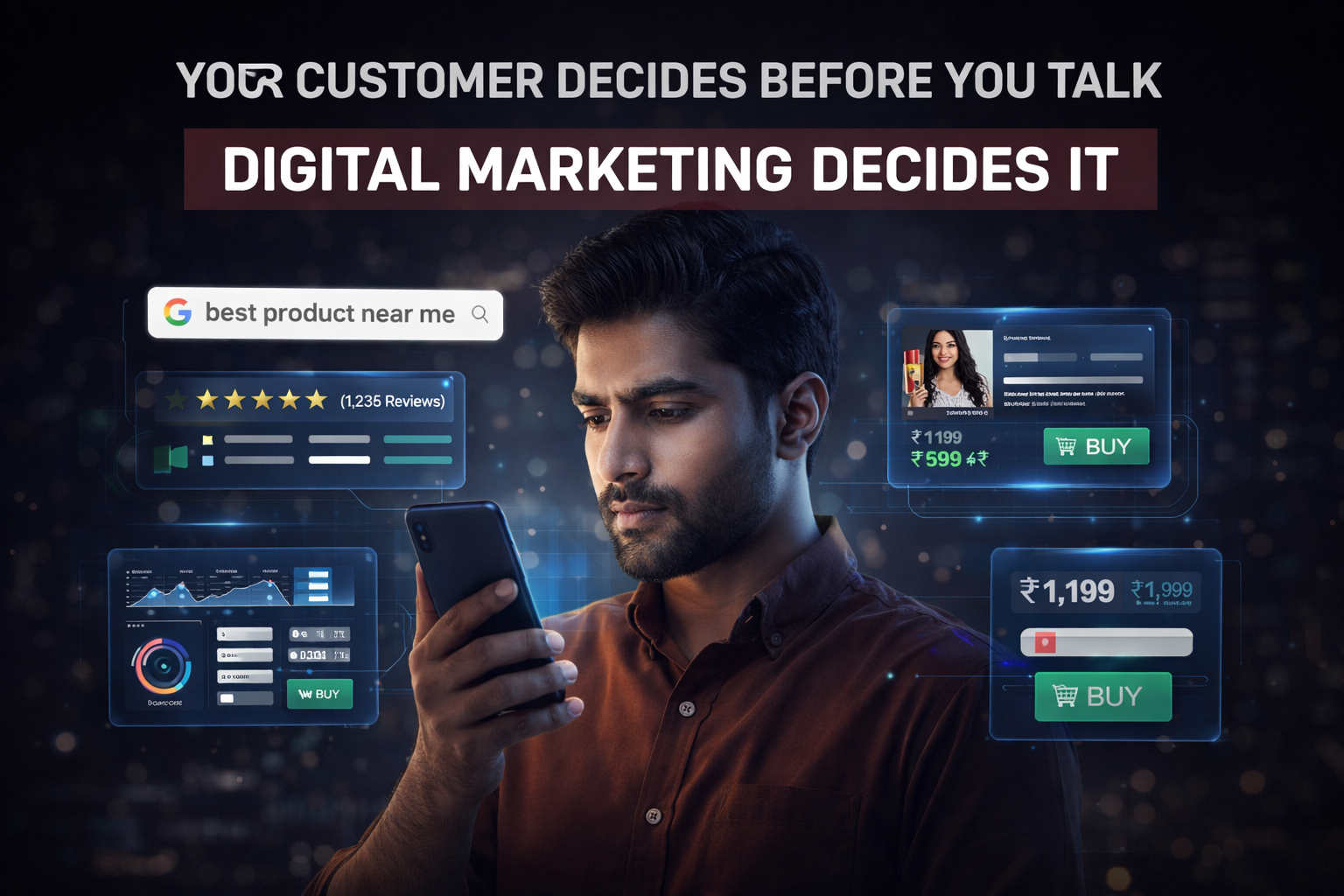
For Indian businesses, the most important implication of the research on the impact of digital marketing on consumer behavior is this: your customer’s buying decision is largely made before they contact you. They have already searched Google, read your reviews, compared you with competitors, and checked your social media. Your digital marketing strategy is your sales process.
Conclusion
The research is unambiguous: the impact of digital marketing on consumer behavior is profound, measurable, and growing. From the 78% of Indian consumers who research products online before buying, to the 44% share of total advertising now claimed by digital media, every data point confirms that consumers have fundamentally changed how they discover brands, evaluate options, and make purchases.
For businesses in India, understanding this shift means recognizing that digital marketing is no longer a support function. It is the primary channel through which consumers form impressions of your brand, build trust, and make buying decisions. The businesses that invest in this shift are capturing a disproportionate share of Indian consumer spending in 2026 and beyond.
How Dizispark can Help
Every finding in this guide on the impact of digital marketing on consumer behavior has a direct practical application for your business. Dizispark builds complete digital marketing strategies for Indian businesses that are designed around how your specific target consumers actually search, evaluate, and decide.
We manage SEO to capture consumers during their information search phase, social media content and paid ads to create awareness and build trust, influencer partnerships to leverage social proof, WhatsApp automation to reduce friction at the purchase stage, and email campaigns to drive repeat buying behavior. We combine consumer behavior research with real performance data from your campaigns to consistently improve your cost per acquisition. Get your free Digital Marketing Strategy Audit today and discover exactly where your current marketing is losing consumers before they convert.
Frequently Asked Questions
What is the impact of digital marketing on consumer behavior?
The impact of digital marketing on consumer behavior encompasses changes across every stage of the buying process. Digital marketing has increased consumer awareness of products and brands globally, shifted information search from physical to online sources, enabled personalized marketing experiences, amplified social proof through reviews and ratings, reduced friction in the purchase process, created new opinion leadership through influencers, and built loyalty through consistent post-purchase digital engagement. Research confirms it plays a significant role in shaping consumer attitudes, preferences, and purchase decisions.
How has digital marketing changed consumer buying behavior in India?
Digital marketing has changed Indian consumer buying behavior in several specific ways. 78% of Indian consumers now research products online before buying. The internet revolution driven by affordable mobile data increased social media activity in India by 200%. 52.9% of surveyed Indian consumers have adopted online shopping as their preferred purchasing channel. Price comparison behavior has intensified as digital platforms make it trivial to compare multiple options simultaneously. Tier-2 and tier-3 city consumers now access the same products and price information as metro consumers.
How does social proof in digital marketing affect consumer decisions?
Social proof through digital marketing, including online reviews, star ratings, testimonials, and user-generated content, significantly reduces the perceived risk of purchasing. Research by Dwivedi and Ismagilova (2021) confirms that social proof mechanisms in digital marketing lower barriers to online purchase by providing independent validation of product quality and seller reliability. For Indian consumers, Google reviews, Amazon ratings, and platform-specific ratings on Zomato and Practo have become primary trust signals that directly determine which business receives the purchase.
What role does personalization play in digital marketing’s impact on consumer behavior?
Personalization is one of the most powerful mechanisms of digital marketing’s influence on consumer behavior. When consumers receive marketing messages relevant to their specific interests, past behavior, and purchase history, they are significantly more likely to engage and convert. Research in the JMRA study confirms that personalized messaging creates a sense of connection with consumers and increases purchase likelihood. Businesses that use data analytics to personalize their digital marketing communications consistently achieve higher conversion rates and greater customer retention than those sending generic messages.
How does mobile marketing affect consumer behavior in India?
Mobile marketing has a particularly significant impact on Indian consumer behavior given that over 91% of internet users access the web via mobile devices. The majority of product searches, price comparisons, review reading, and online purchases by Indian consumers happen on smartphones. Mobile marketing enables location-based targeting, instant WhatsApp communication, mobile-optimized shopping experiences, and push notification campaigns that meet consumers at the exact moment of purchase intent. Businesses with poorly optimized mobile experiences lose a large proportion of potential customers before a sales conversation even begins.
What is the impact of influencer marketing on consumer behavior in India?
Influencer marketing has a significant and growing impact on Indian consumer behavior. With India’s influencer marketing industry expected to reach Rs. 28 billion in 2026, influencers function as trusted opinion leaders whose product recommendations carry the credibility of personal referrals combined with media-scale reach. Micro-influencers with 10,000 to 100,000 followers in specific niches deliver particularly high engagement and purchase intent among their audiences. IBEF research confirms that influencers play a key role in shaping consumer behavior, particularly among India’s large young consumer demographic.
How does email marketing affect consumer purchase behavior?
Email marketing affects consumer purchase behavior at two primary stages: initial purchase conversion and repeat buying. Research by Rosario et al. (2021) confirms that email marketing remains a highly effective method for consumer engagement and sales. Personalized email campaigns with product recommendations based on past behavior, abandoned cart reminders, exclusive offer announcements, and post-purchase follow-up sequences all significantly influence consumer purchasing decisions. For Indian businesses, WhatsApp marketing delivers equivalent or higher engagement than email given India’s 98% WhatsApp message open rate.
How should Indian businesses respond to the impact of digital marketing on consumer behavior?
Indian businesses should respond to the impact of digital marketing on consumer behavior by building digital presence across the channels their specific target consumers use most. This means optimizing for Google search to capture the information search phase, building reviews and social proof on Google, Zomato, Practo, or Amazon depending on the industry, creating consistent social media content to build awareness and trust, using personalized email and WhatsApp marketing for conversion and retention, and partnering with relevant micro-influencers to leverage social proof at scale. Businesses that align their digital marketing with the actual research-verified behavior of their target consumers consistently outperform those that market without this framework.