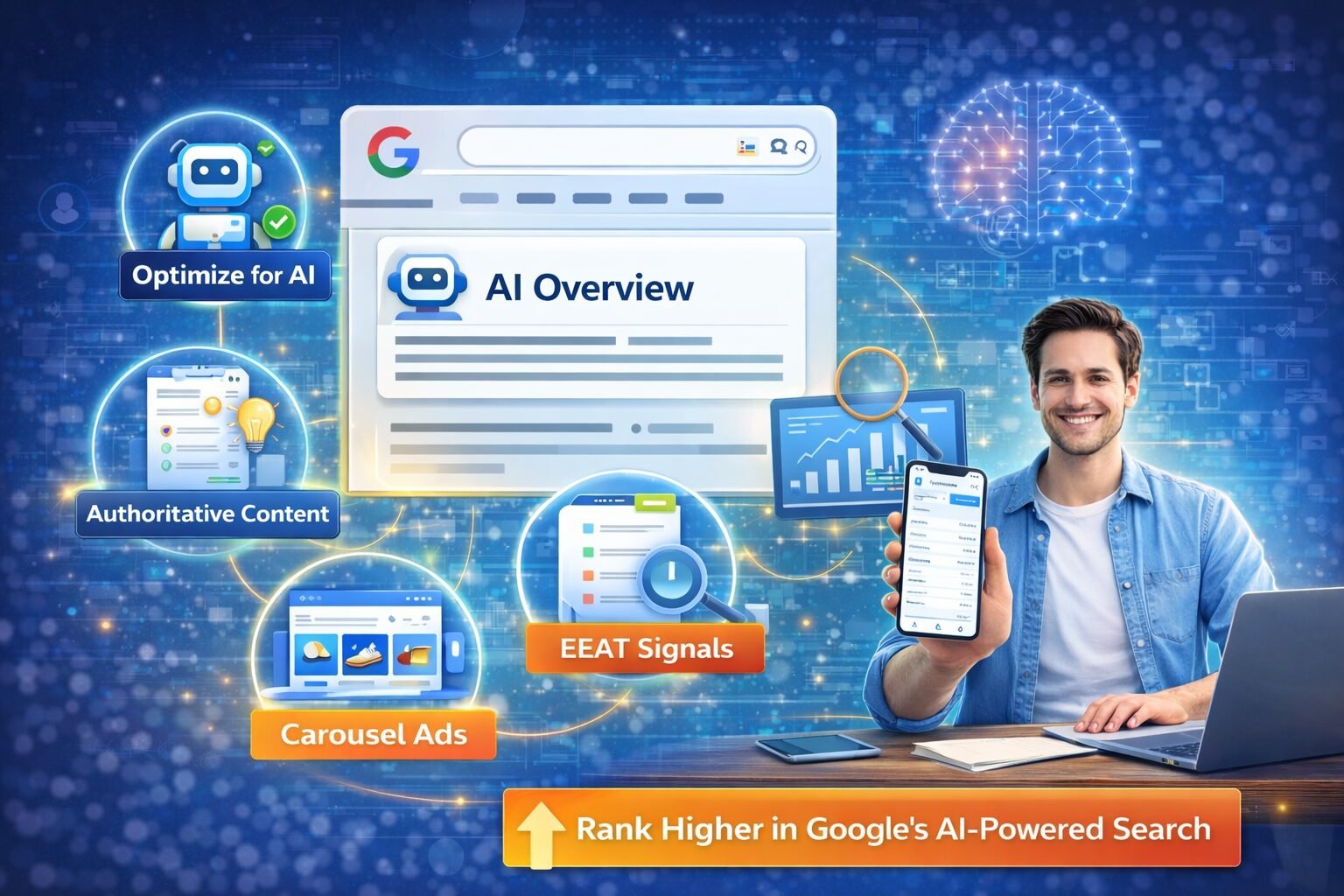
Search engines are evolving faster than ever. In 2026, Google search results are no longer just a list of links. Instead, users often see AI-generated summaries at the top of the page, known as AI Overviews. These summaries provide quick answers to search queries by combining information from multiple trusted sources. For website owners, marketers, and SEO professionals, this creates a new challenge: Ranking in traditional results is not enough anymore. To stay visible, your website must rank in Google AI Overviews. This guide explains how AI Overviews work and the proven strategies you can use to optimize your content for AI-powered search.
What Are Google AI Overviews?
Google AI Overviews are AI-generated answer summaries displayed at the top of search results. Instead of showing only blue links, Google provides a summarized explanation generated from multiple trusted sources.
These summaries usually include:
- Key insights from multiple websites
- Bullet-point explanations
- Links to supporting sources
- Suggestions for follow-up questions
This new search format helps users get answers quickly without visiting multiple pages.
However, it also means websites that are not included in AI Overviews may lose visibility.
How Google AI Overviews Work
Google AI Overviews are powered by advanced AI models that analyze search queries and retrieve information from Google’s index.
The system works in four steps:
- Understand the search intent
- Analyze relevant web pages
- Extract important information
- Generate a summarized response
Unlike featured snippets, which usually quote one page, AI Overviews combine information from multiple sources to produce a comprehensive answer. This means several websites can be cited within a single AI response.
Why Ranking in AI Overviews Is Important in 2026
Search behavior has changed significantly due to AI-powered results. Industry research indicates that AI summaries appear in a large percentage of informational searches. At the same time, studies show AI Overviews can reduce click-through rates by around 34.5%.
This creates two scenarios.
1. If your site is not featured
- Less organic traffic
- Lower visibility
- Reduced brand awareness
2. If your site is cited in AI Overviews
- Higher brand authority
- Greater visibility
- Increased user trust
For modern SEO strategies, being included in AI results is becoming more valuable than traditional rankings.
Key Ranking Factors for Google AI Overviews
Google AI selects sources using several quality signals.
Important ranking factors include:
1. Content Clarity
Clear explanations help AI understand and summarize content.
2. Structured Content
Proper headings and formatting improve AI readability.
3. EEAT Signals
Google evaluates Experience, Expertise, Authoritativeness, and Trustworthiness.
4. Semantic Relevance
Content should include related concepts and contextual keywords.
5. Fresh Information
Updated content signals accuracy and reliability.
Google AI prefers pages that provide complete answers in a clear and structured format.
10 Proven Strategies to Rank in Google AI Overviews
1. Write Question-Based Content
AI search engines prioritize content that answers real questions.
Instead of targeting only keywords, create content around queries like:
- How do Google AI Overviews work?
- How to optimize content for AI search?
- What is AI SEO?
Question-driven content increases the chances of appearing in AI summaries.
2. Provide Immediate Answers
Always answer the main question within the first 50–60 words.
A good structure is:
- First paragraph → Direct answer
- Second paragraph → Explanation
- Remaining sections → Examples and details
This structure helps AI extract content quickly.
3. Structure Content for AI Readability
Clean formatting helps both readers and AI systems.
Use:
- Clear H1, H2, H3 headings
- Short paragraphs
- Bullet points
- Numbered steps
Structured content is easier for AI to interpret and cite.
4. Use Semantic SEO
Instead of repeating the same keyword, include related phrases such as:
- AI search optimization
- Generative engine optimization
- AI-powered search results
- SGE ranking strategies
Semantic SEO helps Google understand topic depth.
5. Implement Structured Data (Schema Markup)
Structured data helps search engines understand your content better.
Useful schema types include:
- FAQ schema
- Article schema
- Organization schema
You can learn more about structured data at Proper schema markup improves AI comprehension of page content.
6. Optimize for Search Intent
Before creating content, analyze the top search results for your keyword.
Identify whether the intent is:
- Informational
- Navigational
- Commercial
- Transactional
Matching user intent increases engagement and improves ranking chances.
7. Build Topical Authority
Google prefers websites that consistently publish content on a specific topic.
Instead of writing unrelated articles, build topic clusters such as:
- AI SEO guides
- AI search optimization tutorials
- Generative search marketing strategies
This strengthens your expertise signals.
8. Update Content Regularly
AI prefers fresh and updated information.
Best practice:
- Update content every 3–6 months
- Add new statistics and examples
- Expand sections with new insights
Fresh content improves credibility.
9. Build Brand Authority
Google AI trusts recognized brands and authoritative websites.
To improve authority:
- Earn backlinks from reputable sites
- Publish expert-level content
- Create detailed author profiles
- Maintain active brand presence
Brand credibility increases your chances of AI citations.
10. Optimize for Follow-Up Questions
AI search encourages users to ask additional questions.
Include sections that answer related queries like:
- Why does this strategy work?
- What happens next?
- What are the benefits and risks?
FAQ sections help your content appear in multiple AI responses.
Best Content Formats for AI Overview Rankings
Certain formats work particularly well for AI extraction.
- Answer-First Paragraphs: Provide direct answers before long explanations.
- Bullet Lists: AI frequently extracts bullet lists for summaries.
- Step-By-Step Guides: Tutorials are commonly cited in AI results.
- Tables: Comparison tables make information easier to interpret.
Common Mistakes That Prevent AI Overview Rankings
Avoid these SEO mistakes:
- Keyword Stuffing: Repeating keywords excessively reduces quality.
- Thin AI-Generated Content : Generic content without insights performs poorly.
- Poor Formatting : Large paragraphs make content difficult to parse.
- Lack of Expertise : Content without real experience appears unreliable.
- Outdated Information : Old statistics reduce credibility.
Google AI aggressively filters low-quality pages.
How to Track AI Overview Visibility
Currently, Google Search Console does not provide a dedicated AI Overview report.
However, you can track indicators such as:
- Changes in CTR: If impressions increase but clicks drop, AI Overviews may be appearing.
- Brand Mentions: Search your brand name to see if it appears in AI summaries.
- Traffic Pattern Changes: AI results often increase impressions while reducing clicks.
Understanding these signals helps you adapt your strategy.
The Future of SEO: Generative Engine Optimization
SEO is moving toward Generative Engine Optimization (GEO). Instead of optimizing only for rankings, websites must optimize for AI citation and summarization.
Successful websites in the AI era will:
- Write structured and clear content
- Demonstrate real expertise
- Provide complete answers to user questions
- Build strong topical authority
Those who adapt early will dominate the next generation of search.
Conclusion
Google AI Overviews are redefining how search works. To rank in Google AI Overviews, websites must move beyond traditional keyword optimization and focus on structured, authoritative, and AI-friendly content. By implementing the strategies in this guide, you can improve your chances of being cited in AI-powered search results and maintain visibility in the evolving search landscape.
How Dizispark Can Help
If you want your website to rank in Google AI Overviews and stay competitive in AI-powered search results, having the right SEO strategy is essential. At Dizispark, we help businesses optimize their websites for the future of search through AI Search Optimization, Generative Engine Optimization (GEO), advanced content SEO, and technical SEO with structured data implementation. Our team focuses on creating AI-friendly content, improving site authority, and ensuring your website is properly structured so search engines and AI systems can easily understand and cite your content. By working with Dizispark, you can strengthen your online visibility and prepare your website for the next generation of SEO.
FAQ
What are Google AI Overviews?
Google AI Overviews are AI-generated summaries that appear at the top of search results and combine information from multiple websites to answer a user query.
How can a website rank in Google AI Overviews?
Websites can rank by creating structured content, answering questions clearly, implementing schema markup, and demonstrating strong expertise and authority.
Do AI Overviews reduce website traffic?
Yes, research shows AI summaries can reduce click-through rates because users often receive answers directly on the search results page.
What is the difference between AI Overviews and featured snippets?
Featured snippets usually quote one website, while AI Overviews combine information from multiple sources.
Is traditional SEO still important?
Yes. Traditional SEO factors such as backlinks, page speed, content quality, and internal linking still influence AI search visibility.