If you are running Google Ads and your cost per click keeps going up while your results stay low, there is a good chance your Google Ads Quality Score is the problem. Most advertisers focus only on their budget and their bids but Quality Score is the hidden factor that controls how much you pay and where your ad appears. In this blog, we will explain exactly what is Google Ads Quality Score, how it is calculated, why it matters so much for your campaigns, and most importantly how you can improve it step by step.
Table of Contents
ToggleWhat Is Google Ads Quality Score?
What is Google Ads Quality Score it is a rating that Google gives to every keyword in your Google Ads account. This score goes from 1 to 10. A score of 1 is the worst and a score of 10 is the best. Google uses this score to measure how relevant and useful your ad and landing page are to the person who is searching.
In simple words Google is asking Is this ad actually helpful for the person who clicked on it? If your ad and landing page are highly relevant to what the person searched, Google rewards you with a high Quality Score. If they are not relevant, you get a low score and you pay a penalty in the form of higher costs and lower ad positions.
Simple Definition
Google Ads Quality Score is a score from 1 to 10 that Google gives to each keyword in your campaign. It measures how relevant your keyword, Ad, and landing page are to what the person searched. A higher score means lower cost per click and better ad position.
Why Does Quality Score Matter So Much?
Understanding what is Google Ads Quality Score becomes even more important when you see how directly it affects your costs and results. Quality Score is one of the main factors in something called Ad Rank which determines where your ad shows on Google and how much you pay per click.
Here is the key thing to understand two advertisers can be bidding for the same keyword, but the one with a higher Quality Score will pay less per click AND show up higher on the page. This is Google’s way of rewarding advertisers who create relevant, useful ads and landing pages.
For example, if your competitor bids Rs. 100 per click but has a Quality Score of 4, and you bid Rs. 70 per click with a Quality Score of 9 you can actually beat them in ad position while paying less. That is the power of a high Quality Score.
| Quality Score | What It Means | Impact on Your Ads |
|---|---|---|
| 1 to 3 | Poor Page and ad are not relevant | You pay much more per click. Ad rarely shows. |
| 4 to 6 | Average Some relevance but needs work | Normal cost per click. Average ad position. |
| 7 to 8 | Good Ad and page are well matched | Lower cost per click. Better ad position. |
| 9 to 10 | Excellent Highly relevant and optimized | Lowest cost per click. Top ad position. |
How Is Google Ads Quality Score Calculated?
What is Google Ads Quality Score made of? Google calculates it using three main factors. Each factor gets a rating of Below Average, Average, or Above Average. These three ratings combine to give you your final score from 1 to 10.
| Factor | Weight | What Google Looks At |
|---|---|---|
| Expected Click-Through Rate (CTR) | Most Important | Will people click your ad when they see it? |
| Ad Relevance | Important | Does your ad match what the person searched for? |
| Landing Page Experience | Important | Is your page fast, relevant, and easy to use? |
1. Expected Click-Through Rate (CTR)
This is the most important factor. Google looks at how likely it is that someone will click your ad when they see it. This is based on your historical CTR data as well as how other advertisers have performed for similar keywords. If people regularly click your ad when it appears, that is a strong signal that your ad is relevant and compelling. If people see your ad and ignore it, your expected CTR drops and so does your Quality Score.
2. Ad Relevance
Ad relevance measures how closely your ad copy matches the keyword the person searched for. If someone searches for ‘Google Ads for restaurants’ and your ad headline says ‘Digital Marketing Services for All Businesses’, the relevance is low. But if your ad says ‘Google Ads Campaigns for Restaurants Get More Customers’, the relevance is high. Google wants to see that your ad directly speaks to what the person is looking for.
3. Landing Page Experience
After someone clicks your ad, they land on your website. Google evaluates that page too. Is it fast? Is it mobile friendly? Does the content on the page match what the ad promised? Is it easy to navigate? A good landing page experience means the visitor finds exactly what they were looking for quickly and easily. A bad landing page one that is slow, confusing, or unrelated to the ad brings your Quality Score down significantly.
How to Check Your Quality Score in Google Ads
Checking your Quality Score is simple. Here is how to do it
- Log in to your Google Ads account: go to your campaigns dashboard
- Click on Keywords: in the left hand menu
- Add the Quality Score column: click the columns icon at the top, search for Quality Score, and add it to your view
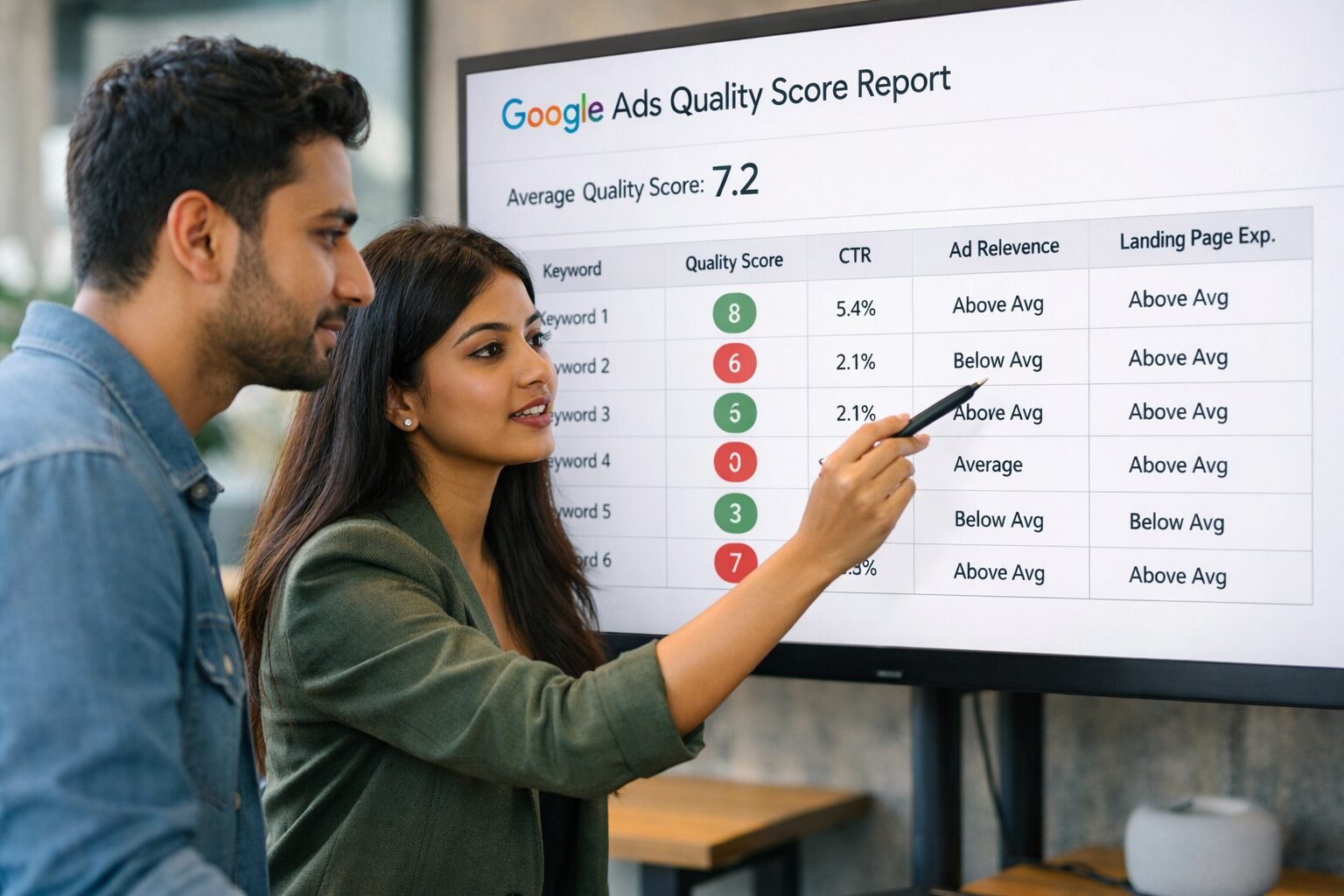
- You will now see: a score from 1 to 10 next to each keyword, along with sub-scores for Expected CTR, Ad Relevance, and Landing Page Experience
Look at each keyword carefully. Keywords with a score of 6 or below need attention. Keywords with a score of 3 or below are hurting your campaign and need to be fixed or paused immediately.
How to Improve Your Google Ads Quality Score Step by Step
Now comes the most important part of understanding what is Google Ads Quality Score how to actually improve it. Here are the most effective strategies, explained simply.
1. Write Ads That Directly Match the Keyword
The single fastest way to improve Ad Relevance is to make sure your ad headline contains the exact keyword someone searched for. If your keyword is ‘Google Ads for real estate’, your ad headline should say ‘Google Ads for Real Estate Get More Property Leads’. This direct match tells Google that your ad is highly relevant to the search, which boosts both your Ad Relevance score and your Expected CTR.
2. Use Tightly Grouped Ad Groups
One of the most common mistakes in Google Ads is putting too many different keywords in one ad group. When you have 50 different keywords in one ad group, you cannot write a single ad that is relevant to all of them. Instead, group your keywords tightly each ad group should have 5 to 15 very closely related keywords. This way, you can write ads that are highly specific and relevant to that small group of keywords, which directly improves your Quality Score.
3. Improve Your Click-Through Rate
A higher CTR signals to Google that people find your ad useful and relevant. To improve CTR, write more compelling ad copy. Use numbers in your headlines ‘5 Ways to Get More Leads’ performs better than ‘Get More Leads’. Include your focus keyword in the headline. Use a strong call to action ‘Get a Free Quote Today’, ‘Book a Free Call’ ‘Claim Your Discount’. Use all available ad extensions sitelinks, callouts, and structured snippets all make your ad bigger and more clickable.
4. Fix Your Landing Page
Landing Page Experience is one of the three factors in Quality Score, and it is often the most neglected. Make sure your landing page loads in under 3 seconds. Make sure it works perfectly on mobile. Most importantly, make sure the content on the page directly matches your ad. If your ad says ‘Free SEO Audit for Small Businesses’, your landing page should start with exactly that offer not a generic homepage about all your services. Message match between ad and landing page is critical for a good Quality Score.
5. Add Negative Keywords
Negative keywords are words you tell Google you do NOT want to show your ad for. If you are a paid Google Ads agency, you probably do not want your ad showing up when someone searches ‘free Google Ads course’. Adding ‘free’ and ‘course’ as negative keywords stops your ad from showing to people who will never convert. This improves your CTR because the only people seeing your ad are those most likely to click it which improves your Quality Score over time.
6. Use Dynamic Keyword Insertion (Carefully)
Dynamic Keyword Insertion is a Google Ads feature that automatically inserts the searched keyword into your ad headline. For example, your headline becomes ‘Best {KeyWord: Digital Marketing} in India’ and Google fills in the actual keyword the person searched. This instantly makes your ad look more relevant to the searcher, which improves CTR and Ad Relevance. Use it carefully though it does not work well for every campaign and can create awkward headlines if not set up properly.
7. Pause or Remove Low-Performing Keywords
Keywords with a Quality Score of 1 or 2 are dragging your entire campaign down. They are costing you money and hurting your Ad Rank. If a keyword has been running for a few weeks with a very low Quality Score and no conversions, it is better to pause or remove it. Focus your budget on keywords that have a Quality Score of 6 or above and are actually generating results.
Common Quality Score Mistakes to Avoid
- Sending all PPC traffic to the home page instead of a relevant landing page
- Using too many keywords in a single ad group this destroys Ad Relevance
- Never checking Quality Scores letting low-score keywords run for months
- Writing generic ad copy that does not include the target keyword
- Ignoring mobile a slow or broken mobile landing page kills Landing Page Experience score
- Not using ad extensions they increase ad size and CTR for free
- Bidding on too broad keywords that attract irrelevant searches and lower your CTR
What is a Good Quality Score to Aim For?
A Quality Score of 7 or above is considered good. A score of 9 or 10 is excellent and means you are paying significantly less than your competitors for the same clicks. Most well-managed campaigns have an average Quality Score of 6 to 8 across their keywords. Do not get stressed if some keywords have a score of 5 or 6 that is normal, especially for competitive industries. Focus on fixing keywords that are below 5, and continuously work on improving the three sub scores over time. Quality Score improvement is not instant it takes consistent optimization over several weeks. But the results are worth it.
Key Takeaway
A Quality Score improvement from 5 to 8 can reduce your cost per click by 30 to 50%. That means getting the same number of leads for significantly less money without changing your bids at all.
Conclusion
Now you have a clear answer to what is Google Ads Quality Score and how to improve it. It is Google’s way of measuring how relevant and useful your keyword, ad, and landing page are to the person searching. A high Quality Score means you pay less, show up higher, and get more results from the same budget.
The three pillars of a great Quality Score are simple write relevant ads that match your keywords, group your keywords tightly, and make sure your landing page delivers exactly what your ad promised. Fix these three things and you will see your Quality Score improve, your cost per click drop, and your campaign results get significantly better.
Quality Score is not a one time fix. It requires regular monitoring and continuous improvement. But every point you gain on your Quality Score is money saved and results improved. Start with your lowest scoring keywords today and work your way up.
Fix Your Quality Score. Fix Your Google Ads. Right Now.
A low Quality Score means you are paying more for every click and getting fewer results from your ad budget. At DiziSpark, we specialize in Google Ads management from keyword research and ad copywriting to landing page optimization and Quality Score improvement. Our clients regularly see their cost per click drop and their leads increase after we optimize their campaigns. If you are running Google Ads and not getting the results you expected, the problem might be your Quality Score. Let us take a look. Visit us at Dizispark and get a free Google Ads audit today.
Frequently Asked Questions
What is Google Ads Quality Score?
What is Google Ads Quality Score it is a score from 1 to 10 that Google assigns to each keyword in your account. It measures how relevant your keyword, ad, and landing page are to the person who searched. A higher score means lower cost per click and better ad placement.
What are the three factors that make up Quality Score?
The three factors are Expected Click Through Rate (how likely people are to click your ad), Ad Relevance (how closely your ad matches the keyword), and Landing Page Experience (how useful and relevant your landing page is after the click). All three are rated as Below Average, Average, or Above Average.
How long does it take to improve Quality Score?
It depends on how much traffic your keywords get. For high traffic keywords, you may see improvement within 1 to 2 weeks after making changes. For lower traffic keywords, it can take 3 to 4 weeks. Quality Score is based on historical data, so it takes time to update after you make improvements.
Can I improve Quality Score without changing my bid?
Yes. Quality Score is completely separate from your bid. You improve it by writing better ads, using tighter ad groups, adding negative keywords, and improving your landing page. None of these require changing your budget or bids.
What happens if my Quality Score is 1 or 2?
A Quality Score of 1 or 2 means your keyword is very poorly matched to your ad and landing page. Your ad will rarely show, and when it does, you will pay a very high cost per click. It is better to pause these keywords, rework your ad copy and landing page completely, or remove them from your campaign.