
Digital marketing for clinics has moved from a competitive advantage to a survival requirement. According to WebMD Ignite’s healthcare marketing research, 77 percent of patients perform online research before booking an appointment, and 80 percent of internet users have searched for health-related information online. The patient who walks into your clinic in 2026 has already Googled your specialty, read your reviews, visited your website, and compared you with at least two other clinics in your area before deciding to call. If your digital presence is weak, that patient chose someone else.
This guide covers every practical strategy in digital marketing for clinics in 2026, from building a patient-converting website and ranking on Google to running ads, managing your reputation, and creating content that positions your clinic as the trusted authority in your specialty.
Table of Contents
ToggleWhy Digital Marketing for Clinics Is Non-Negotiable in 2026
The healthcare consumer of 2026 is fundamentally different from the patient of ten years ago. WebMD Ignite’s analysis of the evolving role of digital marketing in healthcare notes that today’s patients are healthier, more informed, and more selective. They have access to physician reviews, ratings, and online forums. They do extensive research before committing to a provider. And they expect the same level of digital experience from a clinic that they get from any other consumer service they use.
A Think With Google study referenced by WebMD Ignite found that search engines drive three times as many visitors to hospital and clinic websites than any other source. The same study found that 44 percent of patients who research clinics on a mobile device end up scheduling an appointment.
This data makes the case for digital marketing for clinics unambiguous: your potential patients are actively searching for you online, and the clinic that shows up clearly, professionally, and credibly is the clinic that books their appointment.
Key stat:
71% of patients check online reviews before booking an appointment (Zealous web study, 2026). 77% of patients perform online research before visiting any clinic. If your digital presence does not exist or is weak, you are invisible to the majority of your potential patient base.
Build a Professional, Patient-Converting Website
Your website is the digital face of your clinic and the foundation on which every other element of digital marketing for clinics depends. WhiteCoats describes it as the digital face of your practice, often making the first impression on potential patients. A website that is slow, outdated, or difficult to navigate on a mobile phone tells a patient everything they need to know about whether your clinic is modern and professional before they ever meet a doctor.
A patient-converting clinic website in 2026 must load within three seconds, work flawlessly on mobile devices, include clear service descriptions, feature real photos of your team and facility, display your qualifications and experience prominently, offer online appointment booking or at minimum a click-to-call button, and include genuine patient testimonials. Inklik’s guide on digital marketing for doctors notes that an impressive website with all relevant information, healthcare services, address, and clinic photos is bound to attract patients and that this alone can be a game-changer for a clinic with no previous digital presence.
Mobile optimisation is no longer optional. WebMD Ignite cites data showing that more than 50 percent of all web searches are now conducted on mobile devices, and 47.6 percent of healthcare emails are opened on mobile. If your website is not designed to be fast and easy to use on a smartphone, you are losing patients to competitors whose websites are.
Local SEO and Google Business Profile: Get Found by Nearby Patients
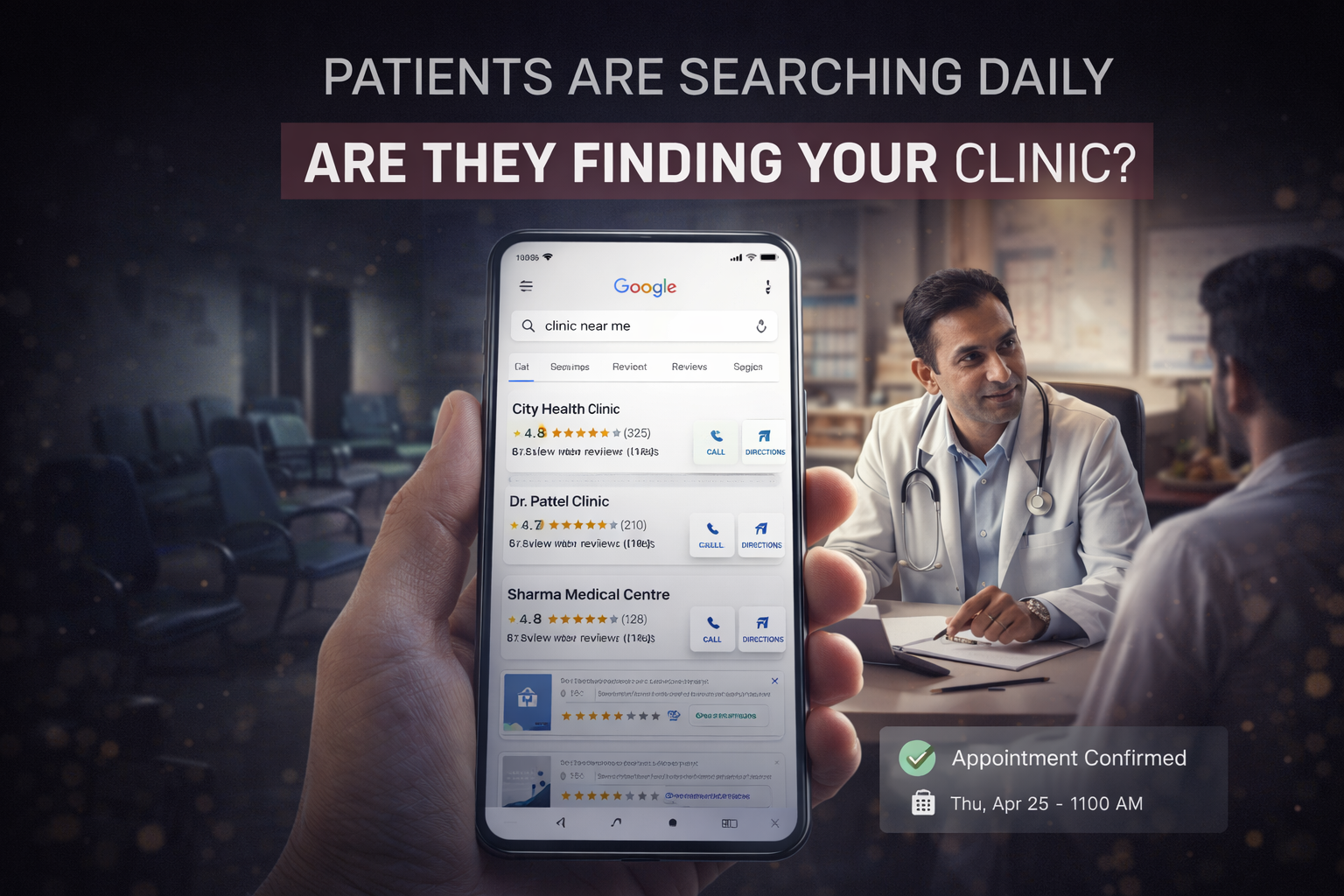
Local SEO is the single highest-impact channel in digital marketing for clinics because most patients choose healthcare providers near their home or workplace. When someone searches ‘dermatologist near me’ or ‘best gynecologist in Delhi’, Google shows a map pack of three local results before any organic listings. Ranking in that map pack is the most visible real estate in local healthcare marketing, and it is driven almost entirely by your Google Business Profile (GBP) and local SEO signals.
1. Optimize Your Google Business Profile
Iniki’s digital marketing guide for doctors identifies the Google Business Profile as a critical component that tells Google your clinic exists, its exact location on the map, your specialty, working hours, services, and contact details. Whitecoats notes that at times, creating a Google Business Profile can be a game changing strategy if no other clinic in your area has registered their profile.
The steps for an optimized GBP include: selecting the correct medical category, listing every service you offer, uploading professional photos of your clinic and team, keeping hours accurate, and posting regular updates and health tips to signal active management to Google’s algorithm.
2. Local Keywords and Directory Listings
Beyond your GBP, digital marketing for clinics requires consistent local keyword targeting across your website. Service pages should include your city and area names naturally within headings and content, such as ‘skin clinic in Bandra’ or ‘pediatrician in Indiranagar’. Inklike also recommends local business listings on healthcare-specific platforms like Practo and Lybrate as well as general directories like Just Dial and Sulekha. These listings build citation consistency, which is a significant local SEO ranking signal that helps Google trust your clinic’s location and legitimacy.
Content Marketing: Become the Trusted Authority in Your Specialty
Content marketing is one of the most cost-effective long-term strategies in digital marketing for clinics. WhiteCoats describes it as a way to establish your clinic as an authority in the medical field by writing blog posts, articles, and videos about common health issues, treatment options, and wellness tips. When patients search for health information online and find your clinic’s content answering their questions clearly and accurately, it builds trust before they ever book an appointment.
Inklik’s guide to online marketing for doctors specifically recommends medical blogging as a long-term activity for fetching maximum traffic. Blogs around health tips, disease information, treatment options, and symptom guides answer the exact questions patients type into Google. When a blog post from your clinic ranks for ‘signs of early diabetes’ or ‘what to expect from a knee replacement’, the patient who reads it already trusts your expertise. WebMD Ignite confirms that search engines drive three times as many visitors to healthcare websites as any other source, and content is a primary driver of that organic search visibility.
Video content is the next frontier in digital marketing for clinics. WebMD Ignite cites a study showing that using video on landing pages can increase conversions by up to 80 percent. Doctor introduction videos, procedure explainer videos, and patient journey content make your clinic approachable and help new patients feel comfortable before their first visit. Short-form video for Instagram and YouTube Shorts is increasingly how patients discover healthcare providers in 2026, particularly the under-35 demographic.
Social Media Marketing for Clinics: Build Trust and Engage Patients
Social media marketing is an essential component of digital marketing for clinics because it builds the community and human connection that drives long-term patient loyalty and referrals. WebMD Ignite’s healthcare marketing guide cites a study showing that 57 percent of consumers’ decisions to receive treatment at a healthcare facility are strongly influenced by that provider’s social media presence, illustrating how directly social engagement translates to patient choice.
WhiteCoats recommends sharing informative content regularly including health tips and medical advancements, highlighting patient success stories while following privacy guidelines, keeping followers informed about clinic updates and services, and engaging actively with audiences by responding to comments promptly and hosting discussions. Inklik emphasises that social media marketing for doctors works best when managed consistently by a specialist rather than handled ad hoc by the doctor or reception staff, because the strategic consistency of posting schedule, content quality, and audience engagement is what builds following and patient trust over time.
Paid social media advertising on Facebook and Instagram is a powerful complement to organic content in digital marketing for clinics. Facebook Ads allow precise targeting by age, gender, location, interests, and health-related behaviours, making them ideal for reaching the exact patient demographics a clinic wants to attract. Inklik notes that Facebook Ads for doctors can be used to promote posts, gain page followers, and run targeted advertisements for specific conditions or services, with the ability to reach local patients or extend to telemedicine audiences across larger geographies.
Google Ads for Clinics: Generate Patient Leads Immediately
Google Ads is the paid acceleration channel in digital marketing for clinics, delivering visibility to people actively searching for medical services right now. While SEO and content marketing build long-term organic presence, Google Ads puts your clinic at the top of search results within hours of launching a campaign. WhiteCoats confirms that a well-structured Google Ads campaign provides a significant return on investment for clinics by reaching potential patients based on their demographics and search behaviour.
Inklik acknowledges that Google applies restrictions to healthcare advertising and that navigating these requires specialist knowledge of what is permitted. Effective clinic Google Ads campaigns promote health tips, educational content, and clinic services through compliant ad formats. Campaigns can target specific treatments, search terms, and geographic areas to ensure budget is spent reaching patients who are genuinely looking for your specialty in your service area. Landing pages linked from Google Ads should be specific to the service advertised, load quickly on mobile, and have a prominent call-to-action for appointment booking or enquiry.
Online Reviews and Reputation Management
Online reputation management is one of the most commercially impactful yet most underinvested areas of digital marketing for clinics. Inklik highlights that Google prioritises clinic profiles based on ratings and reviews, meaning that a clinic with more and better reviews ranks higher in local map searches than competitors with equivalent websites and SEO. More practically, 71 percent of patients check online reviews before booking any medical appointment, making your Google review profile a direct patient acquisition asset.
WhiteCoats recommends building a systematic process for encouraging satisfied patients to leave positive reviews on platforms like Google Business Profile, and for responding to negative reviews professionally and promptly. Inklik goes further, recommending textual and video patient testimonials displayed on your website, social media, and YouTube channel. A collection of genuine, specific patient testimonials that describe actual outcomes and experiences builds far more trust than generic promotional content, and it signals to both Google and prospective patients that your clinic has a track record of real results.
Email Marketing and Analytics: Retain Patients and Measure Everything
Email marketing for clinics is a highly cost-effective channel for patient retention, appointment reminders, and re-engagement of lapsed patients. WebMD Ignite identifies email as a relatively low-cost, effective, and immediate form of communication with significant personalisation potential.
Healthcare email campaigns that perform best are educational: wellness tips, condition-specific guidance, seasonal health reminders, and updates about new services consistently outperform generic newsletters. Every email should include a clear, simple call-to-action for booking an appointment or calling the clinic.
Analytics is the intelligence layer that makes every other element of digital marketing for clinics improvable over time. WhiteCoats recommends regularly analysing website traffic, social media engagement, and advertising campaign performance using tools like Google Analytics and Google Search Console. WebMD Ignite identifies analytics as essential for understanding brand awareness data, blog traffic, social engagement, click-through rates, and conversion metrics. Without this data, digital marketing for clinics is expensive guesswork. With it, every rupee of marketing investment is accountable and every channel can be optimised for better patient acquisition.
Digital Marketing Channels for Clinics: Quick Reference Guide
The following table summarises the most important channels in digital marketing for clinics, what each one does, and the timeline for results so clinics can plan their investment strategically.
| Channel | Primary Purpose | Results Timeline | Cost Type |
|---|---|---|---|
| Google Business Profile | Appear in local map pack, show hours, reviews, and location | Weeks 1 to 4 | Free to set up |
| Website (SEO-optimised) | Convert visitors, rank in search, establish credibility | 1 to 3 months | One-time + monthly SEO |
| Local SEO | Rank for ‘specialty + city’ searches organically | 3 to 6 months | Monthly investment |
| Content Marketing | Build authority, drive blog traffic, support SEO | 3 to 12 months | Ongoing content creation |
| Google Ads (PPC) | Immediate visibility for high-intent patient searches | Days to weeks | Daily ad budget required |
| Social Media (Organic) | Build community, share health tips, build trust | 2 to 6 months | Time + content creation |
| Facebook/Instagram Ads | Target specific demographics; reach local patients fast | Days to weeks | Ad spend budget |
| Online Reviews (GMB) | Improve local ranking, build patient trust | Ongoing | Free with effort |
| Email Marketing | Retain patients, appointment reminders, re-engagement | Immediate sends | Low cost |
| Video Marketing | Build trust, explain procedures, rank on YouTube | 1 to 3 months | Production cost |
Conclusion
Digital marketing for clinics in 2026 is not a single tactic but a coordinated system of channels that work together to make your clinic visible, credible, and accessible to the patients who need your expertise. A professional website anchors the system. Local SEO and Google Business Profile make you discoverable. Content marketing builds trust and authority. Google Ads generates immediate enquiries. Social media creates community and human connection. Reviews build the credibility that converts interest into appointments. Email keeps patients engaged and loyal. And analytics ensures every investment is measured and improved over time.
Clinics that treat digital marketing for clinics as a consistent, long-term investment rather than an occasional activity consistently outgrow those that rely on referrals and walk-ins alone. In a healthcare market where patients search before they visit, your online presence is your most important first impression.
How Dizispark Can Help
Dizispark builds end-to-end digital marketing strategies specifically for clinics and healthcare providers across India.
We handle everything: your Google Business Profile, local SEO, Google Ads, social media content, patient review strategy, and performance analytics, all managed as one integrated growth system designed to fill your appointment slots with the right patients. From single-doctor practices to multi-specialty clinics, we build digital presences that patients trust and search engines reward.
Frequently Asked Questions
Why is digital marketing important for clinics?
Digital marketing for clinics is important because 77 percent of patients perform online research before booking an appointment. When patients search for a specialist, they compare clinics based on Google reviews, website quality, and online visibility before deciding who to call. Clinics without a strong digital presence are simply invisible to this majority. Digital marketing helps clinics appear in local search results, build patient trust through credible online content and reviews, and consistently attract new appointment bookings without relying entirely on referrals.
How can a clinic get more patients through digital marketing?
Clinics get more patients through digital marketing by combining several strategies: optimizing their Google Business Profile to rank in local map searches, running Google Ads to appear for high-intent searches like ‘dermatologist near me’, publishing health content that builds organic search visibility, managing social media to build community trust, and systematically collecting patient reviews. The most effective approach uses all of these channels as an integrated system where each one supports the others, rather than investing in just one tactic in isolation.
How much does digital marketing for a clinic cost in India?
Digital marketing for clinics in India typically starts from INR 10,000 to INR 20,000 per month for foundational services including Google Business Profile management, basic local SEO, and social media content. A more complete strategy covering Google Ads, advanced SEO, content marketing, and reputation management typically ranges from INR 25,000 to INR 60,000 per month depending on clinic size, location competitiveness, and the number of channels managed. Google Ads spend is charged separately from management fees.
How long does it take for digital marketing to bring new patients to a clinic?
The timeline for digital marketing for clinics varies by channel. Google Ads and paid social media campaigns can generate patient enquiries within days of launching. Google Business Profile optimization typically shows improved local ranking within two to four weeks. SEO and content marketing take three to six months to produce significant organic traffic. Email marketing and social media content build cumulative engagement over months. Most clinics see meaningful and measurable patient acquisition improvement within 60 to 90 days of implementing a complete digital marketing strategy.
What is the best social media platform for clinics?
The best social media platform for digital marketing for clinics depends on specialty and patient demographics. Instagram is most effective for visual specialties like dermatology, cosmetic surgery, dental, and aesthetics because before-and-after content and educational Reels perform exceptionally well. Facebook is best for reaching older demographics and running targeted local ads. YouTube is ideal for longer educational videos and procedure explainers that build deep trust. LinkedIn is relevant for B2B healthcare and specialist referral marketing. Most clinics perform best with a combination of Instagram for content and Facebook for targeted paid advertising.
Is SEO or Google Ads better for clinics?
Both SEO and Google Ads are important in digital marketing for clinics but serve different purposes and timelines. Google Ads delivers immediate visibility and patient leads, making it ideal for new clinics building patient volume quickly or for promoting specific high-value services. SEO builds long-term organic ranking that generates free, ongoing traffic without per-click costs, making it the higher ROI investment over 12 to 24 months. The most effective clinic marketing strategy uses both: Google Ads for immediate lead generation while SEO builds sustainable organic visibility in the background.
How do online reviews affect a clinic’s ability to attract patients?
Online reviews have a direct and significant impact on patient acquisition in digital marketing for clinics. Research shows 71 percent of patients check online reviews before booking an appointment. Google also uses review count and rating as a ranking factor in local search, meaning clinics with more and higher-rated reviews rank higher in the map pack and receive more organic clicks. A clinic with 50 reviews averaging 4.7 stars will consistently outperform a competitor with better SEO but fewer reviews in local search results. Systematically asking satisfied patients to leave reviews is one of the highest-return activities in clinic digital marketing.
Can a small clinic compete with large hospitals online?
Yes. Digital marketing for clinics actually gives smaller practices a significant advantage in local search. Large hospitals target broad, national-level keywords, while small clinics can dominate the specific local searches that matter most, such as ‘best pediatrician in Delhi’ or ‘skin clinic near Delhi’. A well-optimized Google Business Profile, consistent local SEO, strong patient reviews, and a professionally presented website allow a single-doctor clinic to outrank large hospitals in its immediate service area. Local specialization and personalized patient communication are advantages that smaller clinics can leverage online that large institutions cannot easily replicate.