
Two websites can publish the exact same quality of content and get completely different results in search. One ranks on page one within months. The other sits buried on page four, no matter how good the writing is. The gap between them usually comes down to one thing, technical SEO vs on-page SEO, and which one got neglected.
Most business owners hear both terms thrown around by marketing teams without ever getting a clear answer on what each actually means. This guide breaks down exactly what each covers, how they work together, and which one deserves attention first.
Table of Contents
ToggleThe Core Difference in One Sentence
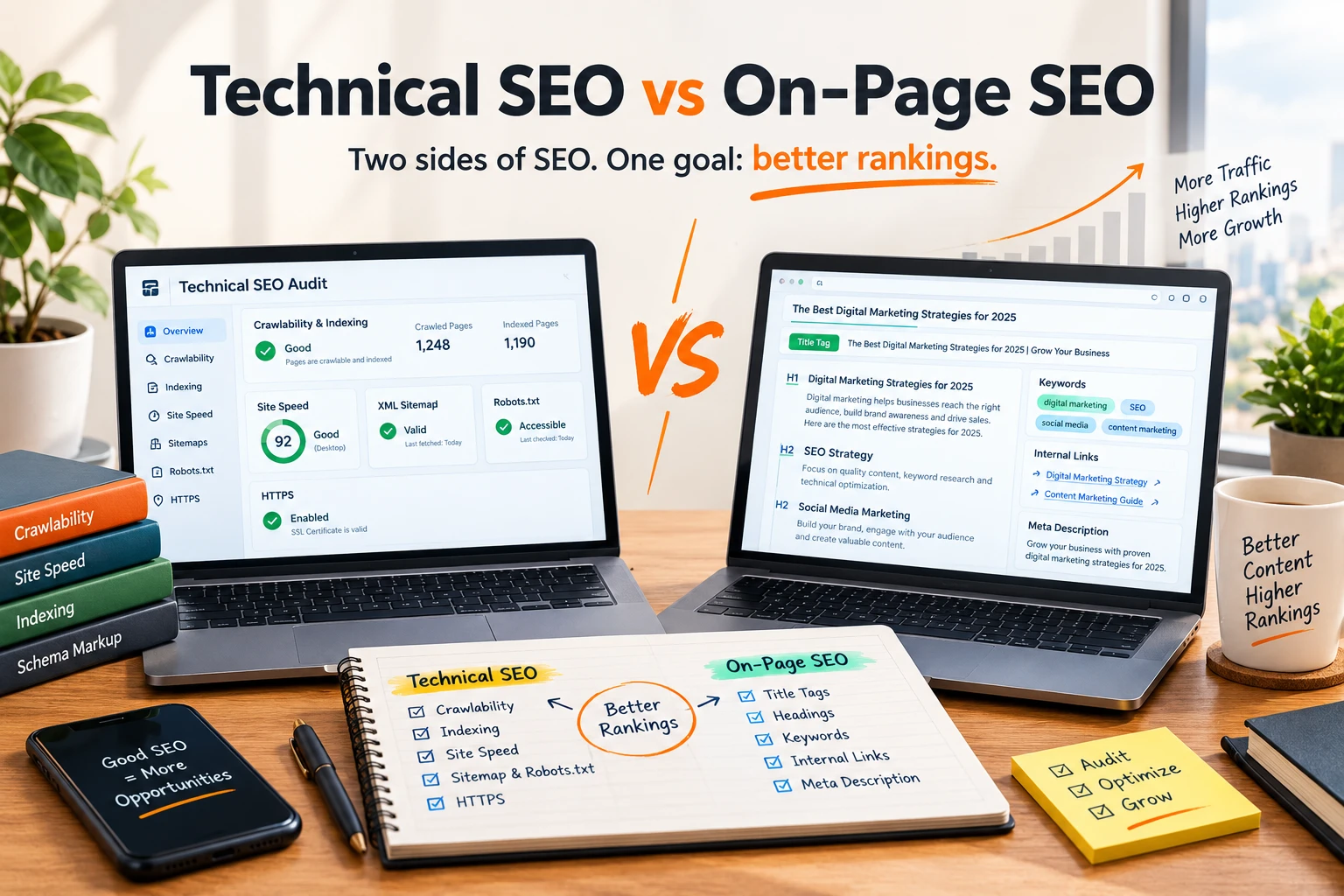
Technical SEO determines whether search engines can find, crawl, and understand your website at all. On-page SEO determines whether, once found, your content actually deserves to rank for what someone searched. One is about access. The other is about merit. A page search engines cannot properly crawl will never get a fair shot at ranking, no matter how well written its content is.
What Technical SEO Actually Covers
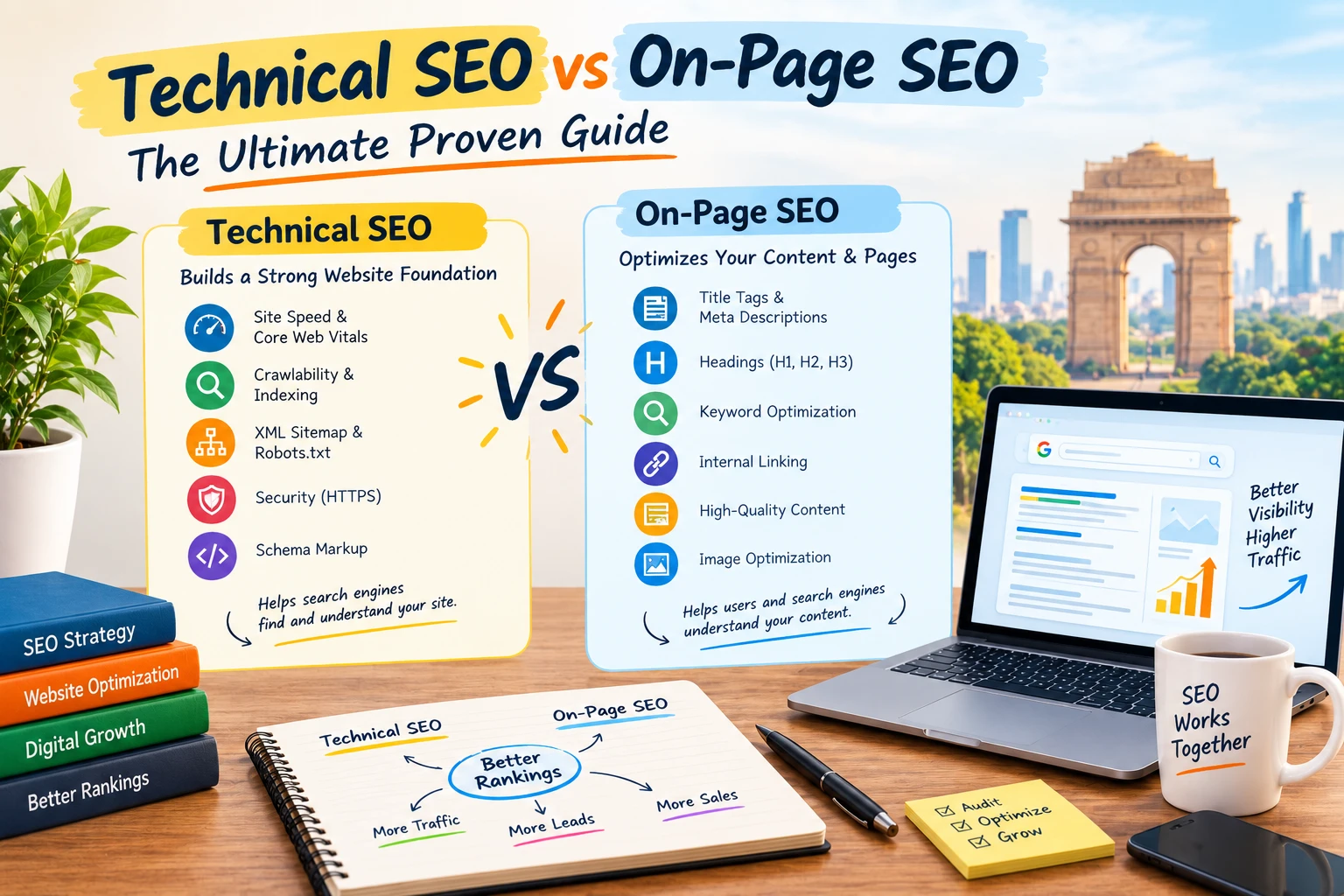
Technical SEO optimizes the backend mechanics of a website, the parts a visitor never consciously notices but that shape every single search result. It’s entirely independent of the actual words on the page. Site speed sits near the top of this list, since Google treats loading time as a direct ranking factor and users today expect a page to load in under two seconds. Compressing images, enabling browser caching, and reducing server response time all improve this metric.
Mobile friendliness matters just as much, given how much search traffic now comes from phones. A responsive design that scales properly across screen sizes is no longer optional, it’s a baseline requirement for ranking competitively. Crawlability and indexing round out the core technical work. A correctly configured robots.txt file and an up-to-date XML sitemap tell search engines exactly what to crawl and what to prioritize, while broken links, stray no index tags, and misconfigured canonical tags can quietly block pages from ever being indexed at all.
Security, structured data, and duplicate content management complete the picture. HTTPS encryption is now a baseline trust and ranking signal, schema markup helps search engines understand content well enough to generate rich snippets, and clean canonical tagging prevents duplicate pages from diluting ranking potential.
What On-Page SEO Actually Covers
On-page SEO optimizes everything directly visible and readable on a specific page, built to make that page relevant to both the people reading it and the search engines ranking it. It’s entirely content-specific, unlike the site-wide scope of technical work.
Keyword research and placement sit at the foundation. Content needs to naturally include the terms and phrases real people actually search, placed in titles, headers, and body copy without tipping into keyword stuffing, which search engines actively penalize.
Title tags and meta descriptions act as a page’s first impression in search results, and well-written ones directly influence click-through rate even before someone reads a single word of actual content. Heading structure, from H1 through H3, signals topic hierarchy to both readers and crawlers simultaneously.
Internal linking distributes authority across a site while helping both users and search engines navigate between related pages. URL structure, image alt text, and overall content quality, depth, originality, and genuine usefulness to the reader, round out the core on-page elements.
Technical SEO vs On-Page SEO at a Glance
| Dimension | Technical SEO | On-Page SEO |
|---|---|---|
| Main goal | Let search engines crawl, read, and index the site | Tell search engines what a page is about and why it deserves to rank |
| Primary audience | Crawlers and bots | Both crawlers and human readers |
| Scope | Site-wide infrastructure | Individual page content |
| Typical owner | Developers, technical SEO specialists | Writers, content strategists |
| Example fixes | Site speed, mobile responsiveness, XML sitemaps, schema | Title tags, headings, keyword placement, internal links |
| How often revisited | Ongoing maintenance, especially after site changes | Continuous, every new piece of content |
Why This Distinction Confuses So Many Business Owners
Both disciplines technically happen “on” the same website, which is exactly why the line between them gets blurry for anyone outside the SEO field. Marketing teams throw around both terms assuming everyone understands the split, when in practice few business owners ever get a plain explanation.
Adding to the confusion, some practitioners treat technical work as a subset of on-page SEO rather than a separate category entirely, since both ultimately live on your own domain rather than an external site. Either framing works in practice as long as the underlying actions get done, but it does make the terminology genuinely inconsistent across different sources.
How They Work Together
Technical SEO and on-page SEO are not competing priorities, they’re sequential and complementary. Technical work builds the foundation a site stands on, and on-page work is what actually earns the ranking once that foundation holds.
Think of it as a ceiling and a floor. Technical SEO sets a hard ceiling on what everything else can achieve, since no amount of brilliant content can rank if search engines can’t properly crawl or index the page it lives on. On-page work, once that technical ceiling is high enough, is what determines how close to it your rankings actually climb.
Neither one compensates for serious failure in the other. A technically flawless site with thin, generic content will plateau quickly, while brilliant content trapped behind crawl errors or a painfully slow server may never get indexed at all.
What Happens When One Is Strong and the Other Is Weak
Strong technical SEO paired with weak on-page SEO produces a site that’s crawlable and properly indexed, but poor content limits both rankings and genuine user engagement once visitors actually arrive. The door is open, but nothing compelling waits behind it.
Strong on-page SEO paired with inadequate technical SEO produces the opposite, frustrating problem: genuinely great content that remains effectively invisible to search engines, leading to low organic traffic despite real quality sitting just out of reach. The content deserves to rank, but the infrastructure never gives it the chance. Regular SEO audits are what reveal which side of this imbalance a specific site is currently facing, since the symptoms alone, low traffic, stalled rankings, aren’t always obvious about their underlying cause without deeper investigation.
Which Should You Fix First
For a brand-new site or a full relaunch, technical SEO comes first, always. Crawlability, indexing, and site speed must be solid before content work has any real chance of being seen and properly evaluated by search engines at all.
For an established site already generating some organic traffic, the right starting point depends entirely on specific symptoms. Pages that aren’t indexed at all point to a technical problem, needing immediate attention, while pages that are indexed but earning few impressions usually point toward an on-page or content relevance issue instead.
A simple diagnostic framework helps here: not indexed is almost always technical, indexed but no impressions tends to be a content or search intent mismatch, impressions but no clicks usually traces back to a weak title tag or meta description, and clicks but no conversion typically sits outside SEO’s scope entirely, in landing page or offer quality instead.
Who Should Own Each One
Technical SEO usually sits with developers or a dedicated technical SEO specialist, since many of the required fixes involve code, server configuration, or CMS-level settings that a content writer simply isn’t equipped to touch. This split exists for good reason, not organizational convenience alone.
On-page SEO typically sits with writers and content strategists, who understand audience intent, tone, and how to structure genuinely useful content around real search queries. Some elements, like structured data, heading tags, and internal linking, sit in a genuine gray zone between the two and need an explicit, assigned owner so nothing falls through the cracks of an unclear handoff.
Common Mistakes in Both
On the technical side, the most damaging and common mistakes include ignoring mobile responsiveness, leaving broken links and redirect chains unresolved, and skipping HTTPS migration entirely, each of which silently caps how well everything downstream can perform. On the on-page side, skipping real keyword research before writing, stuffing content with awkward, unnatural keyword repetition, and writing thin, generic pages that don’t genuinely answer a searcher’s actual question are the recurring, costly patterns.
A mistake common to both sides deserves its own mention: treating either discipline as a one-time project rather than ongoing, continuous maintenance. Technical SEO needs regular audits as platforms, plugins, and algorithms all evolve, and on-page SEO needs fresh content and periodic updates to stay genuinely relevant and competitive over time.
How to Audit Your Site for Both
A technical audit should check site speed and Core Web Vitals, mobile usability across devices, crawl errors in Search Console, correct XML sitemap and robots.txt configuration, HTTPS status, and whether structured data is implemented correctly wherever it applies.
An on-page audit should review title tags and meta descriptions for every important page, heading structure and keyword placement, internal linking patterns, content depth relative to genuine search intent, and whether any pages show signs of thin or duplicate content dragging down overall site quality.
Tools like Google Search Console, Screaming Frog, and PageSpeed Insights cover most technical checks, while a simple content and keyword review, page by page, covers the on-page side without needing anything more elaborate than a spreadsheet and some discipline.
Conclusion
Technical SEO vs on-page SEO was never really a competition between the two. Technical SEO ensures search engines can find, crawl, and trust your website, while on-page SEO ensures the content on that website actually deserves to rank once it’s found and properly evaluated.
Neglect either one and the other’s hard work gets wasted somewhere along the way. The sites that consistently rank well treat both as ongoing, parallel priorities, not a single project to finish once and never revisit again.
How Dizispark Can Help
Dizispark runs full technical and on-page SEO audits together, since fixing one without the other rarely moves the needle on actual rankings or traffic. That includes site speed and crawlability fixes on the technical side, paired with keyword strategy, content structure, and internal linking work on the on-page side.
Every engagement starts with a clear diagnosis of which side is actually holding a site back, rather than applying the same generic checklist to every client regardless of their specific situation. For local businesses, Dizispark also keeps Google My Business optimization folded into the broader SEO strategy, since local visibility depends on both technical accuracy and genuinely relevant on-page content working together.
Frequently Asked Questions
What is Technical SEO vs On-Page SEO?
Technical SEO vs On-Page SEO refers to two different areas of website optimization. Technical SEO vs On-Page SEO compares website infrastructure with page-level content and relevance. Understanding Technical SEO vs On-Page SEO helps businesses identify whether a ranking problem comes from crawlability or content. In simple terms, Technical SEO vs On-Page SEO is about access versus relevance. A complete Technical SEO vs On-Page SEO strategy should address both areas.
What is the main difference between Technical SEO vs On-Page SEO?
The main difference in Technical SEO vs On-Page SEO is the area each discipline improves. Technical SEO vs On-Page SEO shows that technical work focuses on crawling, indexing, speed, mobile usability, and site structure. Technical SEO vs On-Page SEO also shows that on-page work focuses on keywords, headings, content, internal links, and relevance. When comparing Technical SEO vs On-Page SEO, technical SEO builds the foundation while on-page SEO improves the page’s ability to rank. This makes Technical SEO vs On-Page SEO an important distinction for SEO planning.
Which is more important, Technical SEO vs On-Page SEO?
Neither side of Technical SEO vs On-Page SEO is more important in every situation. Technical SEO vs On-Page SEO should be treated as complementary rather than competing approaches. Serious technical problems can prevent pages from being indexed, while weak on-page optimization can limit rankings. Therefore, Technical SEO vs On-Page SEO should be evaluated together during an SEO audit. A balanced Technical SEO vs On-Page SEO strategy gives both technical accessibility and content relevance proper attention.
Can a website rank with only Technical SEO vs On-Page SEO?
Looking at Technical SEO vs On-Page SEO, strong technical SEO alone is not enough to guarantee good rankings. Technical SEO vs On-Page SEO demonstrates why a technically accessible website still needs useful, relevant content. Likewise, Technical SEO vs On-Page SEO shows why excellent content may struggle when search engines cannot properly crawl or index it. The relationship between Technical SEO vs On-Page SEO means both areas need to work together. Effective Technical SEO vs On-Page SEO implementation therefore requires attention to both technical and content factors.
What are the main elements of Technical SEO vs On-Page SEO?
The technical side of Technical SEO vs On-Page SEO includes site speed, Core Web Vitals, mobile responsiveness, crawlability, indexing, XML sitemaps, HTTPS, canonical tags, and structured data. The on-page side of Technical SEO vs On-Page SEO includes title tags, meta descriptions, headings, keyword placement, internal linking, URLs, and content quality. Comparing Technical SEO vs On-Page SEO helps assign these tasks to the right specialists. A complete Technical SEO vs On-Page SEO audit should review both groups. This makes Technical SEO vs On-Page SEO useful as a practical SEO framework.
Should I fix technical issues or on-page issues first?
When prioritizing SEO improvements, serious technical issues should generally be addressed first because crawlability and indexing problems can prevent content from receiving a fair opportunity to rank. Once these issues are resolved, the focus can shift toward content relevance, keyword targeting, and page-level optimization. For an established website, the right priority may depend on the specific symptoms affecting search performance. Pages that are not indexed may require technical attention, while indexed pages with weak visibility may need content improvements. A combined SEO audit helps identify the underlying problems and determine which improvements should receive attention first for better overall performance.
How do I audit my website for technical and on-page SEO?
An audit should begin by checking crawlability, indexing, site speed, mobile usability, sitemap configuration, HTTPS, and structured data. It should then review title tags, meta descriptions, heading structure, keyword placement, internal linking, and overall content quality. Tools such as Google Search Console and PageSpeed Insights can support the technical checks and identify potential issues. A detailed content review should then assess whether each important page provides useful, relevant information that matches search intent. Reviewing technical and on-page factors together provides a more complete view of SEO performance and helps identify which improvements should be prioritized first.
Can Dizispark help with technical and on-page SEO?
Yes. Dizispark can evaluate technical and on-page SEO together rather than treating them as separate activities. Its SEO work can address technical issues such as site speed, crawlability, indexing, and website structure while improving keyword strategy, content structure, headings, metadata, and internal linking. This combined approach helps identify which areas may be limiting a website’s organic performance. Businesses can use a complete SEO audit to understand the most important issues and create a focused optimization plan. By reviewing both technical foundations and page-level content, Dizispark can help businesses prioritize improvements, strengthen search visibility, and maintain a more consistent SEO process over time.