
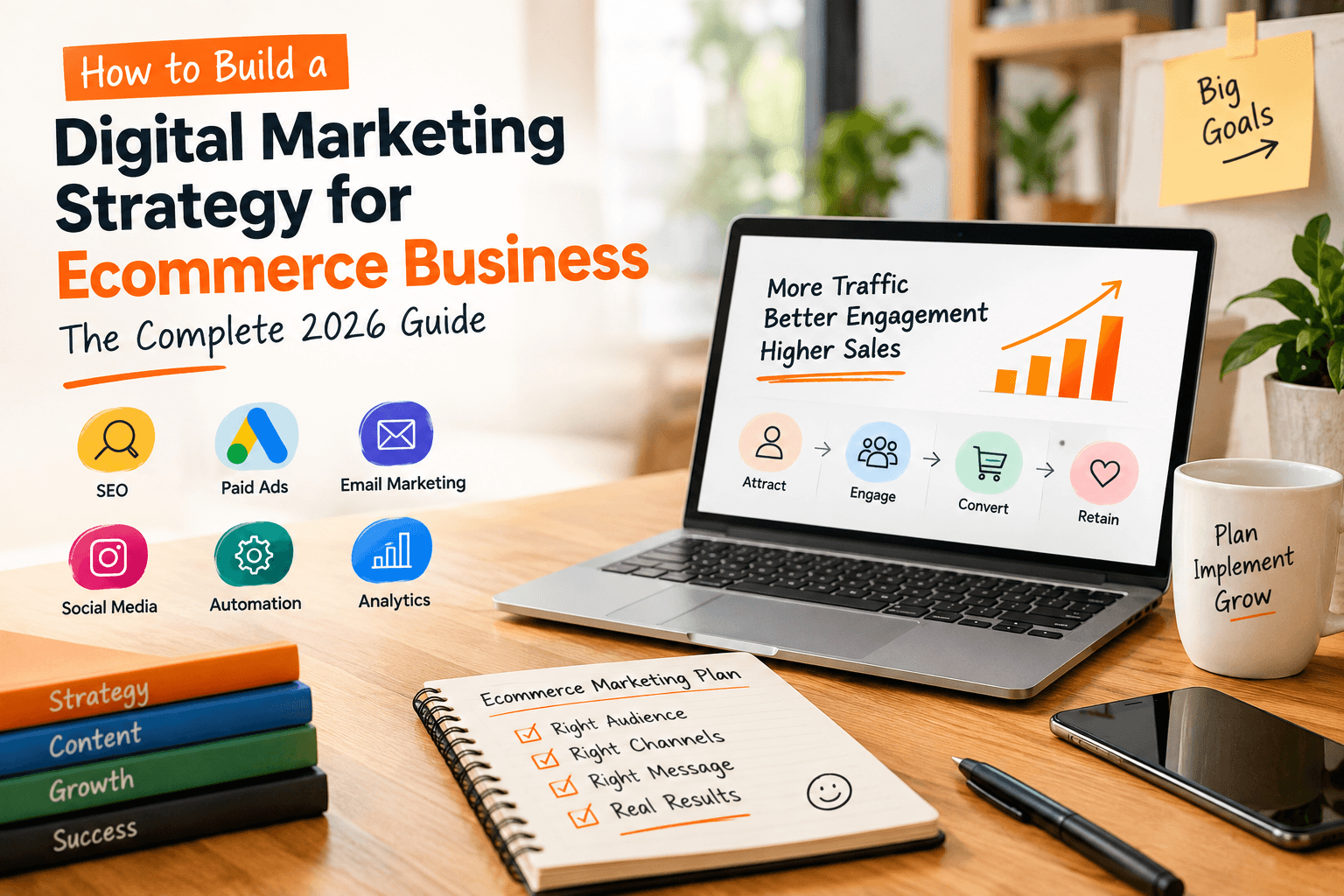
A powerful digital marketing strategy for ecommerce business helps online stores attract shoppers and increase sales. It combines SEO, paid advertising, content marketing, email, social media, automation, and analytics. The strategy should connect these channels instead of managing them separately. Using customer data can improve personalisation and create a smoother buying journey. Continuous testing and performance tracking can help ecommerce businesses achieve sustainable growth in 2026.
Table of Contents
ToggleWhat Is a Digital Marketing Strategy for Ecommerce Business?
A digital marketing strategy for ecommerce business is a structured plan to attract and engage online shoppers. It helps move customers through the buying journey and convert them into paying customers. The strategy uses channels such as SEO, paid advertising, content marketing, email, and social media. Marketing automation and unified customer data can make these channels work together more effectively. The main goal is to increase sales, improve customer experience, and encourage repeat purchases.
7 Core Channels for a Digital Marketing Strategy for Ecommerce Business in 2026
Maropost identifies seven proven channels that form the foundation of any effective digital marketing strategy for ecommerce business in 2026. The following section covers each channel with the strategic rationale, actionable steps, and the performance context needed to prioritise investment correctly.
01. Search Engine Optimisation (SEO)
SEO helps ecommerce businesses attract organic traffic from search engines. Optimise product pages, category pages, and blogs for relevant buyer-intent keywords. Improve site speed, mobile usability, structured data, and internal linking. Helpful guides, comparisons, and FAQs can also build topical authority. A strong SEO strategy can generate sustainable traffic without paying for every click.
02. Search Engine Marketing and Paid Search
Paid search gives ecommerce businesses immediate visibility for valuable keywords. Google Ads can promote products, seasonal offers, and high-margin categories. Use branded and non-branded campaigns to reach customers at different stages of buying intent. Keep product feeds, landing pages, and ad copy closely aligned. Measure campaigns using ROAS instead of focusing only on clicks or impressions.
03. Content Marketing
Content marketing helps ecommerce brands build trust before customers make a purchase. Create useful blogs, product guides, comparisons, reviews, and FAQs based on customer needs. Content should support awareness, consideration, and purchase stages of the buying journey. A single blog can also be repurposed into social posts, emails, and video content. Consistent content can build long-term organic traffic and authority.
04. Email Marketing and Automation
Email marketing helps ecommerce businesses increase repeat purchases and customer retention. Use promotional campaigns for product launches, discounts, and seasonal offers. Automated flows can handle welcome emails, abandoned carts, post-purchase follow-ups, and win-back campaigns. Segment customers based on their behaviour, purchase history, and engagement. This makes email communication more relevant and supports long-term customer value.
05. Social Media Marketing
Social media helps ecommerce brands reach customers through product discovery and engagement. Platforms such as Instagram and TikTok can influence customers during the research and buying process. Choose one or two platforms where your target audience is most active. Combine organic content with paid retargeting and product catalogue campaigns. Social media can support both website sales and direct social commerce.
06. Marketing Automation
Marketing automation connects different ecommerce marketing activities into a coordinated system. It reduces repetitive manual tasks and helps businesses respond to customer behaviour. Start with important workflows such as welcome emails, browse abandonment, cart recovery, and post-purchase messages. Automation can also support personalised customer journeys across multiple channels. As the business grows, more advanced automated campaigns can be added.
07. Analytics and Performance Measurement
Analytics helps ecommerce businesses understand which marketing activities generate revenue. Track important KPIs such as ROAS, conversion rate, and customer lifetime value (CLV). Organic traffic, email engagement, and acquisition costs can provide additional performance insights. Use consistent UTM parameters to improve campaign attribution. Reliable data helps businesses make better budget and optimisation decisions.
The 2026 Digital Marketing Strategy for Ecommerce Business Framework
Maropost’s unified commerce framework and Emarsys’s customer engagement strategy identify five foundational principles that should structure every digital marketing strategy for ecommerce business in 2026.
| Principle | What It Means | Why It Matters | How to Implement |
| Unified Data Foundation | Connect all customer, product, and transaction data into one source of truth | Eliminates siloed reporting; enables genuine personalisation; makes AI optimisation reliable | POS, storefront, email, social, and analytics all feeding one customer profile |
| AI-Powered Personalisation | Use AI to deliver product recommendations, dynamic content, and predictive segmentation | 58% of consumers value personalised product recommendations; 55% appreciate personalised content | AI-driven recommendations, predictive segments, lifecycle journey adaptation |
| Channel Synchronisation | Ensure consistent pricing, stock, messaging, and experience across web, social, and in-store | 63% of consumers say their favourite brand delivers connected experiences across all channels | Omnichannel automation that recognises the customer across every touchpoint |
| Automated Retention | Use predictive SMS and email to drive repeat purchases based on individual purchase cycles | Acquiring a new customer costs 5 to 7 times more than retaining an existing one | Welcome, cart recovery, post-purchase, replenishment, and win-back automation flows |
| Continuous Testing | Run structured A/B tests on creative, subject lines, landing pages, and CTAs systematically | Small changes in CTA placement, offer framing, and page layout can shift revenue materially | Weekly creative tests, monthly offer tests, ongoing landing page conversion optimisation |
Conclusion
A successful digital marketing strategy for ecommerce business in 2026 requires connected channels, reliable data, and continuous optimisation. SEO, paid search, content marketing, email, social media, automation, and analytics each support different parts of the customer journey. Ecommerce brands should focus on the channels that deliver measurable business results rather than chasing every platform. Regular testing and performance tracking can help improve marketing efficiency over time. A well-planned strategy can turn consistent digital marketing efforts into sustainable ecommerce growth.
How Dizispark Can Help
Dizispark is a Delhi-based digital marketing agency specializing in building complete digital marketing strategies for ecommerce businesses across India in 2026, covering ecommerce SEO, Google Shopping and paid search management, Meta Ads and dynamic product ad campaigns, social media content and community management, email marketing automation, WhatsApp retention campaigns, website development, and a fully optimized Google My Business Profile that strengthens local and national search visibility alongside every paid and organic channel we manage.
Frequently Asked Questions
What is a digital marketing strategy for ecommerce business?
A digital marketing strategy for ecommerce business is a structured plan to attract online shoppers. It helps move customers through the buying journey and increase sales. The strategy can include SEO, paid advertising, email marketing, social media, content, and automation. It should focus on the target audience and measurable business results. Unified customer data can also help create more relevant and consistent customer experiences.
What are the best digital marketing channels for ecommerce?
The main digital marketing channels for ecommerce include SEO, paid search, content marketing, email marketing, and social media. Marketing automation helps connect these channels into a coordinated customer journey. Analytics helps businesses measure which activities are driving revenue. Each channel supports a different part of the customer journey. Connecting the channels can make the overall strategy more effective.
How much should an ecommerce business spend on digital marketing?
Growth-stage ecommerce businesses can consider allocating around 10–15% of their revenue to digital marketing. The exact budget should depend on the business stage and marketing goals. SEO and email automation can be prioritised before increasing paid advertising. Paid campaigns should be scaled according to verified performance data. ROAS and customer lifetime value can help guide future budget decisions.
What is ecommerce marketing and how is it different from regular digital marketing?
Ecommerce marketing focuses specifically on generating online product sales. It aims to increase conversions, recover abandoned carts, and encourage repeat purchases. General digital marketing can focus more broadly on awareness, traffic, or lead generation. Ecommerce marketing measures channels against orders, revenue, and ROAS. It also relies on store, inventory, order, and marketing data to improve customer experiences.
How important is email marketing in a digital marketing strategy for ecommerce business?
Email marketing is an important channel for ecommerce businesses because it supports both sales and customer retention. It can be used for product launches, promotions, and seasonal campaigns. Automated flows can handle welcome messages, abandoned-cart recovery, post-purchase follow-ups, and win-back campaigns. Customer data can make these messages more relevant and personalised. Email can also support repeat purchases and long-term customer value.
How does social media fit into an ecommerce digital marketing strategy?
Social media supports product discovery, customer engagement, and online sales. Platforms such as TikTok, Instagram, and Facebook can influence customers during the buying journey. Ecommerce brands can combine organic content with paid catalogue ads and retargeting campaigns. Social platforms can also support direct purchases through social commerce features. Connecting social activity with customer data helps create a consistent experience across channels.
What role does AI play in ecommerce digital marketing strategy?
AI has become an important part of ecommerce digital marketing in 2026. It can help businesses personalise product recommendations and segment customers based on behaviour. AI can also optimise email timing and automate content personalisation. These capabilities can help marketing teams deliver more relevant customer experiences. AI also allows growing ecommerce brands to scale marketing activities more efficiently.
How do I measure the success of a digital marketing strategy for ecommerce business?
The success of a digital marketing strategy for ecommerce business should be measured using revenue-focused KPIs. Important metrics include customer lifetime value, ROAS, and conversion rate. Organic traffic, email engagement, and customer acquisition costs can provide additional insights. UTM parameters should be used consistently to improve campaign tracking. Comparing marketing data with ecommerce order data can also improve attribution accuracy.