
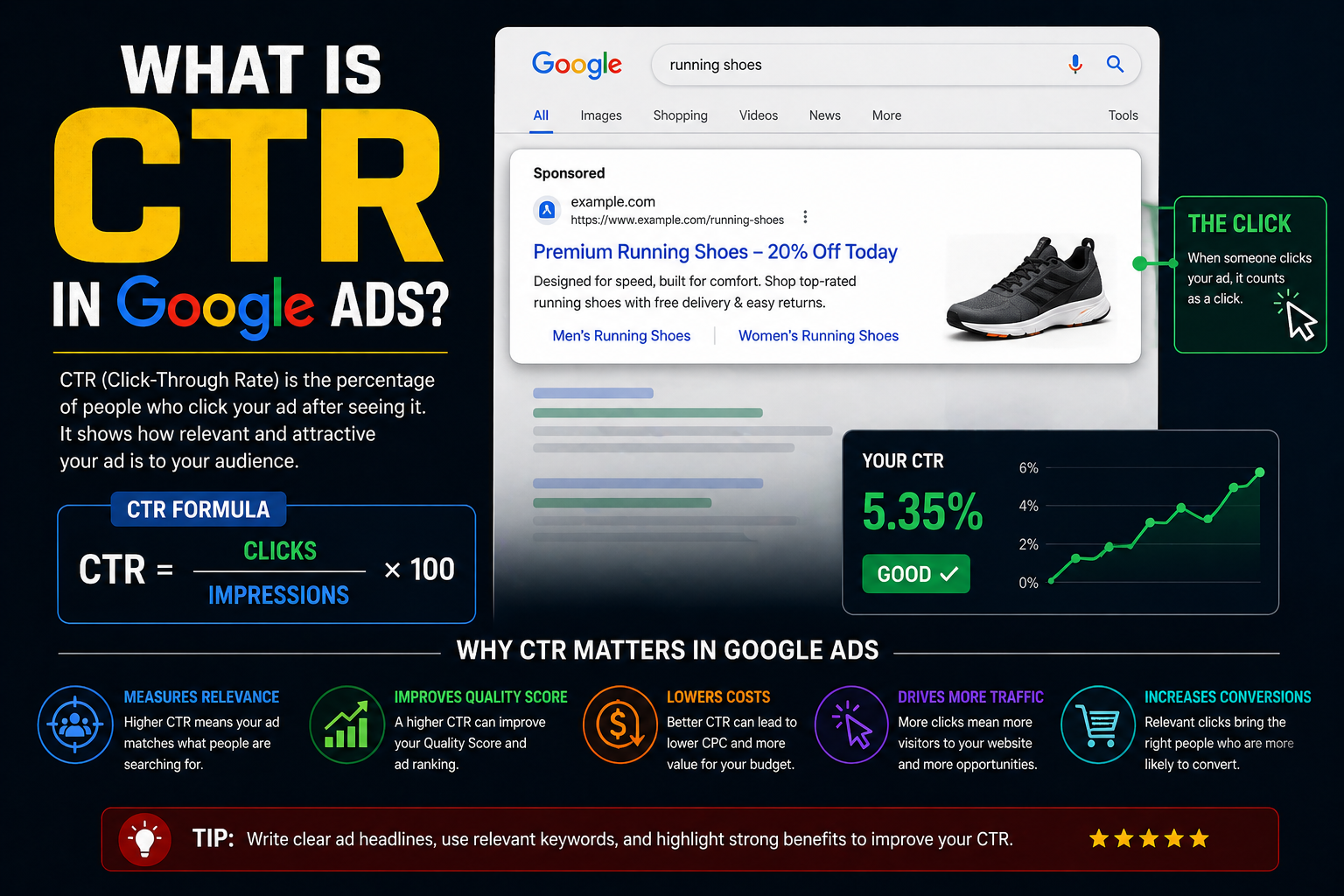
Understanding what is CTR in Google Ads is foundational for any business running paid search campaigns in 2026. CTR stands for Click-Through Rate. It measures how often people click your ad after seeing it. Keywordme’s complete CTR guide defines it precisely CTR is calculated by dividing clicks by impressions, making it a direct signal of how relevant and compelling your ad is to the people who see it.
OMR Digital’s Google Ads guide adds the business stakes in 2026, the median CTR on Google Ads stood at 1.92 percent, a 4.38 percent month-over-month increase, meaning smarter advertisers are extracting more clicks from the same impressions. This guide covers what is CTR in Google Ads, how it is calculated, what a good CTR looks like, why it matters beyond clicks, and 7 proven ways to improve it.
Table of Contents
ToggleThe CTR Formula: How What Is CTR in Google Ads Is Calculated
The formula for what is CTR in Google Ads is simple.
CTR = (Clicks divided by Impressions) multiplied by 100
If your ad receives 50 clicks from 1,000 impressions, your CTR is 5 percent. Keywordme confirms there is no complex math involved. The percentage itself is what carries all the meaning.
CTR functions as a relevance score from real users. When someone types a search query and clicks your ad, it signals that your headline and offer matched what they were looking for. When they skip your ad, it signals a disconnect. Either your headline did not match their intent, your offer was not relevant, or your ad did not stand out in a competitive auction.
You can find CTR data throughout the Google Ads interface. The Campaigns tab shows account-level CTR. Drilling into specific campaigns, ad groups, and keywords reveals where performance is strong and where it needs attention. The Keywords tab is especially useful. Sort by CTR to identify underperformers quickly. A keyword with hundreds of impressions but a CTR below 1 percent is a signal that the keyword or ad copy needs reviewing.
EEAT – Authoritativeness:
CTR Formula Visual Reference:
CTR = (Clicks / Impressions) x 100. Example: 100 clicks from 5,000 impressions = 2.0% CTR. Example: 250 clicks from 5,000 impressions = 5.0% CTR. Example: 500 clicks from 5,000 impressions = 10.0% CTR (branded search). A higher CTR tells Google your ad is relevant. Google rewards this with better ad position and lower cost per click.
What Is a Good CTR in Google Ads? Benchmarks by Campaign Type
The most common question after understanding what is CTR in Google Ads is: what number should I aim for?
OMR Digital confirms that a good CTR in Google Ads typically ranges from 2 to 5 percent for Search campaigns, depending on the industry. This is a starting reference, not a fixed target. Search campaigns generate higher CTR than Display campaigns because of intent. A user actively searching a specific query is far more likely to click a relevant ad than a user passively browsing a website.
Display campaign CTR operates on a different scale. A 0.5 percent CTR on Display is not poor performance. It reflects the nature of the format and audience context. Branded keywords change the numbers significantly. When users search a specific company name, branded CTR can reach 20 to 30 percent or more. That is expected and healthy. Non-branded keywords compete against multiple other advertisers. Lower CTR is natural because the user has not yet chosen a brand.
Keywordme makes a critical point: your own historical data matters more than industry averages. If your account consistently runs at 3 percent CTR, improving to 4 percent is a meaningful win. Chasing a competitor’s reported numbers without knowing their keyword mix is not useful. Track CTR trends over time. A campaign that drops from 4 to 2 percent CTR needs investigation, not acceptance.
| Campaign Type | Typical CTR Benchmark | Key Context |
|---|---|---|
| Search (non-branded) | 2% to 5% | Highly variable by industry and competition level |
| Search (branded) | 20% to 35%+ | Users specifically seeking your brand |
| Display | 0.35% to 0.75% | Passive audience; contextual targeting |
| Shopping | 0.86% to 3% | Product intent; visual format competes on image and price |
| Performance Max | 1% to 3% blended | Varies by asset quality and audience signal strength |
| YouTube (TrueView) | 0.5% to 1.5% | Video format; lower click intent than Search |
Why CTR in Google Ads Matters Beyond Getting Clicks
CTR in Google Ads is not just a performance number. It is a lever that directly controls how much you pay and where your ads appear. This happens through Quality Score, Google’s 1 to 10 rating system that evaluates ad relevance, keyword relevance, and landing page experience. Expected CTR is one of Quality Score’s three main components. When your CTR consistently exceeds expectations, Google rewards you with a higher Quality Score.
Why does Google care? Because Google earns revenue when ads are clicked. An ad with high CTR signals genuine relevance to users. Google prioritizes those ads in the auction. Keyword me explains the compounding effect clearly: a higher Quality Score leads to better ad positions and lower cost per click. Improve CTR, and your Quality Score improves. Better Quality Score means lower costs and better positions, which can generate even more clicks. OMR Digital identifies six specific commercial reasons why CTR improvement matters for every Google Ads advertiser.
| Benefit | Why It Matters for What Is CTR in Google Ads |
|---|---|
| Higher Conversion Rates | When users click because your ad genuinely matched their intent, they arrive with stronger purchase interest. This lifts conversion rates across the funnel. |
| Better Quality Score | A high CTR tells Google your ads are relevant. Google rewards this with better ad placement, lower CPC, and higher overall campaign visibility. |
| Enhanced Ad Relevance | Improving CTR confirms that your ad copy and keywords align with what users are actually searching for at the moment they see your ad. |
| Lower Cost Per Click | Google lowers bid costs for advertisers with high engagement. Better CTR means more reach from the same budget without increasing daily spend. |
| Competitive Edge in Auctions | Ads with strong CTR earn priority in Google’s auction. You can outrank competitors with higher bids if your Quality Score is significantly stronger. |
| Efficient Budget Use | Higher CTR ensures your budget reaches users genuinely interested in your offer. Irrelevant impressions stop consuming spend that generates no return. |
7 Proven Ways to Improve CTR in Google Ads in 2026
Understanding what is CTR in Google Ads is only valuable when paired with a concrete improvement plan. Both Keywordme and OMR Digital confirm that CTR improvement is systematic, not guesswork.
01. Tighten Keyword-to-Ad Relevance
This is the single highest-impact action available for improving what is CTR in Google Ads performance. Your ad copy must directly reflect the search query. If someone searches ‘waterproof hiking boots,’ your headline should include those exact words. Generic headlines like ‘Shop Our Collection’ consistently underperform.
Keyword me recommends organizing campaigns into tightly themed ad groups where every keyword shares a common intent. Write ads that speak directly to that intent. When searchers see their exact query reflected in your headline, they are far more likely to click.
02. Use Ad Extensions Strategically
Ad extensions increase your ad’s real estate on the search results page, making it more visible and giving users more reasons to click. Sitelinks highlight specific pages like ‘Free Shipping’ or ‘Customer Reviews.’ Callouts add short phrases like ’24/7 Support’ or ‘Price Match Guarantee.’ Structured snippets showcase product categories or service types.
OMR Digital confirms that optimising ad extensions is one of the 7 proven ways to improve CTR for Google Ads without increasing bid costs. Extensions also signal to Google that you are providing a comprehensive ad experience, which supports Quality Score improvement.
03. Add Negative Keywords Weekly
Irrelevant impressions destroy CTR because your ad appears for searches it cannot satisfy. Every irrelevant impression reduces the overall CTR percentage. Keywordme recommends reviewing the Search Terms report weekly, or daily for high-spend accounts. This shows the actual queries triggering your ads.
Identify searches that do not match your offering. A B2B software company showing ads for ‘free software download’ wastes budget and drags down CTR simultaneously. Adding those terms as negative keywords immediately improves CTR by filtering out impressions that were never going to convert.
04. Write Compelling Ad Copies with Emotional Triggers
OMR Digital identifies compelling ad copy as the most direct lever for CTR improvement in Google Ads. Use emotional triggers, action-oriented language, and clear benefit statements. Phrases like ‘Limited Time Offer’ and ‘Only 3 Left’ create urgency that drives clicks.
Questions in headlines resonate with users experiencing specific problems. Numbers add credibility: ’30 Percent Off Today’ outperforms ‘Big Savings.’ Test different emotional angles including curiosity, urgency, relief, and social proof. Monitor which angles produce the highest CTR for your specific audience.
05. Refine Audience Targeting
OMR Digital confirms that audience targeting is one of the 7 proven ways to improve CTR in Google Ads for 2026. Use demographic filters, remarketing lists, and custom intent audiences to ensure your ads reach users most likely to find them relevant.
The more precisely your ad reaches its intended audience, the higher the probability of a click. Tighter targeting also reduces wasted impressions from unqualified users, directly lifting the CTR percentage.
06. A/B Test Ad Variations Continuously
A/B testing is how improving CTR in Google Ads compounds over time. Each test produces data. That data informs the next variation. OMR Digital confirms that continuous testing allows marketers to identify what resonates with their audience across headlines, descriptions, creatives, and CTAs.
Run at least two to three ad variations per ad group simultaneously. Let them collect statistically meaningful impressions before drawing conclusions. Pause underperformers. Scale winners. Repeat the cycle consistently.
07. Align Match Types with Search Intent
Broad match keywords reach wider audiences but often at the cost of CTR because they trigger loosely related searches with less intent alignment. Exact match and phrase match keywords are more restrictive but typically produce higher CTR because they more precisely match what users actually searched.
Keyword me recommends auditing match type distribution if CTR is suffering. An over-reliance on broad match may be pulling in irrelevant impressions at scale. Shift budget toward phrase and exact match for core commercial terms. Use broad match selectively for discovery, paired with aggressive negative keyword lists.
When High CTR in Google Ads Is Not Actually a Win
A high CTR sounds like success. But it can be misleading without the right supporting metrics. Keyword me identifies the most common trap: the landing page disconnects. Your ad promises one thing, but the landing page delivers something different. Users click because the ad resonated, then bounce immediately because the page failed to deliver. Overly aggressive or clickbait-style ad copy also inflates CTR while attracting the wrong audience. A premium service advertising ‘Lowest Prices Guaranteed’ will attract price-sensitive users who were never going to convert.
The right metric pairing is CTR alongside conversion rate and cost per acquisition. A 7 percent CTR with a 0.5 percent conversion rate is worse than a 4 percent CTR with a 3 percent conversion rate. The first scenario attracts many unqualified visitors. The second attracts fewer but genuinely interested buyers. Always optimize CTR and landing page relevance together. High CTR should produce more conversions at a similar or better CPA. If CPA rises as CTR improves, the wrong audience is clicking.
Conclusion
What is CTR in Google Ads in April 2026? It is the most direct, visible signal of whether your ads are relevant to the people seeing them. A strong CTR improves Quality Score, lowers cost per click, and earns better ad positions. It compounds over time as each improvement reinforces the next. The 7 proven improvement methods covered in this guide, from tightening keyword-to-ad relevance and adding negative keywords weekly to A/B testing ad variations and refining audience targeting, give every business a clear, actionable roadmap for raising CTR systematically.
Start with a Search Terms report audit this week. Identify the keywords with the most impressions and the lowest CTR. Fix the ad copy or add negatives. Measure the impact over two weeks. Repeat the cycle with the next group. Consistent CTR improvement is compounding improvement. Small gains accumulate into significantly more efficient campaigns over time.
How Dizispark Can Help
Dizispark is a Delhi-based Google Ads and performance marketing agency helping businesses across India improve CTR, lower CPC, and build profitable campaigns from the ground up, including a fully optimized Google My Business Profile that strengthens local visibility and drives verified customer enquiries directly from Google search and maps alongside every paid campaign we manage. We handle keyword selection, ad copy writing, match type optimization, negative keyword management, ad extension setup, A/B testing, and monthly performance reporting, connecting every campaign metric to real business outcomes like leads generated and cost per acquisition.
Frequently Asked Questions
What is CTR in Google Ads?
CTR in Google Ads stands for Click-Through Rate. It measures how often people click on your ad after seeing it in search results or display placements. The formula is CTR equals clicks divided by impressions, multiplied by 100. If your ad receives 50 clicks from 1,000 impressions, your CTR is 5 percent. Keyword me confirms that CTR is one of the most important metrics in Google Ads because it directly influences Quality Score, cost per click, and ad position. A higher CTR signals to Google that your ad is relevant to the users seeing it, which triggers rewards in the form of better placements and lower costs.
What is a good CTR for Google Ads?
A good CTR for Google Ads on Search campaigns typically ranges from 2 to 5 percent depending on industry, competition level, keyword intent, and whether the campaign targets branded or non-branded terms. OMR Digital confirms this benchmark range for 2026. Branded campaigns can reach 20 to 30 percent or higher because users are actively seeking that specific brand. Display campaigns operate at a different scale, where 0.35 to 0.75 percent is normal. Keyword me advises focusing primarily on your own historical account data rather than generic industry benchmarks, tracking trends over time and setting targets based on account baselines.
How is CTR calculated in Google Ads?
CTR in Google Ads is calculated using the formula: CTR equals the total number of clicks divided by the total number of impressions, multiplied by 100 to express the result as a percentage. For example, 200 clicks from 10,000 impressions produces a CTR of 2 percent. The calculation is the same across all campaign types including Search, Display, Shopping, Performance Max, and YouTube. You can find CTR data in the Google Ads interface at the campaign, ad group, keyword, and individual ad levels. Sorting keywords by CTR in the Keywords tab is a fast way to identify underperforming terms that need ad copy or targeting improvements.
Why is CTR important in Google Ads?
CTR is important in Google Ads because it directly influences Quality Score, which controls ad position and cost per click. Keyword me explains that a higher CTR improves Quality Score, better Quality Score earns better ad placements, and better placements can generate more clicks, creating a compounding improvement cycle. OMR Digital identifies six specific reasons CTR matters: it lifts conversion rates, improves Quality Score, enhances ad relevance, lowers cost per click, provides competitive auction advantage, and ensures efficient budget allocation. Low CTR signals that your ad is not connecting with its intended audience, which both wastes budget and suppresses campaign performance.
How do I improve CTR in Google Ads?
Improving CTR in Google Ads requires a systematic approach across seven areas: tightening keyword-to-ad relevance so headlines reflect actual search queries, using ad extensions to increase ad real estate, adding negative keywords weekly from the Search Terms report, writing compelling ad copy with emotional triggers and urgency, refining audience targeting to reduce irrelevant impressions, A/B testing ad variations continuously to identify winning copy, and adjusting match types to favor exact and phrase match for core commercial terms. Keyword me and OMR Digital both confirm that these seven methods are the most consistent and proven approaches to CTR improvement in 2026.
What is the difference between CTR and conversion rate in Google Ads?
CTR measures how many people clicked your ad out of everyone who saw it. Conversion rate measures how many people completed a desired action out of everyone who clicked. Both metrics are essential and must be evaluated together. Keyword me identifies the risk of optimizing CTR without monitoring conversion rate: a 7 percent CTR with a 0.5 percent conversion rate is worse commercially than a 4 percent CTR with a 3 percent conversion rate. High CTR with low conversion rate typically indicates that the ad is attracting the wrong audience, or that the landing page does not deliver on the ad’s promise.
How does CTR affect Quality Score in Google Ads?
CTR is one of the three primary components of Quality Score in Google Ads, alongside ad relevance and landing page experience. Google uses expected CTR, which is its prediction of how likely your ad is to be clicked, as a forward-looking Quality Score input. Historical CTR also influences the Quality Score calculation. Keyword me explains that when CTR consistently beats Google’s expectations, Quality Score improves. Higher Quality Score reduces cost per click and improves ad position. This means improving CTR produces compounding benefits across the entire campaign, lowering costs while simultaneously improving placements.
Can a high CTR be bad for Google Ads performance?
Yes, a high CTR can be misleading without strong conversion rate support. Keyword me identifies several scenarios where high CTR fails to produce business value. Clickbait-style ad copy attracts unqualified users who bounce immediately from the landing page. Broad match keywords trigger loosely related searches that generate clicks from users who are not actually in the market for the advertiser’s product. A landing page that does not match the ad’s promise causes high CTR clicks to immediately leave without converting. The correct approach is to track CTR alongside conversion rate and cost per acquisition, optimizing the full funnel rather than CTR in isolation.